

Hook lift truck cost drivers and used unit checks
Where the money goes on a new hook lift truck, and what to look at before signing on a used one
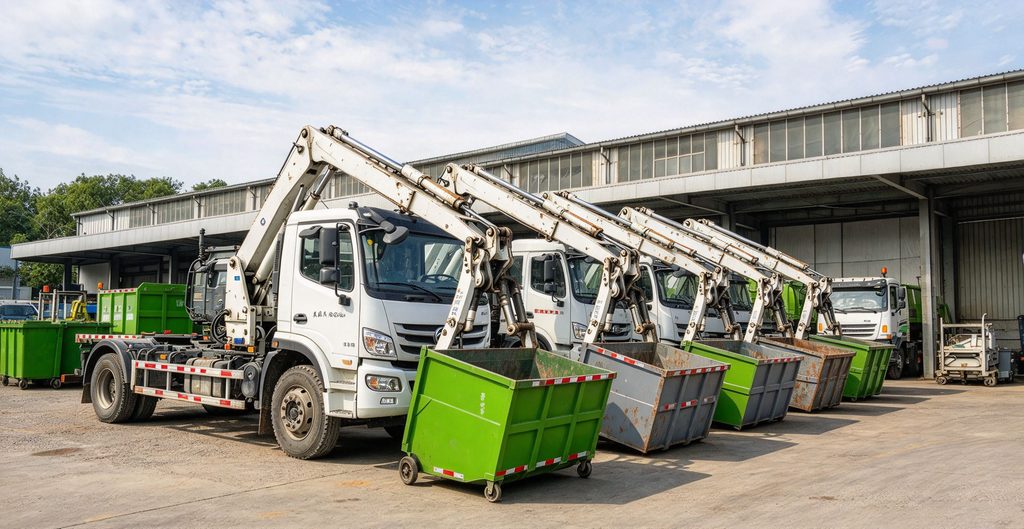
A hook lift truck is quoted as one price, but it is really four products bolted together: a chassis, a hook lift mechanism, a hydraulic package, and one or more containers. Each of those carries its own cost structure, its own lead time and its own failure pattern. Buyers who compare only the sticker price tend to end up with a truck that is cheap to buy and expensive to keep, which is why the more useful comparison is total cost across the period you intend to run it.
This piece breaks down what drives the purchase price, how new and used units compare once you look past the headline figure, and which checks matter most when you are standing in front of a used truck. It is written for municipal procurement teams, sanitation and fire service administrators, construction contractors, fleet managers running their own special-purpose vehicles, and the maintenance leads who inherit the result. CRRC Vehicles covers rail transit, smart mobility, new energy vehicles and special-purpose vehicles, and the ranges below reflect current market practice rather than any single supplier’s price list.
What you are actually paying for
The chassis is normally the largest single line, and it is the one with the least room to negotiate, because it is priced by the manufacturer against axle configuration, engine and emissions standard rather than by the bodybuilder. The hook lift mechanism is the second largest and the most variable: capacity, tipping angle, telescopic versus fixed arm, and whether the unit is a recognised brand or a local fabrication all move the number substantially.
Typical cost composition of a new hook lift truck
Read that breakdown as a negotiation map rather than a fixed rule. The two lines with real movement are the mechanism and the container: you can trade capacity margin, arm specification and container specification against price, and you should do it deliberately rather than discovering later that the truck was value-engineered in the wrong place. The compliance and delivery line is the one that surprises people, because it scales with distance and with how much documentation your jurisdiction wants.
New versus used: where the trade-off sits
A used truck at 45 to 65 percent of new money looks like a clear saving until you price in the first two years of downtime and the fact that the specification was chosen for somebody else’s duty cycle. A truck that spent five years on short, flat municipal runs is a very different asset from one that spent the same five years on construction sites, even if the odometer and the hour meter read similarly.
| Factor | New | Used, 3 to 6 years |
|---|---|---|
| Purchase price | Reference, 100 percent | Typically 45 – 65 percent of new |
| Lead time | 8 – 20 weeks depending on chassis supply | Available immediately |
| Warranty | Full cover, usually 12 – 24 months | None, or 1 – 3 months limited |
| Specification fit | Built to your container and duty cycle | Built to the previous owner’s duty cycle |
| Emissions and local rules | Current standard | May predate current low-emission zone rules |
| First-year unplanned downtime | Low, covered by warranty | Medium to high, depends on inspection depth |
| Finance terms | Better rates, longer terms | Higher rates, shorter terms |
| Resale value at exit | Steeper early depreciation | Flatter, already absorbed |
The pattern that comes out of that comparison is fairly consistent. New wins when the duty cycle is demanding, when the specification has to be exact, or when downtime costs more than the capital saving. Used wins when the work is predictable and light, when you have workshop capacity in house, and when you need a truck on the road next month rather than next quarter.
Running costs that outlast the purchase
Purchase price is a one-off. These are the lines that keep charging, and they are worth modelling before you commit:
- Hydraulic oil and filters: the dominant consumable on a hook lift. High cycle counts mean short change intervals, and neglected oil is the usual starting point for cylinder and valve failures.
- Hook pivot pins and bushings: wear items that show up as play in the arm. Left long enough, the wear transfers into the pivot housing, which is a much bigger repair.
- Rail and roller wear: driven by how often containers are loaded slightly off-centre, which is mostly an operator training issue.
- Tyres and rear axle brakes: loaded rear axle weight sits near the limit on most hook lift specifications, so both wear faster than on a comparable freight chassis.
- Container refurbishment: floor and cross member corrosion, door seals, hook bar rebuild. A container fleet usually needs attention on a rolling basis rather than all at once.
- Downtime: the cost nobody budgets. One spare hook lift in the yard is often cheaper than the service-level penalties that follow a missed collection round.
None of these are large on their own. Stacked over five to eight years they routinely add a third to a half of the purchase price, which is roughly the size of the saving a used truck appears to offer. That is the comparison worth doing before the decision, not after.
Used unit inspection, in order
Work through these in sequence. If an early item fails badly, there is no point spending money on the later ones:
- Documentation first: service records, hydraulic oil change history, any accident or repair welding record, and confirmation that the chassis is not under finance or a write-off marker.
- Hook pivot assembly: with the arm down and unloaded, have someone rock the arm and watch the pivot. Visible movement at the pin means bushing or pin replacement, and a cracked housing means walk away.
- Cylinders: look for weeping at rod seals and for scoring on the rods. A light film of oil is common on older units; active drips under pressure are not.
- Chassis rails near the pivot: check for cracks, fresh paint over old damage, and repair welds. This is the highest-consequence item on the list.
- Full cycle under load: insist on hooking, loading, tipping and setting down with a loaded container. A unit that only gets demonstrated empty is hiding something.
- Hydraulic temperature: after three or four consecutive cycles, feel the tank and check for a temperature warning. Overheating under moderate cycling points to a pump, valve or cooler problem.
- Rails, rollers and rear lock: measure rail wear and confirm the rear lock engages cleanly and releases without the operator forcing it.
- Hour meter as well as odometer: hook lift wear tracks cycles and hydraulic hours far more closely than distance. A low-mileage truck with high hours has done plenty of work.
Budget for the findings rather than negotiating them away. On a three to six year old truck, replacing pins, bushings, a set of hoses and the hydraulic oil is normal and should be priced into your offer. Discovering cracked rails or a worn pivot housing is not a negotiation, it is a reason to look at the next truck on the lot.
Frequently asked questions
How much does a hook lift truck cost?
As an indicative range, light-duty units typically land between USD 60,000 and 90,000 new, medium-duty between USD 110,000 and 160,000, and heavy-duty units between USD 170,000 and 260,000, with containers priced separately. Chassis supply, emissions specification and regional compliance requirements move those numbers more than the hook lift brand does.
Is a used hook lift truck worth buying?
It can be, provided the duty cycle is light, the documentation is complete, and you have inspected it through a full loaded cycle. The saving is real but smaller than the sticker gap suggests, because warranty cover, finance terms and first-year repair bills all shift against you. For high-cycle operations, new usually works out cheaper over five years.
What mileage is too high?
Mileage is a weak signal on this type of vehicle. A hook lift truck that runs short municipal rounds might cover 40,000 kilometres a year while completing a thousand load cycles, and the cycles are what wear the arm, the cylinders and the rails. Judge on hydraulic hours and condition, not distance.
Should the containers be bought new or used?
Containers are far more forgiving than trucks, and good used stock is usually a sensible saving. Check floor and cross member corrosion, hook bar condition, door seal integrity and rail width compatibility with your chassis. Reject anything with a bent hook bar or with rail dimensions that do not match your truck, because those two cannot be fixed cheaply.
Can I assess the hook arm without a workshop?
You can get most of the way there. Watch the pivot for movement, look for cylinder leaks, run a full loaded cycle, check hydraulic temperature after several cycles, and listen for pump cavitation or relief valve chatter. Crack detection on the chassis rails near the pivot is the one item that genuinely needs dye penetrant or ultrasonic testing, and it is worth paying an inspector for that alone.
Compare the total, not the sticker
The decision between new and used comes out cleaner once you put purchase price, first-year repairs, downtime exposure and finance terms on the same page. A used truck at half price with a quarter of its service life left and no warranty is not automatically the cheaper asset, and a new truck specified with more capacity than the work needs is not automatically the safer one. Work out the cycles you actually run, then price both options against that number.
CRRC Vehicles is a consulting and industry insight team focused on the global mobility and vehicle sector, covering rail transit, smart mobility, new energy vehicles, special-purpose vehicles and emerging transport technologies. We publish ongoing analysis of special-purpose vehicle cost structures, residual values and procurement practice. More detail is available at crrcvehicles.com.
Keyword: hook lift truck for sale | Audience: municipal procurement teams, sanitation and fire service administrators, construction contractors, fleet managers and private special vehicle owners, equipment maintenance leads