Crane Lifting
Lifting Power Built Into The Truck Instead Of Hired By The Hour
Every crane hire invoice is a margin leak. If your work involves moving the same kind of load every day — a pallet of blocks, a broken-down car, a transformer, a container of steel — the lifting capacity should be on the truck, not on a call-out sheet. This section covers the two configurations that do that work: truck-mounted loader cranes from 3.2 to 5 tonnes for loading and placing, and recovery wreckers from 3 to 20 tonnes of boom capacity for towing and underlift recovery.
Loader cranes are XCMG telescopic and articulating units with lifting moments up to 12.5 tonne-metres, 11 metres of hydraulic outreach, 13 metres of lifting height and 360-degree slewing. The heavy wrecker runs a 20-tonne boom with a 25-tonne underlift, 9,020 mm of boom length, 6,600 mm of lifting height and two 100 kN planetary winches on 40-metre ropes. Chassis range from a 3-tonne Aumark flatbed for city work to a 49,000 kg GTL recovery unit on Cummins X12 power.
Six Specifications That Decide Whether The Crane Is Useful
A crane that lifts 5 tonnes at 2 metres and 800 kilograms at 11 metres is normal physics, not a defect. The problem is buyers who compare only the headline capacity, then discover the outreach they need is outside the chart.
The 5-tonne XCMG unit has an 11-metre maximum hydraulic outreach and a 13-metre lifting height at a 12.5 tonne-metre moment. Ask for the load chart at your working radius, not the capacity at the pin.
Front H-type outriggers and an integral slewing mechanism are what let the crane work at full reach without the chassis lifting. Outrigger spread, not crane capacity, is usually the limiting factor on a narrow site.
A loader crane that also carries a cargo body, a hydraulic tailgate and a working basket replaces a crane hire, a flatbed delivery and an aerial platform. That is three assets replaced by one registration and one driver.
Wireless remote control, overwind protection, automatic hook retraction and a load moment limiter mean one operator can position a load without a banksman on the deck. On a two-man crew that is a direct labour saving.
A wrecker needs boom capacity to lift and underlift capacity to hold. The 20-tonne unit gives 20,000 kg at the retracted boom and 9,000 kg extended, with an underlift rated 25,000 kg retracted and 11,000 kg at full extension.
A crane adds 2,200 kg of dead weight before it lifts anything. On the 5-tonne unit the 15,500 kg GVW minus a 9,375 kg kerb leaves 5,770 kg of loading weight — enough for the crane, the body and a real payload only if the numbers are done first.
Which Configuration Fits Your Call-Out Pattern
A municipal utility lifting transformers and a motorway recovery operator are both in "crane lifting", and they need completely different vehicles.
3.2-tonne articulating crane on an Aumark chassis, lifting blocks, timber and steel to first-floor level while the same truck carries the load.
5-tonne telescopic crane with a working basket, for pole setting, transformer placement and overhead line maintenance without a separate platform vehicle.
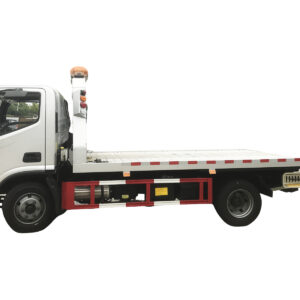
3-tonne flatbed wrecker for cars and light vans, with a 20-tonne GTL integrated unit for trucks, buses and heavy casualties.
Flatbed or repo wrecker that lifts a vehicle without hook-and-chain damage, so the removal stands up to dispute and the vehicle arrives undamaged.
Car hauler flatbed moving non-running trade-ins and auction stock between sites, often two at a time on the 5-tonne unit.
An in-house recovery unit for leasing and rental fleets, replacing a third-party call-out with a controlled response time.
Loader crane for moving attachments, drums and site cabins inside a yard, where a mobile crane cannot justify a full day's hire.
Electric flatbed tow truck for urban recovery and enforcement work where diesel access is restricted and noise complaints are a real constraint.
Lifting Equipment Needs Its Own Certification
A crane is regulated as lifting equipment, separately from the vehicle. These are the documents and tests that ship with the unit.
Subframe fabrication, crane mounting and hydraulic integration under an ISO 9001 certified system, with a per-unit inspection record.
China Compulsory Certification for the Foton chassis, the baseline conformity document for registration in most export markets.
Crane proof-load test at rated capacity, hydraulic system pressure verified to 22 MPa on the 5-tonne unit, and winch pull test to rated load on wreckers.
Overwind protection, boom angle indicator, load moment limiter or overload relief valve, outrigger interlocks and rear outriggers on recovery bodies.
Certificate of Conformity, Certificate of Origin, invoice, packing list and bill of lading, with an English manual and parts list.
Euro 3 to Euro 6 powertrains, plus SGS or TÜV pre-shipment inspection and loading photographs on request.
Crane certification is periodic in most jurisdictions. Ask for the load chart and the test certificate at delivery, not at the first inspection.
Two Families, One Selection Table
Capacity, outreach and chassis class decide the fit. Each row links to the family page with full parameter sheets.
| Family | Capacity and reach | Chassis and power | Best-fit work |
|---|---|---|---|
| Loader crane 4 models listed |
3.2 t and 5 t builds; 12.5 T·M moment, 11 m outreach, 13 m lifting height, 360° slew | Cummins ISDe270 270 hp on the 5 t unit, 15,500 kg GVW, 5,770 kg loading weight, Fast 8-speed | Material delivery, utility work, basket access, yard handling |
| Recovery wrecker 6 models listed |
3 t to 20 t boom capacity; 25 t underlift on the heavy unit, 9,020 mm boom, 6,600 mm lift height | Cummins X12NS6B470 466 hp, 2,200 Nm, 49,000 kg GVW, Fast 12-speed with 12 forward gears | Accident recovery, breakdown towing, parking enforcement, fleet first response |
| 5 t XCMG telescopic crane Reference build |
5,000 kg maximum capacity, 4-section boom, 11 m outreach, 13 m height, 90 L oil tank | Foton Auman 4×2, 5,000 mm wheelbase, 9,000 × 2,550 × 3,660 mm, front H-type outriggers | Crane plus cargo plus basket in one unit, for contractors and utilities |
| 20 t integrated wrecker GTL heavy recovery |
Boom 20,000 kg retracted and 9,000 kg extended; underlift 25,000 kg retracted and 11,000 kg extended | Cummins X12NS6B470 Euro 6, 11.8 L, 49,000 kg GVW, 6,500 kg front and 18,000 kg rear axles | Trucks, buses, heavy casualties, motorway and port recovery contracts |
| 3 t flatbed tow truck Aumark city unit |
3 t deck carrying capacity, flatbed loading without hook and chain | Foton Aumark light chassis, compact enough for city streets and underground car parks | Car and light van recovery, dealership movement, parking enforcement |
| Electric flatbed tow truck Zero-emission build |
Flatbed recovery body on an electric chassis, for restricted-access city zones | Electric driveline, quiet operation, suited to depot-based urban duty cycles | City-centre recovery, low-emission zones, night operations near housing |
Crane capacity is quoted at the shortest radius. Always specify the load you need at the radius you will work at, and check the outrigger spread available on site.
Crane, Subframe, Body And Chassis Engineered Together
Mounting a crane is a structural problem before it is a hydraulic one. The subframe has to spread the load into the chassis rails, the outriggers have to reach ground that can take the reaction, and the PTO has to deliver the flow the crane expects. When the crane arrives from one supplier and the truck from another, that engineering falls to the buyer's workshop.
We quote the complete unit: chassis, subframe, crane or recovery body, outriggers, PTO, hydraulics and paint, with the load chart and the test certificate issued against the finished vehicle. Cranes are XCMG telescopic or articulating units; recovery bodies use electrophoresis coating, steel modular construction, dual planetary winches and a full LED light pylon.
The chassis base is the Foton programme, produced through the Daimler-Foton joint venture in Beijing — a partnership covered by Reuters and Automotive News Europe — with engines from Beijing Foton Cummins Engine Company, Cummins' largest engine joint venture worldwide. Every unit ships with a one-year or 30,000 km warranty, 24-hour online after-sales support, factory-cost parts and a drawing review against your site conditions before fabrication.
Coverage of CRRC as the world's largest rolling-stock manufacturer by revenue, the industrial base behind the CRRC Vehicles name.
Reporting on the Daimler and Foton joint venture in Beijing and the Auman heavy-truck platform it produces.
Beijing Foton Cummins Engine Company described as Cummins' largest engine joint venture, supplying the ISF and F2.8 platforms.
Delivery reporting on Foton's African network — 220+ outlets, 12 KD plants, 43 parts warehouses, 8 training centres.
Crane And Recovery Orders On Record
Publicly documented deliveries of truck-mounted cranes and wreckers. Client type, date, quantity and source are given so each record can be checked.
5 Foton Aumark recovery trucks ordered by a Peruvian road contractor setting up an emergency roadside rescue service. Cummins 145 hp, 5,600 × 2,300 mm flatbed, 5-tonne deck carrying capacity and 8-tonne towing capacity. The buyer compared against Japanese alternatives and chose the Foton on performance and price, with a stated intention to order further wreckers in the same year.
8 six-wheel-drive crane trucks ordered in a single batch by a contractor working on roads, bridges and material lifting. Specified with a 371 hp engine for hilly terrain, a four-section XCMG 10-tonne straight boom reaching a 12-metre working radius, dual-side controls, automatic hook retraction and safety limit devices. All 8 units completed and factory-tested within 30 working days before shipment.
5 six-wheel-drive crane trucks delivered to a large Angolan logistics and transport company, each with an XCMG SQS250 crane: 260 kN·m lifting moment, 11,000 kg maximum capacity, 18.64 m maximum boom outreach, 360-degree slewing and outrigger spans from 2,480 to 7,605 mm. The customer cited chassis reliability on complex roads and crane stability under daily loading cycles as the deciding factors.
What Buyers Ask Before Signing
Fourteen questions on capacity charts, outriggers, chassis choice and recovery specifications.
Do I need a loader crane or a mobile crane?
ANSWERA loader crane is for lifting the loads you also transport, at radii up to about 11 metres. A mobile crane is for lifts beyond that, or where the crane must move between positions faster than a truck can. If more than half your lifts are loading or unloading your own cargo, the truck-mounted crane replaces the hire.
What does 5 tonnes of crane capacity actually mean?
ANSWER5,000 kg at the shortest radius. The same crane is rated at a 12.5 tonne-metre lifting moment, so capacity falls as outreach rises toward the 11-metre maximum. Always ask for the load chart at the radius you will actually work at, and add the weight of any grab or basket attachment.
How much payload is left after the crane is fitted?
ANSWEROn the 5-tonne reference build the crane alone weighs about 2,200 kg. With a 15,500 kg GVW and a 9,375 kg kerb, 5,770 kg of loading weight has to cover the crane, the cargo body, the tailgate and the cargo. That is why we size the body after the crane, not before.
What outrigger spread do I need on site?
ANSWEREnough to put the reaction load onto ground that can take it, which on the 5-tonne unit means front H-type outriggers with an integral slewing mechanism. Measure your narrowest site access before ordering: a crane that cannot deploy its outriggers is a crane that works at reduced capacity.
Articulating or telescopic boom?
ANSWERArticulating for tight spaces and for reaching over an obstacle, because the knuckle folds the boom into places a straight boom cannot enter. Telescopic for maximum reach and faster cycle times on open sites. Both are listed in this category at 3.2 tonnes, and the 5-tonne unit is telescopic.
Can the crane run a working basket?
ANSWERYes — a work basket mounted on the rear cargo area is a standard configuration on the 5-tonne build, with a boom angle indicator, overwind protection and a load moment limiter available. That turns the truck into a lifting, access and transport unit, which is why utilities buy it instead of three separate vehicles.
What is the difference between a wrecker and a tow truck?
ANSWERA flatbed tow truck carries the vehicle on its deck, which protects it from further damage. A wrecker lifts and holds with a boom and underlift, which is faster for a vehicle that still rolls and essential for heavy casualties that cannot be decked. Most recovery operators run both.
What can the 20-tonne wrecker actually recover?
ANSWER20,000 kg of boom capacity retracted and 9,000 kg at full extension, with a 25,000 kg underlift retracted and 11,000 kg extended, an underlift reach of 1,600 to 3,450 mm and a 6,600 mm lifting height. In practice that covers loaded trucks, buses and heavy plant on a 49,000 kg chassis.
How many winches does the heavy wrecker carry?
ANSWERTwo planetary winches at 100 kN each, on 40-metre ropes of 18 mm diameter, running at 5 metres per minute. Two winches allow a side-pull or a stabilised straight pull without re-rigging, which is the difference between a recovery and a second call-out.
Left-hand drive and cab specification?
ANSWERLeft-hand drive is standard. The heavy wrecker uses a GTL-M400 sleeper cab at 2,890 mm height and 2,490 mm width, with airbag, electric seats, reversing camera and remote key. Recovery work involves long waits at scene, so cab specification is a crew retention decision.
What is the minimum order and lead time?
ANSWEROne unit, with mixed crane and wrecker configurations in a single batch. Around 15 working days in low season and one to three months at peak. A crane with a non-standard mount or an unusual boom length adds engineering time before fabrication starts.
How are these vehicles shipped?
ANSWERRoRo or break-bulk for crane trucks and wreckers, because of height and rear overhang. Light flatbed tow trucks can be containerised where dimensions allow. We quote CIF or DAP, arrange lashing and shielding, and supply loading photographs before departure.
What warranty and support apply to the crane?
ANSWEROne year or 30,000 km on the vehicle, whichever comes first, with 24-hour online after-sales support and factory-cost parts. Crane coverage follows the crane manufacturer's terms where that is longer, and the load chart, test certificate and spare-parts list ship with the unit.
What do you need to specify the right crane?
ANSWERHeaviest load, the radius at which you must lift it, maximum lift height, site access width for the outriggers, whether you also need to carry cargo or a basket, plus emission bracket and destination port. With those five we fix crane size, boom type, body and axle rating.
Give Us The Load, The Radius And The Site Access
Crane sizing starts from the load at the radius, not from a headline tonnage. Add your site access width for outriggers and we will return a load chart, drawings and a landed-cost quotation.
Boom type, basket, tailgate, winch configuration and fleet paint are fixed before fabrication.