Municipal

Municipal Fleet Program

Municipal Trucks That Keep a City Running on Schedule

One supplier covers the three fleets a city actually runs: liquid waste, road cleaning and solid waste. Vacuum and jetting tankers from 4 to 20 m³, sweepers and sprinklers from 2 to 20 m³, rear-loading compactors, container handlers, food-waste tankers and Auman tippers from 5 to 25 tonnes. 154 configurations are listed across the three fleets today, from a 2 m³ alley sweeper to a 20,000 litre combination sewer cleaner.

Every unit is specified against a route, not a catalogue page. Send the street width, the bin type, the sewer diameter, the emission standard your registry accepts and the port you ship to. You get a drawing, a chassis match, a spare-parts list and a landed-cost quotation back. Minimum order is one unit, left-hand drive is standard and right-hand drive is built to order.

154
Listed configurations
2 to 20 m³
Body volume range
1 unit
Minimum order
Euro 2 to 6
Emission builds
Why fleets are switching

A sanitation fleet fails quietly, then all at once

The expensive failures are rarely the engines. They are the rear door that drips on the way to the tip, the sweeper that lifts dust instead of collecting it, the tanker nobody can unload without a manual override, and the container of documentation that does not satisfy the port authority. A municipal fleet is judged on collection days met, not on brochure numbers, so the specification work matters more than the sticker price.

The usual procurement

Bodies from three different workshops, on three chassis families, with three spare-parts lists and no shared tooling.

A quotation built from a photo, with tank thickness, pump flow and hydraulic pressure left as open questions.

A sweeper sized for a highway, ordered for a market street 3 metres wide.

Compliance discovered at the port, when the emission standard or the conformity certificate does not match the registry.

Working with this line

One Foton chassis family across the fleet, so operators move between units and the parts store stays small.

Numbers fixed before the order: vacuum degree, jetting pressure, sweep width, hopper volume, payload, wheelbase.

A body volume chosen against the route and the tipping frequency, with a drawing approved before steel is cut.

Market conformity documents prepared against your order, not promised after it.

01

One chassis family, one parts list

Foton Aumark, Forland and Auman platforms cover 4×2, 6×4 and 8×4 duty. Foton's own network runs 220-plus outlets, 43 parts warehouses and 12 KD plants across Africa alone, so consumables are never a single-source problem.

02

Bodies sized to the street, not the yard

A 2 m³ sweeper with a 2.5 m sweeping width for lanes and markets; 6 to 8 m³ for arterials; 20 m³ vac tankers for transfer duty. Same family, different footprint.

03

Specifications you can put in a tender

Vacuum degree of -0.09 MPa or better, 16 to 25 MPa hydraulic working pressure, 2.5 m sweep width and 40,000 m²/h throughput, water cannon reach of 30 m or more. Verifiable, not approximate.

04

Corrosion designed in

Q235B carbon steel at 4 mm with rust-inhibiting primer and epoxy top coat, tank shells from 4 to 8 mm on request, or stainless steel where the water or leachate is aggressive.

05

Sealed where it matters

Fully sealed vacuum tanks, sealed compactor bodies with a 0.36 m³ leachate tank, and dripless rear valves. No secondary pollution charge from your regulator, no road spill on the way to the tip.

06

Support that survives the handover

One year or 30,000 km warranty, whichever comes first, 24-hour online support, a parts list shipped with the unit and operator training material in the box.

Practical for real routes

Six jobs that decide a municipal fleet

Match the duty cycle to the body before you match the body to the budget. These are the six deployments most municipal tenders are actually written around.

CBD and arterial sweeping

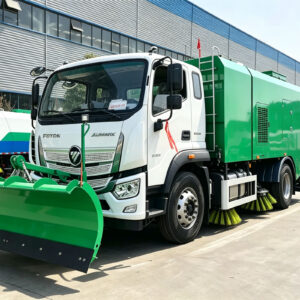
Night-shift sweeping on sealed roads with parked cars and medians. A 6 to 8 m³ body with a 2.5 m sweeping width and four vacuum pickups clears a lane in one pass, and dry or wet mode lets the same unit work through the dry season.

6 m³ and 8 m³ sweepers, dual side brushes

Old towns, markets and alleys

Where a 16-tonne chassis cannot turn, a 2 m³ mini sweeper with a short wheelbase and a 2.5 m sweeping width still works a full shift. Pair it with a 1-tonne hook-lift container truck so one cab services a dozen collection points.

2 m³ sweeper, 1 t hook lift, 4 to 5 m³ vac tankers

Sewer and septic maintenance

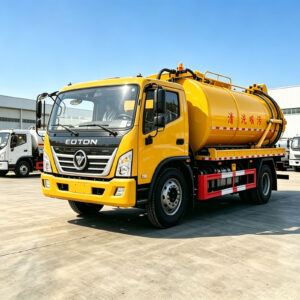
Desilting laterals, clearing blockages and emptying septic tanks on the same shift. Combination units carry a high-pressure pump, hose reel and vacuum pump on one chassis, so the crew jettings the line is the crew that removes the spoil.

10,000 and 15,000 litre jetting plus suction units

Residential refuse collection

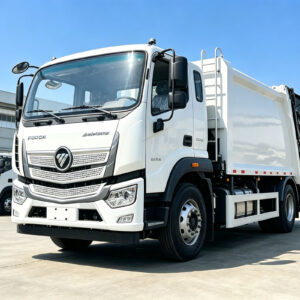
Door-to-door rounds with 240 and 660 litre bins. A rear-loading compactor packs on a bidirectional cycle, holds 6.5 m³ of effective volume and carries its own leachate tank, which is what keeps a housing estate route economical at one trip to the transfer station.

6.5 m³ rear-loader, 240 and 660 litre bin lift

Food waste and wet waste

Markets, hotels and canteens produce weight, not volume. A sealed 6 m³ food-waste body with wash-down and a dedicated leachate compartment stops the drip-and-smell complaint that gets collection contracts renegotiated.

6 m³ Aumark food-waste tanker

Dust, highway and construction

Unsealed haul roads and construction gates. A 15 to 20 m³ sprinkler with a 60 m³/h self-priming pump, 12 m front flush and a 30 m cannon handles road washing, dust suppression and greenbelt irrigation from one tank.

15 and 20 m³ sprinklers, fog cannon optional

Certification and compliance

Documentation that clears the port and the registry

A municipal truck is only delivered when it can be registered, insured and put on a route. These are the certificates, standards and market-conformity documents we build and ship against.

ISO 9001 quality system

Build and inspection under a certified quality management system, with a pre-delivery inspection sheet and photo pack issued per unit.

CCC where the unit is China-registered

China Compulsory Certification for vehicles and bodywork sold into the domestic market, issued before the unit leaves the works.

Euro 2 to Euro 6 builds

The same body can be matched to the emission level your fuel and registry allow, from Euro 2 legacy markets to Euro 6 city fleets.

Foton chassis platforms

Chassis sourced from Foton, whose light commercial range holds EU Whole Vehicle Type Approval, with a service and parts network in more than 220 African outlets alone.

SONCAP, PVoC, SASO, EAC

Conformity documentation for Nigeria, Kenya and Tanzania, Saudi Arabia and East African markets prepared against the order, with pre-shipment inspection booked before loading.

EPA, EEC and RoHS paperwork

Available on request for importers who need emissions, conformity or restricted-substance declarations alongside the commercial documents.

Warranty and parts commitment

One year or 30,000 km, whichever comes first, with a recommended spare-parts kit quoted at order stage rather than after the first breakdown.

Left-hand and right-hand drive

Left-hand drive is the standard build. Right-hand drive is a factory option on new-build units, not a workshop conversion.

Our product line

One table, eight body types, three fleets

Choose the body by duty cycle, then the volume by route. Every row below links into the live municipal catalogue, where 154 configurations are listed with full chassis and body data.

Body type Size and build range Signature specifications Deployed for
Vacuum and fecal suction tanker
Liquid waste fleet
4, 5, 12 and 20 m³ builds; 4×2; GVW 10 to 20 t; tank steel 4 to 8 mm Vacuum degree -0.09 MPa or better; 6 to 10 m suction depth; 5 to 10 min per tank; 100 to 200 mm hose; 16 to 25 MPa hydraulic discharge Septic and latrine emptying, sludge transfer, sewer desilting, public toilet servicing
Combination jetting and suction cleaner
Liquid waste fleet
10,000 and 15,000 litre; 4×2; GVW 15 to 20 t; carbon steel tank 245 hp Euro 5 diesel, 8-speed manual; high-pressure pump, hose reel and outlet valve on one chassis; self-suction and self-discharge Sewer blockage removal, drain and culvert cleaning, liquid waste collection, drainage maintenance
Street sweeper
Road cleaning fleet
2, 3, 6 and 8 m³ hoppers; 2 to 8 t chassis; LHD 2.5 m sweeping width and 40,000 m²/h throughput on the 2 m³; twin side brushes plus four vacuum pickups; three-stage dust suppression; dry and wet mode CBD and arterial cleaning, industrial parks, compounds, alley and market sweeping
Water sprinkler and bowser
Road cleaning fleet
3,000 to 20,000 litre; 4×2, 6×4 or 8×4; Q235B 4 mm or stainless 60 m³/h self-priming pump at 90 m head; 12 m front flush; 30 m cannon; 240 hp Yuchai; 18,000 kg GVW and about 11,200 kg payload Road washing, construction dust suppression, greenbelt irrigation, emergency water supply
Rear-loading compactor
Solid waste fleet
6.5 m³ effective body; 10,495 kg GVW; 2,770 to 3,100 kg rated load; 240 and 660 litre bin lift Bidirectional compression at 16 MPa; 0.6 m³ filler; 25 s fill cycle and 40 s ejection cycle; 0.36 m³ leachate tank; CAN-bus one-button control Household collection in estates, communities, campuses and industrial canteens
Swing-arm and hook-lift container truck
Solid waste fleet
1 to 6 m³ detachable containers; light 4×2 chassis; one cab, many bins Hydraulic arm or hook lift; container interchange without a second vehicle; sealed container lids for wet loads Markets, construction sites, scattered collection points, garden and bulky waste
Food-waste tanker
Solid waste fleet
6 m³ sealed body on Aumark C33; 4×2; wash-down equipped Sealed tipping body, dedicated leachate compartment, rear wash-down, low loading height for hand collection Restaurants, hotels, wet markets, school and hospital canteens, composting schemes
Dump truck and tipper
Solid waste fleet
5 to 25 t payload; 4×2, 6×4 and 8×4; Auman GTL and Aumark cabs 350 to 400 hp Euro 5, 20 to 25 t load capacity on three axles; reinforced tipper body for rubble and dumpsite duty Dumpsite hauling, construction spoil, road repair crews, snow and flood clearance

Volumes, payloads and pressures above are the standard build figures. Alternative tank sizes, right-hand drive, stainless bodies, fog cannons and fleet colours are specified at order stage.

One-stop supply

Body builder, chassis buyer and exporter in one contract

Most municipal tenders are lost in the gaps between suppliers. A dealer quotes the chassis, a workshop quotes the body, a forwarder quotes the freight, and nobody owns the interface between them. When the compactor body arrives with a filler height that does not match the bins in service, three parties have a reason it is not their problem.

This line is built the other way around. One team takes the route data, selects the Foton chassis and the body volume together, issues the general arrangement drawing, builds the body, runs the pre-delivery inspection and books the vessel. The chassis plate, body serial number and shipping documents all carry the same reference, so warranty claims do not start with a search for who supplied what.

That is what factory-direct means in practice: the specification is agreed once, the price does not move after the drawing is signed, and a spare-parts list arrives with the truck rather than months later.

How an order runs
1
Route and duty review
Street width, bin type, sewer diameter, daily tonnage, emission standard, destination port.
2
Drawing and chassis match
General arrangement drawing, axle load check, body volume confirmation, signed off before production.
3
Build, PDI and photo report
Body fabrication, function test of every hydraulic and vacuum circuit, inspection sheet and images before loading.
4
Shipping and handover
RoRo, container or break-bulk, waxed or naked, with conformity documents and a parts list in the cab.
Industry references behind this page
  • UNEP, Global Waste Management Outlook 2024: municipal solid waste is projected to grow from 2.3 billion tonnes in 2023 to 3.8 billion tonnes by 2050, while 2.7 billion people still lack access to collection.
  • World Bank, What a Waste 2.0: global waste generation is on course to reach 3.4 billion tonnes by 2050, with collection coverage lowest in lower-income cities.
  • Foton International, Ethiopia key account delivery, 22 June 2024: 100 Auman heavy trucks delivered to a transport, construction and mining group that has bought more than 400 Foton units since 2013.
Field-proven deployments

Three municipal fleets, three continents, published numbers

Publicly documented deployments of the same truck classes, with the client, the date, the scale and the source stated for each. They show what a working municipal fleet actually buys, in what mix and at what volume.

Road cleaning and liquid waste

Guwahati Municipal Corporation, India

One procurement covered mechanised street cleaning, refuse collection and drain maintenance: 4 mechanical sweeping machines, 50 auto tippers, 7 suction machines and 14 dump tanks were flagged off together in January 2026.

Client: Guwahati Municipal Corporation, Assam
Date: 29 January 2026
Scale: 4 sweepers, 50 tippers, 7 suction units, 14 dump tanks
Source: The Guwahati
Solid waste

Comlurb, Rio de Janeiro, Brazil

A single fleet renewal added 64 vehicles for household collection and public waste removal, including 38 rear-loading compactors, 12 mini tippers for narrow streets and alleys, 6 dump trucks, 1 container-handling dump truck, 4 polycranes and 3 water tankers for washing public spaces.

Client: Comlurb, City Hall of Rio de Janeiro
Date: 1 November 2024
Scale: 64 vehicles, of which 38 compactors
Heavy chassis and tipper duty

Auman fleet delivery, Addis Ababa, Ethiopia

100 Auman heavy trucks were handed over to a multinational transport, construction and mining group that has purchased more than 400 Foton vehicles since 2013, followed by an MOU for further large-volume procurement.

Client: Multinational transport, construction and mining group
Date: 22 June 2024
Scale: 100 Auman heavy trucks, 400-plus units since 2013
Procurement questions

Fifteen questions municipal buyers ask before signing

Chassis, capacity, compliance, shipping and after-sales, answered with the figures used on the build sheets.

Which chassis and engines do you build on?

Foton platforms throughout: Aumark and Forland for 4×2 municipal bodies, Auman for medium and heavy duty up to 8×4. Typical matches are a Cummins 210 hp engine on the 6 m³ sweeper, a Yuchai 240 hp on the 15 m³ sprinkler, 245 hp on the 15,000 litre combination cleaner and 350 hp on the 20,000 litre vacuum tanker, with 6, 8, 10 or 12-speed manual gearboxes.

Which emission standard can you supply?

Euro 2 through Euro 6 depending on the model and the market: the 2 m³ mini sweeper is built to Euro 6, the 6 m³ sweeper to Euro 4, the 15 m³ sprinkler to Euro 3 with Euro 2, 5 or 6 available, and the 20,000 litre vacuum tanker to Euro 5. State the standard your registry will accept and the build is matched to it before the order is confirmed.

Left-hand drive or right-hand drive?

Left-hand drive is the standard export configuration across the range. Right-hand drive is a factory option on new-build units, including the sweeper and compactor bodies, so the control layout and the bin-lift side are set correctly at the works rather than modified locally.

How do I choose the tank volume on a vacuum truck?

Work backwards from the round, not the tank. A 4 to 5 m³ body suits old-town lanes and short septic rounds; 12 m³ is the common choice for municipal septic and sludge rounds; 20 m³ is transfer and long-haul duty. Larger tanks cut trips but raise the axle load, so the GVW and the road class have to be checked together.

What suction depth and vacuum can the tankers reach?

A vacuum degree of -0.09 MPa or better, a suction depth of 6 to 10 m, full-tank filling in 5 to 10 minutes depending on volume, and a 100 to 200 mm heavy-duty hose. Discharge is hydraulic at the rear or by gravity, with 16 to 25 MPa working pressure in the hydraulic circuit, and manual, electric or PLC control on request.

Can one truck jet a sewer and suck the spoil out?

Yes. The combination cleaners carry a high-pressure pump, a hose reel, an outlet valve and a vacuum pump on one chassis, in 10,000 and 15,000 litre bodies. The crew breaks the blockage with the jetter and removes the material in the same visit, which removes a second mobilisation compared with running a jetter and a separate tanker.

How wide does the sweeper clean and how much does it hold?

The 2 m³ mini and multi-functional sweepers run a 2.5 m sweeping width at 40,000 m²/h with three-stage dust suppression. Larger 6 and 8 m³ units use two side brushes and four vacuum pickups with a mid-long suction device, in dry or wet mode, so leaves, stones and plastic are collected in one pass rather than pushed to the kerb.

What compaction does the rear-loader achieve?

The 6.5 m³ body packs on a bidirectional cycle at 16 MPa, with a 0.6 m³ filler and a 0.36 m³ leachate tank. A fill cycle takes about 25 seconds and ejection about 40 seconds, and the bin lift handles standard 240 and 660 litre containers, the sizes most estate and community rounds are built around.

Can you mount the body on a chassis I already own?

Body-only supply is possible, including CKD shipments. Send the chassis drawing, wheelbase, GVW, rear frame width and PTO take-off details, and the body is engineered to suit. Where the chassis is not a Foton unit, the axle load and PTO compatibility are verified before the drawing is released.

What is the minimum order, lead time and payment term?

One unit, and mixed configurations within an order are accepted. Lead time runs 15 to 30 working days as standard and extends to one to three months in peak season. Payment is by T/T or L/C, with the deposit and balance schedule confirmed on the proforma invoice.

How are the trucks shipped?

RoRo for complete vehicles, container for CKD or body-only shipments, and break-bulk or naked with wax protection for larger units. Quotations are issued FOB, CFR or CIF against your port, and the loading plan is confirmed once the body dimensions and the vessel type are known.

Which documents arrive with the unit?

Commercial invoice, packing list, bill of lading, certificate of origin and insurance certificate as standard. Market conformity documents are prepared against the order: SONCAP for Nigeria, PVoC for Kenya and Tanzania, SASO or SABER for Saudi Arabia and EAC documentation for East Africa, plus EPA, EEC or RoHS declarations where the importer requires them.

What warranty and after-sales support is included?

One year or 30,000 km, whichever comes first, on the complete unit, with 24-hour online technical support. A recommended spare-parts kit is quoted at order stage, and consumables are available through Foton's own network, which runs more than 220 outlets, 43 parts warehouses and 12 KD plants across Africa.

Can the fleet colour, tank and equipment be customised?

Body colour to any RAL reference for fleet livery, stainless steel tanks in place of carbon steel, tank shells from 4 to 8 mm, fog cannons, 4×4 drive, extra brushes, additional hose reels and municipal signage. Customisation is agreed on the drawing, so what is painted and fitted is what was approved.

What do you need from us to quote?

City and country, the route or street width, bin type or sewer diameter, required body volume, emission standard, left or right-hand drive, quantity, destination port and target delivery date. With those six or seven data points we return a chassis match, a body drawing, a spare-parts list and a landed-cost quotation.

Send the route. We will send the drawing.

Tell us the street width, the bin type, the sewer diameter, the emission standard and the port. You will get a chassis match, a body drawing and a landed-cost quotation, not a generic brochure.

One unit minimum. Mixed configurations accepted. Left-hand drive standard, right-hand drive on request.

Request a quote
Phone and WhatsApp
+86 189 4292 3930
Open the contact form