

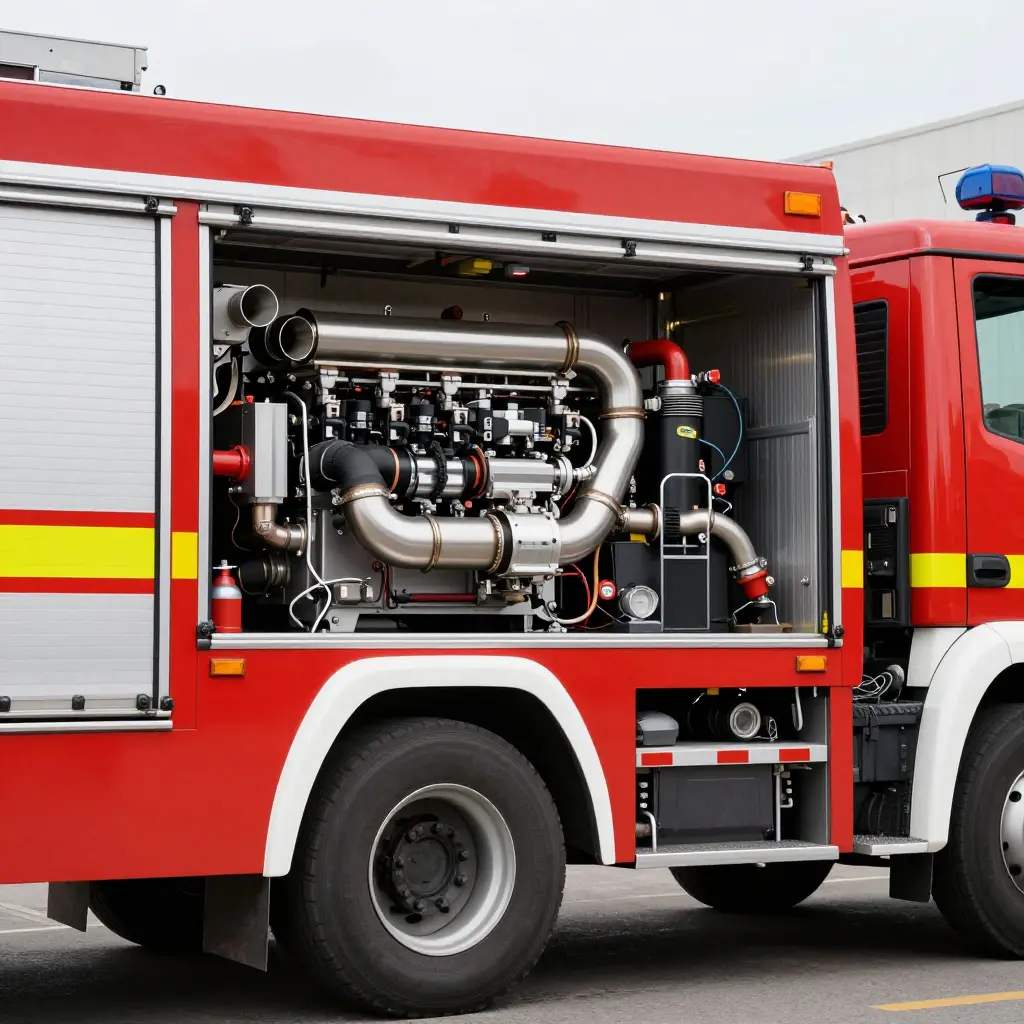
Engine Age Is the Wrong Metric for Fire Apparatus Availability
DPF regeneration cycles and accumulated idle hours cause far more apparatus downtime in fire departments than engine age does. Two pumpers delivered in the same model year can end up hundreds of availability hours apart: one drops into forced regeneration or derate several times a quarter, the other stays in service on a nearly identical odometer. What separates them is the exhaust-aftertreatment duty cycle, not the year on the data plate.
For fleet managers, fire chiefs, and apparatus mechanics, that changes how readiness gets forecast. Fire dept truck idle hours – the cumulative time an engine runs under light load while parked on scene, at a hydrant, or during pumping – predict availability far more reliably than odometer totals or model year. Long idle periods push soot loading up and move the system toward an active or parked regeneration it cannot always finish. Unfinished regenerations show up as apparatus downtime: reduced readiness, unplanned shop visits, higher maintenance cost. Fleets running on municipal fleet vehicle platforms should watch aftertreatment behavior, not age.
- Odometer readings and model year: weak predictors of aftertreatment-driven outages.
- Idle hours and regeneration behavior: strong, actionable predictors of unscheduled downtime.
The DPF Regeneration Cycle at a Glance
The diesel particulate filter (DPF) cycle runs left to right: soot enters and collects in the filter substrate, exhaust temperature climbs to the regeneration trigger threshold, and from there the system takes one of two paths.
Passive regeneration happens continuously during sustained, high-load operation. When exhaust temperature reaches roughly 250-350C, nitrogen dioxide already present in the exhaust oxidizes trapped soot on its own. No extra fuel is injected, and the crew notices nothing.
Active regeneration is the fallback. When exhaust temperature never climbs high enough on its own – the usual pattern for an idling apparatus running a pump or scene lighting for long stretches – the engine control module commands a late post-injection of diesel to push temperatures to roughly 550-650C and burn off the accumulated soot. This is the cycle that eats hours, fuel, and filter life.
Either path ends the same way: the trapped soot is oxidized into carbon dioxide and water, and the filter recovers capacity. (Ash from lubricant additives is not burned off; it collects in the filter and eventually has to be cleaned out.) For operators managing municipal and emergency vehicle fleets, the trigger temperature – not mileage or age – sets the regeneration interval, which is what makes downtime predictable instead of reactive.
Idle Hours and DPF Soot Loading
Fire apparatus work hard and drive little. A pumper can serve for years on a fraction of the highway miles a regional tractor-trailer covers in two, accumulating hours instead: long stretches of idling at the station, on scene, and on standby.
Why Idling Loads the DPF with Soot
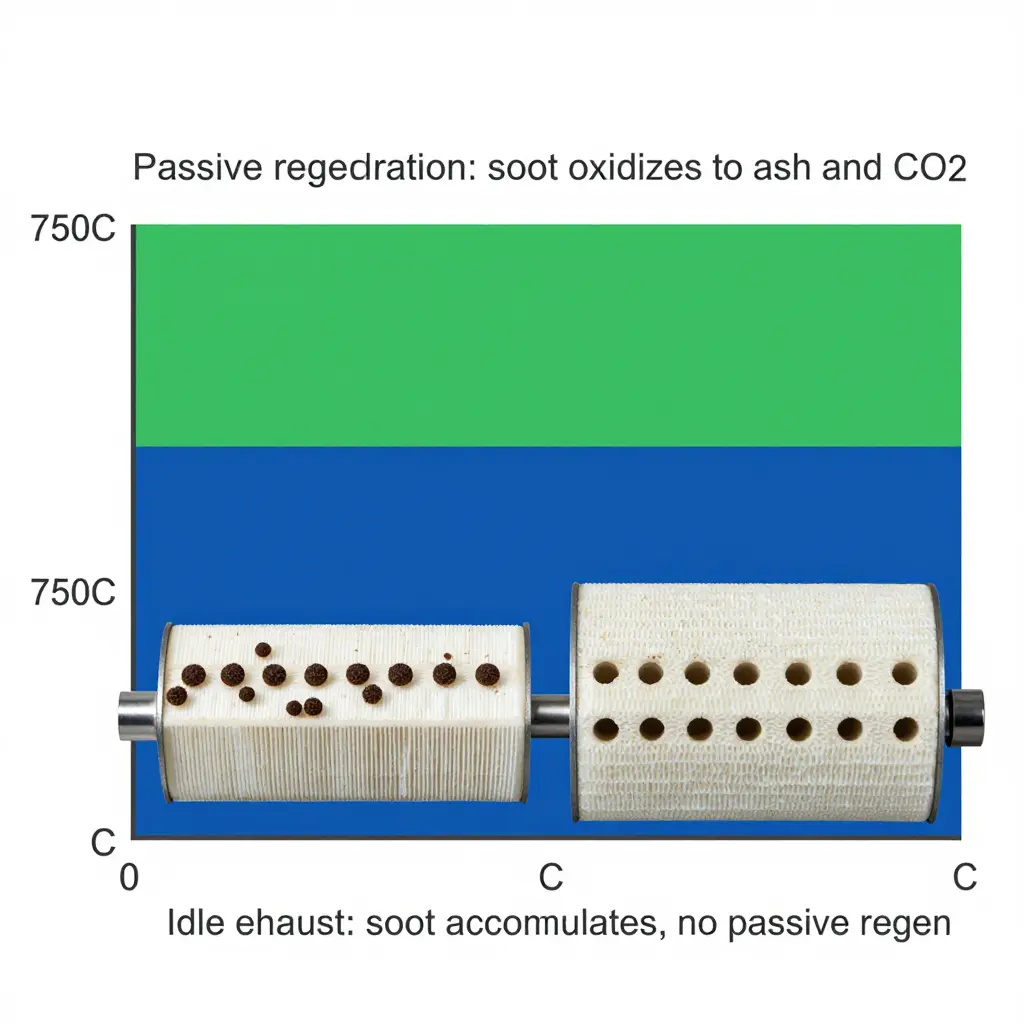
A diesel engine at idle burns fuel at low load and low combustion efficiency. That incomplete burn produces soot, and the DPF traps it. The real problem is temperature. Passive regeneration – the process that oxidizes trapped soot into CO2 and water – needs exhaust gas in roughly the 250-350C range for a sustained period. Idle exhaust rarely climbs above 250C. Instead of self-cleaning, the filter fills.
The Emergency-Response Duty Cycle Is Hostile to Regeneration
Emergency duty cycles combine everything passive regeneration dislikes:
- Short trips between station and incident, rarely long enough to reach light-off temperature.
- Extended pump or standby operation at low engine load.
- Long idle periods while crews work the scene.
The filter loads faster than it can passively clean. Active regeneration (fuel dosing or a burner) becomes necessary more often, and each event consumes fuel, time, and filter life.
Idle Hours, Not Engine Age, Drive the Math
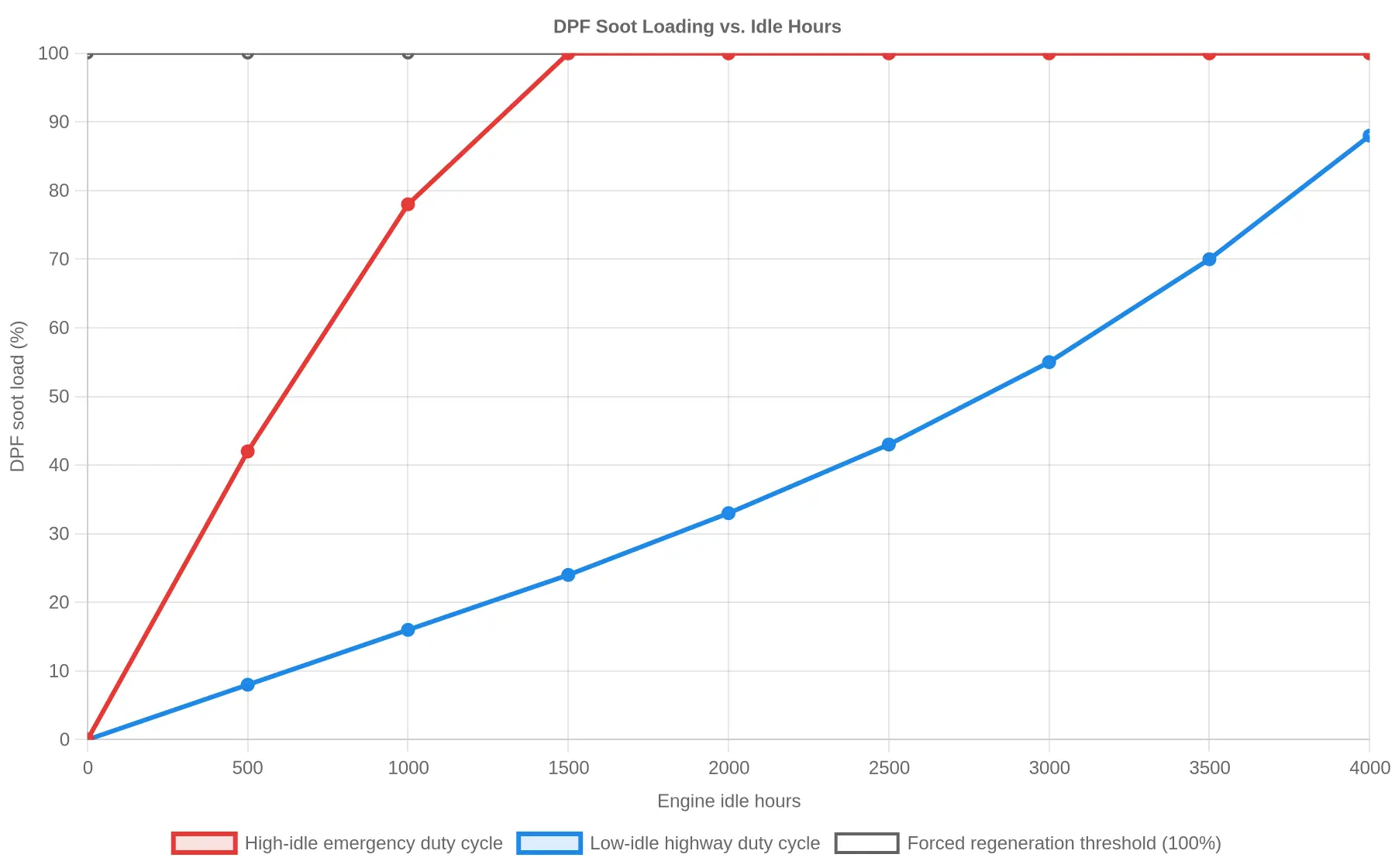
A three-year-old apparatus with 3,000 idle hours will need regeneration far more often than a ten-year-old unit with 800. Regeneration frequency – and the downtime, fuel burn, and maintenance cost that follow it – tracks idle time, not the model year on the door. Engine age is a weak proxy for it.
That is why fire dept truck idle hours belong in readiness planning. Every forced regeneration pulls an apparatus out of service, and enough of them open coverage gaps when response demand peaks. Idle-hour tracking is a readiness problem, not just a maintenance line item.
Designing Around the Problem
The durable fix is aftertreatment-friendly design. Better thermal management, exhaust routing, and duty-cycle-aware engineering can cut soot loading at the source. CRRC’s municipal product lines are built for low-speed, high-idle duty rather than against it.
The table compares the two variables fleet managers cite most when an apparatus goes down: engine age and the exhaust-aftertreatment duty cycle.
| Downtime Driver | Measurement Metric | Typical Impact on Readiness | Predictive Reliability | Management Action |
|---|---|---|---|---|
| Engine Age | Model year / in-service date | Low to moderate – drives parts obsolescence and parts-availability delays, not sudden failures | Low for forecasting unplanned downtime | Track for lifecycle and front-line/reserve rotation planning, not for daily readiness risk |
| Odometer reading (chassis mileage) | Moderate for driveline, brakes, and tires; weak proxy for aftertreatment wear | Moderate for chassis PM, low for emissions-related downtime | Use for brake, tire, and driveline service intervals – not as a DPF health gauge | |
| Engine-hour to mileage ratio | Only becomes meaningful once it flags extended idling; the ratio is a bridge to aftertreatment load | Moderate, and only because it correlates with idle hours | Investigate high ratios (e.g., greater than 5:1) as an idle-reduction trigger | |
| DPF Regeneration Cycles / Idle Hours | Idle-hour accumulation | High – each idle hour loads soot while exhaust stays below the approx. 250-300 C passive-regen threshold | High | Log idle hours via telematics, set fleet idle-reduction targets, and schedule proactive regens |
| Active (forced) regeneration frequency | High – frequent active regens signal a duty cycle that cannot sustain passive regeneration | High | Trend regen counts per week; adjust duty cycle or add a controlled park-and-regen strategy | |
| Soot load percentage / DPF backpressure (delta-P) | Very high – the direct trigger for engine derate and stop-engine events | Very high | Trend soot load and delta-P; intervene well before the 80-100 percent derate threshold | |
| Exhaust temperature profiles (DOC/DPF inlet temps) | High – passive regen needs roughly 300 C+, active regen needs approx. 550-600 C at the DPF inlet | High | Review duty cycles and ensure sufficient sustained load or highway time for passive regeneration |
Every engine-age metric in that table lands at low predictive reliability; every regeneration metric lands at high. A 2006 engine with long, hot runs will out-standby a 2019 engine stuck in stop-and-go, high-idle service. Model year tells you how old the block is. Idle hours, active-regen frequency, soot load, and exhaust-temperature profiles tell you whether the truck answers the next call.
Why Regeneration Cycles, Not Engine Age, Decide Apparatus Downtime
Ask a veteran fleet manager why a rig is out of service and you usually get the same answer: “It’s getting old.” That answer is wrong, and it costs money. What governs apparatus downtime is the frequency and difficulty of DPF regeneration cycles, not engine age.
A DPF captures the soot that would otherwise leave the tailpipe, and it only cleans itself when exhaust temperature climbs high enough to burn that soot off. On the highway that happens passively and invisibly. In a firehouse bay or on scene it does not. When a truck idles for hours, exhaust stays cool, soot accumulates, and the engine control module either triggers an active (forced) regeneration or, if conditions never let one finish, derates the engine and sidelines the apparatus.
Picture a two-year-old pumper that idles 75 percent of its run time. Its soot load never clears passively, so it can log dozens of forced regenerations and several derates in a year. A twelve-year-old engine on a favorable duty cycle – longer trips, higher loads, frequent passive regeneration – can accumulate far less soot-related downtime. The newer truck is newer on the calendar; the older one is newer by the only measure the aftertreatment system reads.
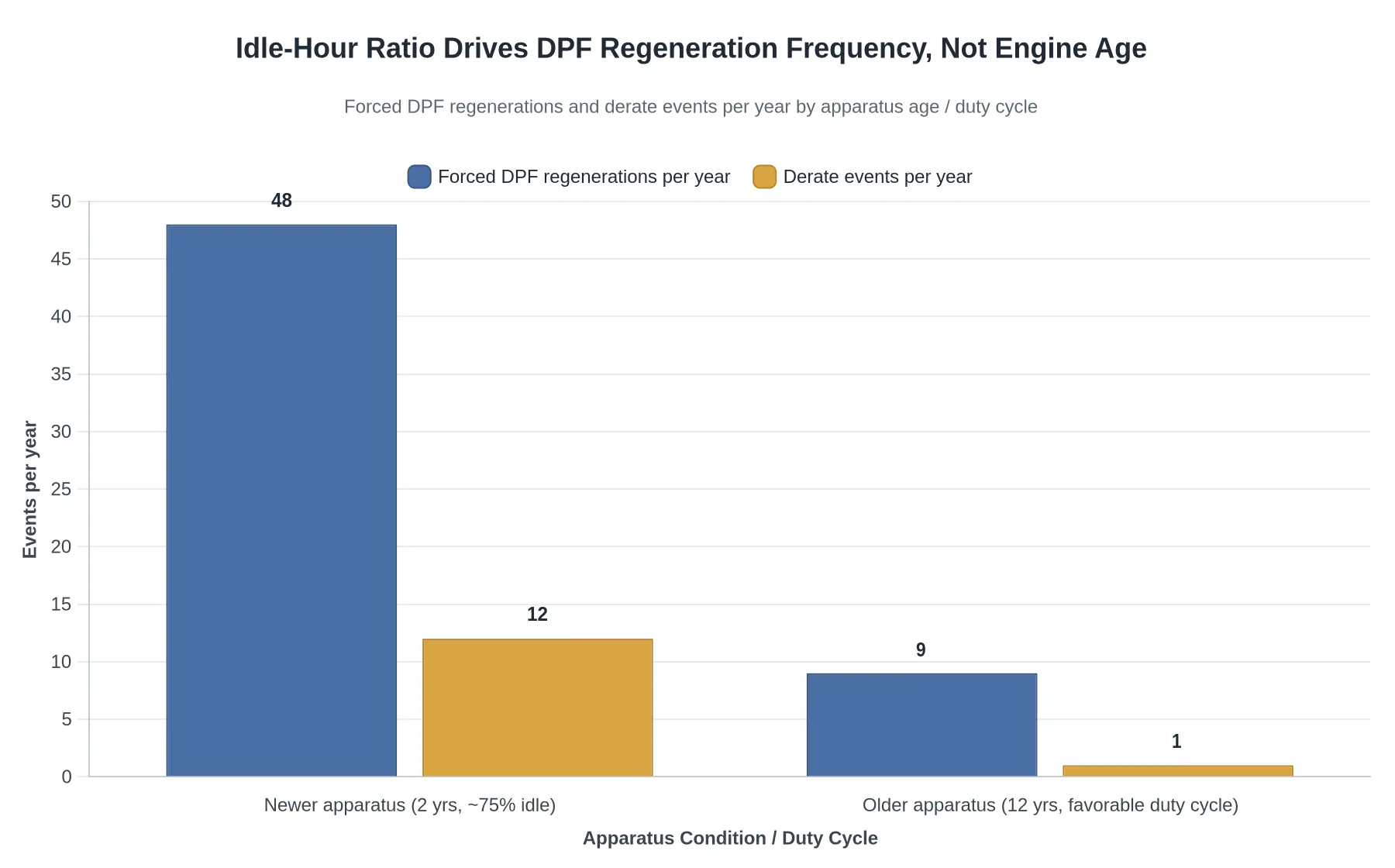
Forced regenerations and derates track idle-hour ratio, not model year. A two-year-old unit with a punishing idle profile can log roughly five times the forced regenerations and more than ten times the derate events of a twelve-year-old unit with a clean duty cycle.
The factors that override engine age are measurable:
- Idle-hour ratio – the share of operating time spent idling versus under load, which sets exhaust temperature
- Duty-cycle profile – trip length, road speed, and engine load, which decide whether passive regeneration is even possible
- Passive regeneration opportunity – how often the filter can actually burn off soot on its own before it must be forced
- Soot loading rate – how quickly particulate builds between regeneration events
- Forced-regeneration and derate frequency – the direct drivers of unplanned outages and in-service failures
- Aftertreatment and fuel-quality maintenance – the multipliers that shorten or extend filter service life
Departments that budget replacement on engine age alone retire serviceable rigs while keeping younger, idle-heavy units in the worst regeneration profiles. If you are planning replacements or expanding a municipal fleet vehicle program, spec for the duty cycle and track idle hours alongside regeneration data. Do that and apparatus downtime becomes predictable instead of a mystery blamed on old trucks.
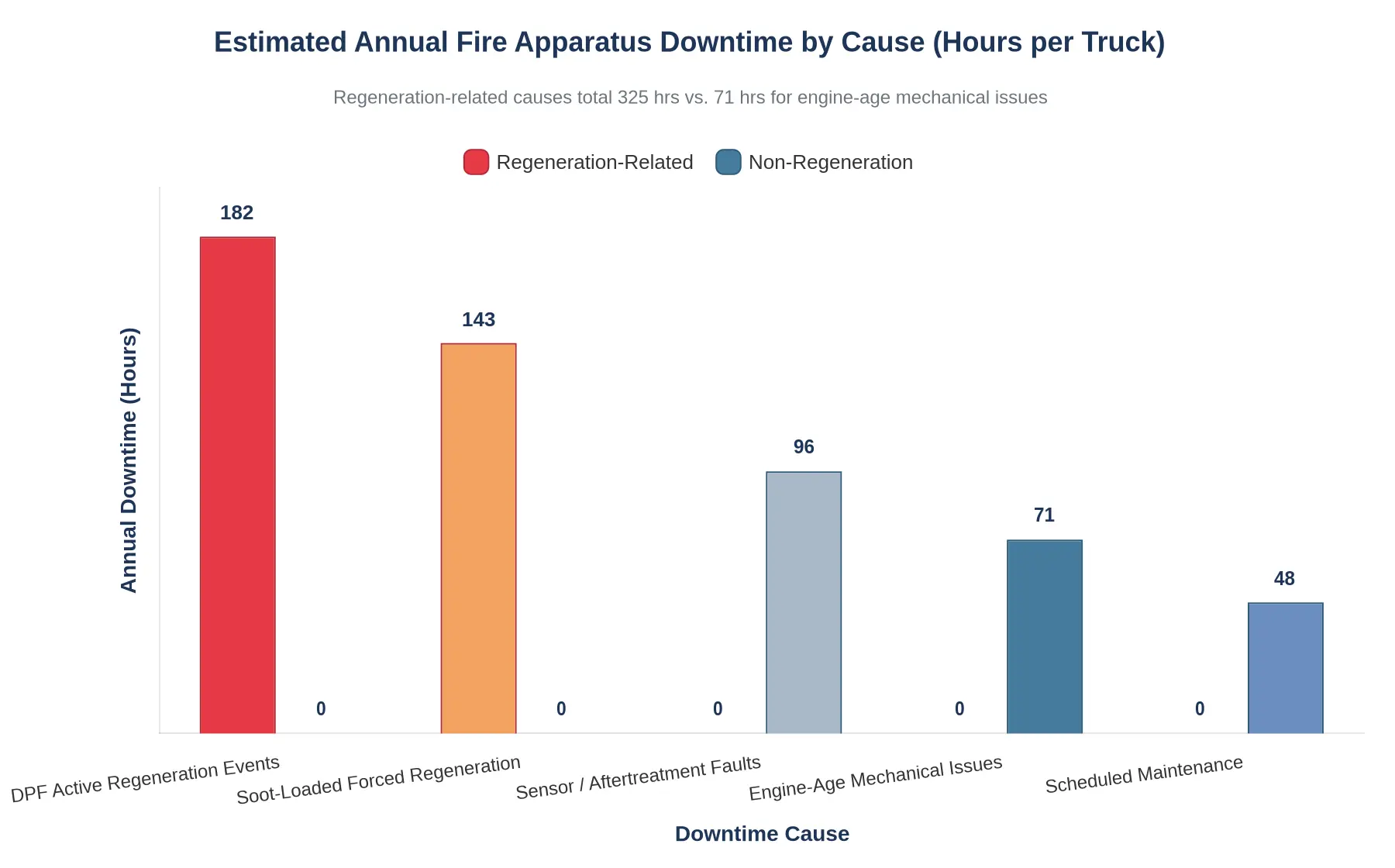
Chart: Estimated Annual Fire Apparatus Downtime by Cause (Hours per Truck)
| Downtime Cause | Category | Annual Downtime (Hours) |
|---|---|---|
| DPF Active Regeneration Events | Regeneration-Related | 182 |
| Soot-Loaded Forced Regeneration | Regeneration-Related | 143 |
| Sensor / Aftertreatment Faults | Non-Regeneration | 96 |
| Engine-Age Mechanical Issues | Non-Regeneration | 71 |
| Scheduled Maintenance | Non-Regeneration | 48 |
- X-axis: Downtime Cause
- Y-axis: Annual Downtime (Hours), scaled 0-200 in increments of 25
- Regeneration-related subtotal: 325 hours (182 + 143)
- Engine-age-related subtotal: 71 hours
- Legend: Regeneration-Related (orange/red bars) vs. Non-Regeneration (blue/gray bars)
Fleet-Management Best Practices for Idle Hours and DPF Regeneration
Managing fire apparatus well depends less on replacing aging engines than on controlling idle time and exhaust aftertreatment behavior. These practices cut the unplanned downtime driven by DPF regeneration cycles.
Measure idle hours per unit, not just total engine hours. Idle time is the hidden driver of soot loading, yet most departments only log total hours. Break out fire dept truck idle hours by apparatus and by shift so you can identify which rigs are quietly accumulating the highest regeneration demand.
Deploy telematics with DPF-specific alerting. Modern telematics gateways expose soot load percentage, exhaust gas temperature, and active-regeneration status in real time. Configure threshold alerts so a rig that has missed passive regeneration for a set distance triggers an inspection before it derates on scene.
Schedule high-temperature regeneration drives proactively. Active regeneration requires sustained exhaust temperatures that occur only under real load. Assign a planned weekly highway or loaded-apparatus movement to each high-idle unit so regeneration completes under controlled conditions rather than mid-emergency.
Train operators on passive versus active regeneration. Crews cause the majority of interrupted cycles by shutting down mid-sequence. Teach personnel to recognize the dash indicator and to let parked regeneration finish whenever the apparatus is out of service.
Integrate aftertreatment diagnostics into PM intervals. Pull DPF differential pressure, DOC efficiency, and regeneration history at every preventive-maintenance visit. Early detection of a clogged filter or failed dosing injector prevents the escalating derates that pull apparatus out of service for days.
Spec regeneration-friendly apparatus. When writing specifications, prioritize exhaust layout, thermal management, and duty-cycle tolerance for high idle. Selecting regeneration-tolerant municipal vehicle platforms engineered for stop-and-go duty reduces regeneration frequency from day one.
Quantify downtime cost to justify capital decisions. Build a simple dashboard tying regeneration-related downtime hours to a dollar cost per unit. This data makes the budget case for proactive replacement far more persuasive than engine mileage alone.
Budgeting and Procurement Implications
Once a department accepts that regeneration cycles, not engine age, drive downtime, the budgeting question changes. Replacement plans built on model year or odometer miss what actually empties bays: idle hours.
Fire apparatus spend much of their service life stationary – on scene, at the station, during pump operations. Every idle hour loads the aftertreatment system and moves the diesel particulate filter (DPF) toward another active regeneration, which can trigger a warning light and an out-of-service window.
Model downtime cost with idle-hour data
Stop asking, “How old is this rig?” Start asking, “What does one idle hour cost us?” A simple formula gets you there:
Annual downtime cost = (idle hours per year ÷ 100) x (regeneration events per 100 idle hours) x (average hours out of service per event) x (fully loaded replacement cost per hour).
The event count times the hours per event gives annual out-of-service hours; multiply that by the hourly cost. On this table the arithmetic reduces to out-of-service hours x $450/hour.
| Apparatus | Idle hours/yr | Regen events per 100 idle hrs | Out of service (hrs/yr) | Est. downtime cost |
|---|---|---|---|---|
| Engine A (6 yrs old) | 4,000 | 3 | 48 | $21,600 |
| Engine B (12 yrs old) | 1,200 | 2 | 14 | $6,300 |
The older unit is the cheaper one here, because it idles less. Age is the wrong lens.
Prioritize capital planning around aftertreatment performance
Score replacement candidates on regen burden: active-regeneration frequency, DPF soot-loading trends, and oil-dilution history. Fund telematics that logs idle hours and regen events, then weight those signals above model year in your capital plan.
When writing specifications, operators compare their choices against mature commercial platforms such as cargo and trailer solutions and crane-lifting and tow-truck platforms, where idle-hour durability is already engineered in.
Treat aftertreatment health as a capital-planning metric, and your budget follows readiness instead of chasing it.
Frequently Asked Questions
Does engine age determine DPF downtime?
No. Engine age is a weak, often misleading predictor of apparatus downtime. A well-maintained 15-year-old engine that spends its life on long, hot highway runs completes its DPF regeneration cycles cleanly, while a 3-year-old rig that idles for hours on scene can clog its filter far sooner. What matters is soot loading and how often the filter actually reaches regeneration temperature, not the calendar year stamped on the block. Judge a truck by its duty cycle, not its birthdate.
How many idle hours trigger a forced regeneration?
There is no single magic number, because forced regeneration is triggered by measured soot load or exhaust backpressure, not by a clock. Still, when fire dept truck idle hours climb past roughly 30 to 40 percent of total engine hours, soot accumulates faster than passive regeneration can burn it off, and the ECU begins demanding parked or active regens. As a rule of thumb, the higher the idle-to-total ratio, the shorter the interval between regeneration events.
Can short emergency runs prevent passive regeneration?
No – short runs usually work against you. Passive regeneration needs sustained exhaust temperatures (roughly 300 degrees C / 570 degrees F and above) held for an extended period, typically achieved during longer highway drives. Brief emergency responses of a few miles at low speed with frequent stops rarely reach or hold that thermal window long enough. The result: soot keeps building, and every stop piles a little more load onto the next forced regeneration.
How should a department measure regeneration-driven downtime?
Track regeneration separately from routine preventive maintenance. Log every event – commanded parked regens, dealer-forced regens, DPF cleaning or replacement, and the diagnostics around them – as out-of-service time dedicated to the emissions system. Then correlate that total against idle-hour ratios across the fleet. Departments that spec durable municipal vehicle platforms for demanding duty cycles often find this data justifies redesigning routes or duty assignments. Measure it, and the pattern becomes obvious: regeneration cycles, not engine age, own your downtime.
The Duty-Cycle Decision Flow, at a Glance
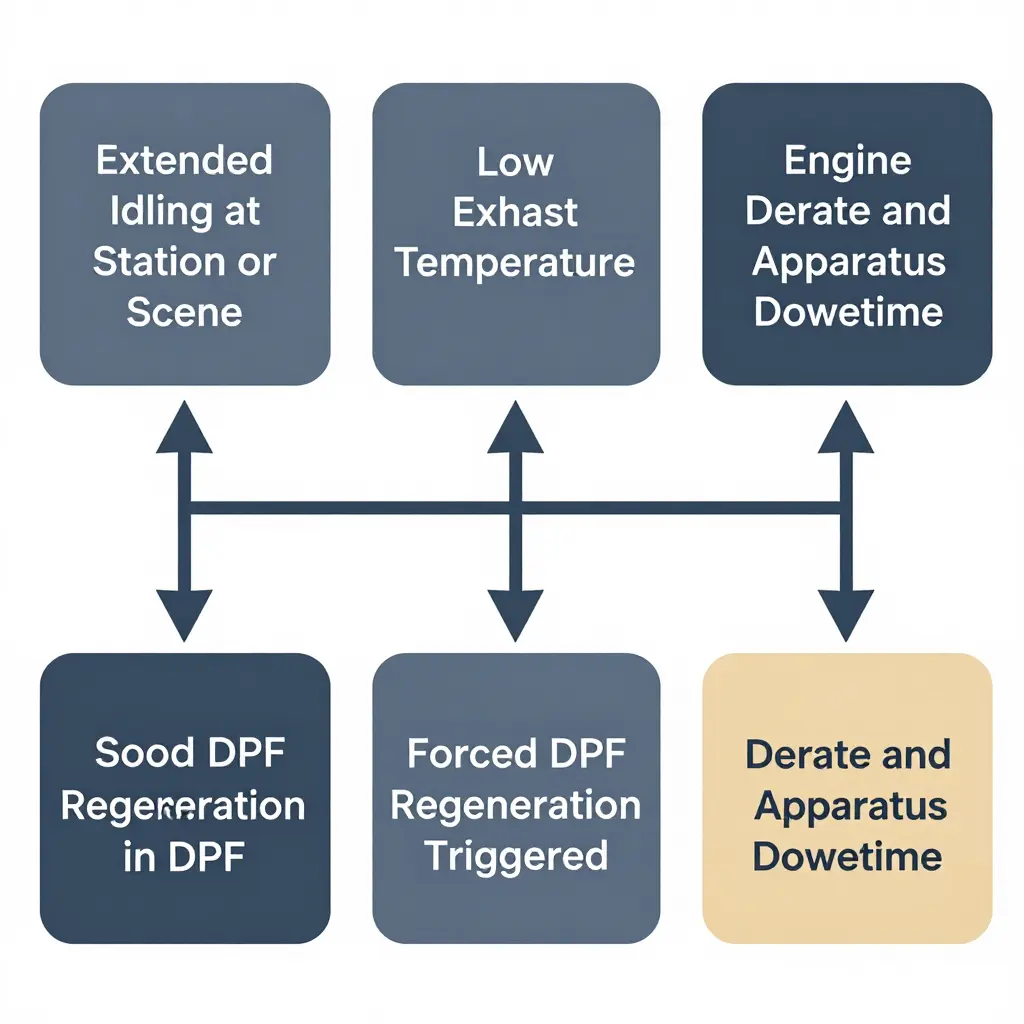
Before a department writes a purchase requisition for a new engine, a fleet manager can run each apparatus through one question: how many idle hours has this rig accumulated, and what does that mean for DPF regeneration? The diagram traces the logic – how an operating condition either clears an apparatus for passive regeneration or flags it for a forced event, and where that leads.
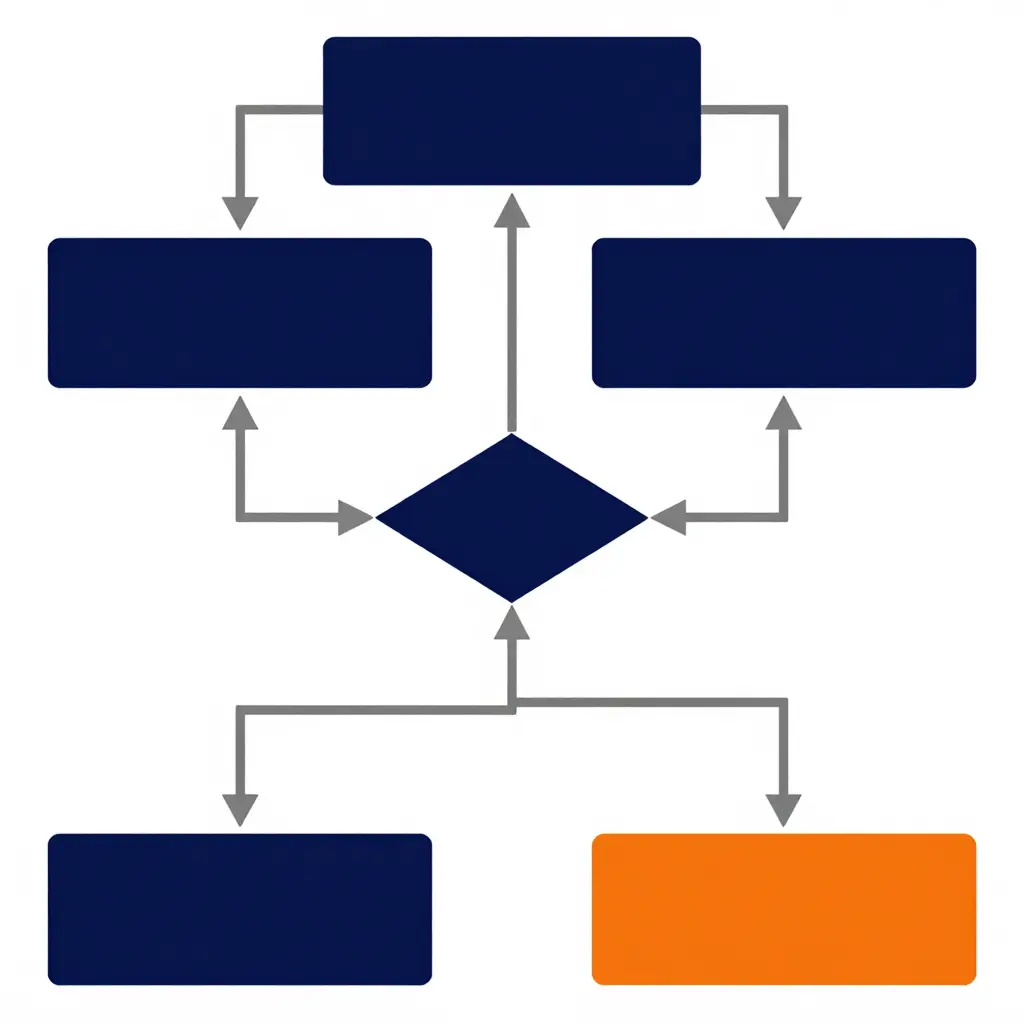
The flow runs in this order:
- Vehicle operating condition – Does the rig spend its days responding to runs at highway speed, or parked on the apron with the pump engaged and the engine idling for hours?
- Idle-hour threshold check – Compare accumulated idle hours against the duty cycle the DPF was calibrated to expect. Fire apparatus routinely sits far above that threshold.
- Regeneration eligibility – With exhaust temperatures too low during long idling periods, passive regeneration cannot complete, so the soot load climbs.
- Forced regeneration required? – When the soot load crosses the manufacturer’s trigger point, the system demands an active, high-temperature regeneration – often a stationary event that removes the truck from service.
- Downtime outcome – The forced regeneration event, not the calendar age of the engine, is what parks the apparatus.
The point is narrow: engine age is a weak predictor of regeneration-related downtime, idle-hour accumulation a strong one. Tracking idle hours and soot-load trends turns a repair surprise into a scheduled maintenance line item. For departments running mixed municipal fleets, the same duty-cycle discipline applies across municipal vehicle platforms built for stop-and-go duty cycles.
Conclusion: Idle Hours and DPF Regeneration Cycles Drive Apparatus Downtime
Fire dept truck idle hours and DPF regeneration cycles, not engine age, decide fire apparatus downtime. Engine age is a convenient proxy that hides the mechanism; cumulative idle time and the frequency of active regeneration events drive soot loading, thermal stress, and the service interruptions that follow.
- Accumulated fire dept truck idle hours correlate more strongly with emissions-system failures than calendar age or mileage.
- Every DPF regeneration cycle imposes distinct thermal and mechanical stress, so frequent, incomplete regenerations accelerate component degradation.
- Engine age alone carries limited predictive value, which makes it an unreliable basis for forecasting apparatus downtime.
- Regeneration-aware diagnostics allow fleets to schedule interventions before a forced derate removes a unit from service.
Fleet managers should use idle-hour diagnostics as the primary readiness metric and pair them with regeneration-aware maintenance planning. Track idle duration, regeneration frequency, and completion rates, and budget, staff, and schedule service around measured duty cycles instead of assumptions about engine age. That is what reduces unplanned apparatus downtime and protects readiness across the fleet.