

The Rebuild-Cost Valuation Paradox
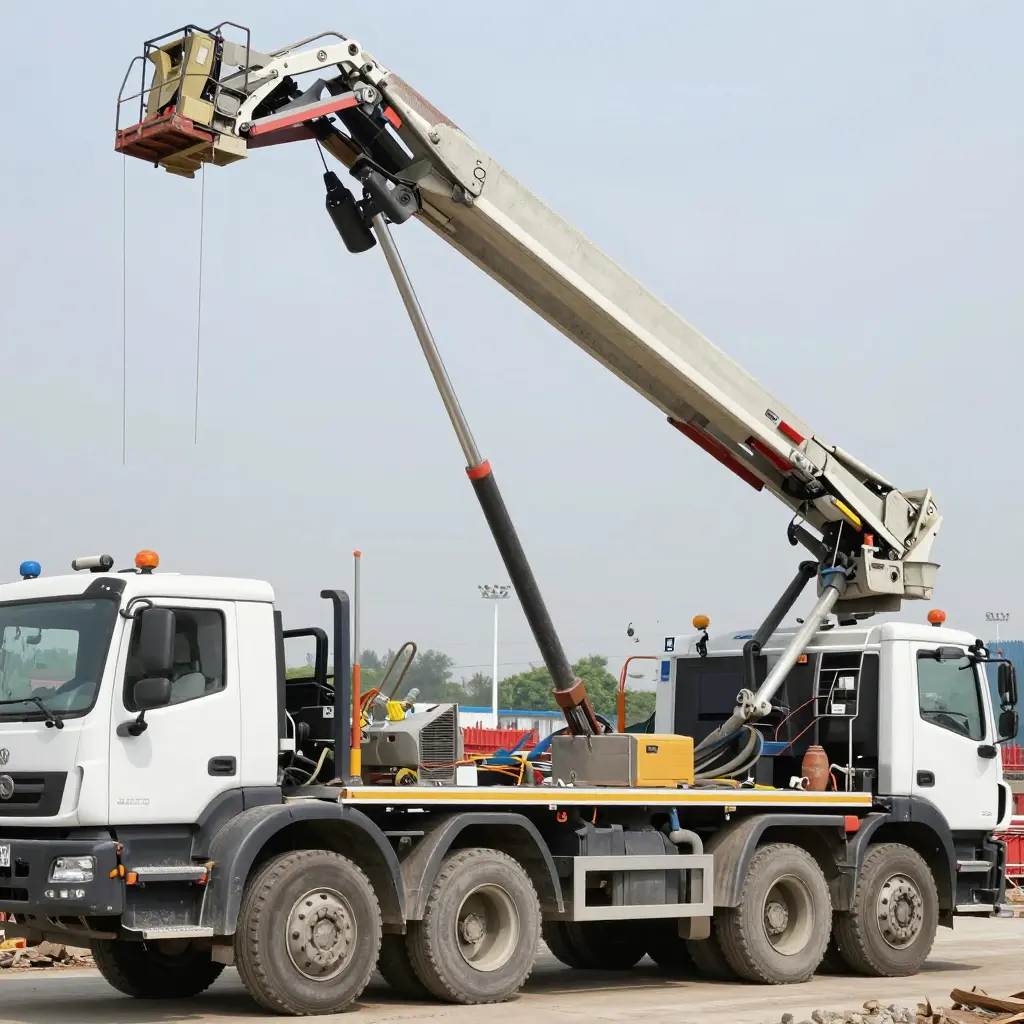
List a used concrete pump truck for sale and engine hours go to the top of the spec sheet. Make an offer and engine hours set the anchor. The habit is hard to shake, but it points at the wrong part of the machine. In concrete pumping, hours worked say little about the cost that decides whether a rebuild is worth doing at all. That cost sits in the boom and its welds.
A boom is a fatigue-loaded steel structure. It flexes through every pour, and each cycle moves its welds a little closer to cracking. The failure modes that matter – seam cracks, cracked pivot bosses, fatigue at hinge points – stay hidden until someone inspects for them. An engine can be rebuilt on a known schedule against known parts pricing. A cracked boom cannot. Once a structural defect turns up, it resets the scope, the downtime, and the rebuild cost in one step.
A defensible valuation therefore weighs three things, not one:
- Drivetrain – engine, transmission, and running gear, where wear is measurable, linear, and largely predictable.
- Boom structure – welds, box sections, and pivot points, where a single crack can dominate the budget. Buyers should study lifting and boom structures the way they would a crane envelope, because the geometry and stress paths are comparable.
- Hydraulic system – pump, valve, and cylinder condition, which either amplifies or contains the cost of the other two.
Read together, they reorder the logic: structure first, hydraulics second, drivetrain third. The rest of this article covers how to read boom weld condition, how to put a number on structural rebuild risk, and how to value a pump truck for sale on the integrity of its boom rather than the count on its hour meter.
Why Engine Hours Are a Misleading Metric
Engine hours are the default proxy for wear in heavy equipment valuation, and on a used concrete pump truck the hour meter does one job: it counts engine runtime. The hydraulic pump turns whenever the engine turns, so its running hours track the same number. None of that says much about cyclic fatigue in the boom.
A boom does not accumulate damage by the hour. It accumulates damage by the cycle. Every deployment, every full stroke of the placing boom, and every load reversal at the knuckle adds a stress excursion at the weld toe. Fatigue life follows the number of load cycles and their amplitude, not the hours on the clock.
Cycle Count, Not Clock Time
A boom that sweeps through thousands of short pours can collect more fatigue damage in one season than a unit that ran twice as many hours on continuous, low-reversal work. The hour meter cannot see the difference, because it only counts while the engine turns.
Site conditions concentrate the load further. Frequent repositioning, extended reach, uneven outrigger footing, and vibration on tight urban pours all raise the stress range per cycle. Each of those variables changes the damage rate on its own, with no effect on the hour reading.
Why a Low-Hour Unit Can Cost More to Rebuild
A low-hour unit that ran in a high-cycle regime can carry a higher rebuild cost than a high-hour unit used lightly. The first may need boom weld repair, crack arrest, and structural re-certification; the second may only need routine drivetrain servicing.
For load-bearing structures such as pedestals, boom mounts, and pivot assemblies, the inspection should track crack indications and weld history rather than the hour meter. Buyers sourcing a loader crane assembly should apply the same cycle-based logic. Fatigue is counted in actuations and stress reversals, not in the hours a diesel engine happens to run.
Boom Weld Cracks: The Real Cost Multiplier
Engine hours measure duty cycle, not structural remaining life. On a used pump truck, boom weld cracks are the variable that actually sets rebuild cost.
Why Fatigue Cracks Form
A concrete boom is welded and dynamically loaded. Every placement cycle applies cyclic loading – alternating bending and torsional stress as the boom articulates and the pump strokes – with vibration from the pumping frequency and boom oscillation layered on top.
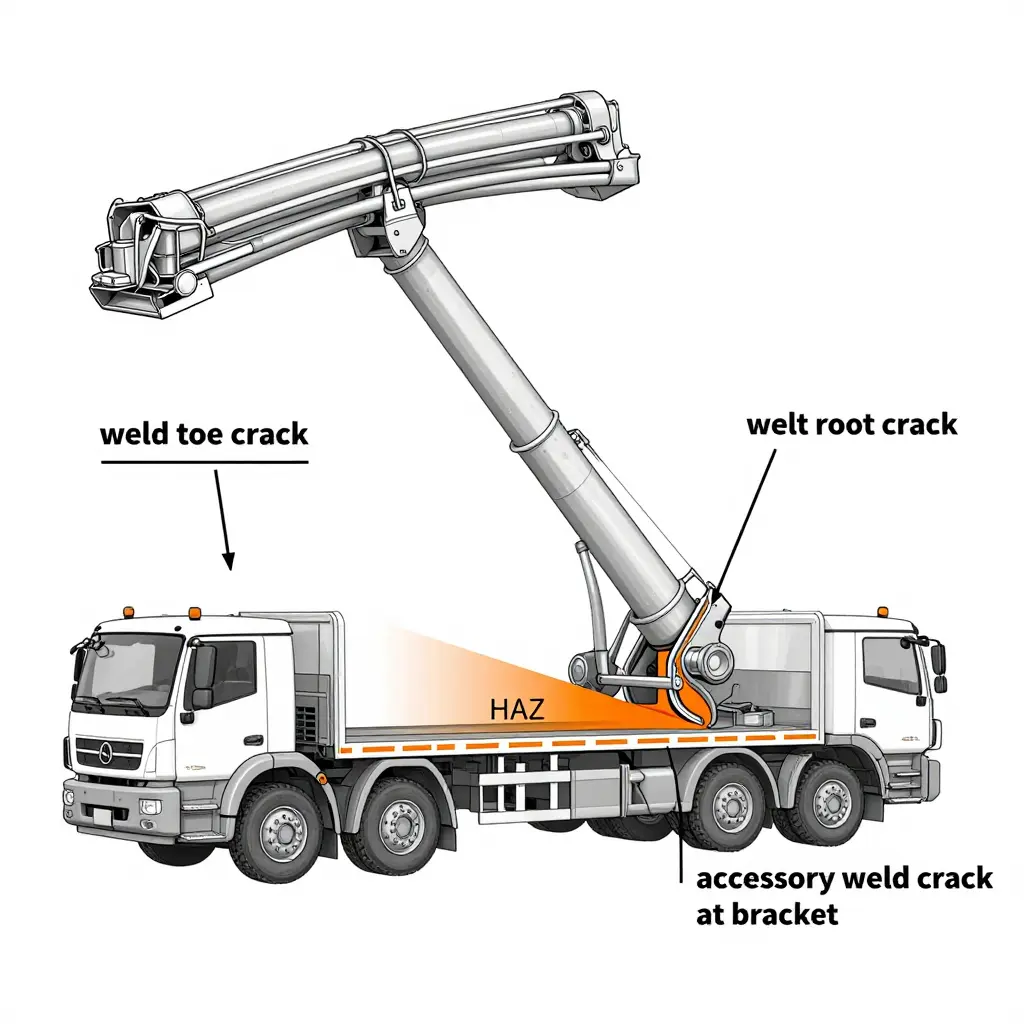
Weld joints concentrate that stress because the geometry changes abruptly at the weld toe, and a sharp toe can multiply nominal stress several times over. The adjacent heat-affected zone (HAZ) has altered microstructure and reduced toughness. Fatigue then starts at the toe or in the HAZ and propagates under continued cycling. The same weld-fatigue mechanism governs every boom-equipped unit, from concrete pumps to loader cranes and heavy lifting equipment.
Location and Depth Set the Repair Scope
- Weld toe cracks – surface-originating, driven by cyclic bending. Shallow toe cracks are the most economical to arrest.
- Root cracks – initiate at the weld root where penetration is incomplete; harder to detect, and they grow toward the plate thickness.
- Accessory weld cracks – at brackets, pipe supports, and outrigger mounts. Local in origin, but they act as initiation sites for larger failures.
Propagation depth is the decisive variable. It tells you how much sound parent metal remains, and therefore whether grinding, overlay, or replacement is required.
Severity Tiers Drive Escalating Rebuild Cost
| Tier | Crack condition | Typical repair | Estimated rebuild cost per boom |
|---|---|---|---|
| 1 | Surface toe crack, depth < 3 mm | Grind and re-weld | $800 – $2,500 |
| 2 | Toe / HAZ crack, 3-8 mm | Weld overlay | $3,000 – $7,500 |
| 3 | Root crack, 8-15 mm, partial penetration | Localized plate replacement | $9,000 – $18,000 |
| 4 | Through-thickness or multi-site, > 15 mm | Full boom section replacement | $25,000 – $60,000+ |
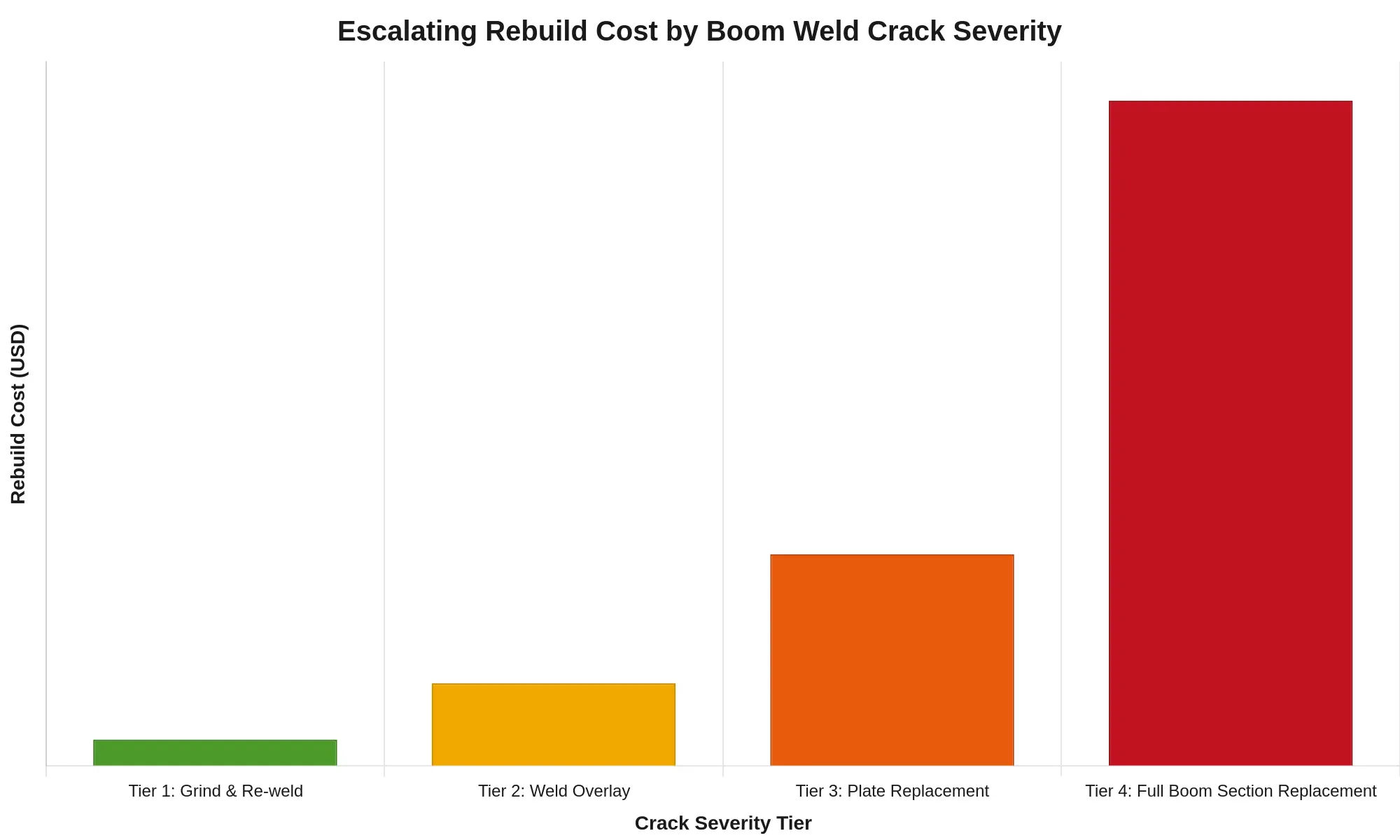
Cyclic stress and stress concentration at the toe start a fatigue crack in the toe or HAZ. The crack propagates deeper, the repair scope grows from grinding to full replacement, and the cost multiplies with it. Between Tier 1 and Tier 4 the jump is roughly 25x, which is why two trucks with identical engine hours can carry very different rebuild costs.
Use this table as a decision aid when you evaluate a used concrete pump truck for sale. Boom condition, like the welds on any hydraulic lifting system, outweighs engine hours every time.
| Cost Driver | What It Measures | Typical Diagnostic Method | Cost Impact (Low/Medium/High) | Rebuild Priority |
|---|---|---|---|---|
| Boom weld crack severity | Depth, length, and number of cracks in boom welds | Dye penetrant or magnetic particle inspection, phased-array ultrasonic testing | High | 1 – Highest |
| Boom section corrosion | Metal loss and wall thinning on boom box sections | Ultrasonic thickness gauging, visual pitting assessment | High | 2 – High |
| Outrigger / structural frame condition | Frame straightness, outrigger beam wear, and mounting integrity | Visual inspection, crack testing, dimensional check | Medium-High | 3 – Medium-High |
| Hydraulic pump condition | Flow, pressure, and internal wear of the pump | Flow and pressure testing, case-drain measurement, oil analysis | Medium | 4 – Medium |
| Drivetrain wear | Transmission, driveshaft, and axle wear | Fluid analysis, vibration check, loaded road test | Medium | 5 – Medium |
| Engine hours | Cumulative operating hours and duty cycle | Hour-meter reading, ECM download, service records | Low | 6 – Low |
How to Inspect Boom Welds Before You Commit
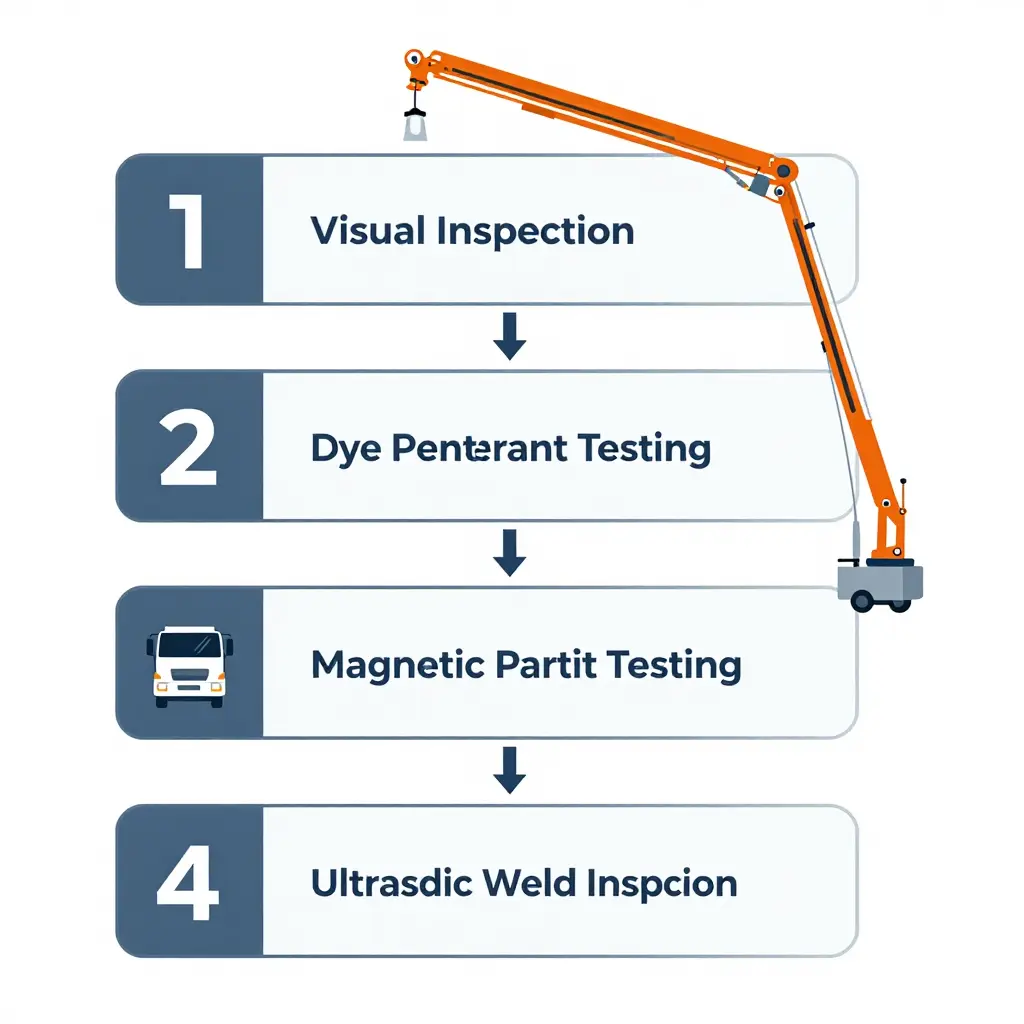
Treat the boom as a fatigue structure, not a paint finish. Cracks at box-section transitions, hinge bosses, and weld toes decide whether the machine returns to service or becomes a rebuild liability. Inspect in a fixed sequence, from surface to volume, so each method confirms or refines the one before it.
Step 1 – Visual Inspection
Clean the boom and start at the highest-stress zones: the base weld, the elbow welds, and the pin-housing reinforcement. Look for rust staining that bleeds from a toe, paint cracking, and any weld that has been ground and re-covered. Visual work finds location and orientation, but it cannot size a defect.
Step 2 – Dye Penetrant Testing (PT)
PT pulls surface-breaking indications into view on the weld toe and heat-affected zone. It is ideal for confirming whether a suspected line is a crack or a scratch, though it reports nothing about depth.
Step 3 – Magnetic Particle Testing (MT)
On ferritic boom steel, MT detects both surface and slightly subsurface discontinuities, and it reveals shallow depth trends along the weld. MT tells you a crack exists and roughly how deep it starts; it does not certify full wall thickness.
Step 4 – Ultrasonic Weld Inspection (UT)
UT is your volumetric check. It measures crack depth and through-wall extent, which is what actually drives repair feasibility. A shallow toe crack may be ground and re-welded; a through-thickness or multi-planar defect in a high-stress node usually justifies section replacement or a rejected unit.
| Method | Detects | Depth Data | Repair Insight |
|---|---|---|---|
| Visual | Location, orientation, coating cracks | None | Screening only |
| Dye penetrant | Surface-breaking cracks | None | Confirms crack vs. scratch |
| Magnetic particle | Surface and near-surface defects | Shallow trend | Grading early-stage cracks |
| Ultrasonic | Internal and through-thickness flaws | Crack depth measured | Re-weld vs. section replacement |
Reading Service and Repair Records
Service records are a proxy for weld integrity. Look for repeat welding on the same boom section, a replaced boom cylinder cradle, or a boom that was re-certified after a strike. A history of the same joint failing twice signals a design or duty-cycle problem, not bad luck, and it changes your rebuild math on any used concrete pump truck. Pair the paper trail with a fresh UT on any previously repaired node, and bring your own inspection platforms and lifting support rather than relying on the seller’s.
For buyers who need inspection and support equipment on site, it helps to know what crane and lifting support equipment is available to keep the walkthrough safe and repeatable.
Rank every candidate by measured crack depth and documented repair history, not paint. That ranking separates a profitable purchase from an expensive lesson.
Field Checklist: Boom Weld and Structure Checkpoints
- Inspect weld toe discoloration for blue, gray, or black heat tint that signals overheating or localized over-stress along the boom’s primary load path.
- Check for surface cracks near hinge points and pivot lugs, confirming findings with dye penetrant or magnetic particle testing.
- Evaluate corrosion at weld interfaces where moisture, chlorides, or concrete slurry tend to accumulate and initiate pitting.
- Verify boom section deformation, including bowing, buckling, or ovality of the box structure that compromises column stability.
- Assess worn pin and bushing joints for excessive clearance, hole elongation, or fretting at all articulation points.
- Examine hydraulic ram anchor welds for cracking, undercut, or fatigue around cylinder and mounting-bracket attachments.
- Inspect outrigger beam welds for crack propagation, section loss, and corrosion along the full extension stroke.
- Document evidence of prior re-welding, including grinding marks, mismatched bead profiles, or non-OEM reinforcement plates.
- Confirm weld bead geometry and leg length against OEM specification to flag under-sized or over-dressed passes.
- Look for paint blistering or rust bleeding that masks subsurface weld defects beneath protective coatings.
Each checkpoint feeds the rebuild scope and labor hours: every confirmed crack adds repair, reinforcement, re-certification, and downtime to the estimate. A boom with multiple defects will push the rebuild cost well past that of a mechanically sound unit. Recording each finding as you go gives buyers a defensible basis for pricing repair against outright replacement.
The Number Buyers Trust – and Why It Misleads
Two figures dominate a concrete pump truck listing: year of manufacture and engine hours. Buyers compare them, dealers lean on them, and auctions sort by them. Neither predicts the bill once you sit down with a rebuild estimate. The variable that moves the number is hidden in the steel – the condition of the boom welds.
A pump truck’s boom absorbs heavy cyclical stress. Every pour bends, extends, and retracts the section, flexing the weld toes at the boom root and hinge points thousands of times a year. That fatigue accumulates regardless of how gently the engine has been treated. A low-hour truck that spent its life on low-volume, high-pressure jobs can carry deeper weld damage than a high-hour unit running steady, moderate cycles. Engine hours measure the pump’s uptime; weld condition measures its structural debt.
Rebuild Cost Curve: Boom Weld Severity vs. Engine Hours
The chart below tracks two things. The blue curve is a relative rebuild cost index as weld cracks progress from a cosmetic blemish to a load-bearing failure. The orange line shows how much engine hours influence that cost, and it stays flat.
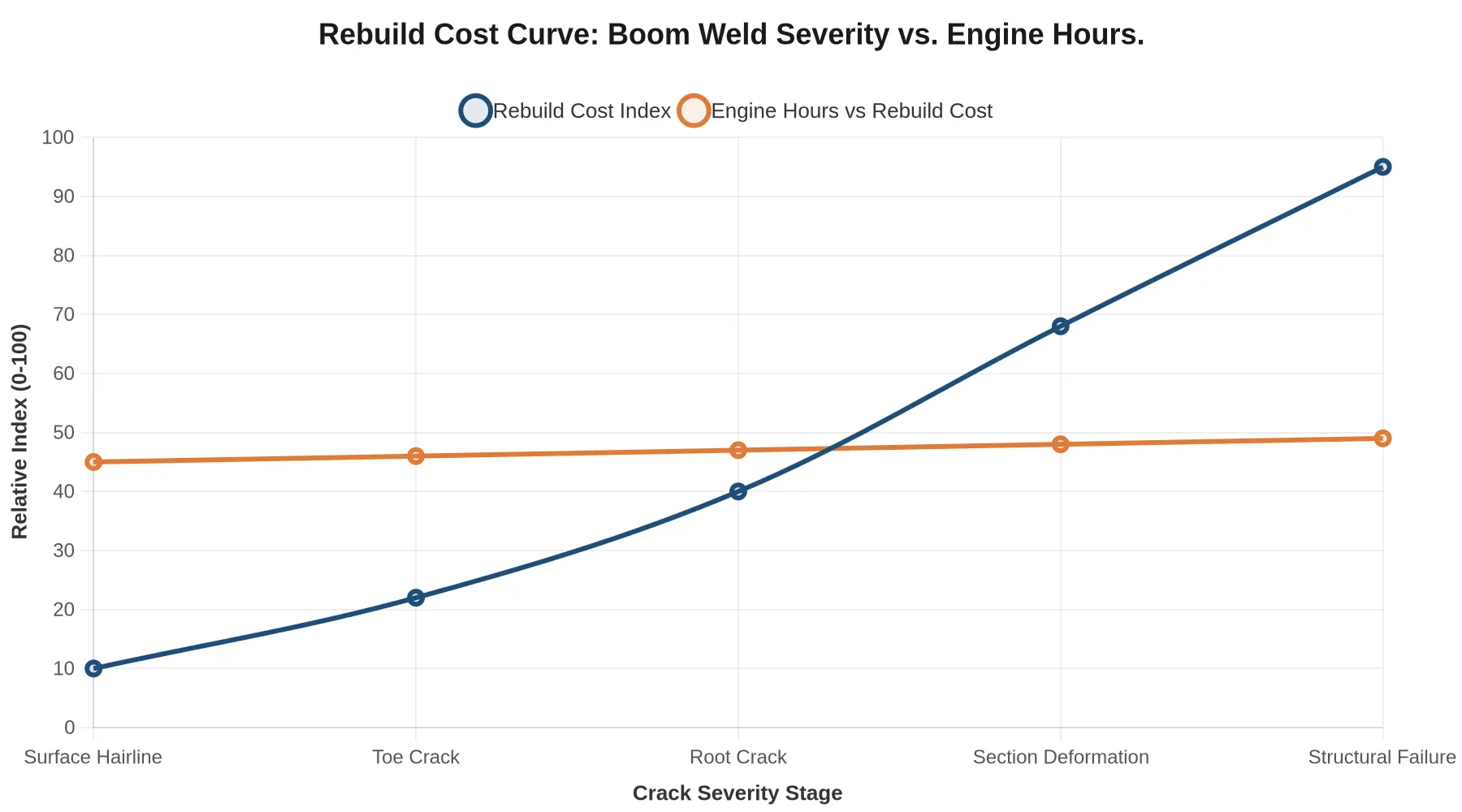
The gap between the two lines is the argument: structural condition drives rebuild economics, and engine hours barely register.
Reading the Curve Stage by Stage
The cost relationship is not linear; it accelerates. Each step up the severity ladder costs more than the last, because repair scope expands from simple welding to full section replacement or boom rejection.
| Severity Stage | Typical Condition | Relative Rebuild Cost Index |
|---|---|---|
| Surface Hairline | Cosmetic surface crack, no penetration | 10 |
| Toe Crack | Fatigue crack at weld toe, early propagation | 22 |
| Root Crack | Crack growing from the weld root into the base metal | 40 |
| Section Deformation | Boom tube distortion, alignment loss | 68 |
| Structural Failure | Load-path failure, section rejection | 95 |
Catch damage at the hairline stage and the rebuild stays in the low-cost band. Wait until section deformation or structural failure and the same repair moves into a different order of magnitude – often past the point where rebuilding is worth it at all.
Why Engine Hours Stay Flat
Engine hours track maintenance schedules, oil changes, and drivetrain condition. They tell you how hard the powerplant worked, and nothing about stress cycles on the boom, corrosion between welded plates, or whether a previous owner ran the boom beyond rated reach. That is why the orange line barely rises. A truck with double the engine hours but sound welds is often the cheaper rebuild, and sometimes the better buy.
What This Means for Your Next Purchase
Buy on the numbers in a listing and you are pricing the wrong component. Before committing capital to a used pump truck, ask for a boom weld inspection: dye-penetrant or magnetic-particle testing on the critical weld toes, ultrasonic checks on suspect roots, and a straightedge check of tube alignment. The inspection costs little next to the rebuild bill it can prevent.
The same logic holds across heavy equipment. Lifting and structural machinery lives or dies by its load-path integrity, not its hour meter, which is why experienced fleet managers inspect structure before drivetrains.
The asking price should follow the welds, not the odometer. Let the crack severity stage, not the engine hours, anchor your offer, your rebuild budget, and your walk-away number.
The Rebuild Cost Logic: Repair, Reinforce, or Reject
Rebuild cost on a concrete pump truck is bracketed by the metallurgy of its boom weld cracks, not by engine hours. Two units with identical hour meters can carry rebuild budgets that differ by a factor of three once nondestructive testing (NDT) maps crack severity, location, and count across the boom’s load-bearing welds. Fleet managers and dealers who price a pump truck for sale on hours alone mis-price risk.
Dye penetrant and ultrasonic inspection sort a boom into four decision tiers. Localized weld repair applies when cracks are short, isolated, and confined to non-critical fillet welds. Structural reinforcement applies when cracking is distributed across a hinge or knuckle region and plates or gussets can restore section modulus. Boom section replacement applies when cracking reaches the parent material of a single telescopic or articulated segment. Full rejection applies when cracks propagate through multiple sections or originate at the pedestal connection, where repair cost approaches – or exceeds – replacement value.
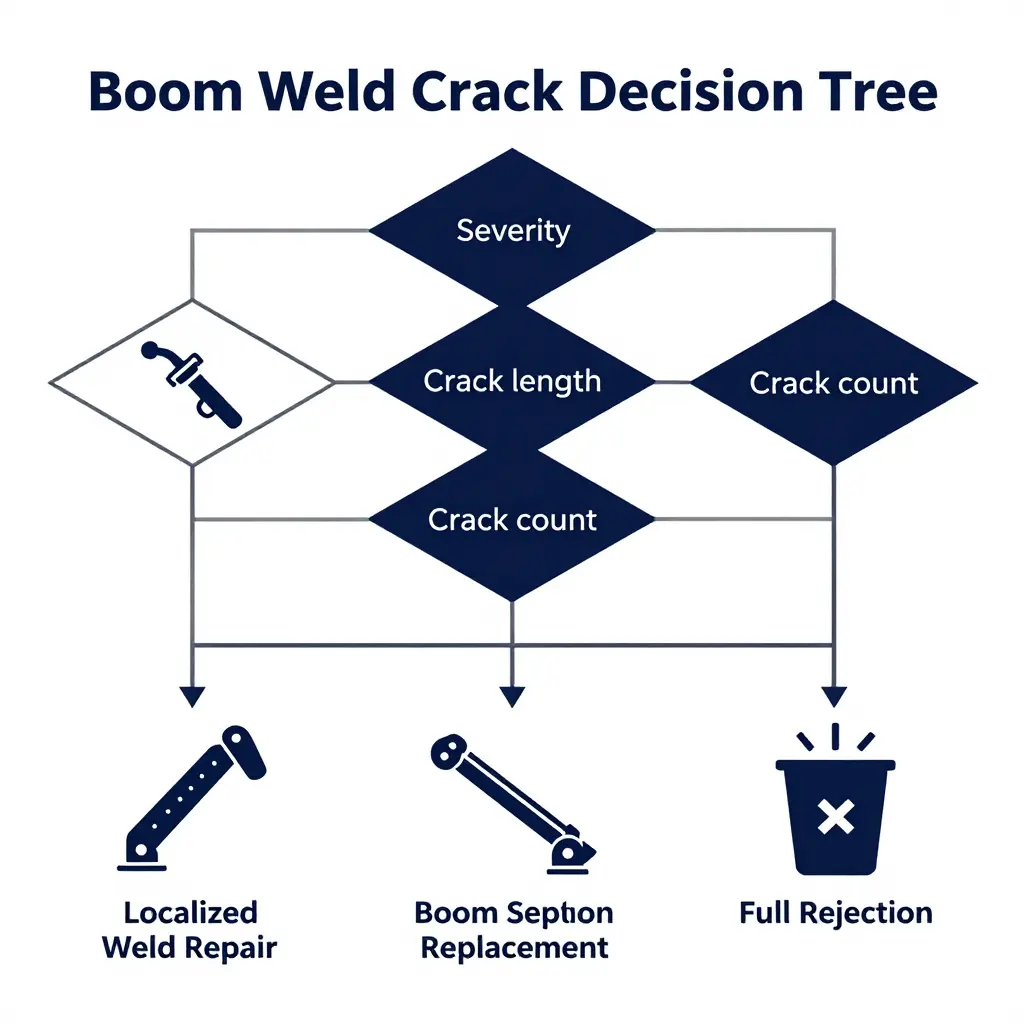
The table below puts numbers on those tiers. The thresholds assume certified welding, post-weld heat treatment, NDT re-verification, and load testing.
| Tier | Trigger (weld crack condition) | Typical Rebuild Cost | Downtime | Resale Value Implication |
|---|---|---|---|---|
| Localized weld repair | Short, isolated cracks in non-critical fillets | USD 4k – 12k | 3-7 days | Minimal loss; documented repair sustains value |
| Structural reinforcement | Distributed cracking at hinge or knuckle | USD 15k – 45k | 2-4 weeks | Moderate discount; disclosure required |
| Boom section replacement | Parent-material cracking in one segment | USD 45k – 120k | 4-10 weeks | Steep discount tied to provenance docs |
| Full rejection | Multi-section or pedestal-origin cracking | Exceeds residual value | Indefinite | Unit sold for parts or scrap |
Downtime carries its own cost. A reinforcement job that idles a pump for three weeks can forfeit more margin than the weld repair itself, so deferring the work rarely protects cash flow. When a unit is sidelined or moved between yards, dedicated trailer assets for relocating pump equipment keep mobilization costs predictable instead of emergency-priced.
Build the rebuild budget from the NDT report, not the hour meter. Assign each finding to one of the four tiers, apply the matching cost threshold, add downtime and the resale discount, then compare the total against replacement value. That turns a subjective inspection into a number you can take into an acquisition, negotiation, or walk-away decision.
Valuing a Pump Truck on Structure, Not the Hour Meter
When you assess a used concrete pump truck for sale, the engine hour meter is a poor proxy for structural condition. Boom weld cracks carry the machine’s fatigue history, and they should anchor rebuild cost expectations far more than any dashboard reading. An engine can be rebuilt with predictable parts and labor. A compromised boom needs engineered repair, certified welding, and load verification, which cost more and are harder to predict.
Three factors should govern every evaluation:
- Inspection method – direct visual and dye-penetrant examination of boom welds, plus magnetic particle testing at high-stress joints, rather than reliance on paperwork.
- Crack severity – distinguishing surface indications from through-thickness propagation determines whether a repair is cosmetic or structural.
- Repair versus replace thresholds – cracks beyond accepted length or located in primary load paths typically justify boom replacement, not patching.
For fleet managers, dealers, and auction buyers, the practical move is to price the boom welds into the offer before the hammer falls or the deal closes. An inspection that puts numbers on crack location, length, and depth turns an unknown liability into a defensible one.
Across the remaining service life of the asset, total cost of ownership is set long before the first fuel invoice – it is set by the structural integrity documented on inspection day.