

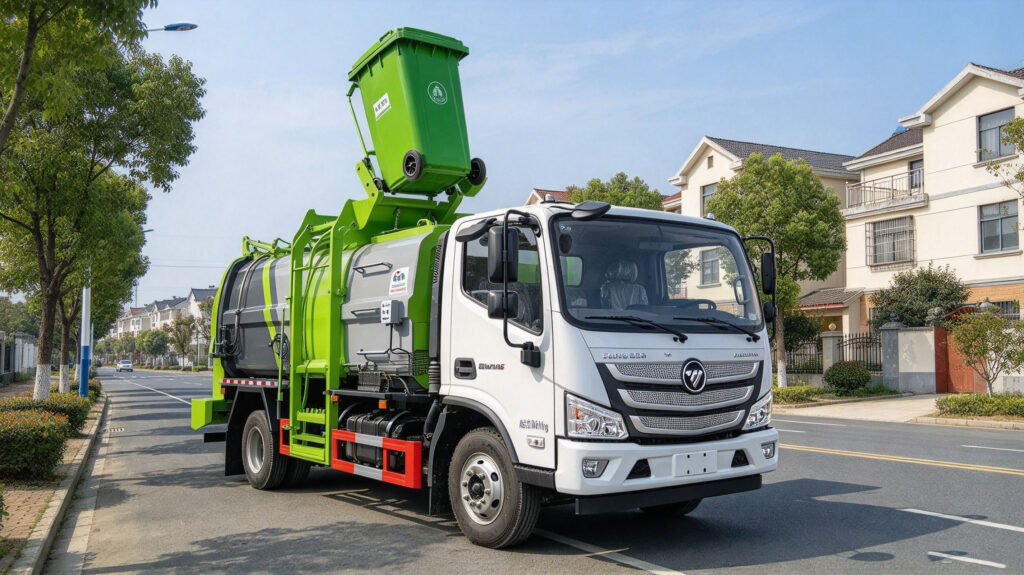
Cart Tipper Types and Bin Fit Requirements
How to match the right automated cart lifter to your wheelie-bin fleet without learning the hard way on route one
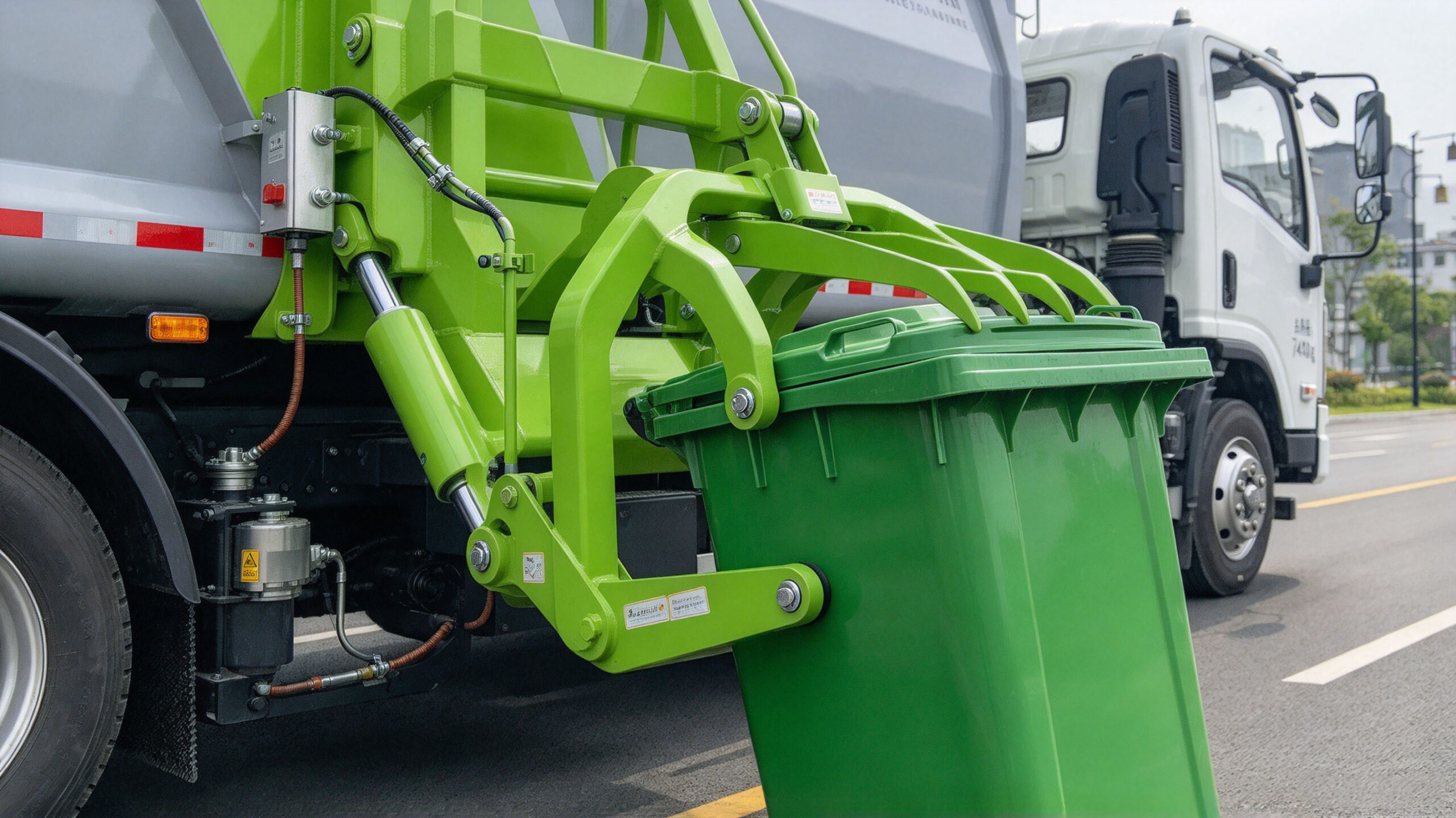
Most collection fleets do not buy a “garbage truck.” They buy a lift that has to grab a specific bin, from a specific curb, on a specific street, hundreds of times a day. The chassis is almost an afterthought next to that single mechanical interface. When the tipper and the bin do not fit, you find out at 6 a.m. on a wet Tuesday: the claw slips, the bin tips half-emptied, the driver gets out, and the route slips by twenty minutes before the first coffee stop.
This guide walks through the main cart tipper types, the bin standards that decide whether a tipper will grab your containers, and a practical way to match the two before you sign a purchase order. It is written for municipal procurement teams, sanitation and waste-contractor fleet managers, and anyone specifying a new automated side-loader or rear loader.
What a cart tipper actually does
A cart tipper, sometimes called a cart lifter or bin lifter, is the powered mechanism that grabs a wheelie bin, lifts it to the top of the hopper, tips it so the contents fall into the body, and sets the empty bin back on the ground. On an automated side loader the tipper is mounted on the side of the cab; on a rear loader it sits at the rear hopper. The mechanism itself is deceptively simple, but the part that matters—the grip—is where incompatibility hides.
The grip is shaped to match a bin’s rim. A 240-liter bin made to the European EN 840 standard has a specific lip that a comb-type lifter hooks under. A bin made to a different regional profile, or a worn bin whose lip has deformed, may sit in the arms but not lock. The result is the same whether you run one truck or fifty: dropped bins, spilled loads, and a driver doing by hand what the machine was supposed to automate.
The main tipper types
Tippers are grouped by where they mount and how many bins they handle at once. The table below covers the variants you will actually be quoted, with the bin sizes each one is built to lift and the trade-offs that show up in daily operation.
| Tipper type | Mount position | Typical bin sizes | Rated lift mass | Best fit | Watch-out |
|---|---|---|---|---|---|
| Single-arm side tipper | Side of cab | 120–360 L | Up to 180 kg | Standard residential curbside routes | One bin per cycle; slower on dense rows |
| Dual-arm side tipper | Side of cab | 120–360 L (two at once) | Up to 360 kg combined | High-volume residential blocks | Wider body; needs wider streets |
| Rear hopper tipper | Rear of body | 120–1100 L | Up to 500 kg | Mixed residential and small commercial | Requires a second crew member to stage bins |
| Heavy comb tipper | Side or rear | 660–1100 L | Up to 600 kg | Semi-commercial and apartment streams | Only fits comb-rim bins; no small carts |
| Front loader arm | Front of cab | 2–8 yd³ commercial dumpsters | Up to 900 kg | Commercial dumpster routes | Different bin family entirely; not for wheelie carts |
| Manual tip assist | Side or rear | 120–240 L | Up to 120 kg | Low-volume or rural hand-collection | Driver still does most of the work |
The single-arm side tipper is the default for municipal curbside work because it lets one driver run the whole route from the cab. The dual-arm variant roughly doubles throughput on long rows of identical bins but adds width that matters on older streets. Rear and heavy comb tippers bridge the gap toward commercial volumes but usually need a second person to present the bins.
Bin fit standards that decide compatibility
A tipper does not grab “any bin.” It grabs a bin whose rim matches the lifter’s comb or claw. Two standards dominate, and mixing them is the most common compatibility mistake.
| Standard / profile | Regions | Bin sizes covered | How the lifter engages |
|---|---|---|---|
| EN 840 / DIN comb | Europe, much of Asia, export models | 120, 240, 360, 660, 1100 L | Two-point or four-point comb hooks under the rim |
| ANSI / COMM Merch | North America | 35–96 gal carts, some 2–3 yd | Curved lifter plate wraps the cart lip |
| Zealand comb | Australia / NZ | 120–330 L | Three-point claw on a flat front rim |
| Proprietary retail bins | Varies | Non-standard | Often no reliable automated grip |
If your fleet is already standardized on EN 840 bins, specify a comb tipper that handles the full size range you run—most comb lifters will take 120 through 1100 L with a simple adjustment, but confirm the upper limit, because lifting a 1100 L bin needs the heavy comb variant, not the residential one. If you run North American carts, you need the ANSI-style lip plate, and a European comb tipper will not hold them.
9 s
11 s
13 s
15 s
18 s
side
side
hopper
comb
arm
| Tipper type | Max bin volume (L) | Cycle time (s) |
|---|---|---|
| Single-arm side | 360 | 9 |
| Dual-arm side | 360 | 11 |
| Rear hopper | 1100 | 13 |
| Heavy comb | 1100 | 15 |
| Front loader arm | 6000 | 18 |
The chart compares common tipper types by the maximum bin volume they can handle and their typical single-cycle time. Cycle time is the part drivers feel: a tipper that lifts a 360 L bin in nine seconds versus fourteen seconds adds up across a 700-stop route. Note that capacity and speed pull in opposite directions—the heavy comb tipper handles the biggest bins but moves more slowly per cycle, which is why it belongs on semi-commercial routes rather than tight residential rows.
Matching the tipper to your bin fleet
Run this sequence before you shortlist models. It takes an afternoon with a clipboard and saves a mis-specified truck:
- List every bin size and standard in your current fleet, by count. Do not estimate—walk the depot.
- Identify the single largest bin the tipper must lift. That sets the minimum rated mass and comb class.
- Decide whether one driver will run the route alone. If yes, a side tipper is mandatory; rear tippers need a second crew member.
- Measure the narrowest street or alley on the route. Dual-arm and heavy comb bodies are wider and may not fit.
- Check bin rim condition. Deformed, cracked, or non-standard rims will not lock regardless of tipper quality.
- Confirm the lifter adjustment range covers your bin sizes without a tool change mid-route.
- Ask the manufacturer for a fit video with your actual bin model, not a generic one.
Common fit failures and what they look like
These are the symptoms that tell you the tipper and bin are not a matched set:
- The bin tips but does not fully empty—the claw sits too high on the rim and the bin never reaches full inversion.
- The bin slips out during the lift—wrong comb class or a deformed rim that the claw cannot hook.
- The lifter grabs only one of two bins on a dual-arm unit—the arms are not aligned to the bin spacing.
- Plastic bins crack at the lip after a few weeks—the retention claws over-stress a rim not rated for automated lifting.
- The driver has to nudge the bin by hand every stop—the presentation window is too tight for the bin’s wheel base.
- Large bins tip the whole truck—the combined load exceeds the stabilizer or the body’s dynamic limit.
Pre-purchase checklist
Before you release the order, confirm each item below with the supplier in writing:
- The lifter’s comb class matches your bin standard (EN 840, ANSI, or Zealand).
- The rated lift mass covers your heaviest loaded bin with a 25% margin.
- The adjustment range covers every bin size in your fleet.
- Cycle time is quoted for your largest bin, not the smallest.
- Spare claws and comb plates are available locally, not only from the factory.
- The body and stabilizer are rated for the combined lift load at the maximum reach.
- A service interval for the lifter is specified, including grease points and cable inspection.
Frequently asked questions
Can one tipper handle both 240 L and 1100 L bins?
A heavy comb tipper can, with an adjustment, but a standard residential side tipper usually tops out around 360 L. If your route mixes small carts and large semi-commercial bins, specify the heavy comb variant and verify the upper limit with your exact bin model.
Will a European comb tipper lift North American carts?
No. ANSI-style carts have a different lip profile that a comb claw cannot hook securely. You need the ANSI lip-plate lifter, or you need to standardize your bins on EN 840 first.
Why does my bin crack at the rim after automated lifting?
Either the bin is not rated for automated lifting, or the retention claws are over-tightening. Use bins certified for automated collection and have the claw tension set to the manufacturer’s spec rather than maxed out.
Is a dual-arm tipper worth the extra width?
On long rows of identical bins it nearly doubles throughput and pays back fast. On older, narrow streets it can be a liability. Match the choice to your actual route geometry, not the brochure.
How often should the lifter be serviced?
Daily visual checks for the driver, greasing at the intervals in the manual (typically every few hundred cycles), and a cable and comb inspection at each scheduled body service. The lifter wears faster than the chassis because it cycles constantly.
About CRRC Vehicles
CRRC Vehicles is a professional consulting and industry insights platform focused on the global mobility and vehicle industry. We cover rail transit, smart mobility, new energy vehicles, special-purpose vehicles, and emerging transportation technologies. With a global perspective and industry-focused expertise, we provide clear, reliable, and practical insights into vehicle technology, market trends, and business opportunities—helping industry professionals, businesses, and investors make informed decisions and navigate the future of mobility. Learn more at crrcvehicles.com.