

Electric Cart Tipper Battery Range and Depot Charging
Real-world range, energy use, and the depot electrical work that decides whether an electric collection truck actually runs the route
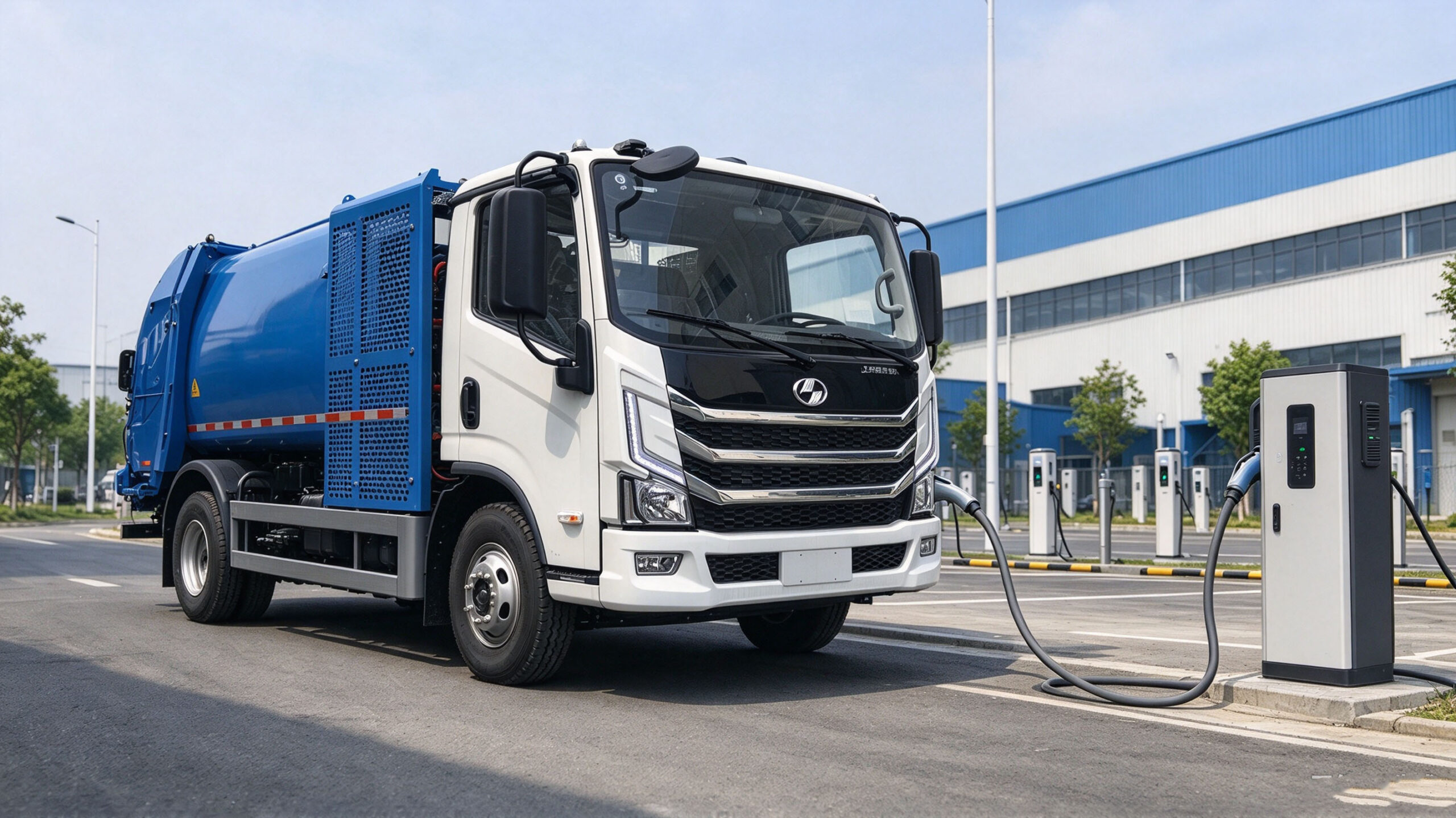
The headline number on an electric garbage truck’s spec sheet—usually a smooth range figure measured in ideal conditions—tells you almost nothing about whether it will finish your route. Collection duty is the worst case for any battery vehicle: a fully loaded body at the start, constant stop-start cycling, a hungry hydraulic tipper lifting bins hundreds of times, and cab heating or cooling running the whole shift. Range collapses from the brochure under exactly the conditions your drivers live in every day.
This guide separates the marketing range from the operational range, shows what actually drains the battery on a collection route, and lays out the depot charging decisions—capacity, charger type, and load management—that determine whether an electric fleet works or strands trucks mid-route.
Why collection duty is hard on batteries
A passenger EV loses range in city traffic because of heating and auxiliary loads. A collection truck loses range for the same reasons plus two big extras. First, the body starts full and gets lighter through the shift, but the lift cycles are constant: every bin tip is a hydraulic pump drawing from the same pack that moves the wheels. Second, the route is a stop-start crawl, and while regeneration recovers some energy on the descent, a bin lift is pure draw with no recovery.
The practical result is that energy use per kilometer on a collection route is far higher than the same chassis would show on a highway. A truck quoted at, say, a comfortable range in mixed driving may cover barely half that on a dense residential loop with a heavy tipper duty. The number that matters is energy per route, not energy per kilometer, because route length and stop count are what you actually plan around.
Range under real conditions
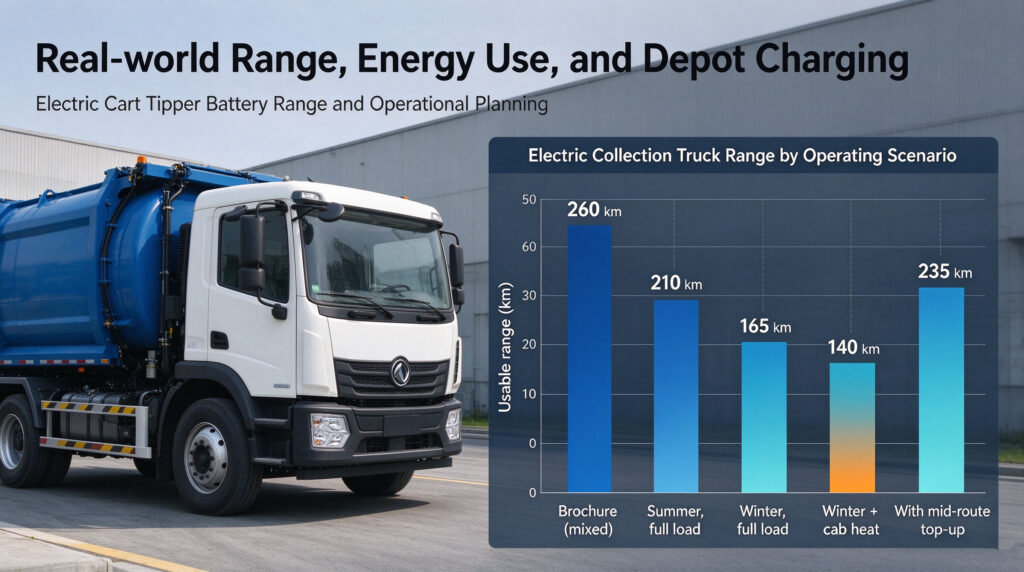
The chart below shows how a representative electric collection truck’s usable range shifts across operating scenarios. The “brochure” bar is the optimistic mixed-cycle figure; the others reflect loads and weather a depot actually sees.
(mixed)
load
load
cab heat
top-up
| Operating scenario | Usable range (km) |
|---|---|
| Brochure (mixed) | 260 |
| Summer, full load | 210 |
| Winter, full load | 165 |
| Winter + cab heat | 140 |
| With mid-route top-up | 235 |
Two effects dominate. Cold weather cuts range because the cabin and, in some architectures, the battery thermal system draw continuously, and battery chemistry simply delivers less at low temperature. A fully loaded body at the start of a long route compounds the problem, because the pack is supporting maximum mass exactly when the tipper is working hardest. Opportunity charging—a short top-up at the half-route point—recovers enough to flatten both curves and is the cheapest way to stretch a smaller pack across a longer loop.
Energy use by route type
Not all routes cost the same. The table breaks down typical energy draw by route profile so you can size the pack and the charger to the worst route in your fleet, not the average.
| Route profile | Stops per shift | Bins lifted | Typical energy use | Range impact |
|---|---|---|---|---|
| Low-density suburban | 300–450 | 300–450 | 1.1–1.4 kWh/km | Mildest draw |
| Dense residential | 700–1000 | 700–1000 | 1.8–2.3 kWh/km | Heavy lift cycling |
| Mixed residential + commercial | 500–800 | 500–800 | 1.6–2.0 kWh/km | Larger bins add mass |
| Winter dense residential | 700–1000 | 700–1000 | 2.4–3.0 kWh/km | Cab heating + chemistry loss |
| Semi-commercial / roll-off assist | 150–300 | 150–300 | 2.0–2.6 kWh/km | High per-stop mass |
The takeaway is not the exact figures—those shift with chassis and body—but the spread. A dense winter route can draw more than double the energy of a calm suburban one. If you size the battery for the suburban average, your worst route will be the one that fails.
Depot charging: the part nobody sees on the spec sheet
Buying the truck is the easy half. Charging it is where fleets get surprised. A single depot charger for one truck is trivial; charging twenty trucks overnight on the same service is a facility engineering problem. The constraints, in order:
- Incoming supply. A 50 kW charger pulls roughly 75 A at 400 V; twenty of them do not fit on a small service. The depot’s grid connection, not the truck, is often the real limit.
- Load management. A smart controller staggers charging so the depot never exceeds its supply, even if every truck plugs in at once. Without it, you either upgrade the supply or watch breakers trip.
- Charger power vs shift length. A bigger pack needs either a higher-power charger or more time. Match the charger to the longest window you actually have.
- Opportunity charging sites. A mid-route depot or yard with a fast charger turns a marginal range into a non-issue, and lets you buy a smaller, cheaper pack.
- Cable and connector standard. Confirm the truck and charger share the same connector and communication protocol before delivery, not during commissioning.
- Cold-weather readiness. If the depot drops below freezing, the pack may need preconditioning; plan the supply for heating as well as charging.
Charger sizing in practice
A simple way to size the depot: take the largest daily energy a truck consumes on your worst route, divide by the charging window you have, and add margin for efficiency loss and future trucks. A truck that burns 400 kWh on a winter route and has an eight-hour window needs roughly a 60 kW charger to recover fully with margin—and if ten trucks share one service, the load-management controller, not the individual chargers, becomes the critical component.
Battery chemistry and pack longevity
The pack is the most expensive component on the truck, and collection duty is hard on it. Most production electric trucks use lithium iron phosphate (LFP) or nickel manganese cobalt (NMC) cells. LFP trades some energy density for a longer cycle life and better tolerance to frequent partial charging, which suits a depot that opportunity-charges daily. NMC packs more energy into less mass, helping range on the longest routes, but ages faster under the same duty and is less forgiving of heat. For a fleet that charges every night and tops up mid-route, LFP’s durability usually wins on lifetime cost even if it needs a slightly larger pack to match range.
Two operating habits protect the pack. First, avoid running it to a very low state of charge on the worst route; leaving a buffer reduces stress and preserves capacity over years. Second, let the depot’s load manager keep charge rates within the manufacturer’s window rather than forcing maximum current on a cold pack. A pack that is charged gently and never deep-discharged will still be near its original capacity when the chassis is ready for its first major service, which is the difference between a battery that lasts the truck’s life and one that needs replacement mid-fleet.
Common deployment mistakes
- Quoting range from the brochure and discovering the winter route falls short by a third.
- Forgetting the tipper’s hydraulic load when estimating energy, treating the truck as if it were a delivery van.
- Assuming the existing depot service can handle a row of chargers without a load study.
- Buying oversized batteries to cover one bad route, then paying for capacity the other 90% of the fleet never uses.
- Skipping opportunity charging and instead overspecifying every pack.
- Neglecting connector and protocol compatibility between truck and charger from different vendors.
Frequently asked questions
How much range do I really need for a collection route?
Plan for your single worst route—longest, densest, coldest—with a 20% buffer, not the fleet average. A truck that covers the average will still fail on the bad day, and that is the day a resident complains.
Does the bin tipper really eat that much battery?
Yes. Every lift is a hydraulic pump draw from the traction pack with no regeneration. On a dense route with 800 lifts, the tipper is a major share of total energy use, which is why energy-per-route, not per-kilometer, is the right planning metric.
Is opportunity charging better than a bigger battery?
Often yes. A short mid-route top-up lets you specify a smaller, cheaper pack and still cover long loops. The trade-off is a second charging location and the routing discipline to use it.
Will cold weather really cut my range that much?
On a collection route, yes—typically 20–35% versus mild conditions once you add cab heating and battery thermal draw. Plan the worst month, not the mild one, or winter will expose the gap.
What is the most overlooked part of going electric?
The depot supply. The trucks get the budget and the attention; the service upgrade, load management, and charger commissioning get discovered late. Do the electrical load study before you order the first truck.
About CRRC Vehicles
CRRC Vehicles is a professional consulting and industry insights platform focused on the global mobility and vehicle industry. We cover rail transit, smart mobility, new energy vehicles, special-purpose vehicles, and emerging transportation technologies. With a global perspective and industry-focused expertise, we provide clear, reliable, and practical insights into vehicle technology, market trends, and business opportunities—helping industry professionals, businesses, and investors make informed decisions and navigate the future of mobility. Learn more at crrcvehicles.com.