

Chassis Payload Ratings: The Engineering Fundamentals Behind Every Legal Limit
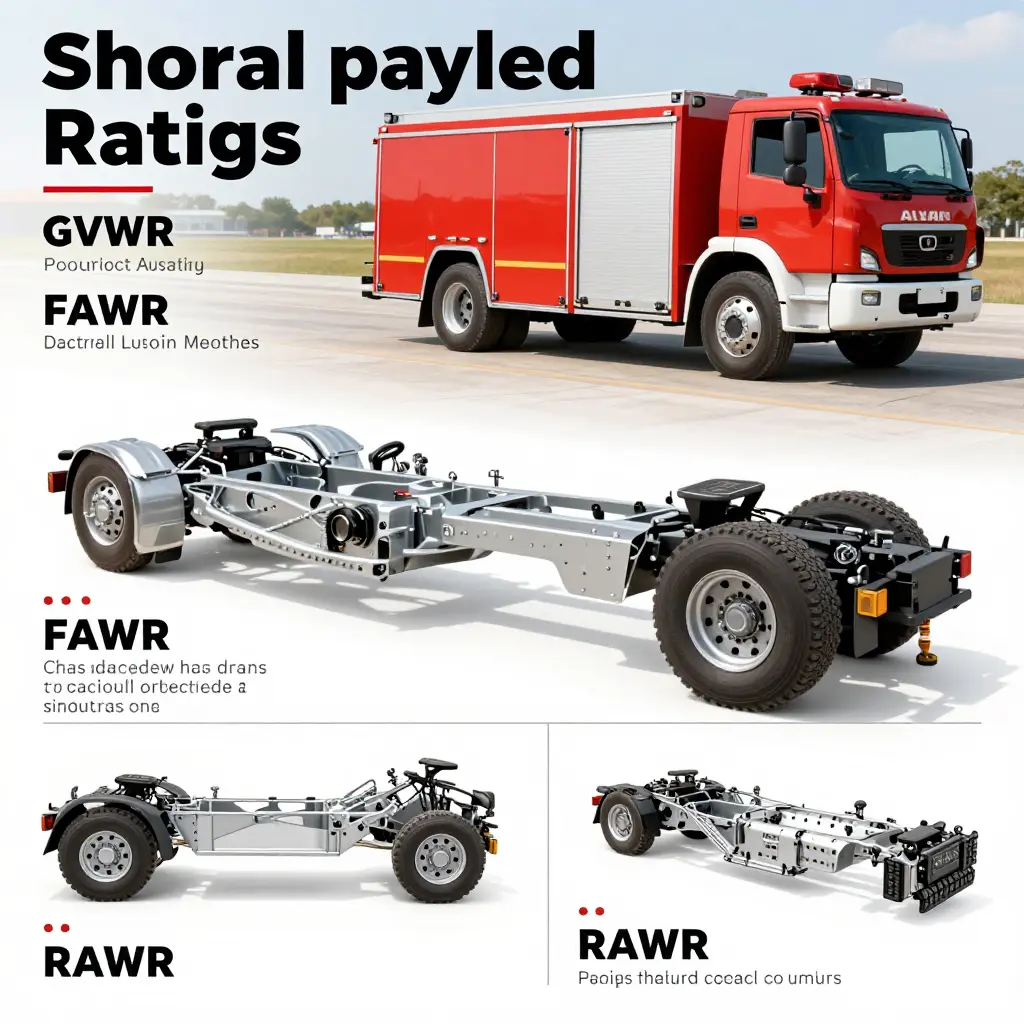
The chassis decides how much a rescue truck can legally carry long before any listing photo tries to sell it. A handful of ratings explain the difference between a truck that looks heavy-duty and one that actually is.
The Core Definitions
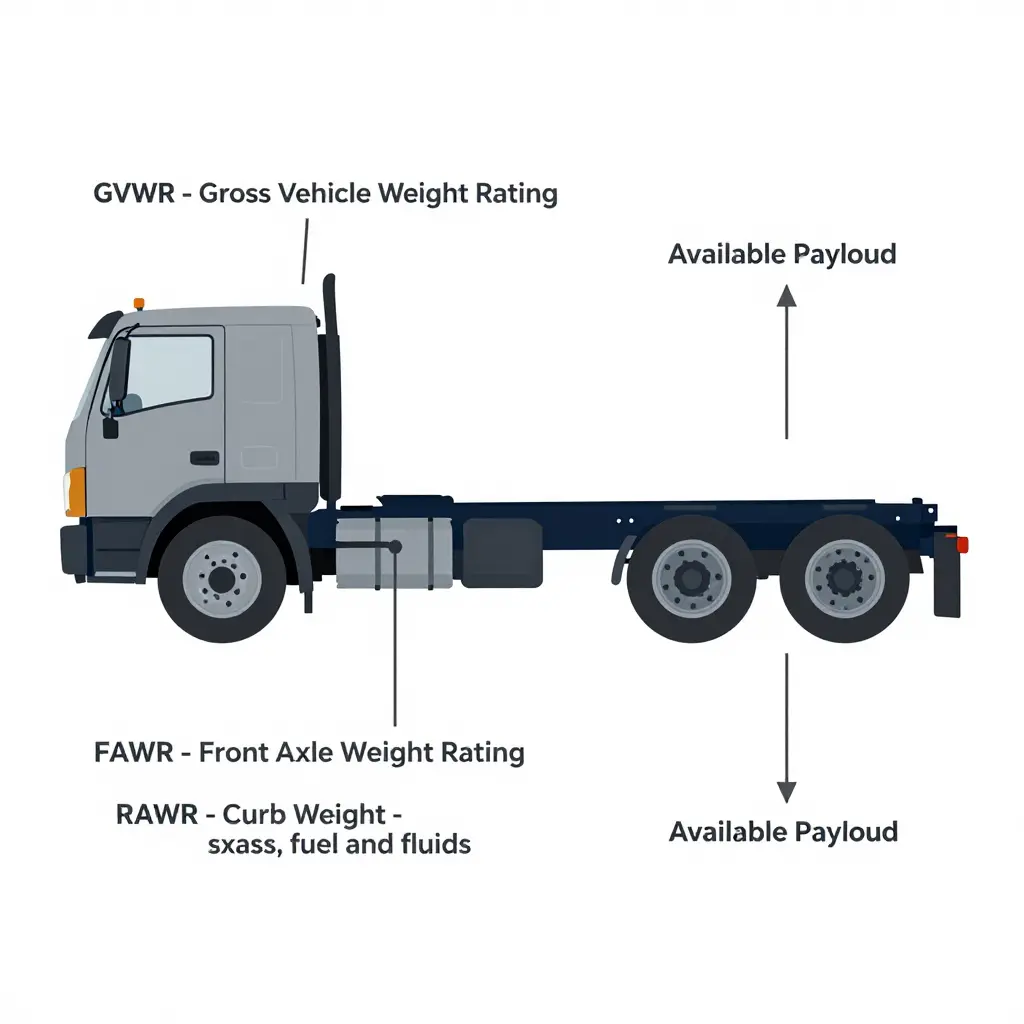
Gross Vehicle Weight Rating (GVWR) is the maximum total weight the completed vehicle is engineered and certified to carry: chassis, body, water, tools, crew, and fuel. The chassis manufacturer sets it; neither the upfitter nor the marketing department can raise it.
Curb weight (often called bare-chassis weight) is what the truck weighs with fluids and a full tank of fuel, before any body or equipment is added. It is the baseline you subtract from.
Front Axle Weight Rating (FAWR) and Rear Axle Weight Rating (RAWR) cap how much load each axle can legally carry. A build can stay under GVWR and still be over on one axle, which is the usual failure mode of front- or rear-heavy configurations.
How Available Payload Is Calculated
The equation is simple, but every term matters:
Available Payload = GVWR – Curb Weight – Body & Accessory Weight
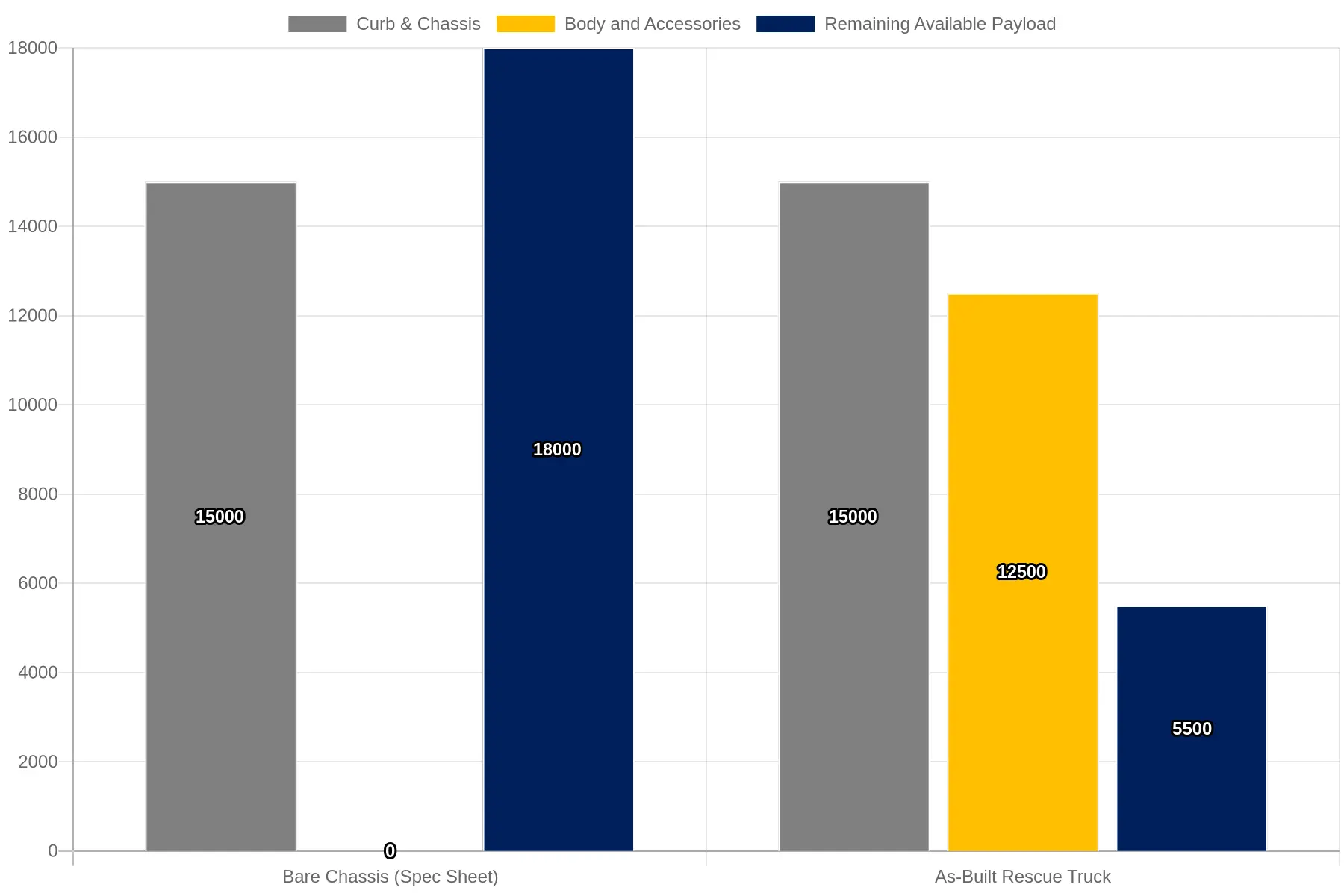
Picture a chassis with a 33,000 lb GVWR that weighs 15,000 lb bare. That leaves 18,000 lb of headroom. Add a 12,500 lb rescue body, tools, and accessories, and the real working margin is about 5,500 lb.
| Component | Weight (lb) |
|---|---|
| GVWR | 33,000 |
| – Curb weight (bare chassis) | 15,000 |
| – Body and accessories | 12,500 |
| = Available payload | 5,500 |
Why the Chassis, Not the Body, Sets the Limit
A rescue body can be styled to look unstoppable, but styling cannot raise the ceiling. GVWR and axle ratings are engineering limits stamped by the chassis maker and checked at the weigh scale. Exceed them and you risk voided warranties, denied insurance claims, and compromised braking and handling. When comparing rescue trucks for sale, start from the chassis rating and work backward. Rear-axle limits, in particular, determine where heavy equipment can be placed.
Why As-Built Weight Differs from the Spec Sheet
A bare-chassis spec sheet lists curb weight for a factory-standard configuration. A finished truck adds fluid tanks, pumps, cranes, compartments, and accessories, often hundreds of pounds each. Those items can consume several tons of payload, and upfit costs climb as soon as a build needs heavier axles or a larger chassis to stay legal. Treat the spec sheet as a starting point, then weigh the finished truck before trusting the margin.
Why Listing Photos and Marketing Imagery Mislead Buyers
When you compare rescue trucks for sale, the photo package is the least reliable document in the deal. A photographer is paid to make a rig look capable, clean, and ready; the scale and the axles will not agree.
Consider how the imagery is built:
- Lighting: Soft, evenly diffused studio light flattens the chassis silhouette. It hides rear-axle squat, soft spring packs, and the reinforced frame plating that signals real overloading.
- Camera angle: Three-quarter front shots are the industry favorite because they frame the cab while cropping the rear overhang, where a boom arm, counterweight, or recovery winch actually lives.
- Attached accessories: Cranes, winches, boom arms, water or foam tanks, and stowed recovery gear are photographed as features, never as mass. Each one adds fixed weight that consumes capacity the moment the truck leaves the lot.
The bigger trap is numeric. An advertised payload figure usually quotes the bare-chassis rating, the number stamped before the upfitter touched the truck. Bolt on tanks, cranes, bodies, and bracing, and usable capacity can fall by thousands of pounds without a word changing on the listing. Buyers who anchor to the headline number instead of the as-built configuration often discover the gap only after delivery.
Demand the front and rear gross axle ratings, then match them against the completed weight of each upfit item. Water tank placement alone can shift enough load onto the rear axle to rebalance the whole vehicle. Treat chassis payload ratings as the baseline, not the answer, and let the spec sheet rather than the photograph drive the purchase.
Chassis Payload vs. Typical Upfit Demand
Photos sell a chassis; the weight math decides whether the build stays on budget. The table below compares rated capacity with the mass a rescue or tow upfit typically adds: body, boom, winches, pump, water tank, tools, and crew. The number that matters is not the GVWR headline on the listing but the headroom left after curb weight and upfit mass meet on the same scale.
| Chassis Class | GVWR (lb) | Approx. Curb Weight (lb) | Available Payload (lb) | Typical Rescue/Tow Upfit Weight (lb) | Payload Headroom or Deficit |
|---|---|---|---|---|---|
| Class 5 | 19,500 | 11,200 | 8,300 | 9,500 | -1,200 (deficit) |
| Class 6 | 25,999 | 14,800 | 11,200 | 12,400 | -1,200 (deficit) |
| Class 7 | 33,000 | 19,500 | 13,500 | 13,200 | +300 (headroom) |
| Class 7 (tandem) | 33,000 | 21,000 | 12,000 | 13,000 | -1,000 (deficit) |
| Class 8 | 37,000 | 24,000 | 13,000 | 14,500 | -1,500 (deficit) |
| Class 8 (heavy tandem) | 54,000 | 31,000 | 23,000 | 18,000 | +5,000 (headroom) |
Caption: Headroom, not horsepower or glossy photography, is what keeps upfit costs predictable. A deficit of even a few hundred pounds forces axle, spring, or frame upgrades that routinely add five figures, while the low-volume upfit capacity delays that follow can stall delivery for months.
How Exceeding Chassis Payload Ratings Drives Upfit Costs Past Budget
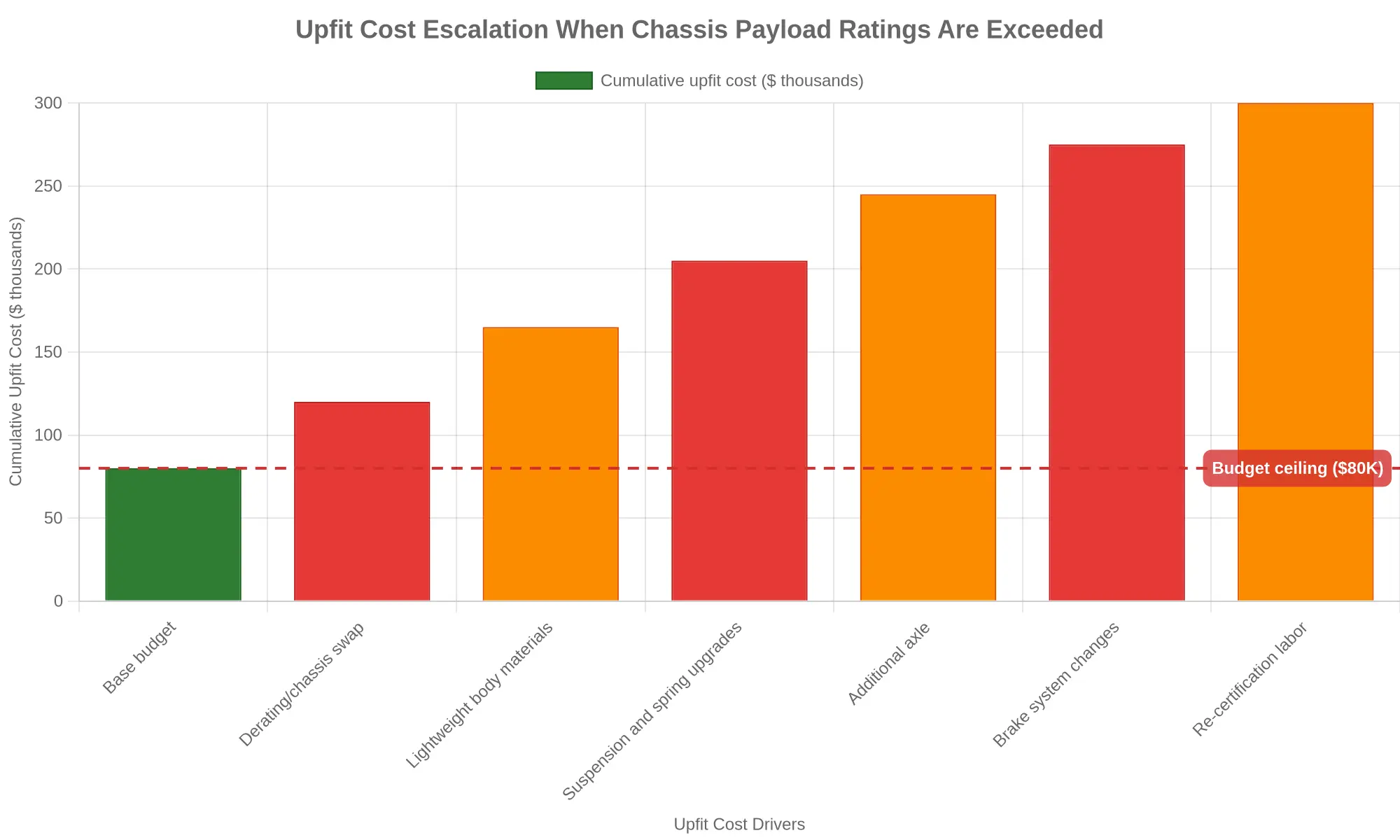
When a rescue truck spec creeps past the chassis manufacturer’s gross vehicle weight rating (GVWR) or gross axle weight ratings (GAWR), costs rise in a predictable sequence. These are the six items, in the order they usually hit.
1. Derating or chassis swap
The first option is to remove capability and regain margin. Derating a heavier chassis means paying for capacity you can never legally use. Swapping to a higher-GVWR platform resets procurement: new pricing, new lead times, a new drivetrain, and a fresh upfit design cycle. Either choice can move upfit costs by five figures before a single tool is mounted.
2. Lighter (but costlier) body materials
You shed weight by trading steel for aluminum or composite. Lighter materials cost more per pound, take longer to fabricate, and require different weld and fit labor. The savings in mass show up as expense in the shop.
3. Suspension and spring upgrades
Overload punishes leaf packs, shackles, and hangers. Upgrading springs, adding air suspension, or reinforcing mounts adds parts and labor, and it typically voids the OEM’s original ride tuning.
4. Additional axles
When weight cannot be legally distributed, engineers add an axle: a frame extension, driveshaft modifications, extra brakes and tires, a longer wheelbase, and reduced maneuverability in tight urban response lanes.
5. Brake system changes
A higher GVWR demands larger brakes, bigger reservoirs, and sometimes a full air system. Braking compliance cannot be skipped, and it is expensive.
6. Re-certification labor
Every structural change triggers an engineering review, weight tickets, and re-certification, with billable hours layered on top of parts.
| Cost driver | Engineering trigger | Procurement / TCO impact |
|---|---|---|
| Derating / chassis swap | GAWR or GVWR exceeded | New chassis pricing, longer lead time, resets upfit design |
| Lightweight body | Weight-reduction mandate | Higher cost per pound, slower fabrication |
| Suspension upgrades | Spring or hanger overload | Added parts and labor, voids OEM tuning |
| Additional axle | Weight cannot be distributed | Frame and driveshaft work, more tires and brakes |
| Brake changes | Higher GVWR rating | Larger brakes, bigger reservoirs, air system cost |
| Re-certification | Structural modification | Billable engineering and compliance hours |
What it means for procurement and TCO
Each fix raises the purchase price, and total cost of ownership takes a second hit: fuel economy drops as mass and axles are added, and maintenance intervals shorten on stressed components. Buyers comparing rescue trucks for sale should ask for the payload calculation before signing. The surest way to protect a budget is to verify chassis payload ratings against the intended build at the specification stage, before engineering change orders start stacking. Capacity shortfalls also create costly delays in brush fire truck manufacturing and upfit capacity.
Chassis Payload vs Typical Upfit Demand
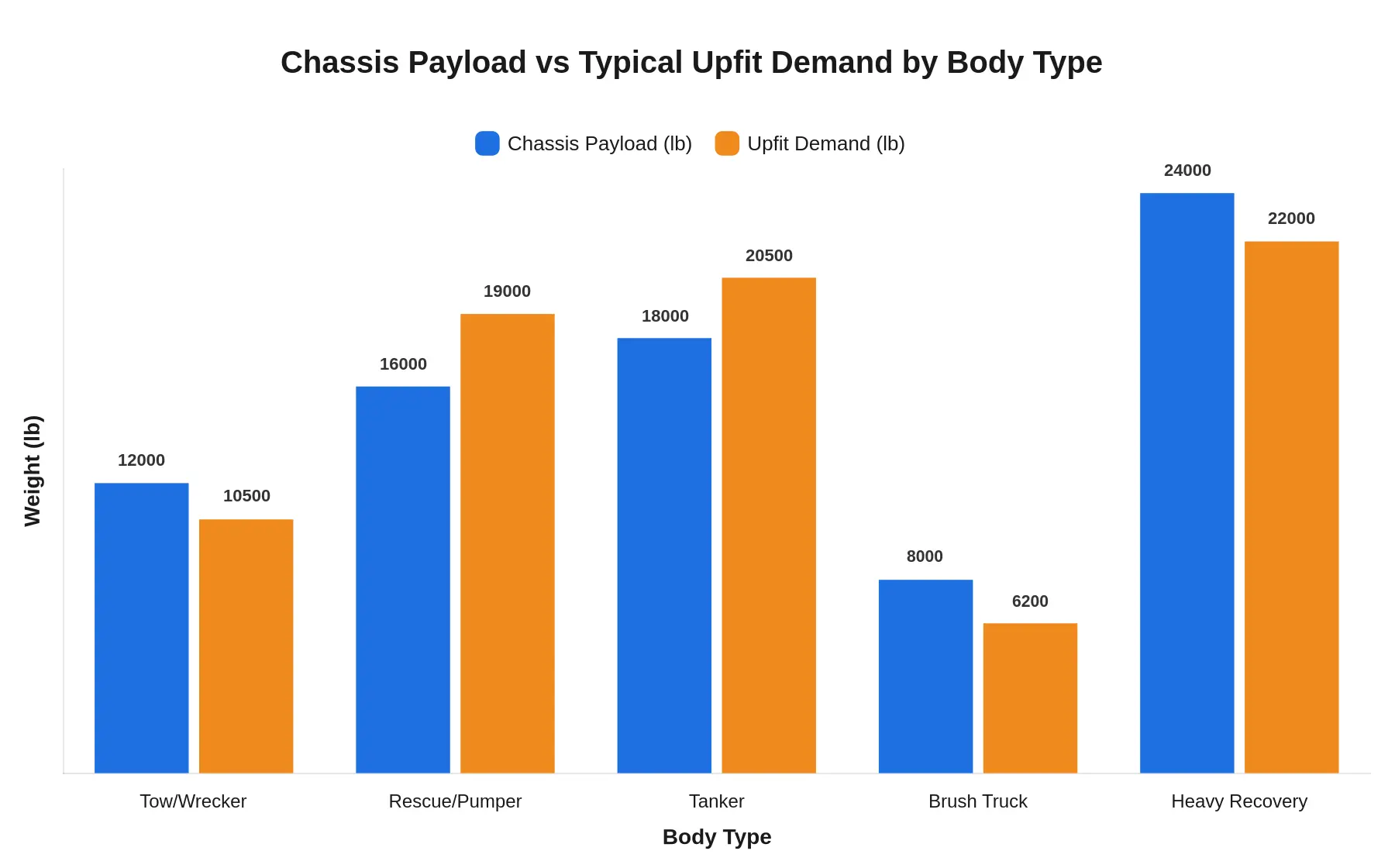
The chart plots available chassis payload against the weight an upfit typically adds for five common rescue and recovery configurations. Whenever the orange upfit-demand bar rises above the blue payload bar, the build carries a payload deficit, and that is where budgets blow past estimates.
Reading the Headroom
| Body Type | Chassis Payload (lb) | Upfit Demand (lb) | Headroom (lb) | Status |
|---|---|---|---|---|
| Tow/Wrecker | 12,000 | 10,500 | +1,500 | Positive |
| Rescue/Pumper | 16,000 | 19,000 | -3,000 | Deficit |
| Tanker | 18,000 | 20,500 | -2,500 | Deficit |
| Brush Truck | 8,000 | 6,200 | +1,800 | Positive |
| Heavy Recovery | 24,000 | 22,000 | +2,000 | Positive |
Tow/wreckers, brush trucks, and heavy recovery units generally sit inside their payload envelope because their upfits are comparatively light for the chassis rating. Rescue/pumpers and tankers are the trouble spots: water, pumps, and foam systems are heavy, dense, and mounted high, so they push an under-specified chassis into negative headroom.
When that deficit appears, upfitters compensate with derated rear axles, reinforced frames, or a larger chassis, and none of those costs show up in the listing photo. Buyers evaluating rescue trucks for sale should ask for the bare chassis payload and subtract the as-built body weight before signing. For more on tank placement and axle loading, see this guide to fire truck water tank placement and rear axle limits.
Pre-Purchase Payload Audit: Your Chassis Verification Checklist
Before signing off on any truck on your shortlist, treat chassis payload ratings as the deciding specification, not the listing photos. Work through this audit in order and write down every number.
Request the as-built weight ticket from the dealer or OEM. Ask for the factory scale slip showing front axle, rear axle, and total as-built curb weight. Do not rely on an estimated brochure figure.
Confirm front and rear axle ratings (GAWR) against the chassis data plate. Write down each gross axle weight rating and compare it with the as-built axle loads you just received. Anything close to the cap leaves no room for upfit.
Subtract every accessory weight before you picture the finished body. Crew, tools, winch, lighting, pump, and onboard water all eat into the remaining payload, so account for each explicitly.
Verify body weight against remaining payload. Add the proposed body, equipment, and fluids to the as-built weight. The total must stay under GVWR with a safety margin, not scrape it. How tank placement stresses the rear axle matters here, so review the guidance on axle limits before approving a layout.
Check tire and wheel load ratings. Each tire’s load index and each wheel’s capacity must cover the fully loaded axle, including dynamic and cornering forces. Mismatched tires and wheels are a hidden failure point.
Confirm in-service weight on a certified scale. Weigh the completed unit at a public scale with a full tank, crew, and gear, then keep the ticket. A certified slip is your proof of compliance and your defense in an overload dispute.
Axle Ratings, Weight Distribution, and Center-of-Gravity Effects
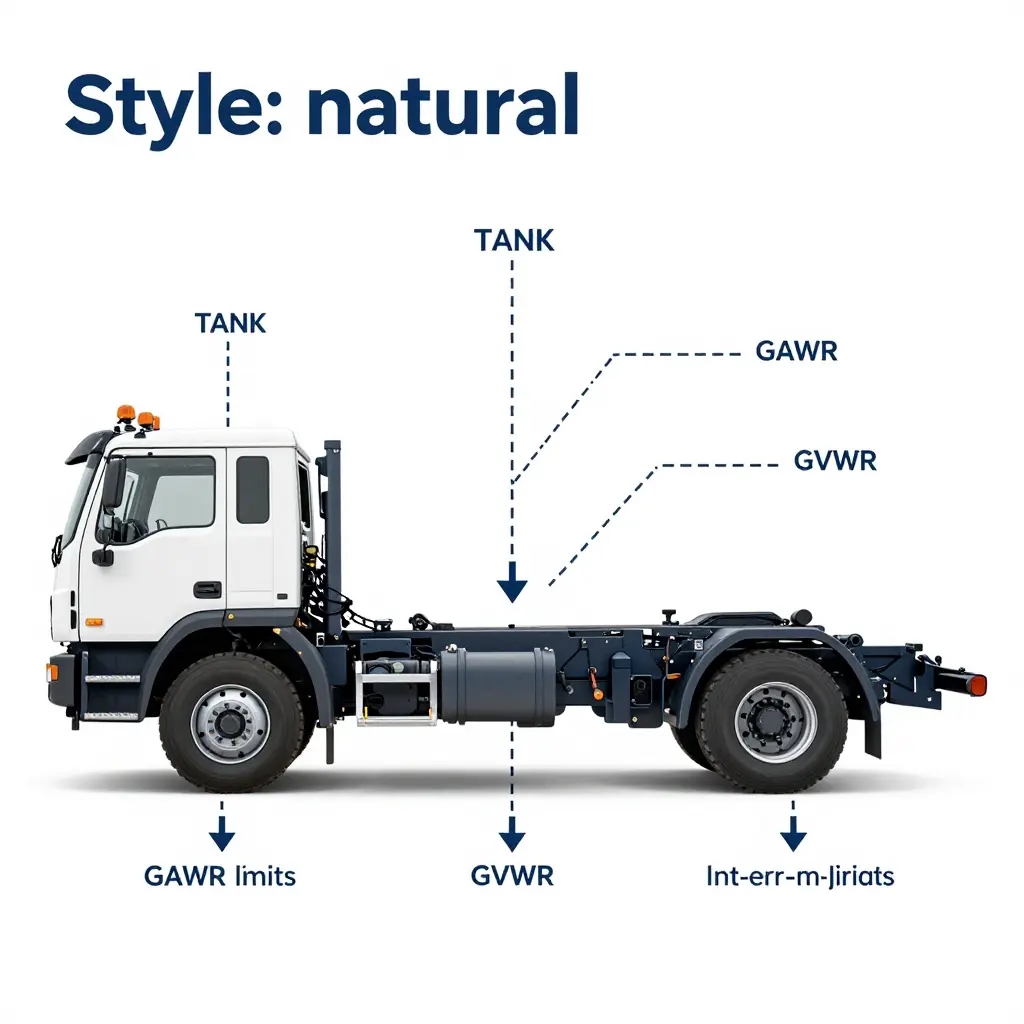
A chassis payload rating is not a single number pulled from thin air. It comes from the axle ratings, the gross vehicle weight rating (GVWR), and the geometry of how weight is stacked on the frame. Buyers who shop listing photos first and spec sheets second are the ones who watch upfit costs spiral after delivery, because the truck cannot legally or safely carry what the marketing image implied.
Axle Ratings Set the Hard Ceiling
Every axle carries a gross axle weight rating (GAWR): the maximum load its springs, brakes, bearings, wheels, and tires are engineered to support. Add the front and rear GAWR and you approach the chassis payload ratings envelope. A truck can sit comfortably under GVWR and still overload a single axle, which voids the warranty and creates a genuine handling hazard.
Weight Distribution Moves the Load
Weight does not stay where you bolt it. It distributes between the axles according to its distance from the center of gravity. A tool locker mounted far forward loads the steering axle; a rear-mounted tank loads the drive axle. Rear-axle limits are the binding constraint on tank, crane, and boom placement, which is why pump ratings and weight balance on steep terrain are engineered together rather than chosen independently. Move a crane boom aft to clear a body compartment and the rear axle can pass its rating without a single pound of total payload being added.
Center of Gravity Is the Hidden Variable
Horizontal center of gravity sets the front/rear load split; vertical center of gravity governs roll stability and braking behavior. Raise a heavy component, such as a tall tank or a raised boom rest, and you elevate the CG, robbing the truck of cornering margin. Lower, more central placement is almost always worth the fabrication cost.
Front-Axle Limits Matter Just as Much
Plows, winches, and heavy front-mounted equipment all sit ahead of the steering axle, and their moment arm is long. A modest winch can add hundreds of pounds of effective front-axle load once bumper, bracket, and cable weight are counted. Exceed the front GAWR and steering feel, tire wear, and braking distance all degrade, often before the truck looks visibly overloaded.
Why This Drives Upfit Cost
For buyers the lesson is straightforward: verify front and rear GAWR, compute the actual loaded distribution, and confirm the center of gravity before committing to a body, tank, or crane. When the numbers work early, upfit costs stay predictable. When they do not, the fix is a bigger chassis, a repositioned component, or both, and that money does not come back.
How Axle Weight Distribution Actually Works
Payload ratings make more sense once you can picture where the weight lands. The schematic below reduces a rescue truck to its essentials: a horizontal datum line for the ground and two load arrows rising from the axle positions. Each arrow’s length reflects the vertical load at that axle, and the distance between them is the wheelbase.
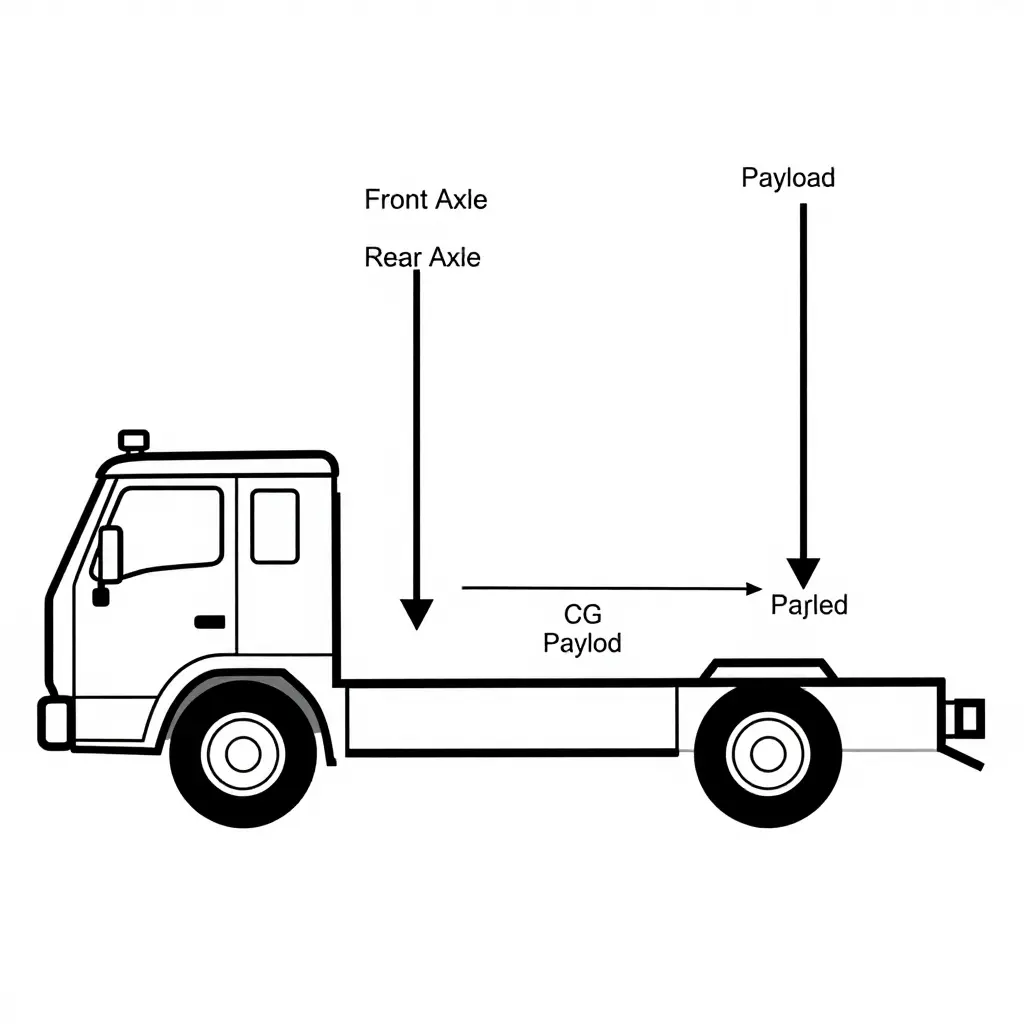
Reading the diagram
- The datum line is the reference plane; all loads are measured relative to it.
- The rear axle arrow is longer in most rescue and tow configurations because the body, tank, pump, and equipment sit behind the cab.
- The center of gravity (CG) marks the balance point where the combined load acts. Move it rearward and the front axle unloads while the rear axle approaches its limit.
- The wheelbase sets how much leverage the payload has; a short wheelbase shifts weight between axles faster than a long one.
That is how a listing photo can show a spotless, fully loaded rig while the build sheet hides a rear axle already at its ceiling. Before any upfit, weigh the empty chassis per axle, subtract that from each axle’s rating, and compare the remainder with the planned body and equipment. For more on how rear-axle loading governs tank and body placement, see this guide to fire truck water tank placement and rear axle limits.
FAQ: Payload and Upfit Budget Questions
Does a higher GVWR always mean more usable payload?
No. Usable payload is gross vehicle weight rating (GVWR) minus the completed curb weight, so a chassis with a higher GVWR but a heavier base configuration can deliver less real capacity. When you shop rescue trucks for sale, ask for the actual scale weight of the finished build instead of trusting the headline number.
Why do listing photos not reveal payload limits?
Photographs document bodywork, lighting, and paint, but they cannot show frame section modulus, spring ratings, or tare weight, the factors that define remaining capacity. Two trucks that look identical online often carry very different chassis payload ratings because of their rear-axle spec and suspension package.
How do I calculate real upfit headroom?
Subtract the finished curb weight (chassis plus body plus fluids) from the GVWR, then confirm that no single axle exceeds its own rating. Weigh each axle separately, because a balanced total can still hide an overloaded rear axle. See this guide to rear-axle limits and how they cap capacity.
What happens if upfit weight exceeds the chassis rating?
Overloading pushes axles, brakes, tires, and frame rails past their design limits, which voids warranties and can make the truck unsafe to operate. It also inflates upfit costs later, because you may have to add suspension upgrades or strip equipment just to register the vehicle legally.
Can chassis payload ratings be legally increased after upfit?
Only within strict limits, and rarely after the build is finished. Manufacturers may offer a higher GVWR option on the original order, but post-build re-rating requires engineering review, updated certification labels, and compliance with federal axle and brake standards, a slow and expensive process most buyers should avoid.
The Rating Sheet Beats the Photo Gallery Every Time
No listing photo ever wrote a check for an over-capacity upfit. Chassis payload ratings, the difference between gross vehicle weight rating (GVWR) and curb weight, set the hard ceiling on what a rescue truck can legally and safely carry. Every tank, winch, boom, tool locker, and crew member competes for the same finite margin. Ignore that margin and the upfit invoice is only the first bill; frame stress, brake overloading, and premature axle wear follow close behind.
Before committing to any rescue truck, run this verification routine:
- Request the actual GVWR and curb weight from the chassis VIN, not the advertised number.
- Subtract required body, equipment, and fluid loads to find the true usable payload.
- Confirm axle ratings separately; a compliant GVWR can still hide an overloaded rear axle.
- Inspect the frame and mounting points for the geometry your intended body demands.
- Document everything in writing before signing a purchase order.
The same discipline applies across the used-truck market; hook-lift truck cost drivers and used-unit checks show how payload math ripples through an entire procurement budget.
Why This Is a Partner Problem, Not Just a Buyer Problem
Payload-aware upfitting is where a capable manufacturing and integration partner earns its keep. CRRC is a state-owned mixed-reform enterprise founded in 2016 and headquartered in Suzhou. It reports nearly 50 billion yuan in assets and nearly 10,000 employees across five sectors, including smart manufacturing, new energy vehicles, and agricultural machinery. For fleet buyers, that breadth translates into payload engineering, chassis-body matching, and lifecycle fleet support that keep an upfit inside its weight and cost envelope.
The Decisive Recommendation
Start with the rating sheet, not the listing photo. Run the payload math and collect documentation before the deposit clears. If the numbers do not balance on paper, they will not balance on the road, and no amount of marketing will cover the difference. Choose a chassis whose payload genuinely fits the mission, pair it with a partner who engineers to that limit, and the upfit budget will hold.