

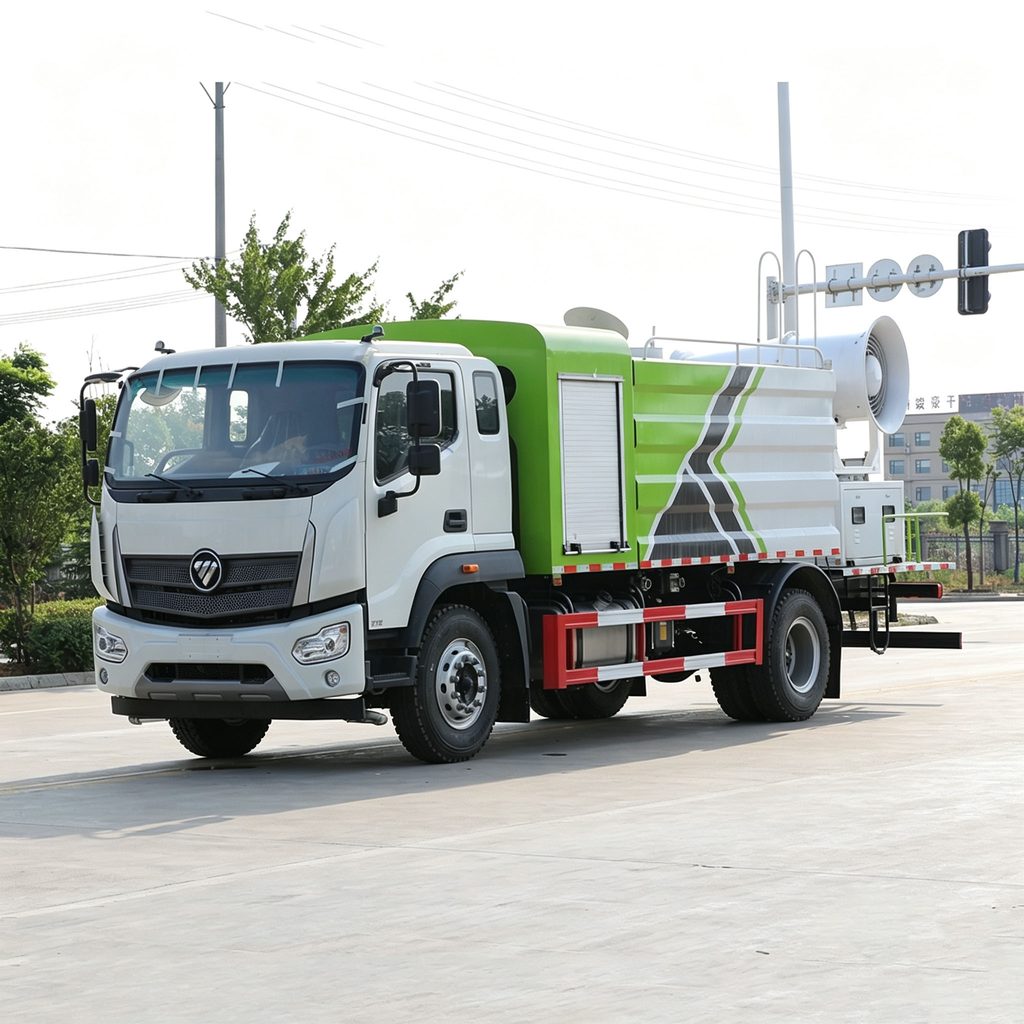
How to Choose a fog cannon truck?
Buying a fog cannon truck is not simply about finding the lowest price or the largest water tank.
Where the truck will operate, the type of dust to be controlled, daily operating hours, and required spray distance determine which dust suppression truck configuration is suitable.
A truck designed for a small construction site may be a poor fit for an open-pit mine. Likewise, a large mining truck can be unnecessarily expensive and difficult to operate on narrow municipal roads.
Beyond the truck itself, buyers should also consider chassis compliance, local road regulations, spare parts availability, export documentation, and after-sales support.
This guide covers the key specifications, operating conditions, and supplier considerations to review before purchasing a dust suppression truck.
What type of fog cannon truck do you actually need?
The first question should be considered is the dust source, not the truck.
A conventional water sprinkler system mainly wets roads and exposed surfaces. A fog cannon projects fine droplets toward airborne dust or a specific dust-generating area. These are different jobs.
For example:
Construction access roads: a rear spray bar or sprinkler system may be sufficient.
Mining haul roads: prioritize water capacity, spray coverage, chassis durability, and refill efficiency.
Demolition sites: a directional fog cannon can be useful for airborne dust around the demolition zone.
Stockpiles and material yards: longer-range directional spraying may be more useful than conventional road nozzles.
Urban or narrow roads: compact dimensions and maneuverability can matter more than maximum spray range.
A fog cannon is not automatically the better option. If you mainly use the truck to wet unpaved haul roads, a large fog cannon may cost more than necessary. Water trucks are widely used for haul-road dust control, but their effectiveness depends on traffic, road material, weather, and repeated application.
How much water tank capacity should a dust suppression truck have?
Tank capacity should be calculated from water consumption and refill logistics, not simply from site area.
As a simple guide, tank capacity should match the amount of water used between refills. But there is another variable: the distance to the water source.
A 5 m³ truck may be enough for a small construction site with easy access to water. For remote mining sites, a larger tank can reduce the number of trips to refill.
Typical configurations can be broadly considered as follows:
| Operating condition | Possible tank range | Main consideration |
| Small construction or municipal work | Around 3–5 m³ | Maneuverability and frequent refill access |
| Medium construction and road work | Around 8–12 m³ | Balance capacity and vehicle size |
| Mining, quarrying and large earthwork | Around 15–20 m³ or more | Refill distance, payload and duty cycle |
These are general guidelines. Dust suppression trucks come in different tank sizes, including models with capacities of about 10 to 30 m³.
Keep in mind that water is heavy. Every 1,000 liters of water weighs about 1 ton. The total vehicle weight will be higher after adding the tank, pump, equipment, driver, and fuel.
So a larger tank is only useful if the chassis, axle loads, braking system, road conditions, and local weight regulations can support it.
What spray range is enough for your worksite?
Spray range is one of the first numbers we will notice. But it should not be the only one.
A manufacturer may advertise a maximum throw distance of 60, 100, or even more than 120 meters. Actual performance can change with wind, humidity, nozzle configuration, pump output, and fan power. Some commercial equipment specifications explicitly state that actual throw distance depends on weather conditions.
Consider the actual working area. If the truck can park 20 to 30 meters from the dust source, you may not need a very long-range fog cannon. If the truck needs to stay farther away from the dust source, a longer-range cannon can be useful. For large stockpiles, quarries, demolition sites, and open yards, good spray coverage may be more important than simply choosing a larger water tank.
When comparing suppliers, ask how far the fog cannon can spray in normal working conditions, not just its maximum range. Also ask how the range was tested. Wind, temperature, and humidity can affect the spray distance. Two fog cannons rated for 100 meters may perform differently in actual use.
What pump flow rate and pressure should you specify?
Pump specifications can look confusing because suppliers may quote pressure, flow rate, or both. They answer different questions.
Pressure shows how strongly the pump pushes water through the spray system.
Flow rate shows how much water the system sprays per minute.
Water consumption shows how quickly the tank will run out of water.
For example, a current commercial dust suppression configuration may specify pump pressure around 1.0 to 3.0 MPa, while the fog cannon and low-pressure spray systems may have different flow requirements.
Do not automatically choose the highest-pressure pump. For road watering, too much pressure can waste water and create a spray pattern that is not suitable for the job. Mining dust-control systems may need higher water flow instead. For atomized misting, the pump, nozzles, fan, and droplet size should be considered together.
Ask the supplier how the pump performs at different flow rates, rather than looking at just one pressure number.
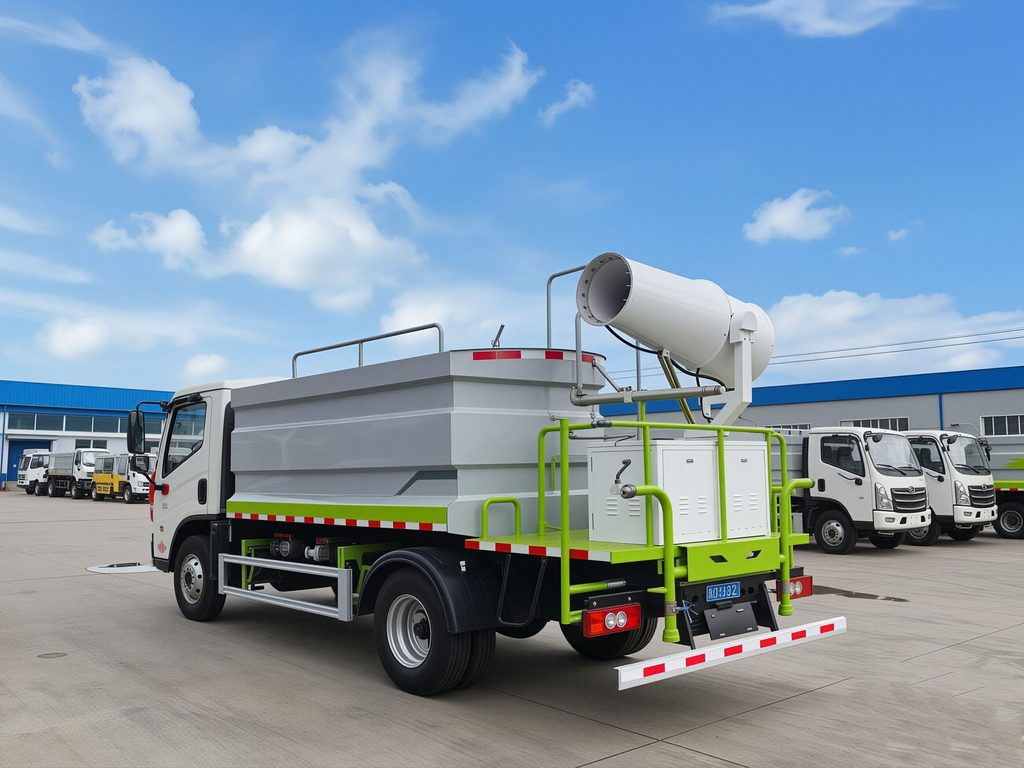
How should choose the chassis and payload?
The chassis must be strong enough to carry and operate the equipment safely. For paved roads, a standard road chassis may be enough. Mining and quarry sites need more. Rough roads, steep slopes, heavy loads, and long working hours require a stronger chassis, suspension, drive train, tires, and brakes.
You should check: the gross vehicle weight, rated payload, axle capacity, wheelbase, ground clearance, engine torque, transmission, suspension, brake system, and tire specifications.
Do not choose the tank size first and check the payload later. The tank, water, pump, cannon, and other equipment all add weight. Make sure the fully loaded truck stays within legal weight and technical limits.
What vehicle and emission requirements apply in your country?
A truck may meet the manufacturer’s requirements but still fail to meet local rules.
Before ordering, check the local requirements for:
• Emissions
• Vehicle registration
• Gross vehicle weight and axle loads
• Driver license
• Left-hand or right-hand drive
• Lighting and safety equipment
• Import and customs documents
Give the supplier the destination country and intended use before choosing the chassis. This helps the manufacturer prepare the right vehicle and documents before production.
Do you need a fog cannon, a sprinkler system, or both?
This is an important purchasing decision.
A conventional sprinkler system is best suited for haul roads, construction access roads, municipal streets, open areas, and general road watering. Its main purpose is to put water directly where dust is generated.
A fog cannon is better suited for demolition areas, stockpiles, quarries, material yards, and transfer areas where airborne dust is concentrated. It sprays fine water droplets toward the dust source.
A truck can use both systems when the project needs road watering and airborne dust control. However, combined equipment adds weight, water use, power needs, and system complexity. Make sure the pump, PTO, tank, power system, and controls can handle the complete setup.
What tank material and construction should you specify?
Tank construction is easy to overlook when comparing quotes, but it is important.
Common materials include carbon steel and stainless steel. Carbon steel is usually more affordable, while stainless steel offers better corrosion resistance.
The right choice depends on the water quality, climate, coastal exposure, chemical conditions, maintenance, and expected service life.
Also check the tank structure, including wall thickness, reinforcement, anti-surge baffles, weld quality, drainage, manhole design, and corrosion protection.
For larger tanks, internal baffles help reduce water movement and improve vehicle stability.
Do not judge a tank by its nominal capacity alone.
Which control functions are actually worth paying for?
A basic dust suppression truck does not need a complicated control system.
For small jobs, manual control may be enough. For larger sites, remote or automatic control can make operation easier.
Useful functions include pump and fan control, spray direction and angle adjustment, water-level monitoring, low-water protection, fault alarms, remote control, and automatic spray cycles.
Sensor-based control can also be useful when the site already has dust monitoring systems.
Choose automation based on actual needs. There is little benefit in paying for complex controls if the truck is only used for a few hours each week on a small site.
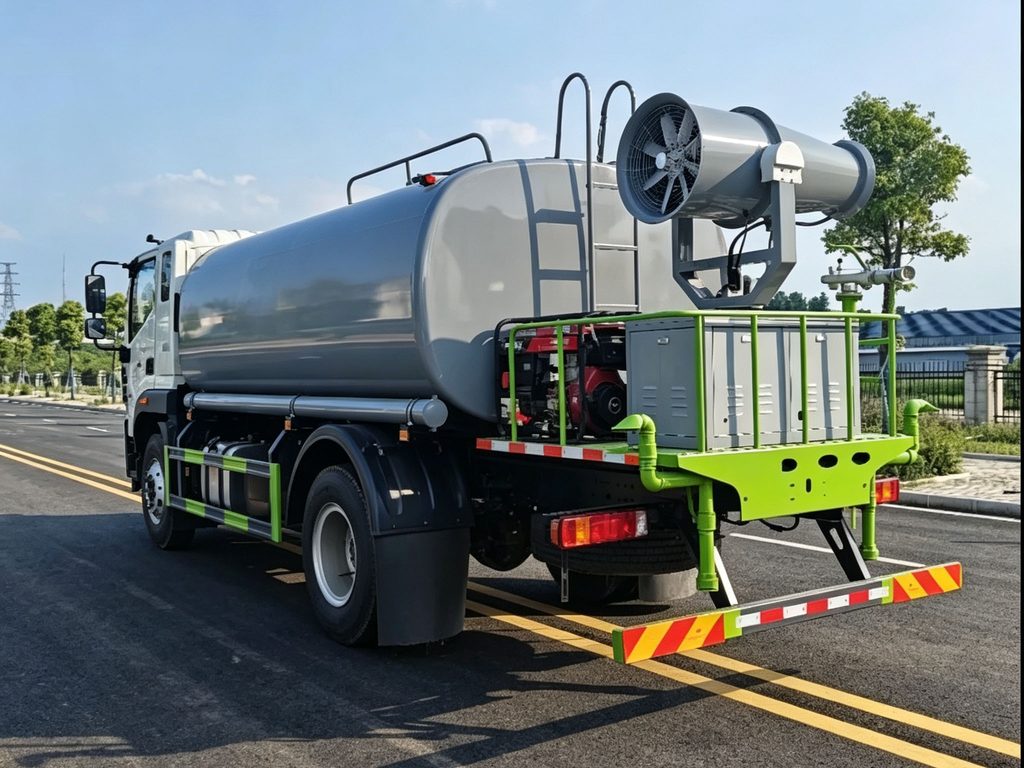
How can you verify a dust suppression truck before buying?
The following checklist can be used as a reference when inspecting a dust suppression truck.
Water System
☐Pump starts smoothly
☐ No abnormal vibration or noise
☐ Stable water pressure
☐ No pipe or hose leaks
Spray System
☐ Actual spray distance meets the requirement ☐ Spray pattern is suitable for the job
☐ Water coverage is even
☐ Horizontal rotation works properly
☐ Vertical adjustment works properly
☐ Nozzles spray evenly
Vehicle
☐ Steering works properly
☐ Brakes work properly
☐ Suspension is suitable for the working conditions
☐ PTO engages properly
☐ Tank remains stable when loaded
☐ Fully loaded vehicle weight is within the required limit
Control System
☐ Remote control responds properly
☐ Water-level alarm works
☐ Emergency stop works
☐ Fault alarms work properly
Field Test
☐ Record spray distance under normal working conditions
☐ Check performance at the expected wind speed
☐ Record temperature and humidity when relevant
☐ Do not rely only on the maximum spray distance claimed by the supplier
How should you compare dust suppression truck manufacturers?
Once the technical requirements are clear, compare manufacturers on more than price.
A useful supplier checklist includes:
| Supplier factor | What to verify |
| Manufacturing capability | Factory, production capacity and quality-control process |
| Technical support | Engineering and configuration support |
| Documentation | Drawings, specifications and test records |
| Chassis options | Available brands and destination compatibility |
| Customization | Tank, pump, cannon and spray layout |
| Spare parts | Availability and lead time |
| Warranty | Coverage and claim process |
| After-sales service | Remote and local support |
| Export experience | Destination-country documentation |
| Reference projects | Similar applications and operating conditions |
Spare-parts availability is also important.
A low-cost truck can become expensive if key parts such as pump seals, nozzles, valves, controllers, or PTO components take weeks to replace.
Ask the supplier which parts are standard or customized and how quickly replacement parts can be supplied.
What information should you send when requesting a quotation?
A vague inquiry such as:“Please send me the price of a dust suppression truck.”usually produces a vague quotation.
A better RFQ should include:
1. Destination country
This helps the supplier identify chassis, emission, drive-side, and documentation requirements.
2. Application
For example: Mining,Quarrying, Construction,Demolition, Municipal road maintenance, Stockpile dust suppression
3. Working area
Provide approximate site size, road width, or route length.
4. Operating hours
State the expected daily working time.
5. Water source
Give the approximate distance to the refill point.
6. Required spray system
Specify whether you need: Rear spray bar, Front spray, Side spray, Fog cannon, Combined system
7. Required spray range
If known, provide the target distance.
8. Chassis requirements
Include preferred brand, drive configuration, fuel type, or local registration requirements if applicable.
With this information, suppliers can propose a configuration rather than simply sending a standard catalog model.
What should be included in the purchase contract?
Do not leave important specifications only in emails or sales discussions.
Include the agreed requirements in the quotation, purchase contract, or technical appendix.
Key items should include tank capacity, usable capacity, pump model, flow rate, pressure, spray range and angles, water consumption, cannon configuration, chassis model, GVW and payload, emissions, control functions, warranty, spare parts, and inspection requirements.
Most importantly, clearly define how performance will be tested and accepted.
For example, instead of simply stating “spray range: 100 m,” specify the test conditions and acceptance method.
This makes supplier comparisons easier and helps avoid disputes during delivery inspection.
Dust Suppression Truck Buying Checklist
Before approving a purchase, check the following:
Application
• ☐ What is the main dust source?
• ☐ Is the truck mainly for road watering or airborne dust control?
• ☐ What is the site size?
• ☐ How many hours will the truck operate each day?
• ☐ How far is the nearest water refill point?
Water System
• ☐ Is the tank capacity matched to water consumption?
• ☐ Is the usable capacity clearly stated?
• ☐ Is the tank suitable for the local climate and water quality?
• ☐ Are anti-surge baffles included?
Spray System
• ☐ Is the spray range suitable for the job?
• ☐ Are flow rate and pressure clearly specified?
• ☐ Is droplet-size information available?
• ☐ Is the spray pattern suitable for the target area?
Chassis
• ☐ Is the payload sufficient when fully loaded?
• ☐ Are axle loads within local limits?
• ☐ Is the chassis suitable for road or off-road use?
• ☐ Does it meet local emission and registration requirements?
Controls
• ☐ Is manual control enough for the job?
• ☐ Is remote control needed?
• ☐ Is low-water protection included?
• ☐ Are automatic functions useful for the project?
Supplier
• ☐ Can the supplier provide complete technical documents?
• ☐ Can the truck be inspected or tested before delivery?
• ☐ Are spare parts readily available?
• ☐ Are warranty terms clearly defined?
• ☐ Is after-sales support available in the target market?
The right dust suppression truck is the one that fits the actual operating cycle.
Start with the dust source. Then work through water consumption, refill distance, spray coverage, chassis capacity, local regulations, and maintenance requirements.
Do not select a truck simply because it has the largest tank or longest advertised spray range.
For overseas procurement, a reliable quotation should clearly show the chassis, tank, pump, spray system, control functions, compliance documents, and after-sales terms. If the standard configuration does not match your site, a reputable manufacturer should be able to discuss practical adjustments rather than forcing the project into a catalog model.
If you already know your destination country, application, required tank capacity, spray distance, and daily operating hours, you can share those details with a qualified manufacturer. This makes it much easier to compare suitable configurations and obtain a quotation that reflects your actual project needs.
Final Thoughts
Choosing a dust suppression truck is not simply about finding the lowest price or the largest water tank. The right truck should match your dust-control needs, site conditions, water supply, spray requirements, and local vehicle regulations.
Before making a purchase, compare suppliers based on product specifications, testing results, manufacturing experience, spare-parts availability, warranty terms, and after-sales support—not just the quotation price.
Manufacturers such as CRRC VEHICLES can provide different dust suppression truck configurations for construction sites, roads, industrial areas, quarries, and other applications. By discussing your working conditions and requirements with the supplier in advance, you can choose a configuration that fits the job and avoid unnecessary equipment or costs.