

Hook lift frame geometry and container limits
How chassis dimensions and hook arm capacity decide which container your truck can actually carry
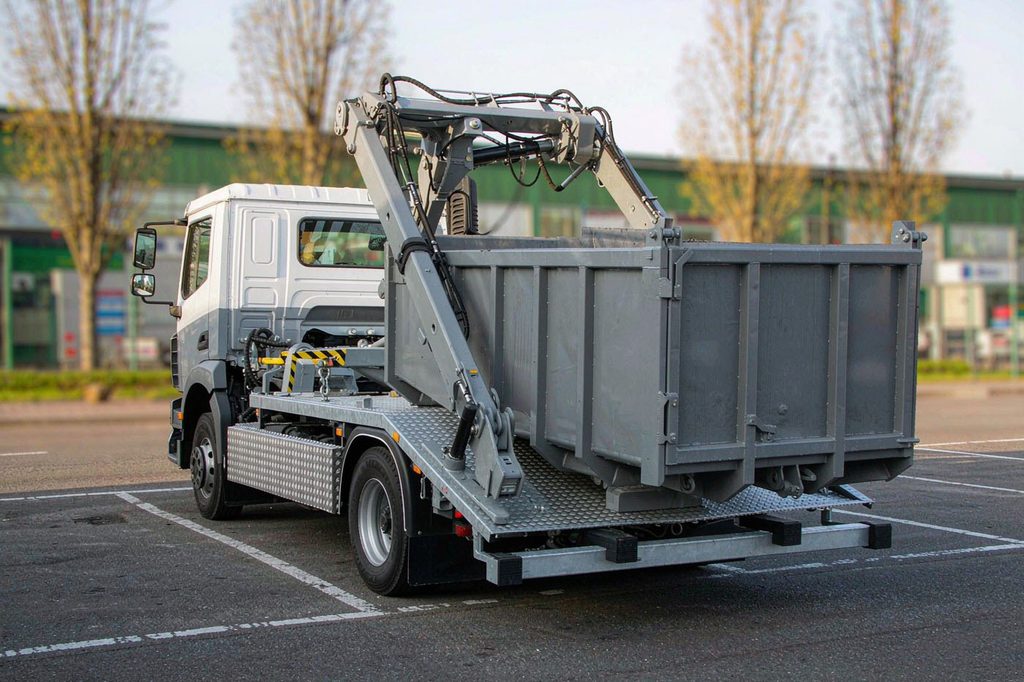
A hook lift truck looks like a simple machine. A hydraulic arm sits on a chassis, reaches out, hooks a container, drags it on board, tips it up, and sets it back down. What decides whether that truck earns its keep over ten years is not the headline lifting number on the brochure, it is how well the hook arm geometry matches the chassis it is bolted to. Buy on “how many tons can it lift” alone and the problems show up later, on the job: the arm cannot reach a container sitting on the ground, the rear axle is overloaded, the container will not seat in the rails.
This piece walks through the geometry that matters, what rated capacity actually means, and where the hard limits on container matching sit. It is written for municipal procurement teams, sanitation and fire service administrators, construction contractors, fleet managers who run their own special-purpose vehicles, and the maintenance leads who inherit whatever gets bought. CRRC Vehicles tracks technology and market developments across rail transit, smart mobility, new energy vehicles and special-purpose vehicles, and the parameter conventions below follow standard industry engineering practice.
How the hook lift mechanism actually works
A complete hook lift system is made up of the main hook arm, a telescopic section on some models, the hydraulic cylinders, the rear locking mechanism, the chassis rails and the container’s hook bar. The working cycle breaks down into three movements, and each one loads the chassis in a different way.
The three movements in one cycle
- Hooking: the arm extends and catches the hook bar at the front of the container. The locking mechanism confirms engagement before the hydraulics start to load up.
- Loading: the arm retracts and the container slides along the chassis rails into position. Vehicle centre of gravity moves forward during this phase, and rear axle load peaks here.
- Tipping and discharge: the rear lock releases, the arm raises the tail of the container and the load slides out under gravity. Setting the container back down runs the same sequence in reverse.
The loading phase is what tests the chassis side rails in bending and the strength of the rear lock, because the full weight of the container transfers onto the rear of the frame in a matter of seconds. The tipping phase tests the cylinder force curve and the torsional stiffness of the rear frame section. Two trucks with the same rated capacity can have very different long-term failure rates if their side rail specification differs.
Chassis geometry: wheelbase, rear overhang and arm reach
A longer chassis is not automatically a better one. Wheelbase determines where the combined centre of gravity sits once the container is on board. Rear overhang determines whether the arm can reach a container standing on the ground during the hooking phase. The height of the chassis top surface sets the ceiling on tipping angle. These three dimensions pull against each other: stretch the rear overhang and the arm has to travel further, which raises the moment the frame has to resist when tipping.
| Parameter | Typical range | What to check at specification stage |
|---|---|---|
| Hook lift rated capacity | 3 – 30 t | Must cover container tare weight plus full payload, with margin left over |
| Container length | 3.0 – 7.5 m | Limited by both arm travel and usable chassis length, take whichever is shorter |
| Maximum tipping angle | 40 – 52 deg | A steeper angle suits high-tip discharge but demands more torsional stiffness at the rear |
| Wheelbase | 3.8 – 6.5 m | Long wheelbase improves straight-line stability at the cost of turning radius |
| Hydraulic system pressure | 20 – 30 MPa | Higher pressure cycles faster, at the cost of seal life and heat rejection |
| Rear axle capacity | 8 – 16 t | Frequently the first limit you hit, and the easiest one to overlook |
| Container rail width | 1060 / 1080 mm | Must match the container’s cross members and hook bar, the two standards do not interchange |
Those figures are common market ranges and individual manufacturers vary. The check that actually matters is this: take the heaviest loaded container you intend to run and push it through three limits, hook arm rated capacity, rear axle capacity and gross vehicle weight. One of them will cap out first. In most real specifications that limit is the rear axle or the legal gross weight, not the hook arm.
Rated capacity is not payload
The most common misreading is treating hook lift rated capacity as “how many tons of waste can I carry”. Rated capacity is the total weight the arm can safely lift in its standard attitude, and that figure already includes the container itself. A 12 cubic metre steel container typically weighs between 1.8 and 2.6 tonnes empty, so specifying the arm against payload weight alone puts you at the ceiling on day one.
The second thing people miss is that capacity changes with geometry. What the arm can lift near horizontal is not what it can lift at full tip, and the maximum printed in a sales brochure is normally measured in the most favourable position the manufacturer could find.
Rated capacity and typical container volume by hook lift class
The classes in that chart are industry convention rather than a regulated standard. A more reliable approach is to ask the supplier for the lifting curve at several fixed tipping angles instead of a single peak number. For fleet orders, writing that curve into the technical specification protects you far better than a line reading “rated capacity no less than X tonnes”.
A sensible order for specification
Work through the list in this order. Reverse it and you will end up re-specifying:
- Start with the container: external dimensions, gross weight, hook bar type, rail width, and whether discharge is by tail tilt or rear door.
- Then the arm: rated capacity must cover container tare plus full payload with roughly 20 percent margin, and the tipping angle has to clear your discharge point height.
- Then the chassis: rear axle capacity, wheelbase, gross vehicle weight against local regulations, and sightlines from the cab to the hook controls.
- Then hydraulics and PTO: system pressure, pump flow, tank volume, and oil temperature control under continuous cycling.
- Then the working environment: ground bearing and gradient at the discharge point, minimum turning radius on site, cycles per day, and whether night operation needs a low-noise package.
- Only then price and lead time. Turn the five items above into a technical specification and go to tender on that.
Pick the chassis first and go looking for containers afterwards, and one of two things happens. Either the containers run half empty and you waste capacity, or the arm never works near its rating and you paid for capability you cannot use. Put the container first and the rest of the decisions narrow down on their own.
Frequently asked questions
How large a container can a hook lift truck handle?
Whichever is shorter, arm travel or usable chassis length. Light trucks usually run 3.0 to 4.5 metre containers, medium trucks 4.5 to 6.0 metres, heavy trucks 6.0 to 7.5 metres. A container much longer than the rear overhang will sit out of reach during hooking, which means repositioning the truck to line up and a clear loss of cycle efficiency.
Is a higher rated capacity always better?
No. A bigger arm weighs more, costs more to buy, and pushes fuel consumption up. If the truck spends its life at half load, the extra capacity is money spent for nothing. Specifying to roughly 1.2 times your heaviest duty cycle usually leaves enough headroom without wasting the budget.
Can containers from different manufacturers be mixed?
It depends on hook bar dimensions and rail width. The 1060 mm and 1080 mm rail widths common in the market do not interchange, and a hook bar height difference of more than 20 mm can stop the arm seating properly, which risks the container coming off during a lift. Always do a physical test hook before mixing, do not work from drawings alone.
Does the chassis need extra reinforcement?
If the chassis maker supplies a purpose-built hook lift chassis, usually with reinforced side rails and a reinforced rear cross member, no additional work is needed. Converting a general freight chassis is different: add a subframe around the hook pivot area and spread the load over a longer section of rail so fatigue cracks do not start near the pivot.
What should I look at on a used hook lift truck?
Five things: play in the hook pivot pins and bushings, any cylinder leakage, cracks or repair welds in the side rails near the pivot, rail wear, and the hydraulic oil and filter change records. Running into two of those five can put repair costs close to a third of the purchase price.
Three things that need to line up
Specifying a hook lift truck comes down to aligning three items. The container decides how much capacity you need. The arm decides whether that container can be loaded safely. The chassis decides whether the result can legally and reliably drive once it is on board. Putting the parameter sheet side by side and checking it line by line takes less time than going back and forth on price, and it avoids the rework that follows a rushed purchase.
CRRC Vehicles is a consulting and industry insight team focused on the global mobility and vehicle sector, covering rail transit, smart mobility, new energy vehicles, special-purpose vehicles and emerging transport technologies. We publish ongoing analysis of special-purpose vehicle specifications, market direction and procurement practice. For a more detailed selection checklist, see crrcvehicles.com.