

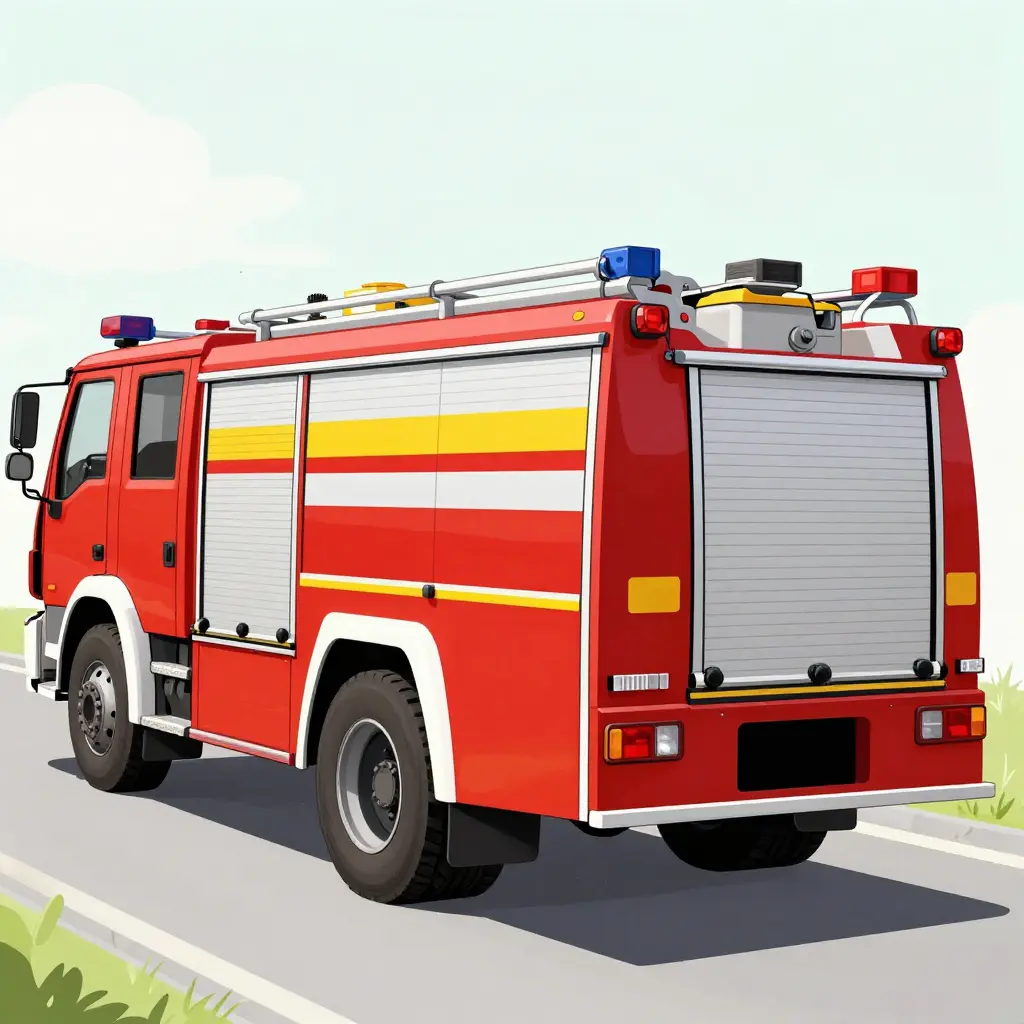
Rear Axle Weight Ratings and Gross Vehicle Limits
A fire truck’s rear axle weight limit comes down to one number: the gross axle weight rating (GAWR). That figure is the maximum load the axle, its springs, tyres and bearings are built and certified to carry. The chassis manufacturer sets it; highway rules such as axle-weight tables and the federal bridge formula enforce it. The gross vehicle weight rating (GVWR) is a separate ceiling on the whole vehicle once chassis, apparatus, water, crew and equipment are aboard.
Both limits have to hold at once. A truck can pass the GVWR check and still overload the rear axle if too much of its mass sits far back. Water payload distribution is usually what tips the balance. At about 8.34 lb per gallon, a 1,000-gallon tank adds roughly 8,340 lb. Mounted above or behind the rear axle, that tank sends much of its weight straight to the rear axle.
Engineers work out axle loads by taking moments about the vehicle’s centre of gravity. Moving the tank forward offloads the rear axle onto the front, but the front axle already carries the cab, pump and steering gear, and it has its own rating. If the calculated rear load exceeds GAWR, the layout is out of compliance no matter what the total weight says. Tank capacity (water capacity of a fire engine), compartment layout and axle spacing then get reworked until every axle sits inside its rating.
Every pound of water has to sit somewhere, so its position decides which axle carries the load and how the truck behaves on the road.
| Placement Position | Effect on Rear Axle Load | Effect on Centre of Gravity | Typical Application |
|---|---|---|---|
| Rear-mount | High; most weight sits behind the rear axle | Raises vertical load well aft | Rural tankers, water tenders |
| Mid-ship (between axles) | Moderate; spreads weight across both axles | Lowers overall centre of gravity | Urban pumpers, rescue engines |
| Side-saddle | Uneven; biases load toward the filled side | Slightly raised, with a lateral offset | Quick-attack units, small engines |
| Split/saddle tanks | Balanced; divides weight fore and aft | Low and well centred | Wildland engines, brush trucks |
| Low-profile elliptical | Reduced; smaller mass and shorter footprint | Lowest of all options | Airport and municipal pumper tenders |
Placement is therefore a capacity trade. Moving the water toward the middle of the wheelbase lowers the rear axle load, usually at some cost in tank volume.
The Physics of Water Weight and Centre of Gravity
Water weighs about 1,000 kilograms per cubic metre, so every litre on board adds roughly a kilogram of fluid mass. A 1,500-litre tank carries approximately 1,500 kg of water before any steel, baffles or pump equipment are counted. That mass is not spread evenly, and where it sits on the chassis decides what each axle has to carry.
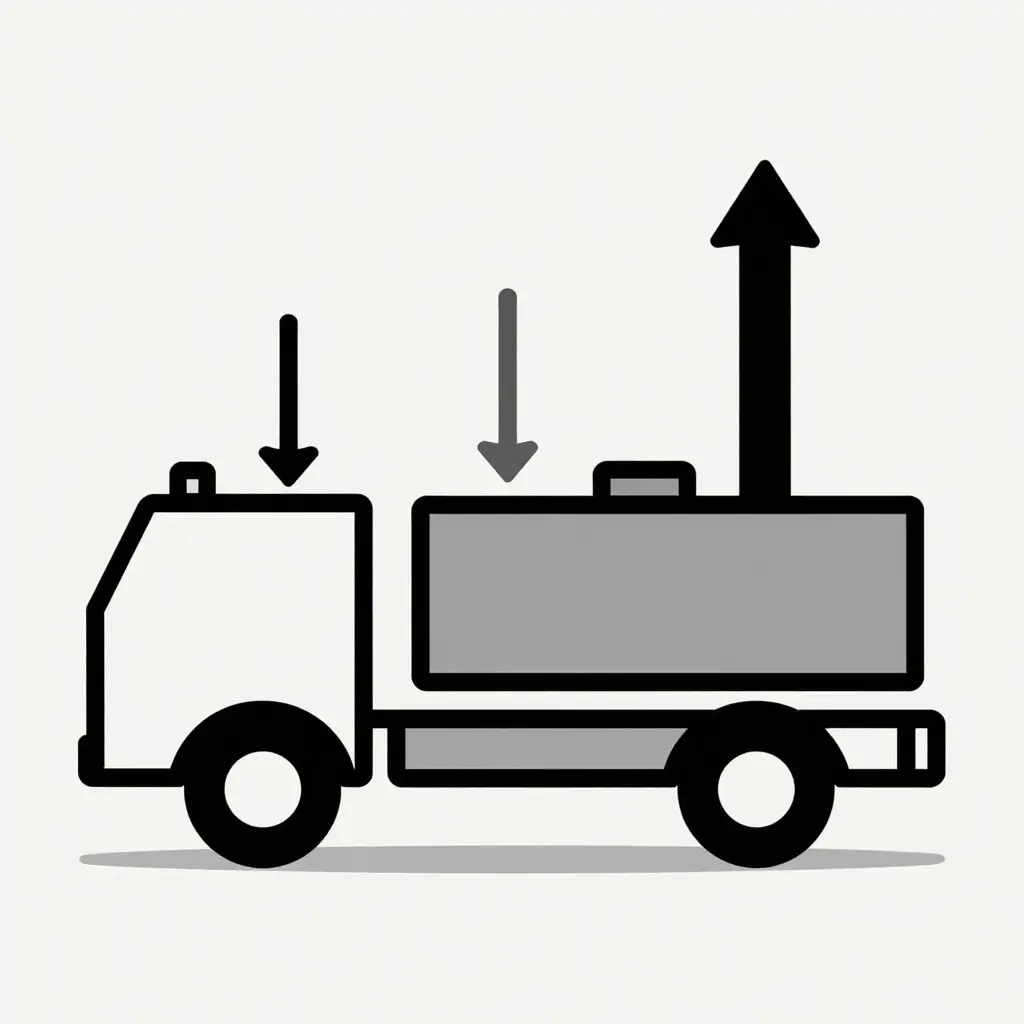
The variable that matters is the moment arm, the horizontal distance from a load’s centre of mass to the axle resisting it. The bending moment is that mass multiplied by the distance, so the longer the moment arm, the greater the load the axle sees. A tank mounted behind the rear axle sits at the end of a long arm: its weight presses down on the rear axle while lifting load off the front, the way pushing down on the far end of a seesaw raises the near end.
As the tank fills, the vehicle’s centre of gravity shifts rearward and its weight distribution follows. Rear axle load rises faster than total weight, which is why rear axle ratings, rather than total tank volume, often set the practical limit on how a fire engine’s tank can be arranged.
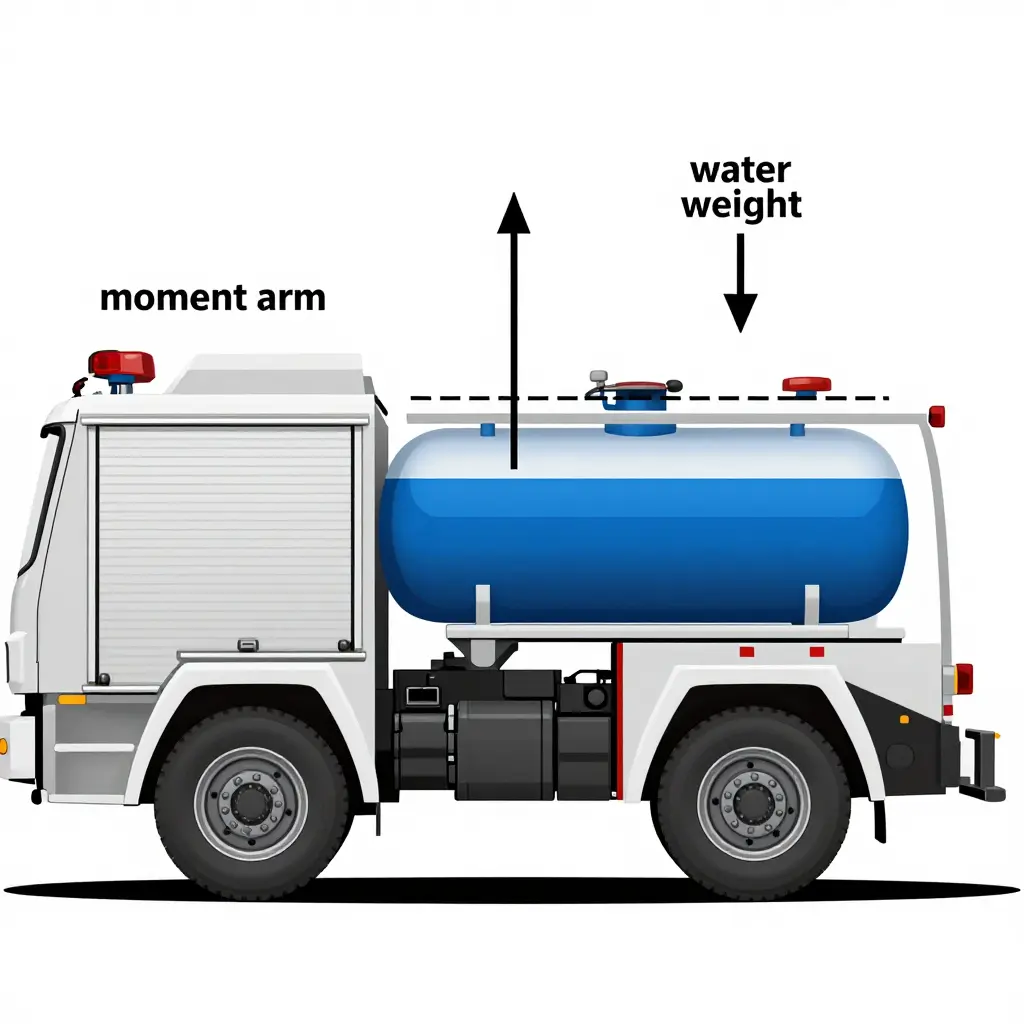
Knowing how water capacity shapes fire engine design makes these constraints easier to anticipate during the specification stage.
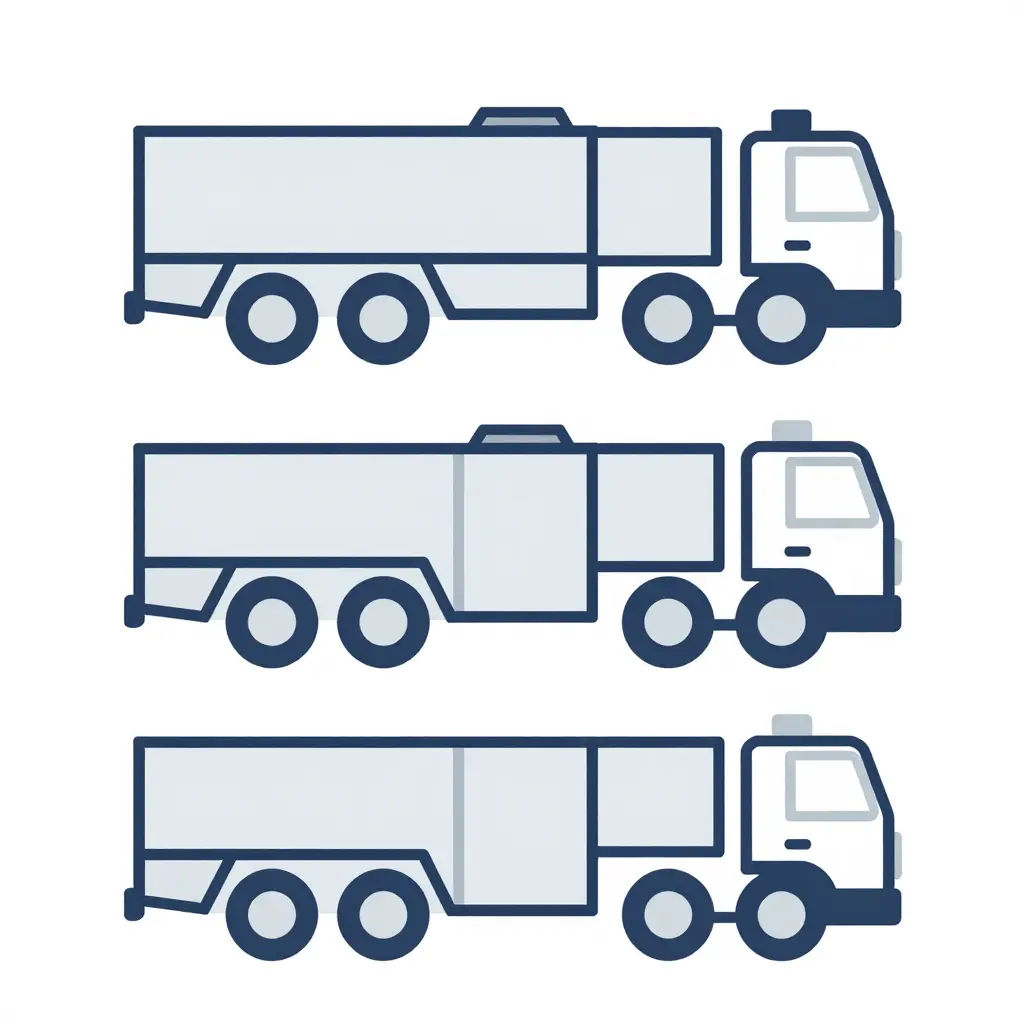
Schematic comparison of the three main water tank placement options on a fire truck chassis: rear-mount (top), mid-ship (middle), and side-saddle (bottom).
Operational Factors That Trigger a Tank Redesign
Rear axles rarely fail on the strength of the water tank alone. They fail because the tank competes with everything else a fire apparatus has to carry. A larger tank, fitted to extend fire engine water capacity, never sits in isolation: its weight eats into rear axle capacity that the pump, hose, crew seating and compartments already depend on.
Pump placement is one pressure point. Mid-mount and rear-mount pumps put both mass and plumbing toward the rear wheels, and relocating a pump to clear space for a bigger tank can add weight to the same axle. Hose bed length is another. A longer bed speeds up deployment, but the hose and the steel needed to support it all ride behind the rear axle.
Seating counts too. Every riding position brings occupants, seats and reinforcement, and seats over or behind the rear axle consume capacity a larger tank would otherwise claim. Compartments add to the squeeze, since tools, rescue equipment and foam systems are usually stowed toward the rear. Add these demands up and the weight budget left for water shrinks, which is what forces a redesign. A workable layout balances all of them before the first gallon goes in.
Rear Axle Load by Tank Placement
Tank placement is the biggest single lever on rear axle load. Move the water mass and the weight distribution moves with it, so a different axle ends up carrying the load. The chart compares four common configurations, indexed against the axle’s rated capacity.
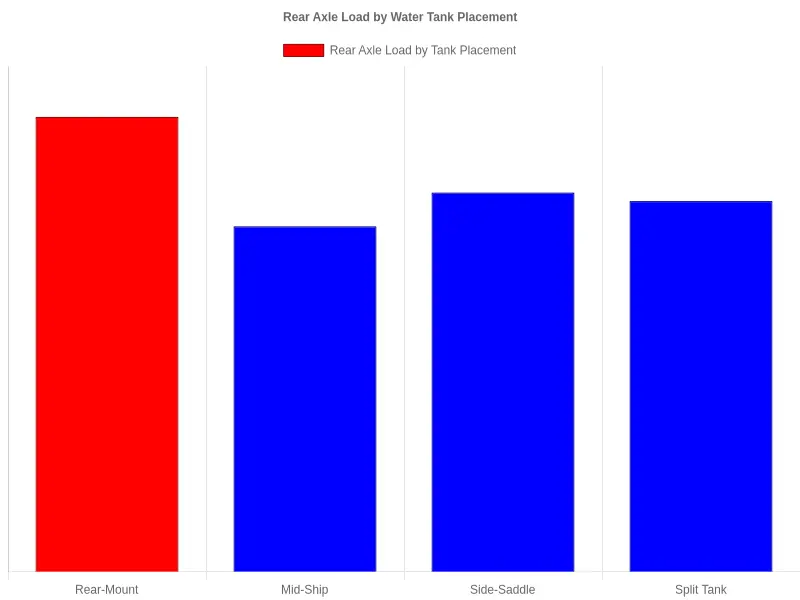
Reading the chart
- Rear-mount (108%) – the tank box sits directly over or behind the rear axle, so almost the entire water load transfers onto it. This is the configuration most likely to blow past gross axle weight rating (GAWR).
- Side-saddle (90%) and split tank (88%) – spreading water between the frame rails or across compartments keeps the rear axle under its limit while still carrying a useful volume.
- Mid-ship (82%) – placing the bulk of the tank forward of the rear axle shifts weight onto the front axle and delivers the lightest rear axle load of the four.
Why this matters for redesign
Once a rear-mounted tank pushes the rear axle over its rating, the cost spreads: suspension, tyres, brakes and frame all need upgrading, and the truck may fall foul of axle-load regulations. A layout that keeps the rear axle inside its envelope often carries comparable water without that cascade of costly changes. Matching tank volume to real-world demand is covered in our guide on water capacity for fire engines.
Where rear axle load is the constraint, moving the tank forward or splitting it is usually the quickest route back into compliance.
Design Considerations for Water Tank Redesign
Redesigning a tank around a fixed rear axle limit means balancing payload, stability and firefighting performance. These are the decisions that matter before a layout is committed:
- Baffling and slosh control – Transverse and longitudinal baffles limit liquid movement and cut the surge forces that destabilise the chassis under braking and in corners.
- Low-profile tank geometry – A flatter cross-section lowers the centre of gravity, improves roll stability and spreads weight more evenly over the axles.
- Split or saddle tank layouts – Twin tanks straddling the frame rails preserve volume without loading any single point behind the rear axle.
- Composite and lightweight materials – Fibreglass-reinforced plastic or polypropylene shells cut tare weight, freeing payload for water and equipment.
- Tank placement forward of the rear axle – Shifting usable volume ahead of the axle line helps satisfy weight-distribution rules and protects steering and braking behaviour.
- Pump and plumbing relocation – Re-routed intakes, valves and pipework keep flow rates high when the tank footprint changes shape.
- Load certification – Validate the finished assembly against axle ratings, GVW limits and stability standards before the vehicle enters service.
A good redesign treats the rear axle as the boundary it is, without giving up the capacity and reliability crews depend on every shift. Related guidance: water capacity shapes fire engine specification in the UK.
Specific Tank Redesign Approaches to Reduce Rear Axle Loading
Rear axle load rarely comes down through one change. Most engineers combine several adjustments, because each one shifts weight in a slightly different way. The aim is to stay inside the rated axle limits while keeping the water capacity the crew needs on scene.
Repositioning the tank. Moving the tank forward, or mounting it between the axles rather than behind the rear axle, is the most direct option. It transfers part of the water mass onto the front and mid-chassis and shortens the moment arm bearing down on the rear axle. Most redesigns start here.
Split and saddle tanks. Two smaller tanks along the sides of the chassis do the job of one large vessel. The same volume is spread over a wider footprint, so no single point is overloaded, and the tanks can be positioned to balance weight front to rear.
Low-profile elliptical tanks. A shallower elliptical tank lowers the centre of gravity and uses the available body space more efficiently. The flatter profile spreads mass and reduces the vertical load concentrated over the rear axle.
Lightweight composite materials. Replacing steel with fibreglass or composite shells cuts the tare weight of the tank itself. Every pound of structure removed is a pound of the rear axle rating available for water instead.
Improved baffle design. Better-placed baffles control water surge and let designers fine-tune how the liquid mass behaves under braking and cornering, which keeps dynamic loads from spiking on the rear axle.
How capacity targets interact with these structural choices is covered in water capacity and axle trade-offs on UK fire engines.
Regulatory and Compliance Considerations
Keeping a redesigned tank inside the rear axle limits is a paperwork problem as much as an engineering one. Before an apparatus returns to service, the redesign has to satisfy a stack of standards, certifications and recorded checks.
Axle Rating Verification
Start by checking the manufacturer’s Gross Axle Weight Rating (GAWR) against the chassis specification sheet. Compliance officers then confirm that the revised tank, baffles, water load and mounted equipment stay under the rear axle’s rated capacity. The usual evidence is a weight ticket from a certified scale, with front and rear axle weights recorded separately.
Weight Distribution Documentation
Compliance calls for a written weight distribution report showing how the water mass balances across the wheelbase. Fuel, personnel and pump loads belong in the figures too, so the totals reflect real operating conditions. Departments keep these records for insurance, warranty claims and inspections.
Fire Apparatus Standards
A redesign has to align with the applicable NFPA standards for automotive fire apparatus and with any national road-vehicle rules covering axle loading. Bigger apparatus and tank configurations make this harder, so guidance on how large fire trucks are engineered helps teams anticipate the ratings and certification steps before they commit to a design.
Manufacturers should also supply updated certification and, where required, third-party verification confirming the redesigned tank meets structural and weight requirements.
Fire Truck Weight Distribution: Where the Pounds Actually Go
A redesign starts with knowing what already sits on the axles. The doughnut chart breaks down the share of total vehicle weight each major component takes. The water tank is the largest single contributor, which is why it dominates the rear axle load conversation.
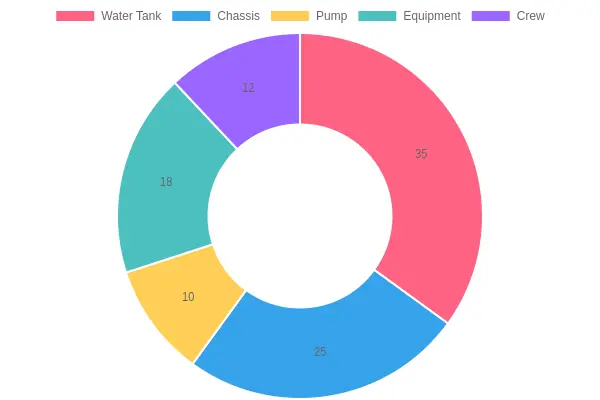
The tank alone accounts for roughly 35% of total weight: more than the chassis and more than triple the pump. That concentration is why the position of a full tank has such a large effect on the rear axle. Equipment adds another 18%, the crew 12%, and the chassis (25%) and pump (10%) make up the rest.
Because the tank carries the heaviest share, even a modest relocation or reshaping changes rear axle load noticeably. Balancing water capacity against axle limits is central to any practical tank redesign, so related guidance on how water capacity is specified for fire engines is worth reviewing.
FAQ: Tank Placement and Rear Axle Limits
Why can’t a larger water tank simply be mounted at the rear?
The rear axle already carries the pump, the rear body structure and much of the apparatus equipment. A larger tank behind it pushes that mass beyond the axle’s rated capacity and creates an overhang that multiplies load through leverage. Overloading the rear axle risks axle failure, poor braking and non-compliance with road weight regulations. That is why fire truck water tank placement cannot be solved by bolting a bigger tank on the back.
How does tank placement affect the centre of gravity?
Water is heavy, roughly 8.34 pounds per gallon, so a full tank sits like a dense block of shifting mass. Mounted high or far to the rear, it raises the vertical centre of gravity and shifts the longitudinal centre rearward, increasing body roll in turns and reducing steering stability. Placing the tank lower and forward between the axles keeps the centre of gravity closer to the chassis midpoint.
Can split tanks reduce rear axle load?
Yes. Splitting capacity into multiple cells lets engineers distribute weight across both axles and lower the mounting height. A forward cell transfers load to the front axle, while a rear cell stays within rear limits. This balances load, improves handling and can add capacity without overloading one axle.
What materials help reduce tank weight?
Polypropylene and fibreglass-reinforced plastic tanks are far lighter than steel and resist corrosion. Aluminium and composite baffles further trim weight while controlling slosh. Lighter tanks free up payload for water and free space within rear axle limits.
How do you set safe rear axle limits?
Manufacturers calculate limits from axle ratings, tyre capacity and spring ratings, then verify with a weighbridge. Reviewing established fire engine water capacity figures helps departments set realistic targets before specification.
Conclusion: Designing Within the Rear Axle Limit
The rear axle sets what a fire truck can carry, and that shapes every decision about fire truck water tank placement. A full tank is the heaviest concentrated load on the chassis, so exceeding the rear axle rating costs braking performance, handling and legal compliance. When the weight calculations say the original design cannot meet the target, a tank redesign stops being optional.
The approaches that work are the ones already described: lower the tank’s centre of gravity, shift capacity forward, split the tank into baffled compartments, use lighter materials. Each redistributes weight or removes mass, so the vehicle stays within its axle rating without losing usable water volume.
Balancing water capacity against axle ratings takes discipline, and it pays back in safer apparatus, longer service life and dependable performance. How large apparatus manage load distribution is covered in this guide to the world’s largest fire trucks.