


Why Upfit Capacity, Not Chassis Supply, Drives Brush Fire Truck Delivery Delays
When a new brush fire truck runs past its delivery date, the first suspect is almost always chassis supply. Fire departments, municipal fleet managers, and emergency service providers assume the bare trucks are the holdup. Most of the time, that is not what happened.
The bottleneck is upfit capacity. Chassis reach the upfitter’s yard within a normal window. What takes months is the work that follows: mounting the tank and body, plumbing the pump, wiring the controls, fitting the foam system, and running the inspections that make a truck fireground-ready. That work depends on trained technicians, an open bay, and parts that are often built to order, not on the chassis itself. Even a decision as specific as wildland engine pump ratings for steep terrain adds engineering time to each build.
Chassis supply still matters in some segments, and shortages do surface. But it rarely accounts for the months of extra delay buyers report. Those months are queued further down the line, where every truck competes for the same limited upfit slots.
Below: why upfit capacity has become the main constraint for brush fire truck manufacturers, how it moves delivery schedules, and what departments and fleet managers can do about it.
The Chassis Supply Misconception
When a delivery runs late, chassis supply is the first thing blamed. It is also the easiest thing to blame. Chassis production across the major commercial platforms upfitters rely on has largely stabilized.
Ford, Ram, Chevrolet, and Freightliner now build on predictable schedules. Dealers carry inventory, and most orders fill within normal lead times. A buyer can typically secure a chassis suitable for a brush fire truck build without an unusual wait.
The constraint sits downstream, at the upfit stage. A pump, water tank, foam system, and custom body take skilled labor and dedicated bay space. When demand rises, that capacity fills long before chassis supply becomes a problem.
Blaming the chassis is understandable. Chassis delays were real a few years ago, and that memory stuck. But today’s slipping timelines usually measure how long it takes to finish a vehicle, not to get one. Whether the project is a standard unit or one with specific Type 6 wildland engine requirements, the base truck is rarely what holds it up.
That distinction changes how you plan. Departments that understand it set realistic expectations, order early, and watch upfit scheduling instead of chasing a chassis shortage that has mostly faded.
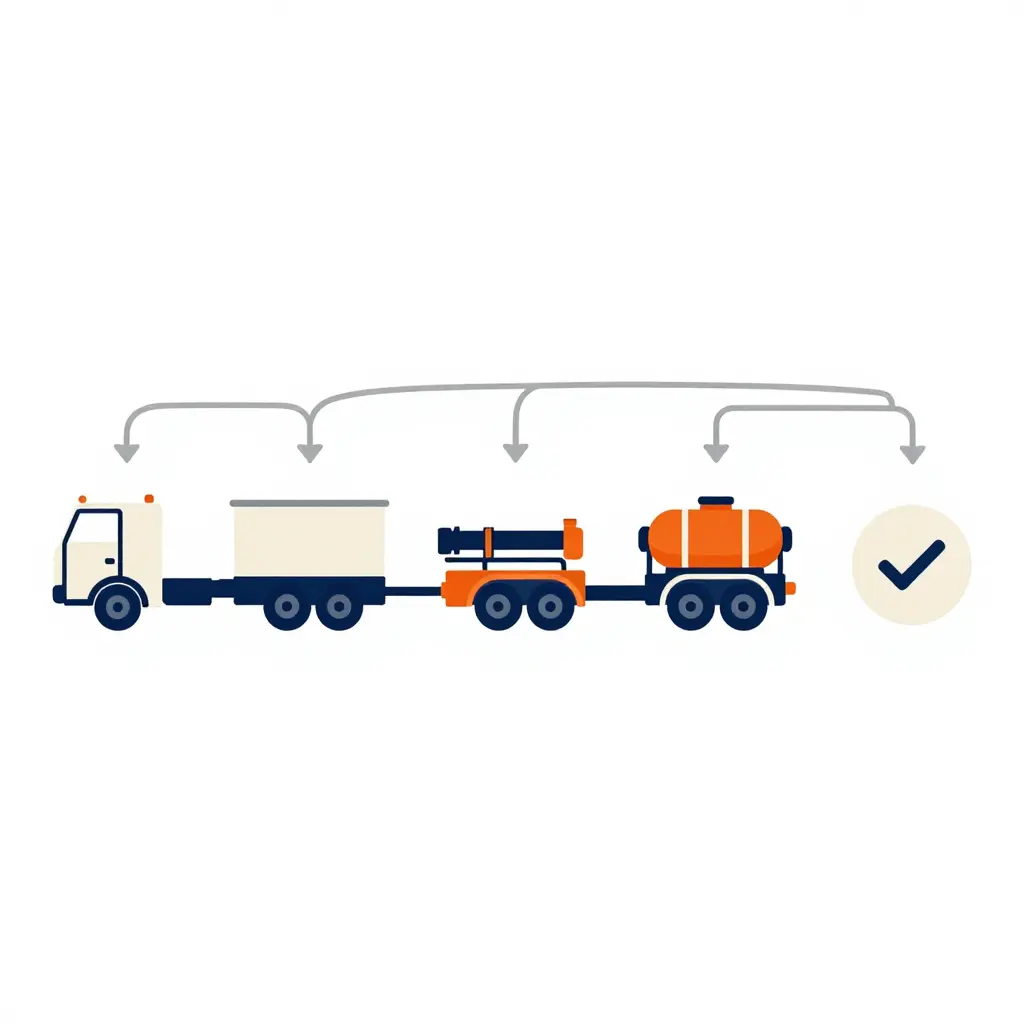
The diagram traces the sequence every brush truck passes through before delivery, and it makes the point that the chassis is only the beginning. Tank fitting and electrical wiring, the fourth and fifth stages, are often where schedules slip, especially when tank placement pushes against rear-axle limits and the layout has to be reworked.
Why Upfit Capacity Sets the Schedule
When a department asks why its new brush truck is months behind, the chassis is rarely the answer. Commercial chassis from the major OEMs arrive on predictable timelines. The real constraint is upfit capacity: the limited supply of qualified shops, dedicated bays, and skilled technicians that turn a bare chassis into a finished wildland engine.
Upfit work does not scale the way mass production does. You can add orders to a queue; you cannot add trained technicians nearly as fast. Each brush truck needs skilled labor for pump plumbing, electrical harnesses, foam systems, and body fabrication, and those are hands-on jobs that take years to learn. Doubling the raw materials does not double output. Doubling the staff would, but trained staff are scarce across the industry.
Bay space is the second limit. One bay holds one truck, and a complex build occupies it for weeks. Adding capacity means building or leasing room, installing lifts and ventilation, and staffing it, a process measured in years rather than weeks.
Third is component integration. Pumps, tanks, foam proportioners, and control systems have to be matched, fitted, and tested as a single unit. That kind of work resists automation and modularization, so it stays labor-intensive and slow to expand.
The result: delivery delays track throughput at the upfit stage, not the supply of chassis rolling off assembly lines. Chassis can sit in a yard waiting for a bay to open, which is why lead times stretch even when base vehicles are easy to get. For a fleet planning replacements, schedules depend on how a Type 6 wildland engine’s pump and body are configured, not on the truck maker’s production volume.
Six Factors That Actually Limit Upfit Throughput
When a brush truck slips past its promised delivery date, the chassis gets the blame. In practice, the constraint almost always sits on the upfit floor. These six factors, roughly in order of how often they show up in production schedules, explain why a finished wildland engine can trail its rolling chassis by many months.
Skilled Technician Shortages – Welding, 12-volt wiring, and pump plumbing are taught trades, not jobs you improvise. When a shop cannot fill those roles, the whole queue moves at the pace of whoever is scarcest.
Limited Build Bay Availability – A brush truck ties up a bay for weeks of fabrication and assembly. With only a handful of bays, the operation caps out the moment demand exceeds floor space, however many chassis arrive.
Custom Pump and Tank Integration – Wildland ratings are rarely off-the-shelf, so engineers match pump curves to a specific tank geometry. How pump ratings behave on steep terrain is part of it: those calculations add engineering hours before a single bolt is turned.
Component Lead Times – Specialty valves, foam proportioners, and control panels are built to order. One backordered part can leave a nearly finished truck sitting idle for weeks, quietly stretching the whole delivery timeline.
Quality Inspection Cycles – Pump flow tests, pressure checks, and electrical verification each take labor and bay time. Skipping them is not an option, since departments want documented proof of performance before they accept a truck.
Seasonal Order Surges – Wildfire seasons cluster demand, so orders pile into the same spring window. No shop can smooth a spike it never hired or expanded capacity to absorb.
Taken together, the pattern points one way: chassis supply makes the headline, but upfit capacity sets the schedule. Departments that plan around build bay hours, staffing depth, and integration complexity, rather than chassis arrival dates, forecast their brush truck deliveries far more accurately.
Lead Times by Stage: Where the Upfit Bottleneck Actually Bites
Here is the paradox that trips up fleet planning: it is often easier to buy a commercial chassis than to get it built out. The chassis market runs tight at times, but it eventually clears. The upfit shop floor is slower to clear. Bays, welders, technicians, and test rigs all have to be in place before a bare frame becomes a finished brush fire truck. The table below breaks down typical lead times and constraint levels across the core production stages, and the pressure clearly piles up downstream of the chassis.
Table: Typical Lead Times and Constraint Levels by Production Stage
| Production Stage | Typical Lead Time | Primary Bottleneck | Upfit Capacity Pressure |
|---|---|---|---|
| Chassis acquisition | 4-10 weeks | OEM allocation and spec matching | Low – largely off-the-shelf or standard order |
| Body fabrication | 6-12 weeks | Welded aluminum/steel shop capacity | High – limited skilled fabricators |
| Pump and tank installation | 4-8 weeks | Custom tank fitment and tank placement within rear-axle limits | High – bay space and rigging crews |
| Electrical and control integration | 5-10 weeks | Wiring harnesses and panel programming | Very high – specialized techs in short supply |
| Inspection and testing | 2-4 weeks | Pump flow and safety certification | Medium – test bay availability |
| Final delivery | 1-3 weeks | Transport permits and dealer prep | Low – scheduling and logistics only |
Reading the Table
The pattern is hard to miss. Chassis acquisition carries relatively modest pressure, while every stage from body fabrication through electrical integration runs hot. Those are exactly the stages that depend on the upfitter’s own labor, floor space, and specialized talent, none of which can be ordered in from a supplier or bought off a lot. When a department blames a chassis shortage for a late truck, the schedule math usually points somewhere else: to a crowded shop with too few welders and too few control technicians.
That is the case for vetting a manufacturer’s upfit throughput, not just its supplier relationships. Ask about fabrication bay counts, in-house electrical teams, and how many units it can realistically commission in a quarter. Those answers say far more about your delivery date than any chassis availability forecast.
What the Delivery Data Actually Shows
Across the market, one pattern keeps surfacing: chassis lead times have largely settled, while completed-unit delivery dates keep sliding. That widening gap points to upfit capacity, not chassis supply, as the real constraint.
- Chassis arrival has steadied at roughly 6 to 12 months for common commercial cab-and-chassis platforms.
- Skid, pump, tank, body, and paint upfitting now adds another 8 to 16 months, depending on shop backlog.
- Departments commonly quote 18 to 30 month windows from order to keys-in-hand.
Read those as ranges, not single points. When brush fire truck manufacturers publish “24 to 30 months,” they are usually describing two stacked queues, a chassis segment plus an upfit segment, rather than one clean number.
Comparative figures reinforce the pattern. A department that takes its chassis in month 10 can still wait until month 26 for a pumped, plumbed, and inspected unit. A shop with idle bays moves the same chassis through in under a year, which shows that quoting spreads track assembly throughput rather than chassis availability.
Reading delivery data this way also explains why similar platforms diverge so widely: even minor changes to wildland engine specifications can reset an upfit queue. Viewed across ranges rather than single points, upfit capacity remains the clearest explanation for the widest delivery spreads.
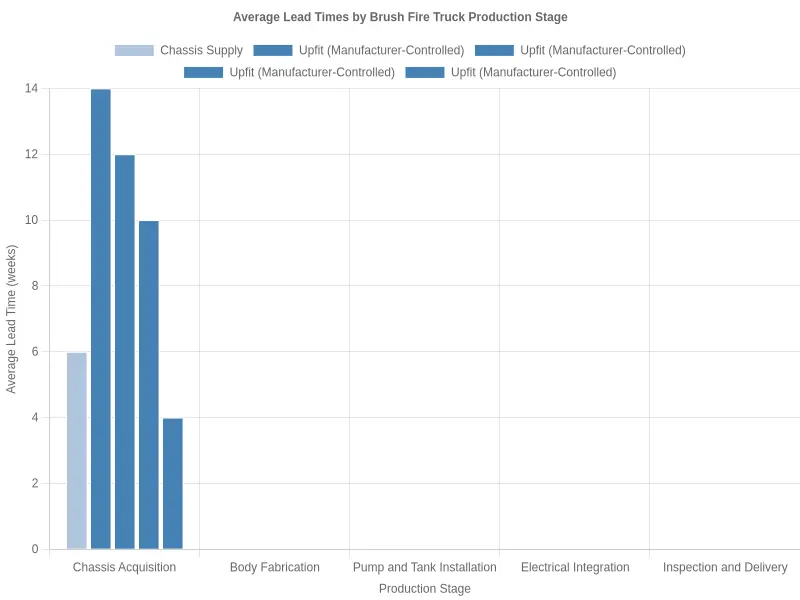
Takeaway: The chart shows chassis acquisition at only about 6 weeks of total lead time, while the manufacturer-controlled upfit stages (body fabrication, pump and tank installation, and electrical integration) consume the vast majority. That is why upfit capacity, not chassis supply, is the real bottleneck in brush fire truck delivery. For departments weighing how tank and pump choices shape these timelines, it helps to understand fire truck water tank placement and rear axle limits.
What Upfit-Driven Delivery Delays Mean for Fire Departments
When the chassis arrives on schedule but the upfit runs late, the department absorbs the delay, not the dealer. Fleet managers build their calendars around an in-service date, and every slip in that date moves staffing, training, and response planning with it.
Fleet readiness is the first casualty. An unfinished rig cannot be dispatched, yet it still occupies bay space and a line-item budget. To hold coverage, departments keep older apparatus in front-line service longer, which raises maintenance costs and wears down units already due for retirement. Late build changes can also force a fresh look at performance details, from Type 6 wildland engine pump ratings on steep terrain to how added weight interacts with fire truck water tank placement and rear axle limits.
Budget planning rarely waits for a late delivery. A department may pay for a chassis long before the finished apparatus enters service, while grant deadlines, bond schedules, and fiscal-year purchasing rules keep moving. A six-month upfit delay can quietly push a funded truck into the next budget cycle.
Coverage gaps get worse when delays overlap seasonal brush fire risk:
- A missing engine narrows first-response options exactly when grass, brush, and interface fires peak.
- Mutual-aid partners cover the shortfall, which strains neighboring districts.
- Crews scheduled around a new rig end up on overtime or temporary assignments.
The practical takeaway: treat upfit capacity, not chassis supply, as the real schedule driver.
Planning and Procurement Strategies for Upfit Capacity Constraints
Upfit capacity, not chassis supply, is usually what decides when a new brush fire truck reaches your station. Departments that plan around that constraint take delivery sooner than those that simply order later and hope.
Three moves make the biggest difference:
- Order early and stagger. Place orders before the budget cycle forces your hand, and spread them across quarters so you are not fighting neighboring departments for the same upfit slot.
- Phase your fleet replacement. Instead of retiring several rigs at once, spread replacements over several years. That smooths demand, keeps older units in reserve, and stops a single delayed upfit from weakening your response capability.
- Keep specifications flexible. Every non-standard feature adds engineering time. Staying open on tank size, pump ratings, and body layout gives builders room to slot your chassis into an existing production run, which matters when even the largest fire truck orders compete for the same limited upfit slots.
During vendor selection, ask directly how much upfit capacity a manufacturer actually has, how far out the schedule runs, and how it handles delays. Departments that confirm their real water capacity needs for a fire engine before locking in specs also avoid costly change orders mid-build. The result is a procurement plan that bends around capacity limits instead of breaking against them.
Frequently Asked Questions
Why do brush fire truck deliveries take so long?
Delivery timelines for a new wildland unit often run 12 to 24 months, and the long stretch is rarely the chassis. Once the cab-and-chassis arrives, the vehicle still needs a water tank, pump, plumbing, foam system, body fabrication, electrical work, and a full acceptance test. Few brush fire truck manufacturers run enough specialized work bays to move every order at once, so finished trucks queue behind one another. Buyers tend to measure “build time,” but the calendar is really governed by upfit capacity.
Is chassis supply the real bottleneck?
Not in most current market conditions. Chassis availability improved faster than many departments expected, and dealers frequently hold inventory that sits unassigned for weeks. The real limit is the number of qualified technicians and equipped bays able to finish a wildland build. Compare chassis supply and upfit capacity directly, and the upfit side sets the completion date.
How can departments reduce upfit delays?
- Order the chassis and the upfit together rather than in sequence.
- Lock the specification early and avoid late change orders that reset your place in the queue.
- Confirm long-lead components such as pumps and foam systems before signing.
- Accept phased delivery if only part of the fleet is ready for service.
What role does upfit capacity play in manufacturer selection?
It should sit at the center of the evaluation. Ask each bidder how many bays handle wildland builds, how many trucks it ships per month, and what happens when a component is backordered. A manufacturer with strong upfit capacity and proven, terrain-specific pump ratings usually delivers more predictably than one competing on price alone.
The Bottom Line: Upfit Capacity, Not Chassis Supply, Sets Your Delivery Date
After working through chassis lead times, specialty fabrication, and the realities of emergency-vehicle assembly, one conclusion holds. For brush fire truck manufacturers, upfit capacity, not chassis supply, is the dominant cause of delivery delays.
The supporting evidence points one way. Chassis availability has largely stabilized across most commercial platforms, yet delivery timelines stay stretched for many buyers. Every pump, tank, foam system, and electrical package still has to move through a limited number of skilled upfit bays, where choices such as tank placement and axle loading are finalized. Those bays, and the trained technicians who staff them, cannot be expanded overnight, so the queue, not the frame, becomes the real constraint.
So build your schedule around upfit booking rather than chassis order dates, and add buffer for the upfit queue. When you evaluate vendors, ask directly about bay count, current backlog, and in-house fabrication capability. Choosing a manufacturer with verifiable upfit capacity is the surest way to protect your delivery timeline and keep your fleet ready for the next call.