

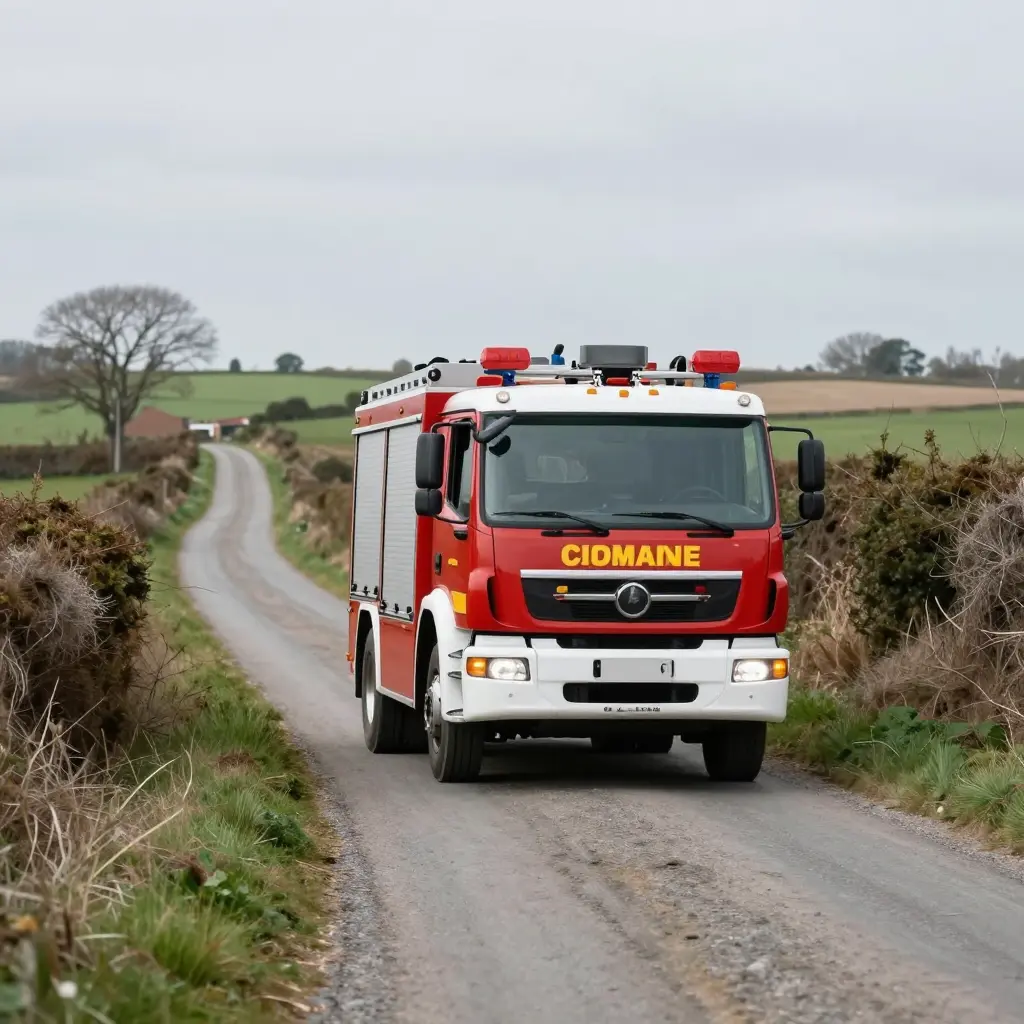
Narrow Lanes Are the Binding Constraint
On a narrow rural lane, the road sets how wide and how long an apparatus can be. That limit then caps usable water capacity and forces hard choices about the pump. A truck that cannot reach the fire delivers no water at all, so geometry comes first, and tank volume or pump rating only get discussed afterward.
For rural and volunteer chiefs, fleet managers, and procurement officers, the consequence is that lane width drives the whole specification. Tank size, pump curve, body length: all of it follows from the width of the road you have to drive.
Why the road decides
Three things set the limit:
- Legal and physical width. Rural lanes, hedgerows, and bridge parapets leave almost no margin. You cannot decide to run a wider body; it will not fit.
- Axle and gross weight limits. Water weighs about 8.34 pounds per gallon, so each extra gallon lands on axles that already carry the pump, foam, and crew. The rear axle often runs out of capacity before the body runs out of room.
- Turning and braking geometry. A longer wheelbase needs more room to turn and shifts more weight under braking, which is the wrong behavior on the cambered, unpaved lanes rural crews drive.
What it means for tank volume and pump
Once the road fixes width and length, water capacity becomes a derived number, and what buyers expect from it varies by market. Some regions accept larger tanks on the same chassis class than others, as this analysis of water capacity expectations in the UK fire engine market shows. When the tank is capped, the pump has to make up the difference through pressure, nozzle choice, and low-volume tactics rather than sheer volume.
Three variables decide what a small fire truck can do: chassis geometry, water volume and where it sits, and pump performance. Take them in that order.
The Geometry Linking Lane Width to Apparatus Footprint
Sizing a small fire truck starts with a tape measure and a rural road. By the time you argue about water capacity or pump curves, the road has already set a hard limit. Narrow rural lanes do not care how much water you would like to carry. They care whether the apparatus footprint — width, length, and swept path — fits at speed, in the dark, in the rain.
From lane width to usable road clearance
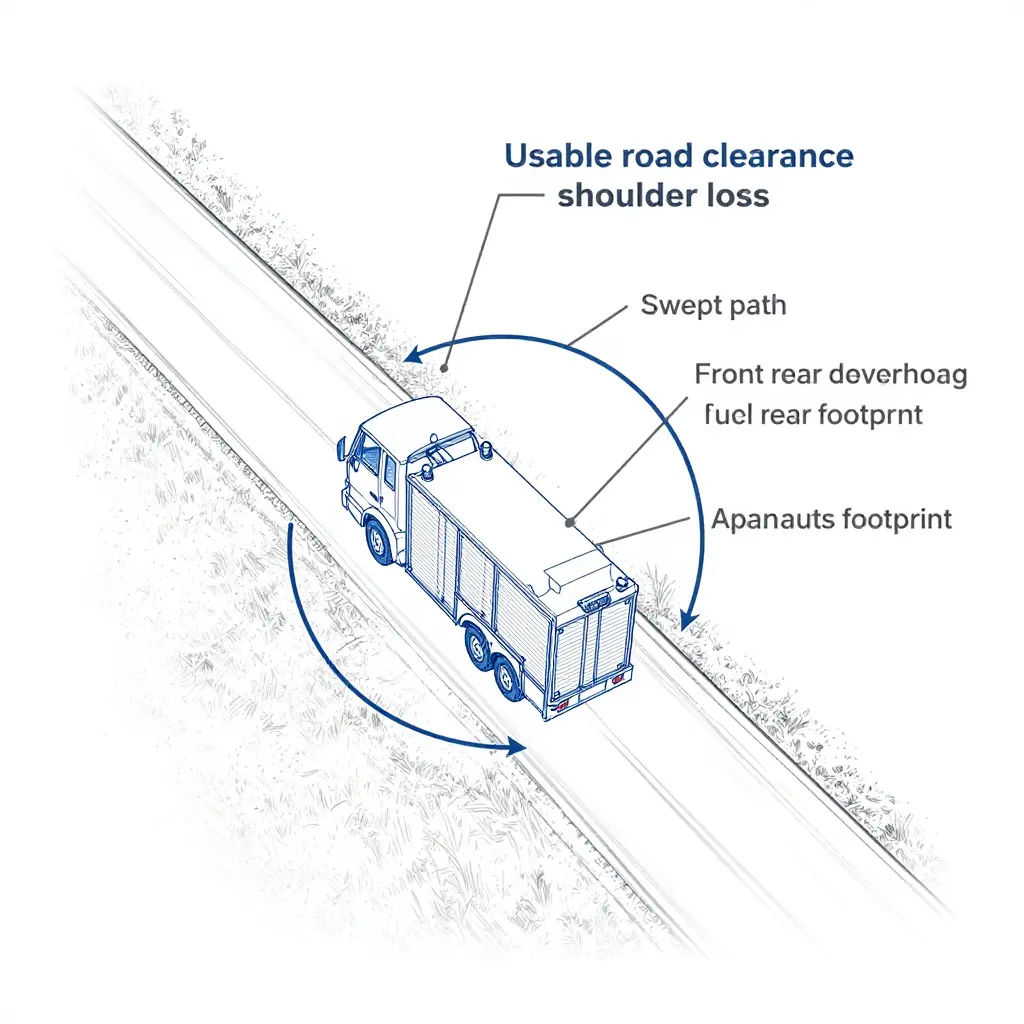
Start with the pavement, then subtract everything that eats into it. Two 11 ft lanes sound generous until you take out gravel shoulders that collapse under a rear axle, brush along the fence line, and mailboxes that force constant corrections. Shoulder loss is width drivers cannot use, so a nominal 22 ft road often behaves like 18 ft. Add mirrors, hosebed edges, and normal drift at 35 mph, and the usable envelope shrinks again.
Wheelbase, track width, and the turning envelope
Track width sets how much lateral room the body needs at each axle. Wheelbase governs off-tracking, the way the rear axle cuts inside the front axle’s path. A longer wheelbase tracks straighter on the highway but swings wider through tight corners, so the swept path is wider than the body itself. Turning radius grows roughly with wheelbase divided by steering angle. Shorten the wheelbase and the truck threads tighter curves, at the cost of ride and weight distribution.
Curve radius, bridges, and overhead clearance
The tightest curve on a road, not the straightest stretch, sets the real limit. Curve radius combines with wheelbase and overhangs to produce the worst-case swept envelope. Bridges and culverts impose width and load limits with almost no margin, and overhead clearance caps body height, which caps how tall the tank can sit on the frame.
| Geometric factor | What it consumes | Practical cap it imposes |
|---|---|---|
| Lane width | travel margin | overall body and mirror width |
| Shoulder loss | edge stability | safe drift allowance |
| Curve radius | swept path width | maximum wheelbase |
| Bridge clearance | weight and width envelope | gross vehicle weight, body width |
| Overhead clearance | vertical envelope | body height, effective tank depth |
| Turning envelope | off-tracking | rear body length and overhang |
Why this caps body length and tank footprint
The constraints compound. A tight curve limits wheelbase. A limited wheelbase limits how much body you can hang behind it without excessive rear overhang. A shorter body means a smaller tank footprint. A 10 ft usable lane can cut practical body length far below what a 16 ft lane allows, and that is the real ceiling on water carried. For how route geometry shapes other chassis choices, see this comparison of route-fit and loading-cycle constraints.
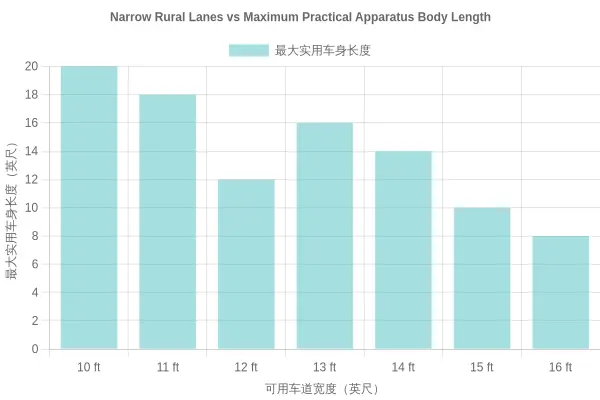
Once the geometry fixes your footprint, the next question is how to spend it on water.
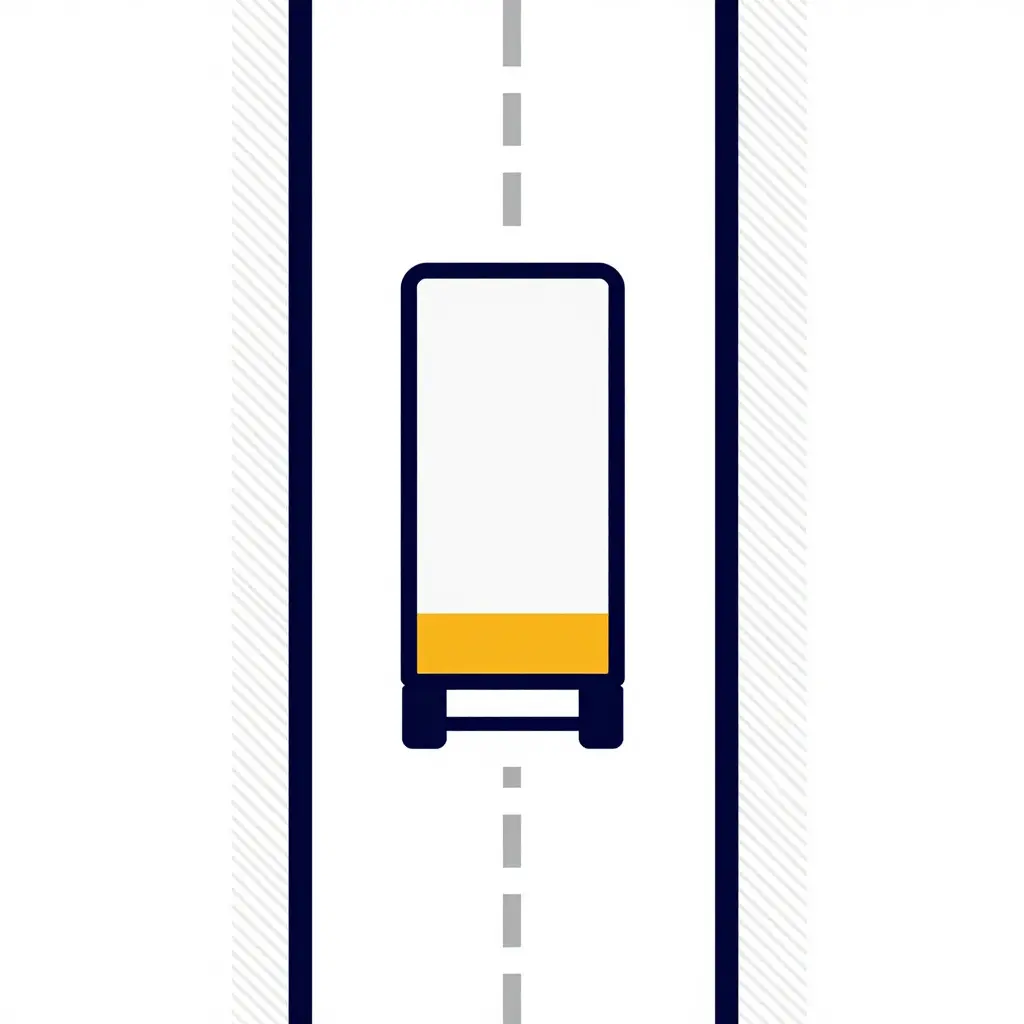
A compact apparatus inside a narrow rural lane. The parallel lines mark the available corridor; the overlaid rectangle and wheel boxes show the vehicle footprint. The hatched margins on either side are the clearance buffer and the shoulder the tires consume. What is left over, not driver preference, sets the ceiling on body width and, by extension, tank size.
Line the classes up and the geometry writes most of the spec sheet: the tighter the lane, the less water the rig can carry and the smaller the pump it can justify. That is why a mini-pumper sits at the bottom of both scales.
Apparatus Class vs. Water Capacity: The Footprint Trade-Off
| Apparatus Class | Typical Body / Lane Footprint Fit | Nominal Water Capacity Range | Typical Pump Flow Rating | Primary Trade-Off |
|---|---|---|---|---|
| Mini-pumper / brush truck (NWCG Type 6) | Body approx. 2.2 m (86 in) wide; fits single-track lanes from 3.0 m (10 ft) | 150-400 gal (570-1,500 L) | 150-250 gpm (570-950 L/min) | Lowest water capacity and smallest pump; every gallon is hard-won payload and refills come fast |
| Type 5 wildland engine | Body approx. 2.3 m (90 in) wide; fits lanes from 3.4 m (11 ft) | 400-500 gal (1,500-1,900 L) | 250-500 gpm (950-1,900 L/min) | Only a modest gain in water capacity, still capped by a light chassis and limited hose reach |
| Type 3 wildland / urban interface engine | Body approx. 2.4 m (96 in) wide; fits lanes from 3.7 m (12 ft) | 500-750 gal (1,900-2,800 L) | 500-750 gpm (1,900-2,800 L/min) | Balances footprint and water capacity, but steering into tight yards gets marginal |
| Type 2 commercial pumper | Body 2.4-2.5 m (96-98 in) wide; needs 4.0-4.3 m (13-14 ft) lanes | 750-1,250 gal (2,800-4,700 L) | 750-1,500 gpm (2,800-5,700 L/min) | Strong water capacity and pump flow, but lane width and turning radius exclude many rural roads |
| Type 1 custom full-size engine | Body 2.5-2.6 m (98-102 in) wide; needs 4.3-4.6 m (14-15 ft) lanes | 1,000-1,500 gal (3,800-5,700 L) | 1,250-2,000 gpm (4,700-7,600 L/min) | Maximum water capacity and pump flow at the cost of access – cannot reach the narrowest rural lanes at all |
The third and fourth columns show the pattern: narrow-lane apparatus carry less water and accept smaller pumps, while the large capacity of a full-size engine is available only to departments whose roads can take it. For how tank positioning reshapes these limits, see our guide to fire truck water tank placement and rear-axle limits.
Forced Pump Trade-offs
Nothing on a compact apparatus comes free. Rated flow, discharge pressure, power take-off (PTO) demand, tank-to-pump plumbing, and the chassis’s remaining payload and space all draw on the same account.
Flow and pressure set the PTO demand. More gallons per minute at usable pressure takes more horsepower off the crankshaft, which means a larger engine, more cooling, and a heavier driveline. Wider tank-to-pump plumbing cuts friction loss but uses the frame rails that carry the tank. With gross vehicle weight rating (GVWR), wheelbase, and lane width fixed, every one of these demands competes directly against water capacity.
Shrink the footprint and the pump envelope and plumbing diameter feel it first. Every gain has a payback:
- A higher-flow pump adds weight that has to come off the tank.
- A larger impeller raises heat load and needs a bigger cooling package.
- Oversized plumbing takes the space that defines tank geometry.
For measured numbers on how ratings behave when space and grade are limited, see this analysis of pump ratings under constrained conditions.
Conclusion
When the tank is small, extra flow buys less and less; the water is gone before the pump can move it. The useful pump trade-offs match rated flow to the water you actually carry instead of chasing the biggest number on the spec sheet.
Lane Width vs. Achievable Water Capacity in Small Fire Trucks
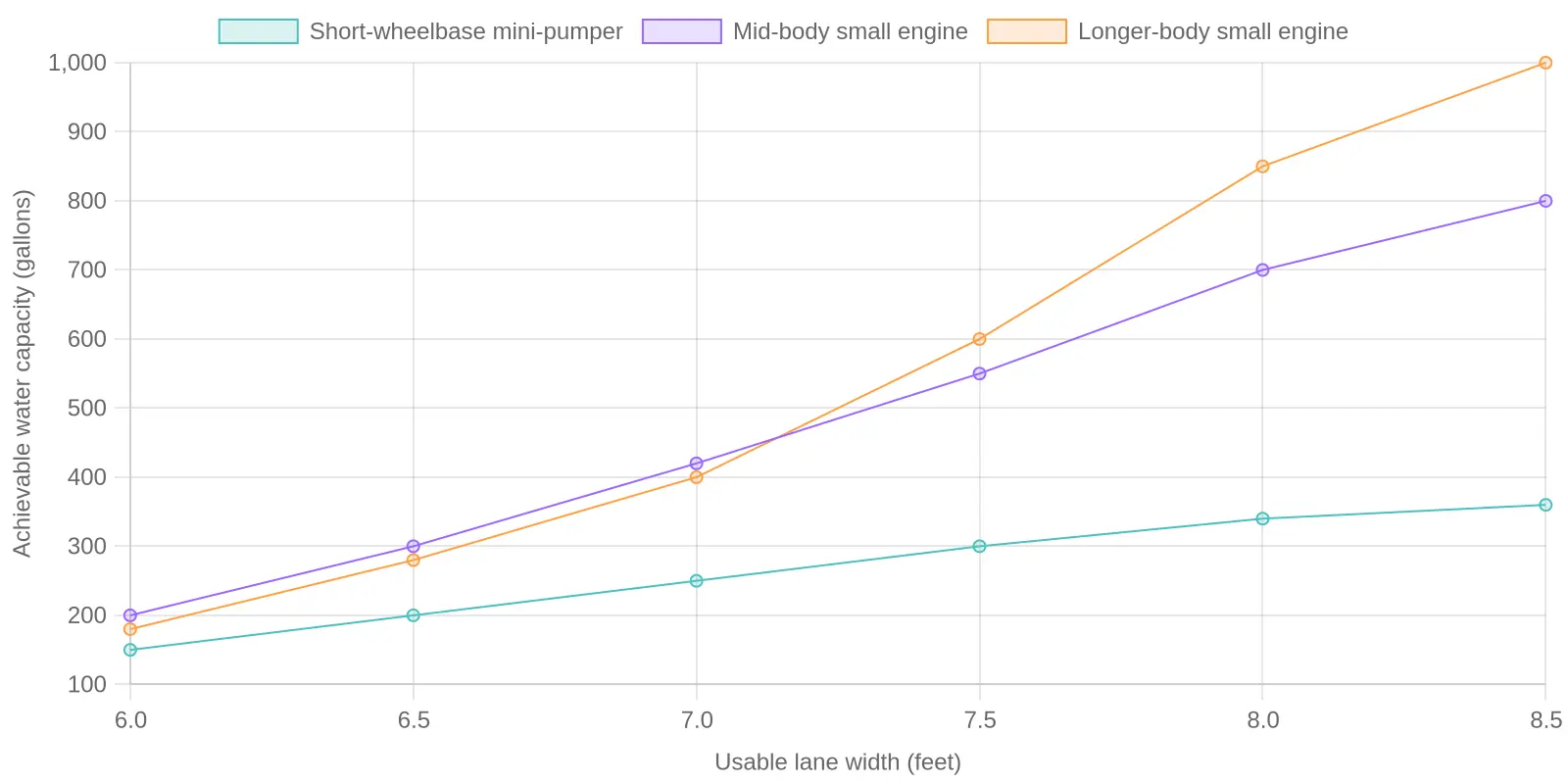
The chart plots usable lane width against achievable water capacity. Across 6.0 to 8.5 feet of clear, drivable pavement, capacity climbs from a few hundred gallons toward 1,000. The shape of each curve matters more than where it starts.
Why the slopes matter
The three configurations diverge, and that divergence is the argument for why narrow rural lanes cap water capacity:
| Configuration | 6.0 ft | 7.0 ft | 8.0 ft | 8.5 ft |
|---|---|---|---|---|
| Short-wheelbase mini-pumper | 150 gal | 250 gal | 340 gal | 360 gal |
| Mid-body small engine | 200 gal | 420 gal | 700 gal | 800 gal |
| Longer-body small engine | 180 gal | 400 gal | 850 gal | 1,000 gal |
- The mini-pumper curve is nearly flat. Its short wheelbase gets it down a 6-foot lane, but capacity plateaus fast. Extra pavement does not help, because the frame cannot carry a longer, heavier tank.
- The mid-body and longer-body curves climb steeply. These engines only approach their true capacity once the lane passes roughly 7.0 to 7.5 feet. Each extra half-foot of usable width is worth hundreds of gallons.
The trade-off in one picture
At 6.0 feet, all three trucks fall into a narrow band between roughly 150 and 200 gallons. There is no way to buy more water, because the limit is not the tank, the pump, or the budget. It is the road. That is why the water a fire engine can deliver is often settled long before anyone writes the spec sheet.
At 8.0 feet, the gap between a mini-pumper and a longer-body small engine opens past 500 gallons. That changes how a rural department runs: fewer refill runs, more time on the attack, less dependence on a tender shuttle. Chassis length, tank placement, and rear-axle loading limits can only be optimized within what the lane geometry allows.
What This Means for Procurement
Before you sign for a larger tank, measure the tightest lanes on the routes to the properties you protect. If the choke points sit at 6.0 to 6.5 feet, a bigger engine buys very little water; the money is better spent on a pump and nozzle package that stretches the smaller onboard volume. If the lanes genuinely allow 8.0 feet or more, the steeper curves turn every extra inch of width into noticeably more capacity.
Weight, Axle, and Payload Limits: Where Tank and Pump Choices Collide
Every pound on a small fire truck is contested. Three numbers govern what the apparatus can do before anyone drafts a spec: the gross vehicle weight rating (GVWR), the gross axle weight rating (GAWR) for each axle, and the payload capacity left after the completed chassis rolls off the line. Together they set the boundary for how much water you can carry and how big a pump you can run.
The payload budget is thinner than it looks
GVWR is the legal ceiling for the loaded apparatus; GAWR splits it between the front and rear axle. Subtract curb weight and what is left is payload, the allowance for water, pump, foam, hose, tools, and crew. On a mini-pumper or brush truck, that allowance disappears faster than most buyers expect.
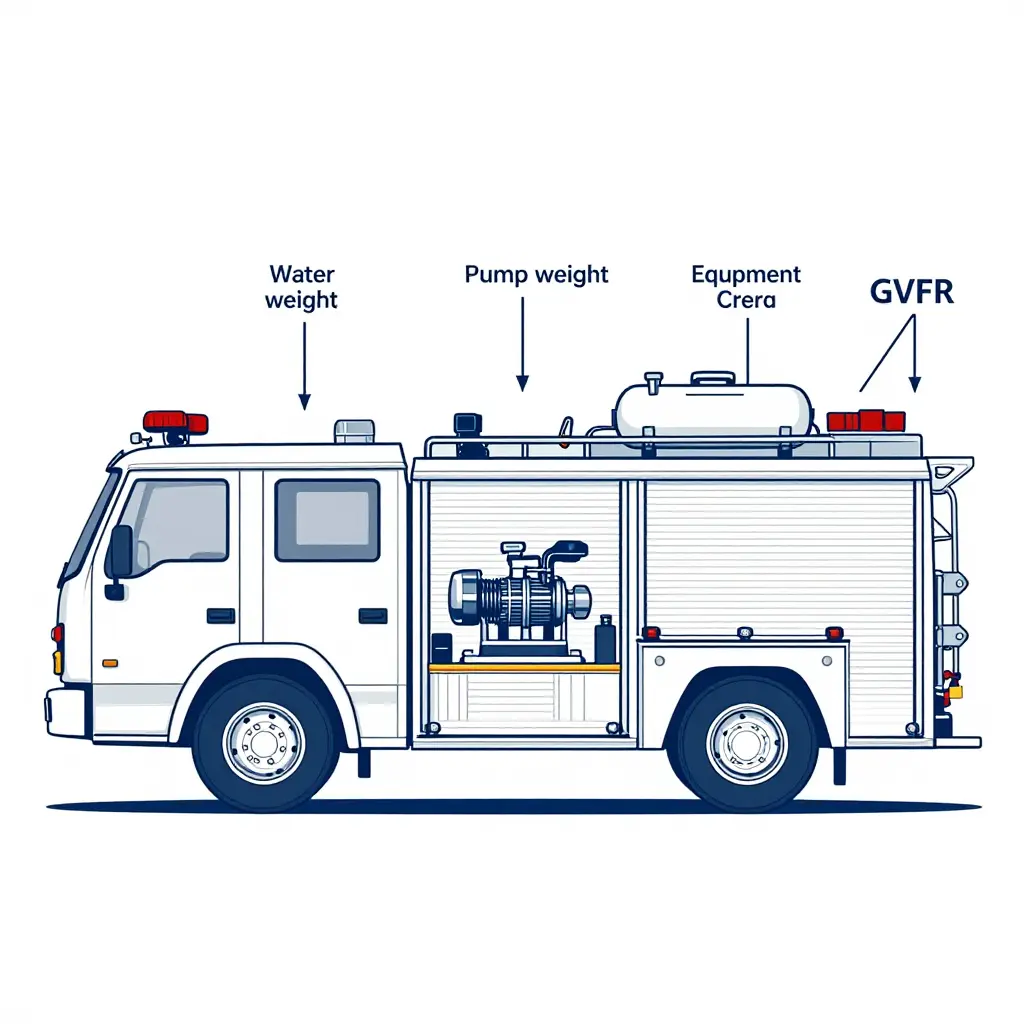
Water is the heaviest single line item. At 8.34 lb per gallon, a 500-gallon tank adds roughly 4,170 lb before a bracket is bolted on. Against a typical budget:
| Item | Approx. weight (lb) |
|---|---|
| Chassis and body (curb) | 9,000 |
| Water (500 gal at 8.34 lb/gal) | 4,170 |
| Hose, tools, foam | 1,200 |
| Crew (4 x 220 lb) | 880 |
| Pump and plumbing | 700 |
| Total | 15,950 |
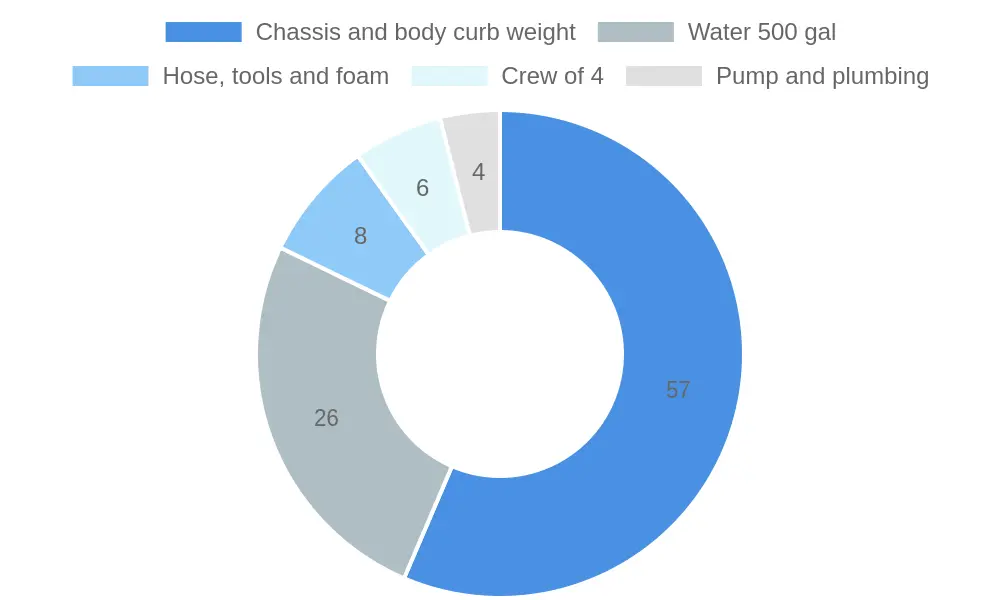
That leaves about 3,550 lb of headroom under a 19,500 lb GVWR, and that is the whole safety margin.
Why water and pumps consume the margin
This is where the pump trade-offs bite. More water means more weight, and because the tank sits behind the cab, that weight lands on the rear axle, usually the first component to reach its limit. A larger pump makes it worse twice: its own mass, plus the heavier plumbing, bigger intake, and stronger driveline it needs. Anyone chasing volume has to trade stored water against equipment and crew weight, and an honest sizing exercise puts that trade in plain view.
When raising capacity does not fit the corridor
The obvious fix is to raise GVWR with heavier suspension, stiffer springs, and bigger brakes. Those changes grow the envelope in the wrong direction for rural work. A wider track, taller frame rails, and beefier axles are harder to place in narrow lanes, tight turns, and low-clearance bridges, which are the corridors these trucks exist to serve. Certifying a higher rating also strains build schedules; see how upfit capacity constraints and delays play out for brush fire truck manufacturers before you commit.
The conclusion
Payload is finite. Every gallon of water and every horsepower of pump comes out of the same account. Size the tank and pump to the corridor first, then fit equipment and crew into what is left.
FAQ
Why do narrow rural lanes cap a small fire truck’s water capacity?
Narrow lanes limit the chassis you can legally and physically run, and that chassis caps the tank. A truck narrow enough to fit tight lanes also tends to have a lower gross vehicle weight rating, which leaves less payload for water. That is why sizing starts with a route survey, not a target water number.
Can a mini-pumper realistically meet rural suppression needs?
Yes, if it works as a first-attack unit backed by a water shuttle or tanker rather than alone. A mini-pumper gives fast knockdown and foam application, but its limited water is not built for sustained delivery. It works when the department models realistic refill cycles and matches the unit to the expected fire load.
How should operators prioritize pump flow versus tank volume?
Start with the nozzle flow needed to knock down the expected fire load, then size the tank to sustain that flow through the initial attack. A large tank paired with an undersized pump cannot produce an effective stream. If a monitor is part of the build, see this guidance on selecting a fog cannon truck to keep flow and pressure matched.
What sizing checks should procurement officers perform before ordering?
Before ordering, verify bridge and road weight limits, turning radius, lane width, and overhead clearance along the response routes. Confirm the chassis GVWR can carry water, pump, and equipment with a reserve, and check the pump curve at your intended operating pressure. It also helps to compare full-size engine specifications so you know what capability you are giving up with a smaller chassis.
Conclusion: Size the Truck to the Lane
The chain runs one way. Narrow rural lanes cap the apparatus footprint. A capped footprint caps water capacity. A capped water capacity forces pump trade-offs. Any spec that ignores the chain, whether a bigger tank, a higher-flow pump, or a longer body, runs into the same wall: the road that has to carry it.
Prioritize in the right order
- Lane fit first. Walk and measure the tightest turns, bridge limits, and driveway radii before writing the spec. If the truck cannot reach the fire, nothing else matters.
- Water strategy second. Decide what the tank must deliver on arrival and what tenders or draft sites will supply. That sets a realistic ceiling for water capacity.
- Pump selection last. Match flow and pressure to the water you carry and the terrain you climb, and accept the pump trade-offs on purpose instead of discovering them on scene.
For chiefs, fleet managers, and procurement officers, the point is the same: keep the wish list inside what the route permits. Equipment matched to real operating conditions, not catalog benchmarks, is apparatus that gets there and keeps working. Teams weighing specialized options may find context in this comparison of fog cannon trucks versus water sprinkler trucks: the right tool depends on the fireground, not the brochure.
The road ahead
Rural fire protection is moving toward lighter, route-aware sizing, where lane width, honest water capacity, and pump trade-offs are designed as one system. Departments that start from route constraints get trucks that fit the lanes they have. Departments that start from capacity wish lists keep buying apparatus their own roads cannot carry.
The answer is not more capability on paper. It is the right capability on the road.