

Matching body size, crew and packing cycle to the streets you actually collect from
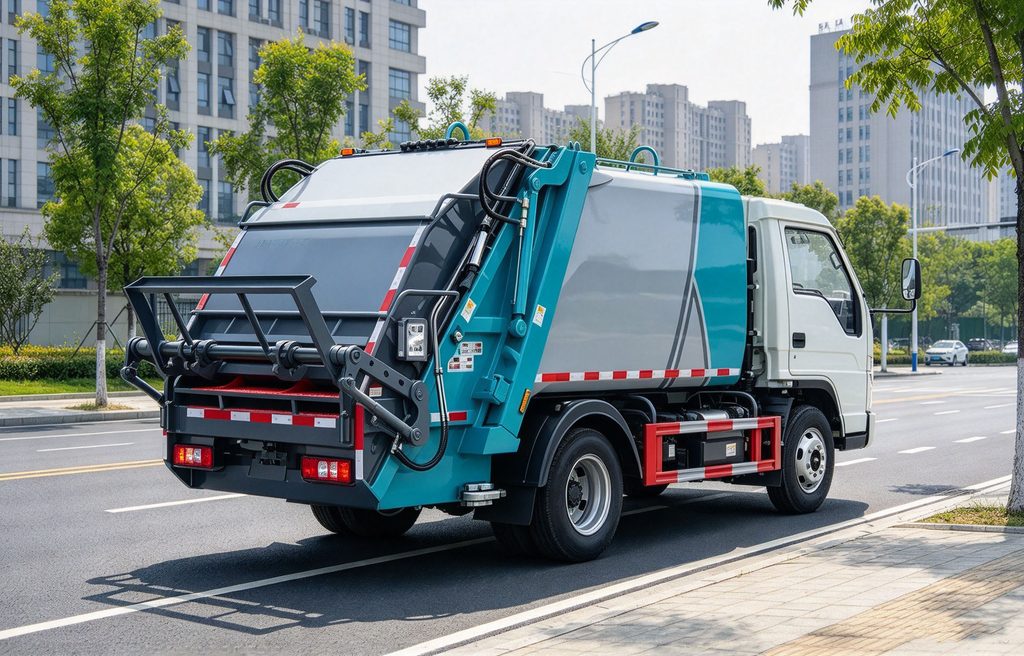
A rear loader is the default answer for household waste collection, and for good reason. It handles loose bins, it compacts as it goes, and it lets a small crew cover a lot of doors in a shift. What it does not do is adapt itself to the route. Body size, hopper volume, packer cycle time and crew size are fixed at purchase, and the route is fixed by the streets you happen to serve. When those two do not line up, the symptom is always the same: the truck finishes the shift half full, or it never finishes the round at all.
This piece looks at how the loading cycle actually breaks down, which route characteristics decide body size, and where the usual specification mistakes get made. It is written for municipal procurement teams, sanitation and fire service administrators, construction contractors, fleet managers running their own special-purpose vehicles, and the maintenance leads who live with the result. CRRC Vehicles covers rail transit, smart mobility, new energy vehicles and special-purpose vehicles, and the figures below are typical operating ranges rather than guaranteed outputs.
What one loading cycle actually costs you
The packer cycle is the shortest, most repeated movement on the whole route, which is why small differences in it compound over a shift. A standard rear loader cycle runs like this:
- Position: the truck stops alongside the bins and the crew brings them to the rear.
- Lift and tip: the bin lifter raises the bin and empties it into the hopper.
- Pack: the packer plate sweeps the hopper contents into the body and returns. This is the fixed mechanical cost of every stop, typically 15 to 30 seconds depending on body size.
- Return and move: the lifter sets the bin down and the truck moves to the next stop.
Only the third step is machine time. The rest is crew movement and driving, which means the biggest gains usually come from route design and bin placement rather than from buying a faster packer. A truck with a 22 second packer cycle on a route with 90 seconds of driving between stops is not going to be transformed by specifying an 18 second one.
Packing cycle time and households served per load by body size
Two things to read out of that chart. Bigger bodies serve more households per load, which is the whole point, but they also take longer to complete each pack. On a dense urban route where stops are 20 metres apart, the extra pack time is barely noticed. On a rural route with several minutes between stops, the same extra seconds are irrelevant for a different reason. Cycle time only becomes the binding constraint on routes with very short inter-stop distances, which in practice means dense old town centres and large housing estates.
Matching the truck to the route
Route characteristics, not fleet preferences, should decide the specification. The table below sets out the common patterns and what each one tends to demand.
| Route type | Defining characteristics | Usually fits | What to watch |
|---|---|---|---|
| Dense old town centre | Narrow streets, frequent stops, on-street parking, kerbside collection | 12 – 16 m³ body, short wheelbase | Turning radius and rear working space matter more than capacity |
| Modern residential estate | Wide roads, clustered bin presentation points, predictable volumes | 16 – 20 m³ body | Noise limits on early rounds, and lifter compatibility with bin sizes |
| Commercial district | Loading peaks vary sharply, restricted parking windows | 16 – 20 m³ with a large hopper | Time windows and hopper volume for bulky commercial loads |
| Industrial park | High volume per stop, long haul to transfer station | 20 – 25 m³ body | Compaction ratio and the cost of deadheading to the tip |
| Rural or peri-urban | Long distances, sparse stops, high mileage per tonne | 20 – 25 m³ body | Fuel use, road speed limits, and driver hours per round |
The mistake that shows up most often is buying one body size for a mixed fleet and then running it across all five of those route types. A 20 cubic metre truck in a dense old town cannot turn or park, so the crew walks further and the round takes longer. A 12 cubic metre truck on a rural round fills up by mid-morning and spends the rest of the shift driving to the tip. Mixed fleets exist for a reason, and the cost of getting the split wrong is paid every single day.
Route checks worth doing before you specify
Most of these can be answered from existing round data rather than a survey:
- Stops per hour currently achieved: the baseline. Anything you specify has to beat it, or the business case does not close.
- Average distance between stops: under 30 metres favours short bodies and fast cycles; over 300 metres makes capacity the priority instead.
- Tonnes collected per round: drives body volume and the number of tip runs per shift.
- Bin mix and sizes: the lifter has to handle what is actually on the street, including 1100 litre containers if they are in use.
- Tip run length: a long haul to the transfer station makes compaction ratio worth paying for.
- Time windows and noise limits: they decide shift length, which decides whether one truck covers the round at all.
- Crew size and turnover: a two-person crew and a one-person crew produce very different stops-per-hour figures on the same truck.
Write those seven numbers into the specification document and send them to suppliers with the enquiry. It turns a discussion about body sizes into a discussion about whether the truck can finish the round, which is the question you actually need answered.
Where the hours go in a shift
A useful sanity check on any specification is to add the shift back up. A typical eight hour round splits roughly into driving between stops, loading, tip runs including travel and queuing, depot time, and statutory breaks. Loading is frequently the smallest of those. If the round is consistently not finishing, the first place to look is usually the tip run, not the packer: a 40 minute round trip to the transfer station taken twice a shift is over an hour of a driver’s day, and it is cheaper to fix by increasing compaction than by specifying a bigger engine.
Frequently asked questions
How many households can a rear loader cover in a day?
Depending on density and crew size, somewhere between 600 and 1,400 households per shift is a realistic band. High-density kerbside rounds with a two-person crew sit at the top of that range; rural rounds with long travel between stops sit at the bottom. Manufacturer brochures rarely quote this because it depends almost entirely on route geometry rather than on the truck.
What body size should I buy?
Take the tonnes you collect per round and divide by the compaction ratio you need, then add margin for seasonal peaks. In practice most municipal household rounds land on 16 to 20 cubic metres, old town routes drop to 12 to 16, and industrial or rural work goes to 20 to 25. Buying the largest body that fits the street is rarely the right answer.
What compaction ratio is enough?
Around 4:1 to 6:1 covers most household waste. Ratios quoted above that are usually measured under ideal conditions with light, dry material and are not sustained on wet mixed waste. If your cost problem is tip runs, compaction is worth paying for; if your problem is round time, it is not.
One-person or two-person crew?
One-person operation cuts labour cost substantially and is common where bins are presented at the kerb in a consistent place. It also reduces stops per hour noticeably, because one person does both the driving and the lifting. On dense rounds the trade-off usually favours one-person operation; on rounds where bins have to be fetched from properties, two people earn their cost.
What should route planning focus on first?
Reduce deadheading first. Distance driven between productive stops and distance driven to the tip are the two largest non-loading costs in most rounds, and both can be improved without touching the truck. Relocating bin presentation points and resequencing rounds often delivers more than a specification change.
Specify against the round, not the brochure
A rear loader is a straightforward machine, and almost every disappointing outcome with one traces back to a specification decided before anyone looked at the round it would run. Measure stops per hour, distance between stops, tonnes per round and tip run length, then choose body size and crew configuration against those four numbers. The result is a truck that finishes its shift, which is the only performance measure that matters operationally.
CRRC Vehicles is a consulting and industry insight team focused on the global mobility and vehicle sector, covering rail transit, smart mobility, new energy vehicles, special-purpose vehicles and emerging transport technologies. We publish ongoing analysis of special-purpose vehicle specifications, operating economics and procurement practice. More detail is available at crrcvehicles.com.