

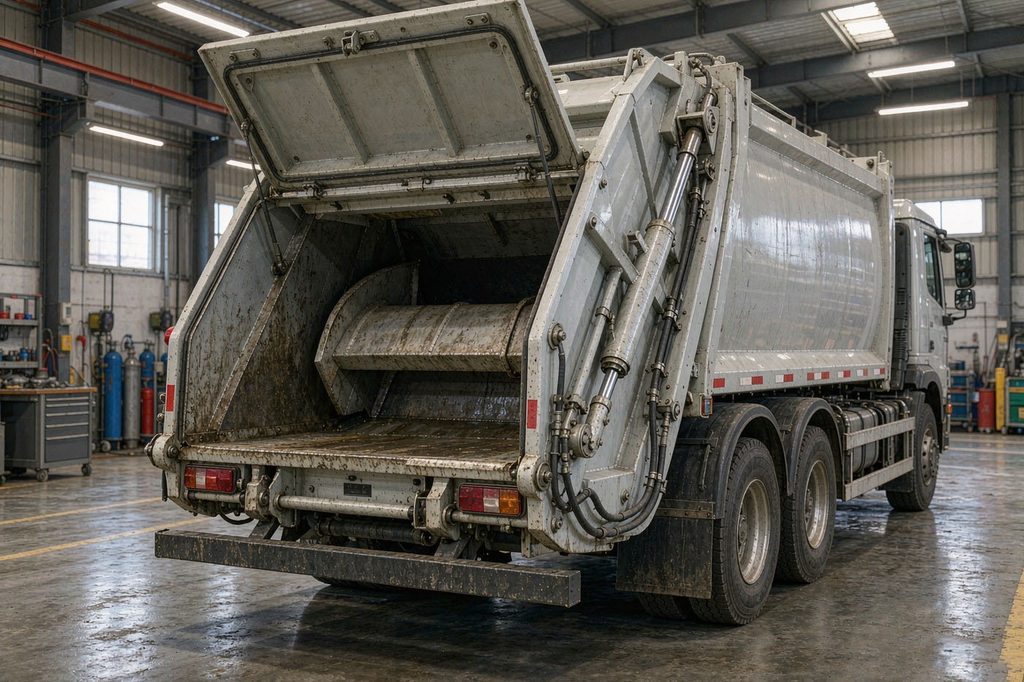
A rear loader that stops packing stops earning. The truck cannot finish its round, the crew is stood down, and the collection backlog builds through the rest of the week. What makes packer faults frustrating is that the visible symptom is often several steps away from the actual cause. A slow packer looks like a weak pump, and it frequently is, but it can equally be a relief valve set too low, a suction strainer blocked with debris, or oil that has simply been in service too long.
This piece sets out where packer downtime actually comes from, how to read the common symptoms, and an order of investigation that reaches the right component without replacing parts on speculation. It is written for municipal procurement teams, sanitation and fire service administrators, construction contractors, fleet managers running their own special-purpose vehicles, and the maintenance leads who get the call. CRRC Vehicles covers rail transit, smart mobility, new energy vehicles and special-purpose vehicles, and the failure distribution below reflects typical fleet experience rather than any single manufacturer’s warranty data.
Establish the baseline first
Before diagnosing anything on a specific truck, you need to know what normal looks like on that model. Record three numbers when the vehicle is healthy: full packing cycle time in seconds at operating temperature, system pressure at the relief setting, and hydraulic oil temperature after ten consecutive cycles. Written on a card kept in the cab, those three figures turn most later faults from a mystery into a comparison. A packer that has gone from 22 seconds to 34 seconds has told you something useful before you have touched a spanner.
Where packer downtime comes from
Across mixed municipal fleets, packer-related downtime concentrates in a fairly consistent pattern. Hydraulics account for the largest share, followed by electrical and control faults, then mechanical wear.
Typical distribution of rear loader packer downtime by cause
The practical reading of that distribution is about where to invest. Hydraulic faults dominate, and a large part of them trace back to oil condition and contamination rather than to component failure. Fleets that treat oil analysis as routine rather than exceptional consistently see the hydraulic share fall. Electrical faults, the second largest group, are usually cheap to fix and expensive to find, which is the opposite of what most workshops budget for.
Symptom to cause, the short version
| Symptom | Likely cause | First check | Typical remedy |
|---|---|---|---|
| Packer slow or weak through full stroke | Pump wear, low oil level, relief valve set low | Oil level and temperature, measured cycle time | Pressure test, reset relief, pump rebuild if flow is down |
| Packer stalls partway through the sweep | Blocked hopper, overloaded material, pressure drop | Hopper contents, current draw on electric drive | Clear and reset, then check relief setting |
| Jerky or uneven movement | Air in the oil, worn cylinder seal | Rod condition, oil appearance for aeration | Bleed the circuit, replace seals |
| Oil weeping at a cylinder rod | Rod seal wear or a scored rod | Rod surface, weep versus active drip | Seal kit, or re-chrome if the rod is scored |
| Packer will not start at all | Interlock, limit switch or solenoid fault | Tailgate switch, emergency stop, fuse and relay | Adjust or replace the switch, reset the interlock |
| Groaning or cavitation noise under load | Suction restriction or low oil | Suction line tightness, tank strainer | Clean the strainer, tighten fittings, top up |
| Cycle time drifting longer over months | Internal pump and valve wear | Compare against the recorded baseline | Rebuild or replace, and review oil intervals |
| Ejector stalls or body will not discharge cleanly | Worn floor liner, bent ejector plate, debris in guides | Floor condition and guide rails | Liner repair, plate realignment, clear guides |
That table is a starting point, not a verdict. Two symptoms can share a cause and one symptom can have three, so the useful habit is to confirm the cheap possibilities before authorising the expensive ones. Replacing a pump to cure a blocked strainer is the classic version of this mistake, and it happens more often than most workshops admit.
An investigation order that works
Run these in sequence. Each step is cheaper than the one after it:
- Ask the operator: when it started, whether it is worse hot or cold, and whether anything changed on the route. Operator reports resolve a surprising share of cases.
- Check oil level, condition and temperature: low level, dark or emulsified oil, and running hot explain most hydraulic complaints.
- Measure, do not guess: time a full cycle and read system pressure against the baseline figures.
- Work the electrical side: interlocks, limit switches, fuses, relays and connectors. Cheap to test, and frequently the answer when the packer will not move at all.
- Inspect cylinders and rods: scoring, weeping, bent rods, play in the pins and bushings.
- Only then test the pump and valves: flow and pressure testing, relief setting, and internal leakage.
- Confirm the repair: re-time the cycle and re-check temperature after ten cycles before the truck goes back out.
Step seven is the one that gets skipped, and it is the reason some trucks come back with the same complaint a fortnight later. A repair that has not been verified against the baseline has not actually been confirmed.
Preventive work that pays for itself
- Oil and filter intervals by hours, not by calendar: packer duty is measured in cycles. A truck doing high cycle counts needs shorter intervals than the manual suggests.
- Annual oil sampling: particle count and water content catch pump wear and cooler leaks months before they become a breakdown.
- Grease the pivot points on schedule: pins and bushings are cheap, and neglect transfers wear into the housing.
- Keep rod covers in place: split or missing covers let abrasive dust onto the rods, which destroys seals.
- Train operators on hopper limits: overloading the hopper is the most common single cause of stalls and bent components.
- Stock the cheap failure parts: limit switches, seal kits, filters and hoses. These are the items that keep a truck parked while you wait for delivery.
Frequently asked questions
Why does the packer work fine cold and slow down when hot?
That pattern points at oil that is either degraded or too thin at operating temperature, which reduces the pump’s volumetric efficiency and increases internal leakage. Check the oil specification against ambient conditions, verify the cooler is working, and sample the oil. If cycle time falls off sharply once the truck is hot, internal pump wear is also a strong candidate.
How long should a packing cycle take?
Typically 15 to 30 seconds for a full sweep depending on body size and packer design. The number that matters is the one recorded when your truck was healthy. A drift of more than about 20 percent from that baseline is worth investigating before it becomes a roadside failure.
Can a slow packer be adjusted rather than repaired?
Sometimes. If the relief valve has been set low or has drifted, resetting it to specification restores cycle time at no parts cost. Do not raise it above the manufacturer’s setting to chase speed, because that shifts the load onto cylinders, hoses and the body structure, and the failure you get next is more expensive than the one you were trying to fix.
Is it worth rebuilding the pump or better to replace it?
For a pump that is simply worn, a rebuild by a competent hydraulic shop is usually the better value. If the pump has suffered contamination damage, scoring or cavitation erosion, replacement is more predictable, and you should find and fix the contamination source first or the new pump will fail the same way.
What should operators report?
Three things: any change in cycle time, any new noise, and any oil on the ground or on the cylinders. Those are the earliest visible signals for most packer faults, and catching them early is the difference between a scheduled repair and a truck off the road mid-round.
Fix the cause, not the symptom
Packer faults reward method over speed. Record the baseline, work from cheap checks to expensive ones, verify the repair against the same numbers, and put the oil interval on hours rather than dates. Fleets that do those four things consistently spend less on packer repairs than fleets with newer trucks and no baseline, which is a fair measure of how much of this is process rather than machinery.
CRRC Vehicles is a consulting and industry insight team focused on the global mobility and vehicle sector, covering rail transit, smart mobility, new energy vehicles, special-purpose vehicles and emerging transport technologies. We publish ongoing analysis of special-purpose vehicle maintenance practice, failure patterns and fleet economics. More detail is available at crrcvehicles.com.
Keyword: rear loader garbage truck compactor failures | Audience: municipal procurement teams, sanitation and fire service administrators, construction contractors, fleet managers and private special vehicle owners, equipment maintenance leads