

What is changing in the rear loader market, and how to write a fleet order that survives delivery
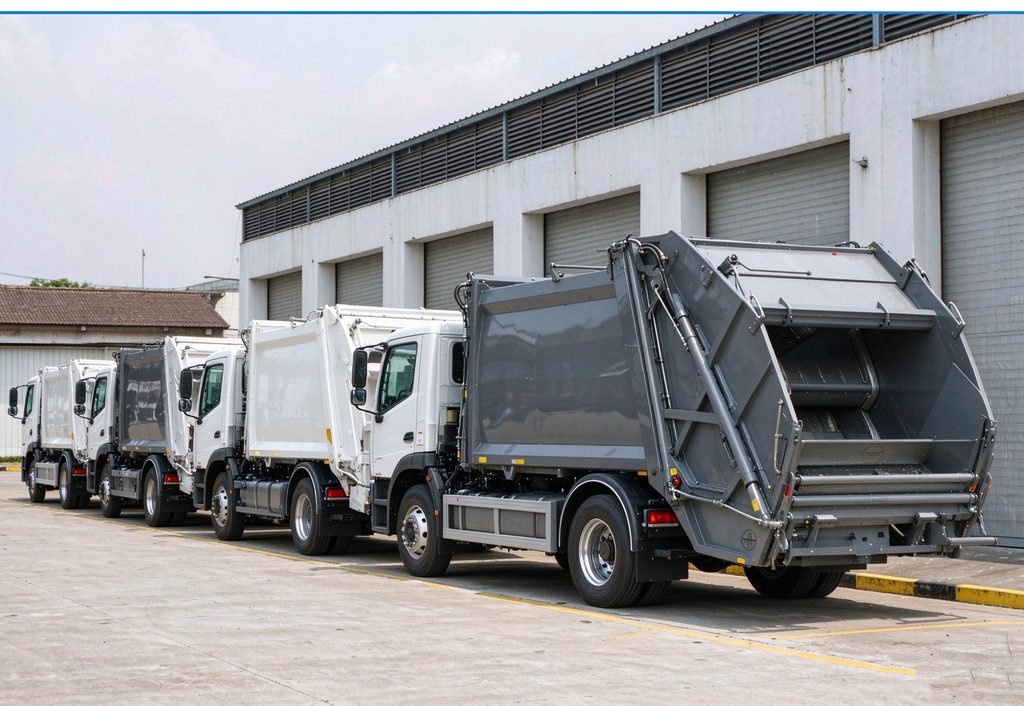
Fleet buyers and single-truck buyers are solving different problems. The single truck is bought to do a job. The fleet order is bought to do a job repeatedly, for years, with predictable parts, training and downtime. That difference changes almost every decision: specification flexibility goes down, documentation requirements go up, and the unit price matters less than the cost of getting the specification wrong across twenty vehicles.
This piece sets out what is currently moving in the rear loader market, what bulk ordering actually saves, and the specification and acceptance checks worth writing into a fleet contract. It is written for municipal procurement teams, sanitation and fire service administrators, construction contractors, fleet managers running their own special-purpose vehicles, and the maintenance leads who inherit the fleet. CRRC Vehicles covers rail transit, smart mobility, new energy vehicles and special-purpose vehicles, and the figures below are indicative market ranges rather than quoted prices.
What is moving in the market
- Alternative drivelines are moving from pilot to fleet: electric rear loaders are now being ordered in tens rather than ones, mostly for urban rounds where the duty cycle is predictable and depot charging can be planned.
- Noise is becoming a specification line: early-morning collection windows in dense areas are being tightened, which pushes buyers towards quieter hydraulics and electric or gas drivelines.
- Telematics is now expected rather than optional: route data, cycle counts and fault codes feed directly into maintenance planning, and fleets are asking for open data access rather than a closed portal.
- Lead times have lengthened and become less predictable: chassis supply, rather than bodybuilding capacity, is the usual constraint, which changes how far ahead orders need to be placed.
- Total cost language is replacing purchase price language: more tenders now score on lifecycle cost, which favours durability and parts availability over the lowest bid.
- Standardisation is being pushed harder: fleets that previously ran three body sizes are consolidating to two, because the training and parts savings outweigh the loss of route-by-route optimisation.
None of those trends remove the basic requirement, which is that the truck has to finish its round. They change which specifications are worth paying for, and they change what you should insist on in writing.
Two of those trends deserve a warning. Electrification is progressing unevenly: it works well where the duty cycle is known and the depot can charge, and it still struggles where routes vary or vehicles do not reliably return to base at night. Buyers who commit an entire fleet at once tend to discover the mismatch route by route, which is expensive to unwind. The lifecycle-cost shift has a similar catch: it only improves outcomes if the tender actually defines how lifecycle cost is calculated. A tender that asks for lifecycle cost without specifying the method gets whichever interpretation suits the bidder.
What bulk ordering actually saves
Volume discount is real but smaller than most buyers expect, and it is not where the main saving sits.
Indicative unit price index by order size
An index of 82 at fifty units sounds like a large saving, and on the purchase line it is. The larger gain usually comes from the things that follow standardisation: one parts inventory instead of three, one training programme, one set of service procedures, and the ability to swap vehicles between routes when one is off the road. Those savings accrue every year of the fleet’s life, while the discount is taken once.
Specification and acceptance checks
| Item | Typical fleet specification | How to verify on delivery |
|---|---|---|
| Body volume | 16 – 20 m³ for household rounds | Physical measurement plus nameplate cross-check |
| Compaction ratio | Not less than 4:1 on mixed household waste | Loaded test with weighed material, not a brochure figure |
| Packing cycle time | 15 – 30 s depending on body size | Time ten consecutive cycles at operating temperature, take the average |
| Bin lifter compatibility | 120 L, 240 L and 1100 L containers | Physical lift test with each container type, loaded |
| Emissions and noise | Current local standard at delivery date | Documentation check plus on-site noise measurement |
| Hydraulic system | Stated pressure, flow and tank volume | Nameplate check plus pressure test under load |
| Corrosion protection | Specified primer and topcoat system with film thickness | Film thickness gauge spot checks across the body |
| Service and parts | Parts stock commitment and response time | Written into contract with named service levels |
| Delivery schedule | Agreed batch delivery dates | Milestone dates in contract with remedies for slippage |
The pattern worth copying is that every line has a verification method. A specification that cannot be checked on delivery is a specification you cannot enforce, and fleet orders are large enough that enforcement matters.
Sequencing a fleet order
- Audit the existing fleet and routes first: body sizes, ages, cycle counts, and which routes consistently fail to finish.
- Decide how many distinct specifications you actually need: usually two, not five. Consolidation is where the long-term saving is.
- Write the technical specification before approaching suppliers: including the acceptance tests in the table above.
- Ask for references on the same duty cycle: not on the same model in a different application.
- Score on lifecycle cost: purchase price, expected parts and service cost, warranty terms and residual value.
- Negotiate parts and training as part of the deal: a discount on parts you will buy for eight years is worth more than the same percentage off the vehicles.
- Negotiate the delivery schedule with milestones: chassis supply is the usual risk, and a batch schedule with remedies is worth insisting on.
- Accept each batch against the written tests: and record the results, because they become the baseline for the vehicles’ whole life.
Residual value deserves a mention here, because it is the line most often left out of fleet business cases. A well-documented fleet with a standard specification, complete service records and a known acceptance baseline sells on a better multiple than a mixed fleet with patchy history, and on a twenty-vehicle order that difference is real money. Keeping the delivery acceptance records from step eight is partly about maintenance, and partly about what the vehicles are worth when you dispose of them.
Step eight is the one that gets compressed when delivery runs late, and it is the one that protects you. A truck accepted without its cycle time recorded cannot be compared against anything two years later, which is when you will want to know whether it has changed.
Frequently asked questions
How much discount should a fleet order achieve?
Indicatively, single units sit at the reference price, five units around 94 percent of it, ten around 89, twenty around 85 and fifty around 82. Beyond roughly fifty units the curve flattens, because the bodybuilder’s own input costs dominate. If a supplier offers a much deeper discount than that, check what has been taken out of the specification.
Should a fleet standardise on one specification?
Usually two rather than one. Most fleets can cover everything with a smaller body for constrained old-town routes and a standard body for everything else. Standardising to a single size either leaves the tight routes unserviceable or buys capacity that rural routes cannot use, and the parts and training benefit is largely achieved at two sizes anyway.
How long do fleet deliveries take?
Currently 8 to 20 weeks per batch is typical, and chassis supply is more often the constraint than bodybuilding capacity. For a fleet, agree a batch schedule with milestone dates rather than a single delivery date, place the order further ahead than you would have two years ago, and put remedies for slippage in the contract.
Are electric rear loaders ready for fleet orders?
For predictable urban rounds with depot charging, yes, and several fleets are running them in volume. For long rural rounds or routes without a reliable return-to-depot pattern, range and charging still constrain them. The honest approach is to electrify the routes where the duty cycle is known and keep conventional drivelines where it is not, rather than committing the whole fleet at once.
What belongs in the contract above all else?
Acceptance tests with pass criteria, parts availability commitments with response times, warranty scope in writing including what is excluded, and a delivery schedule with milestone dates and remedies. Those four are what determine whether the fleet performs over eight years. The headline discount is the one number everyone negotiates and the one that matters least.
Buy the fleet, not the trucks
A fleet order is a decision about eight years of parts, training, downtime and route coverage, made once. Consolidate the specification, write tests you can actually run on delivery, score on lifecycle cost, and negotiate parts and training as seriously as price. Fleets bought that way cost less to run than fleets bought cheaper, and the difference shows up every year rather than once.
CRRC Vehicles is a consulting and industry insight team focused on the global mobility and vehicle sector, covering rail transit, smart mobility, new energy vehicles, special-purpose vehicles and emerging transport technologies. We publish ongoing analysis of special-purpose vehicle markets, fleet economics and procurement practice. More detail is available at crrcvehicles.com.