

Rear loader slide gate jamming causes and fixes
How the sliding tailgate works, why it sticks, and the order to work through when it does
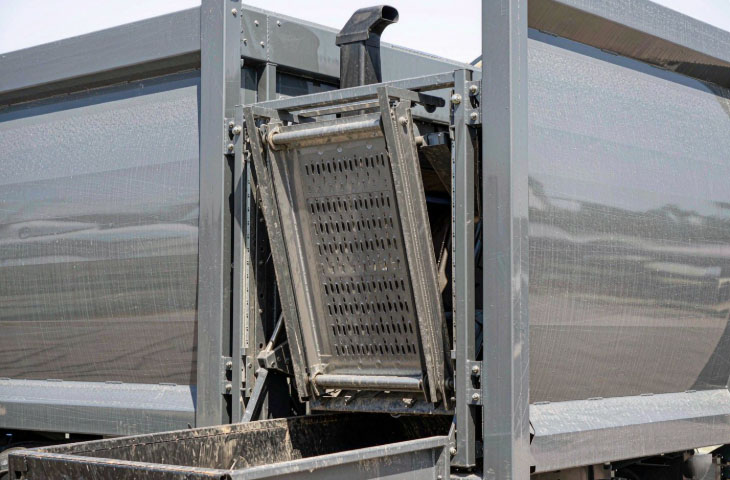
On most modern rear loaders the tailgate does not hinge outwards. It slides vertically in guide channels on either side of the body opening, driven by one or two hydraulic cylinders and held on rollers or slide blocks. That arrangement is compact, it keeps the working envelope small on narrow streets, and it seals well. It is also intolerant of dirt, damage and neglect, because the gate has to stay square as it travels or it binds.
A jammed slide gate takes the truck off the road just as effectively as a failed packer, and it is far more often a maintenance issue than a component failure. This piece covers how the mechanism works, what actually causes jamming, and the sequence worth following when one sticks. It is written for municipal procurement teams, sanitation and fire service administrators, construction contractors, fleet managers running their own special-purpose vehicles, and the maintenance leads who get called out. CRRC Vehicles covers rail transit, smart mobility, new energy vehicles and special-purpose vehicles, and the distribution below reflects typical fleet experience rather than any single manufacturer’s data.
What has to stay true for the gate to move
Four conditions, and it jams if any one of them fails:
- The channels are clear: material packed into a guide channel physically stops the gate.
- The gate stays square: the two sides have to travel together. Anything that holds one side back makes the gate cock in its channels and bind.
- The rollers or slide blocks turn or slide freely: seized rollers convert sliding motion into grinding.
- Hydraulic force arrives evenly: twin cylinders have to be synchronised, and pressure has to reach the setting the mechanism was designed for.
Almost every jam traces back to one of those four. The useful part of diagnosing is working out which, because the fixes are very different and one of them costs nothing.
Where jamming comes from
Typical causes of rear loader slide gate jamming
Material packed into the guide channels is the single largest cause, and it is also the one with the cheapest fix. That is why the first step in any slide gate diagnosis is a look and a brush rather than a spanner. Wear-related causes, channel distortion and roller failure, come next, and they are the ones that need parts and workshop time.
Symptom to cause
| Symptom | Likely cause | How to confirm | What it needs |
|---|---|---|---|
| Gate stops partway on the way up | Material packed in a guide channel, or low pressure | Visual check of both channels, then measure pressure | Clear the channel, then check relief setting |
| Rises slowly or weakly through full travel | Cylinder internal leakage, pump wear, blocked strainer | Time the travel, read system pressure | Seal kit, pump or strainer depending on test result |
| One side lags and the gate tilts | Cylinders out of sync, or one channel obstructed | Measure height difference side to side | Clear the obstruction, adjust the synchronising valve |
| Will not seat fully when closing | Limit switch out of adjustment, or debris on the sealing face | Check switch position and inspect the frame face | Clean the face, reset the limit |
| Metal grinding or squealing during travel | Seized roller or dry, worn channel | Watch each roller while cycling, check for flat spots | Replace rollers, lubricate the channels |
| Leaks once closed | Worn seal profile, or a distorted gate | Inspect seal compression marks around the frame | Replace the seal, or straighten the gate if it is bent |
| Does not move at all | Electrical interlock, limit switch or solenoid fault | Check fuses, switches, relay and solenoid coil | Electrical repair, usually low cost |
One distinction saves a lot of diagnosis time: mechanical resistance and insufficient force feel similar to an operator but behave differently. Mechanical resistance usually shows up at a repeatable point in the travel, often the same height every cycle, and the gate tends to stop rather than slow down gradually. Insufficient force shows as a gate that moves sluggishly across the whole stroke, gets worse as the oil warms up, and may still complete the travel when the body is empty. If the symptom is position-dependent, look at the channels and rollers. If it is speed-dependent and temperature-related, look at the hydraulics.
An order that avoids replacing the wrong part
Run these in sequence. Each step costs less than the next:
- Stop and do not force it: holding the control open against a jam bends cylinders, distorts the gate and damages the channels. Forcing a slide gate is how a cleaning job becomes a fabrication job.
- Look at both channels: brush out packed material and inspect for damage. This resolves the largest single share of cases at no parts cost.
- Check lubrication: dry channels and dry rollers bind. Confirm the grease points have actually been serviced.
- Cycle slowly and watch: have someone operate the control while you watch both sides for lag, tilt, roller rotation and contact marks.
- Measure pressure and cycle time: compare with the figures recorded when the truck was healthy.
- Test the electrical side: interlocks, limit switches, solenoids, fuses and connectors.
- Only then remove components: cylinders, rollers and the gate itself, once the cheap explanations have been ruled out.
- Re-test and record: cycle several times, confirm travel is square and the seal seats, then note the finding so the pattern can be tracked.
Preventive work that actually helps
- Wash the gate area at the end of each shift: material left in the channels dries hard and packs in.
- Grease rollers and slide blocks on a cycle-based schedule, not a calendar one. High-cycle trucks need it far more often than the manual suggests.
- Inspect channel straightness at every major service: a bent channel from a reversing impact will jam the gate repeatedly until it is straightened.
- Keep the seal face clean: hardened material on the sealing surface holds the gate off its seat and starts a leak.
- Train operators on the interlocks: most “it will not move” callouts are a switch, an interlock or a control sequence, not a fault.
- Keep rollers and seals in stock: they are cheap, and they are the parts that keep a truck parked while you wait for delivery.
Frequently asked questions
Why does the slide gate stick most often when the body is full?
A full body means material has been pressed against the gate face and into the lower part of the channels, and the gate is also working against a heavier load. Both raise the force needed to move it. If sticking only happens when full, clean the channels and check the relief setting before suspecting the cylinders.
Can operators force the gate with the controls?
They should not, and the control system should not let them. Holding a control against a mechanical stop bends cylinder rods, distorts the gate in its channels and can tear the mounting. Fit and maintain the interlocks, and make “do not force it” explicit in operator training. The repair from forcing is several times the cost of the cleaning job that would have prevented it.
How often should the channels be greased?
Tie it to cycles rather than to dates. A truck running high cycle counts on dense rounds may need attention weekly; a light rural round may be fine monthly. The practical test is to watch the rollers: if they are dry, dull or not turning, the interval is too long.
How much channel wear is too much?
Measure the channel gap against the new-build figure and look for the gate rocking side to side when partway up. Visible play, polished wear flats, or any distortion that lets the gate cock means the channel section needs replacement or straightening. Chasing it with adjustment alone will not hold.
What is the cheapest way to cut slide gate callouts?
Washing. Most jams start with material packed into a channel, and a proper wash at the end of each shift prevents the majority of them. Fleets that add a gate-area wash to the daily routine typically see this fault category fall sharply, with no parts spend at all.
Clean it before you strip it
Slide gate jams look mechanical and are usually housekeeping. Check the channels, check lubrication, watch a slow cycle, and only then start removing components. Forcing the mechanism is the one thing that reliably turns a cheap fix into an expensive one, so make sure the interlocks work and that operators know why they are there. Do those things and the gate stops being a recurring problem.
CRRC Vehicles is a consulting and industry insight team focused on the global mobility and vehicle sector, covering rail transit, smart mobility, new energy vehicles, special-purpose vehicles and emerging transport technologies. We publish ongoing analysis of special-purpose vehicle maintenance practice, failure patterns and fleet economics. More detail is available at crrcvehicles.com.