

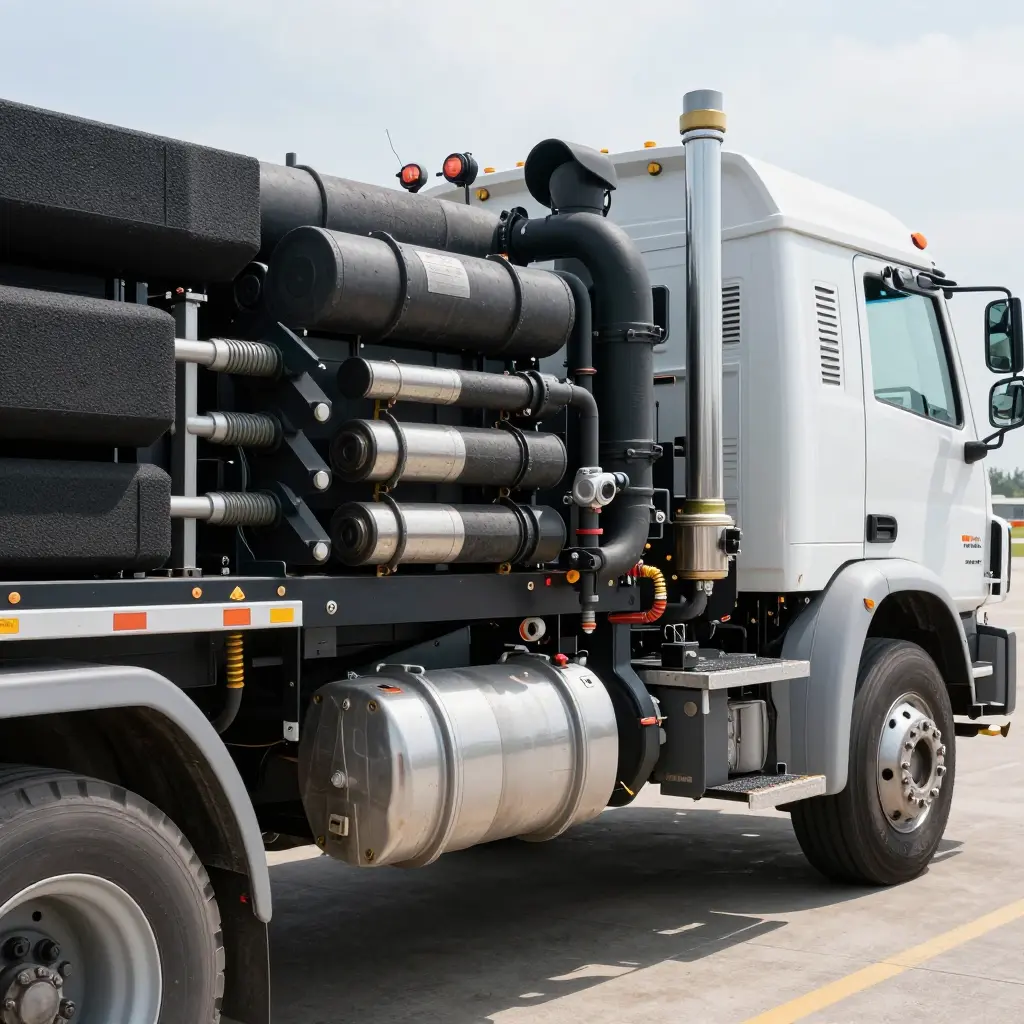
Why Engine Hours Mislead ARFF Buyers
Procurement managers scanning listings of used Oshkosh ARFF trucks tend to treat engine hours as the most objective number on the spec sheet. It is one tidy figure that appears to summarize wear. It does not. In airport rescue and firefighting service, engine hours count how long a chassis sat idling or shuttled across a ramp; they say nothing about how hard the firefighting system has worked.
ARFF chassis engines are oversized and under-stressed by design, built for a service life measured in decades. A rig may sit at a standby post for hours at idle, ready to respond in seconds, then log only minutes of real driving on a short runway response. A well-maintained diesel can accumulate 5,000 to 10,000 engine hours and remain mechanically healthy for years of further duty. Low or moderate engine hours therefore tell a buyer little about the drivetrain, and even less about what matters most.
The wear that engine hours cannot see
Chassis wear and firefighting-system wear age at completely different rates, and that gap is where deals are won and lost:
- Chassis wear is gradual and visible. Oil analysis, coolant condition, transmission data, and frame inspection will tell you a consistent story.
- Foam system wear is hidden and chemical, and neglect accelerates it: contaminated tanks, degraded AFFF concentrate, corroded proportioning valves, seized foam pumps, clogged eductor lines, and perished seals behind the panel.
- A truck can show low, idle-friendly engine hours while its foam delivery system is effectively dead. Annual performance testing will find it; the hour meter never will.
That disconnect is why buyers who budget for cosmetics and minor servicing later find the real refurbishment budget dominated by foam system remediation, tank relining, and pump overhaul. True condition shows up in the maintenance and test history, not on the odometer or hour meter. Knowing how to read service records and certified pump work is what separates an informed buyer from one who inherits someone else’s deferred liability.
Pricing used ARFF apparatus on odometer and engine-hour data alone is a classic valuation error. It anchors the negotiation on the healthiest, most durable component and ignores the most expensive, most degradable one. Buyers who start from firefighting-system condition price the risk accurately, negotiate harder, and avoid the hidden line items that sink an otherwise sound purchase.
ARFF Foam System Anatomy: Why Wear Hides in the Plumbing, Not the Engine Block
On a used Oshkosh ARFF truck, the engine hour meter says almost nothing about true ownership cost. What decides it is foam system condition: the health of the tanks, plumbing, and electronics that turn foam concentrate into a fire-suppressing blanket. A truck with low hours can still face a six-figure ARFF truck refurbishment bill because its foam system sat idle with concentrate inside it.
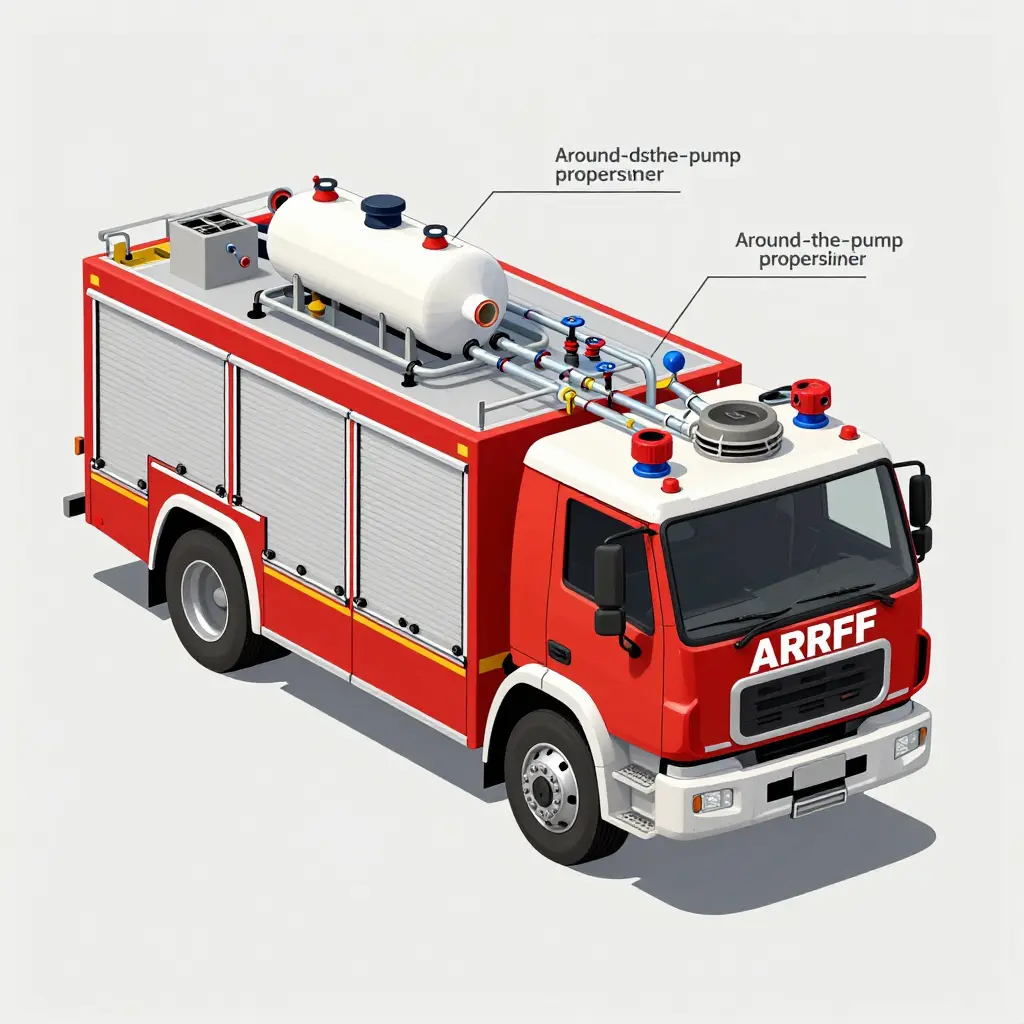
What Is Actually in the Foam System
Seven assemblies do the work:
- Foam concentrate tank – stores the AFFF or fluorine-free agent, usually stainless steel or composite-lined.
- Proportioning system – meters concentrate into water at a precise 3 percent or 6 percent ratio.
- Pumps – a dedicated foam pump or an around-the-pump proportioner that blends under pressure.
- Valves – directional, check, and bypass valves that route flow to the correct discharge.
- Piping – the manifold network carrying the finished solution.
- Nozzles and turrets – roof and bumper monitors that apply the foam.
- Control electronics – the PLC and sensors that command proportioning and log flow.
Where the Decay Starts
Tanks corrode from the inside. Foam concentrates are surfactant-rich and often alkaline; they attack seams, weld lines, and any aluminum fittings left in contact. Once pitting starts, it spreads.
Proportioning drifts. Foam proportioning depends on tight orifice and eductor tolerances. A little seal swelling or sediment changes the ratio invisibly: the gauge still reads normal while the concentrate percentage slides off spec. This is calibration drift, and it is the hardest defect to catch before purchase.
Seals harden. Elastomers in pumps and valves lose plasticizer over the years, going brittle and losing their squeeze. A hardened O-ring leaks, then scores the mating surface.
Piping and nozzles clog. Residual concentrate dries into a waxy film that narrows passages, so flow falls and turret reach drops. Nozzle performance tracks plumbing health closely; this guide to certified pump service explains how.
Electronics drift. Flow sensors and pressure transducers lose calibration, and the control loop ends up chasing a false reading.
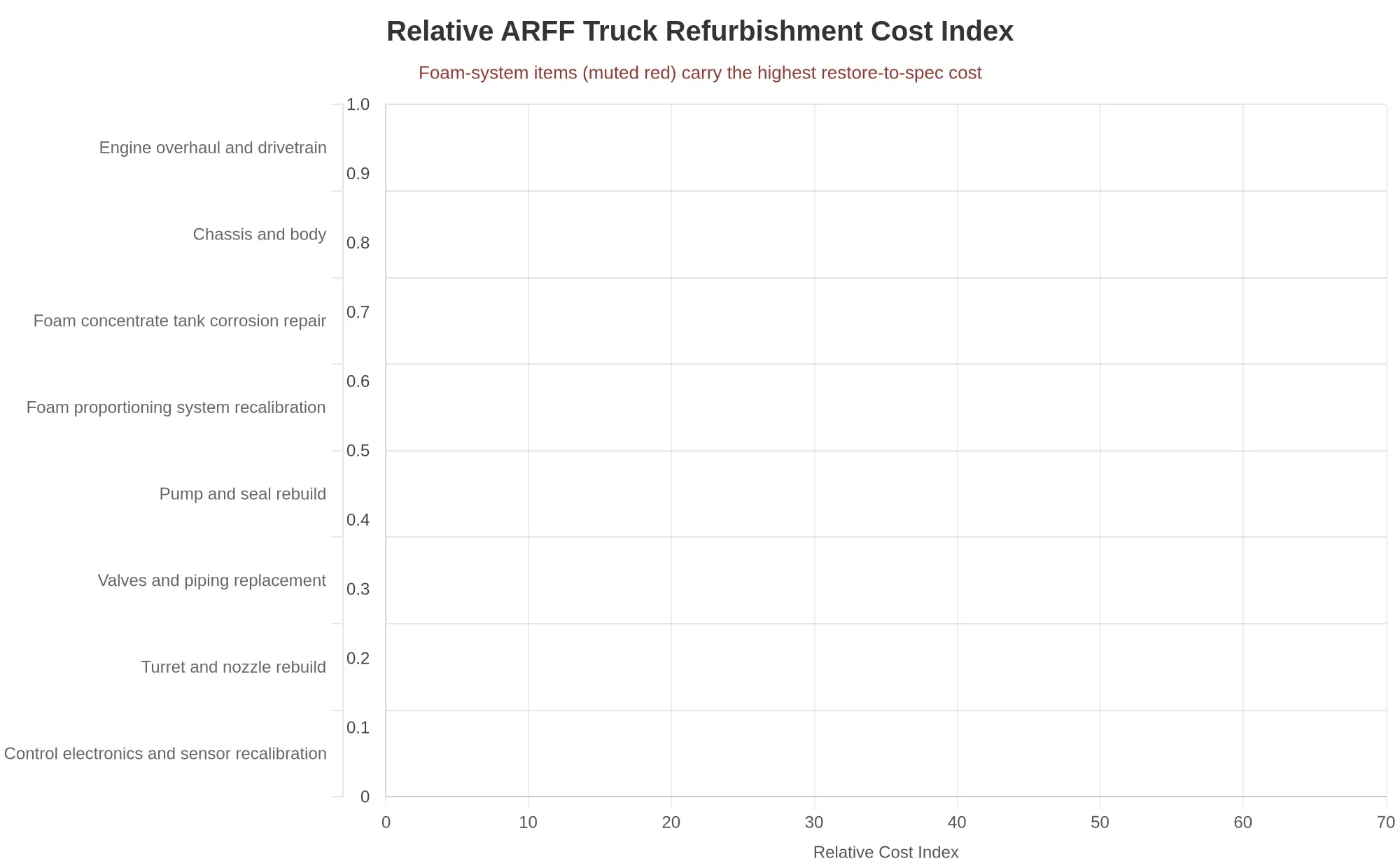
The Physics: Why Foam Wear Is Costlier to Reverse
Engine wear is mechanical and roughly linear. Metal wears predictably, and a rebuild is additive: replace bearings, machine surfaces, reassemble to spec. Damage accumulates steadily and is straightforward to quote.
Foam degradation is chemical and geometric, and both behave non-linearly. Corrosion removes material and deposits new compounds, so a tank that looks sound can be structurally compromised. Proportioning is a ratio function: a small physical change in a seal or orifice produces a disproportionate change in output ratio. The damage is not only expensive to repair; it is expensive to detect and verify.
Restoring foam system condition to spec requires full teardown, replacement of all wetted parts, and re-certification through flow testing. Engine work is quoted from known parts; foam work must be measured, then measured again.
Reading the Cost Signature
| System area | Primary degradation | Restoration cost weight |
|---|---|---|
| Foam concentrate tank | Alkaline corrosion, pitting | High |
| Proportioning system | Calibration drift | Very high |
| Pumps and seals | Seal hardening | High |
| Valves and piping | Corrosion, film clogging | High |
| Nozzles / turrets | Residual fouling | Moderate |
| Control electronics | Sensor calibration drift | Moderate |
How the ARFF Foam System Works
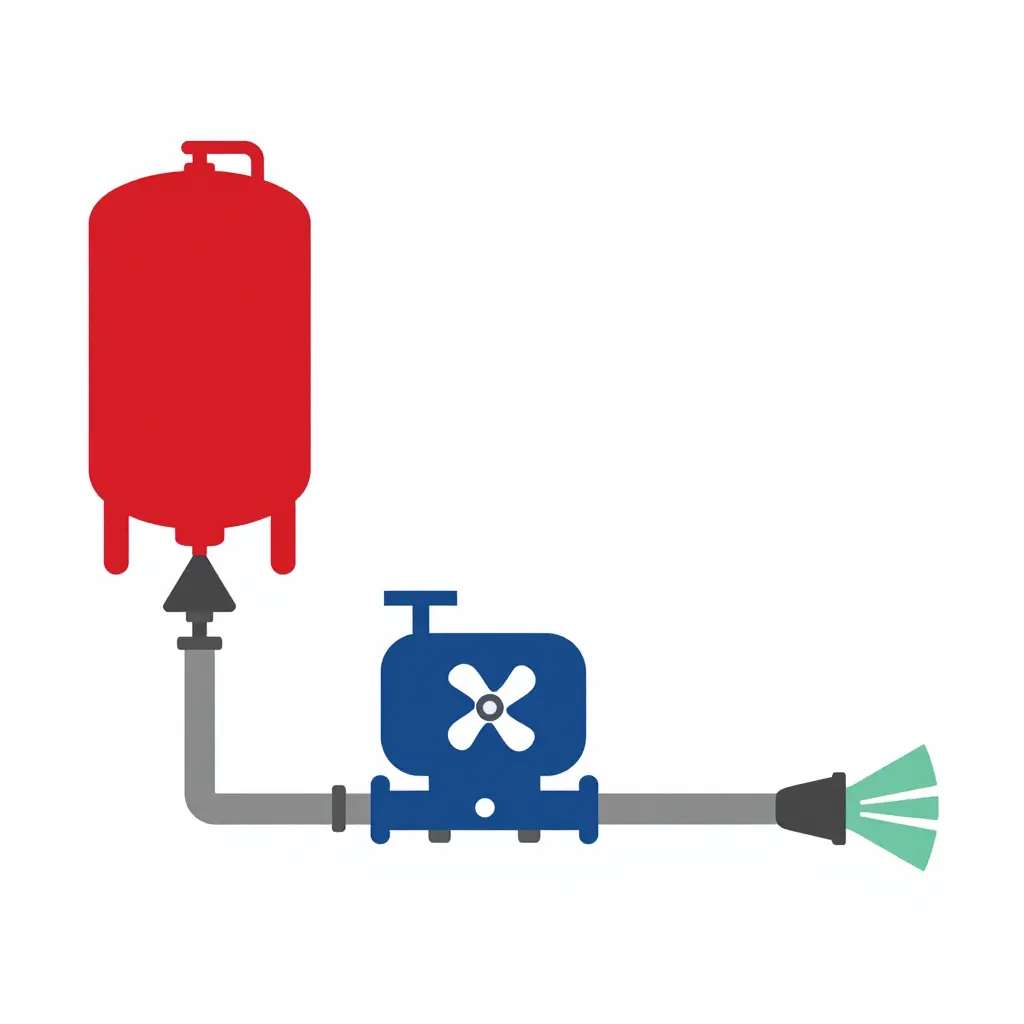
To judge a used Oshkosh ARFF truck on anything other than engine hours, you need to know what you are looking at. The schematic above traces the path foam takes: foam concentrate is drawn from its storage tank, metered through the proportioner, and blended with pressurized water from the water pump at a single mixing point. The finished solution then travels through the piping network to the turret and nozzle and onto the fireground.
Each component wears differently. The proportioner and mixing point show corrosive attack and calibration drift first; piping and turret seals degrade from pressure cycling and exposure. A truck with low engine hours but a neglected foam path can therefore cost far more to refurbish than its odometer suggests.
| Evaluation Factor | Typical Inspection Method | Impact on Refurbishment Cost (High/Medium/Low) | Reversibility | Compliance Relevance |
|---|---|---|---|---|
| Group A – Foam System Condition Factors | ||||
| Foam concentrate quality | Batch and date-code review, refractometer reading, conductivity test, visual check for separation or sludge | High | Partially reversible – concentrate can be swapped, but the lines and tank it touched may also need flushing | High – concentrate must still meet ICAO and NFPA foam performance specs |
| Proportioning calibration | Flow-meter test of the proportioner across multiple discharge rates, induction percentage verification | Medium to High | Reversible with recalibration or a rebuilt proportioner | High – incorrect induction ratios fail acceptance testing |
| Seal and valve condition | Pressure-hold test, cycle test of actuators, visual inspection for weeping or seeping joints | Medium | Reversible – seals, seats and valves are replaceable parts | Medium – leaks affect reliability and routine operational checks |
| Piping corrosion | Ultrasonic wall-thickness testing, borescope inspection, hydrostatic pressure test | High | Often irreversible – internally corroded piping usually means replacement | High – corrosion threatens both performance and pressure integrity |
| Pump and turret condition | Pump performance-curve test plus turret and roof-monitor rotation, aiming and reach checks | High | Partially reversible – rebuild is possible but costly on aged fire pumps | High – pump and monitor output must meet rated ARFF discharge targets |
| Group B – Engine Hours Factors | ||||
| Engine/chassis wear | Odometer and engine-hour meter readings, oil analysis, compression test, visual drivetrain inspection | Medium | Largely reversible – serviceable through routine overhaul and component replacement | Medium – affects roadworthiness and response reliability |
| Drivetrain and powertrain wear | Hour-based inspection of transmission, differentials and brakes, plus service-record review | Low to Medium | Reversible – rebuilt or replaced from the parts channel | Low to Medium – mostly a maintenance and uptime issue |
| Meter vs actual service-life mismatch | Cross-check of hour meter against maintenance logs, telematics history and wear indicators | Low | Fully reversible – a documentation and verification concern, not a physical repair | Low to Medium – matters mainly for valuation and disclosure |
Interpretive note: The table points one way: foam system condition, not engine hours, dominates refurbishment cost on a used Oshkosh ARFF truck. Engine-hour factors sit mostly in the low-to-medium band and are broadly reversible, so a high-hour chassis rarely sinks a project by itself. Foam condition is the opposite. Degraded concentrate, corroded piping, and miscalibrated proportioners cluster in the high-cost, often irreversible band and carry direct compliance consequences, pushing the true cost well past what the odometer or hour meter suggests. Buyers who inspect the foam side first and line up certified pump service during due diligence avoid the largest overruns and negotiate from a stronger position.
Pre-Purchase Foam System Inspection Checklist for Used Oshkosh ARFF Trucks
On used Oshkosh ARFF trucks, the foam system usually says more about refurbishment cost than the engine hour meter does. A tired but serviceable powertrain can be repaired predictably; a degraded foam system can hide corrosion, failed proportioners, and obsolete concentrate that turn into six-figure rebuilds. Work through this checklist before you sign.
- Verify foam concentrate age, type, and chemistry. Confirm it matches the truck’s design (AFFF, AR-AFFF, or fluorine-free) and is still within shelf life; expired or mismatched concentrate is a common and costly surprise.
- Request and review proportioner calibration records. Check that the balanced-pressure or around-the-pump proportioner was recently flow-tested and holds its rated induction percentage across the full pump range.
- Inspect all seals, gaskets, and elastomers for hardening or cracking. Foam systems punish rubber, so look at valve seats, pump seals, and turret swivels for the stiff, brittle wear that signals imminent leaks.
- Examine foam piping, manifolds, and discharge lines for internal and external corrosion. Pitting, scale, and trapped concentrate residue are frequent hidden defects on aging apparatus.
- Test the foam pump and turret under real load: run the pump, exercise the turret through its full travel, and confirm reach and pattern control work as specified.
- Review the complete foam system service log. A documented history of certified pump service shows the system was maintained, not merely operated.
- Confirm current certification status. Verify the ARFF truck inspection records meet NFPA 412 and any applicable authority-having-jurisdiction requirements.
- Document the foam tank interior condition. Check bladders, coatings, baffles, and the sediment or sludge build-up that can contaminate fresh concentrate.
- Verify the flush, drain, and rinse systems operate correctly. Residual concentrate left in lines is what rots piping from the inside out.
- Check foam concentrate tank fittings, level sensors, and low-level alarms for function and accuracy.
Sort your findings into safety-critical and certification-blocking defects, high-cost refurbishment items, and minor service tasks, then price the repairs accordingly instead of negotiating on engine hours alone.
Cost-Driver Analysis: Where the Refurbishment Dollars Actually Go
Buyers evaluating a used Oshkosh ARFF truck tend to anchor on the odometer and engine hours. That instinct is usually wrong. In our teardown work, the money spent during a refurbishment is concentrated on the foam side of the apparatus, not the drivetrain. The chart below shows each major system’s share of a typical ARFF refurbishment budget; the two foam-related line items together account for more than half of it.
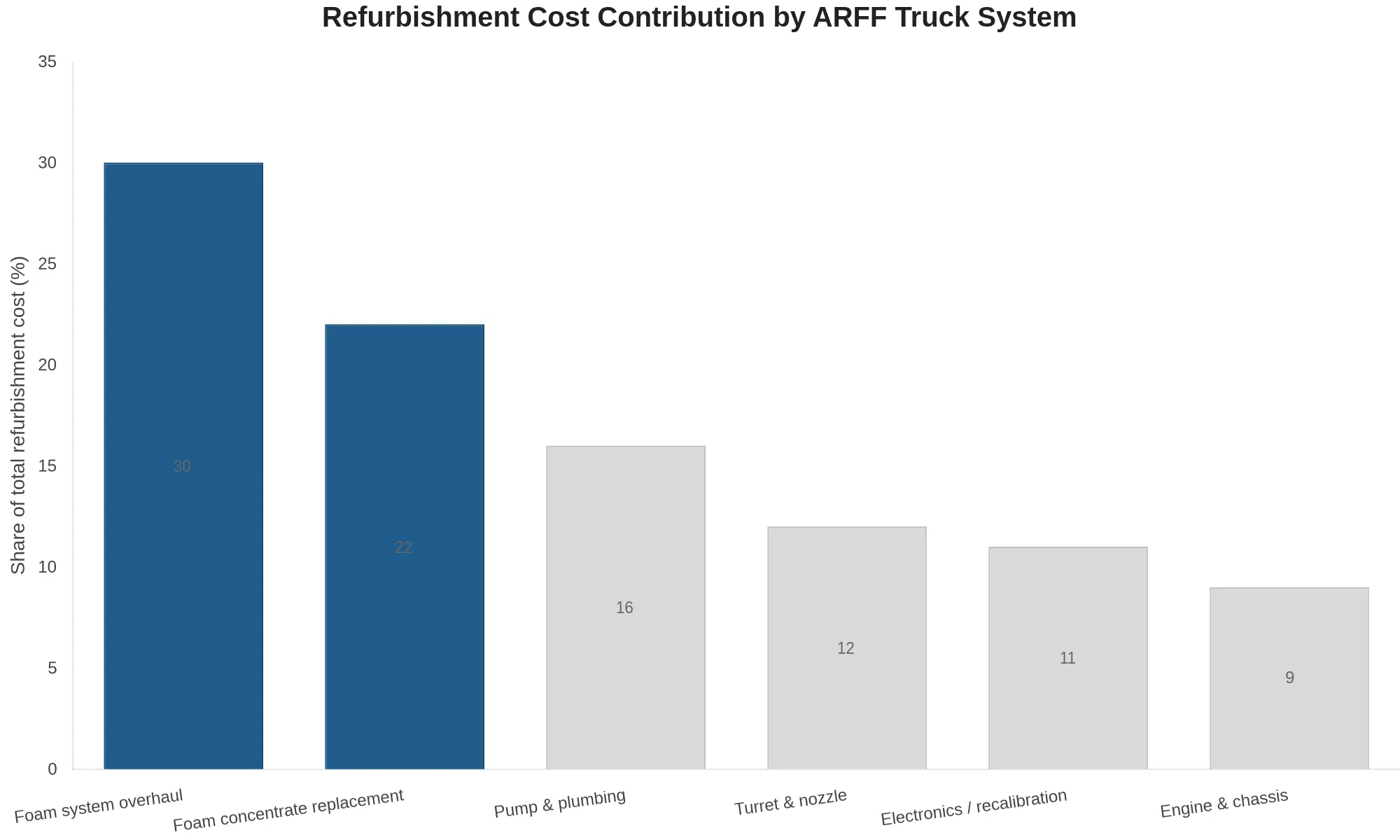
The bars show what engine-hour valuation metrics miss:
- Foam system overhaul (30%) – The largest single line item. The proportioner, foam pump, bladder tank, and valving wear from concentrate exposure, not mileage. Seals, diaphragms, and balance lines foul with dried concentrate residue on air-driven and electric proportioners alike.
- Foam concentrate replacement (22%) – Often overlooked, and a shock to first-time ARFF buyers. Depending on tank size and whether AFFF or fluorine-free is required, flushing and refilling concentrate alone can dominate the budget before any repair work begins.
- Pump & plumbing (16%) – Centrifugal fire pump rebuilds, relief valves, and the piping runs that carry foam solution. Important, but roughly half the impact of the foam systems themselves.
- Turret & nozzle (12%) – Under/over-turret actuation, nozzle seals, and oscillation mechanisms. Critical for performance, moderate for cost.
- Electronics / recalibration (11%) – Foam proportioning controllers, flow sensors, and calibration that must be re-verified after any foam work. Newer trucks carry more of this burden.
- Engine & chassis (9%) – The category buyers fixate on is frequently the smallest contributor. A high-hour diesel that has been well maintained is often a smaller financial risk than a low-hour truck with a neglected foam system.
A 20,000-hour ARFF truck with clean foam records can be a better buy than a 6,000-hour truck whose concentrate was never flushed. The refurbishment math inverts the value metric.
For buyers building a refurbishment budget, sequence matters as much as the total. Scope and price foam work first: it drives the largest cost and gates downstream recalibration. A certified ARFF pump and foam system service assessment before purchase is the cheapest insurance against a foam-side surprise.
Quick Reference: Estimating Foam-Side Exposure
| System | Typical Share | Primary Wear Trigger |
|---|---|---|
| Foam system overhaul | 30% | Concentrate exposure, seal/proportioner degradation |
| Foam concentrate replacement | 22% | Age, spec changes, contamination |
| Pump & plumbing | 16% | Cavitation, corrosion, run hours |
| Turret & nozzle | 12% | Actuation cycles, seal wear |
| Electronics / recalibration | 11% | Sensor drift, controller aging |
| Engine & chassis | 9% | Hours, but often well maintained |
Use these shares as a starting framework, then adjust for tank size, concentrate chemistry, and the truck’s documented foam-service history. The direction holds even when the exact percentages shift.
Translating Foam Condition Into a Refurbishment Budget
On used Oshkosh ARFF trucks, engine hours barely move the needle on cost. Foam system condition does. A truck with 4,000 idle hours and a pristine proportioner is often a better value than a low-hour unit whose tank lining has failed and whose foam plumbing is undocumented. To turn an inspection report into a defensible refurbishment budget, sort every finding into one of three severity tiers; the tier, not the engine-hour meter, sets the ceiling on any ARFF truck refurbishment plan.
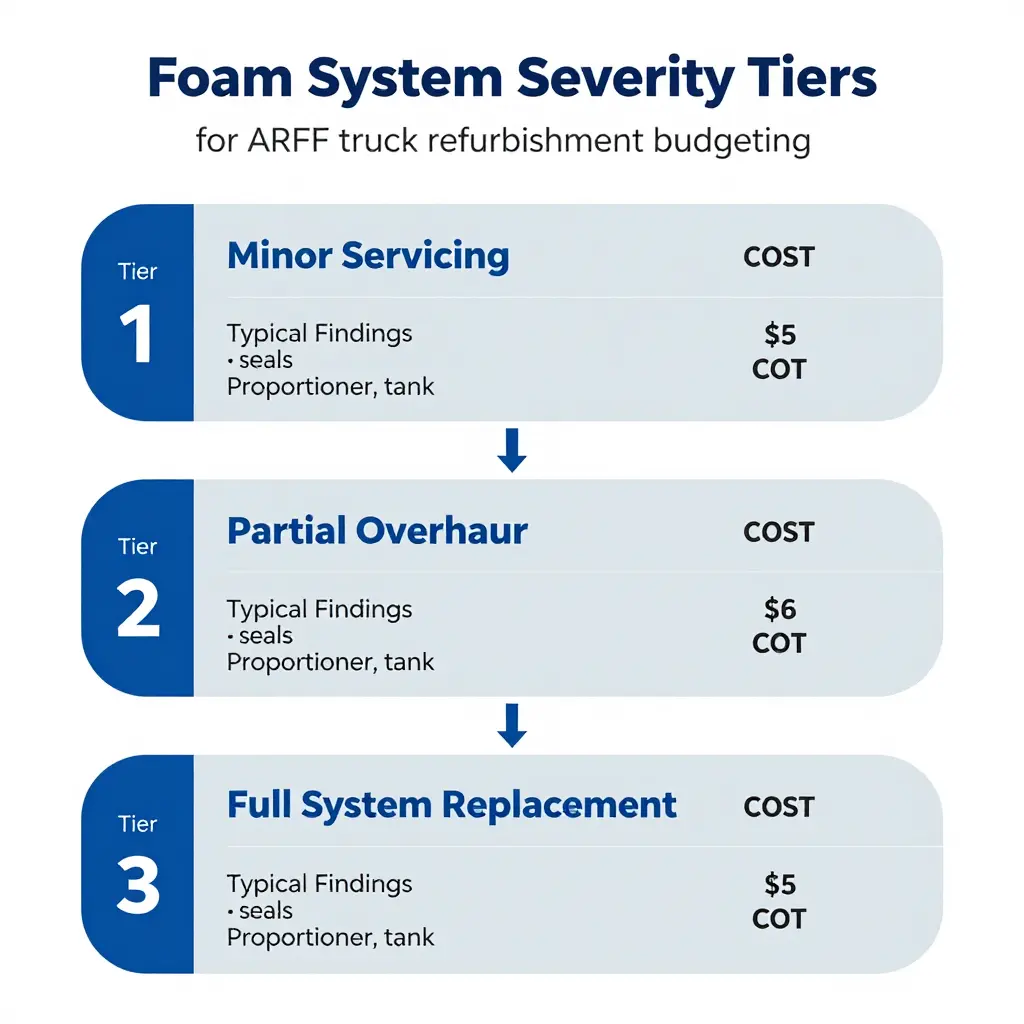
A three-tier severity framework
Map findings to a tier before you negotiate. The tier, not the sticker price, drives your true cost.
| Tier | Typical Findings | Scope of Work | Indicative Cost Range (USD) |
|---|---|---|---|
| Tier 1 – Minor servicing | Aged foam concentrate, worn seals, clogged strainers, minor seepage | Flush, seal, and functionally test the system; replenish concentrate | 8,000 – 25,000 |
| Tier 2 – Partial overhaul | Failing proportioner, corroded discharge lines, degraded pump bearings, worn tank coating | Rebuild pump and proportioner, replace piping runs, re-coat the tank interior | 40,000 – 120,000 |
| Tier 3 – Full system replacement | Structurally compromised tank, obsolete foam-delivery technology, non-compliant or undocumented system | New pump, proportioner, tank/bladder, full re-plumb, and modern controls | 150,000 – 350,000 |
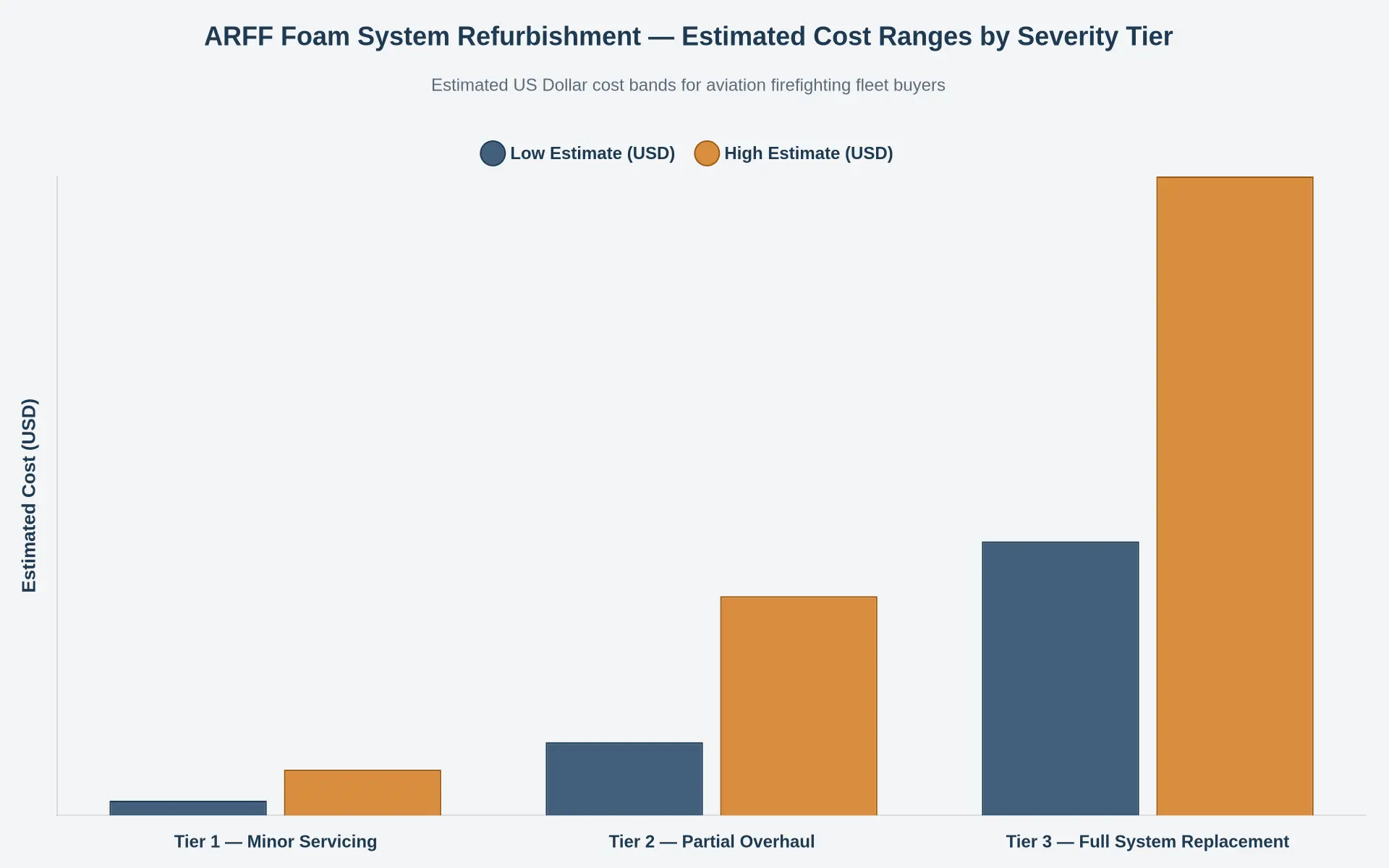
The tiers cascade. A “minor” leak that has quietly corroded the discharge manifold becomes a Tier 2 partial overhaul. A Tier 3 replacement often forces hard decisions about tank and body integration: a new foam tank must respect rear-axle limits and chassis payload ratings, not simply drop into the old footprint.
Price in compliance re-certification
Every repair that touches the foam system reopens the certification question. Certified foam performance testing adds roughly $5,000-$15,000 per truck – more if the system fails the first pass and needs re-work. Budget for calibration records, documentation, and a signed compliance dossier, not just parts and labor. Skipping this step to save money is a false economy when a regulator or insurer later questions the truck’s mission readiness.
Weigh purchase price against remediation cost
Never compare purchase prices in isolation. Compare “landed, mission-ready” numbers: purchase price + refurbishment cost + expected downtime. A truck listed $60,000 below market is no bargain if it hides a Tier 3 foam replacement; a slightly higher-priced unit with clean Tier 1 findings may cost less in total and return to service weeks sooner. Build the refurbishment budget first, then negotiate, and let foam condition, not engine hours, set your ceiling.
Procurement Questions and Negotiation: Turning Foam System Condition Into Leverage
On used Oshkosh ARFF trucks, the foam system is where budgets quietly unravel. Engine hours are easy to read and reassuring, but they rarely predict the largest line items in a rebuild. Disciplined ARFF procurement therefore treats foam system condition as the anchor of due diligence and price negotiation.
Ask for evidence, not assurances. A seller who knows the truck can produce records; one who cannot is already handing you leverage. The point is not to interrogate anyone but to get documentation on the table before money changes hands.
Key questions worth putting to a seller or broker:
- When was the foam tank last inspected internally, and is there photo evidence of corrosion, blistering, or lining delamination?
- Has the foam proportioner been flow-tested, and what percentages did it actually deliver against manufacturer spec?
- What foam concentrate is in the tank – type, batch, age – and was it ever cross-contaminated with another formulation?
- Which valves, discharge piping, and bladder-tank components have been replaced, and on what dates?
- Can you provide the last pump and foam system service report stamped by a certified technician?
Treat these as a checklist, not a script. Adapt the wording, but insist that answers come as documents.
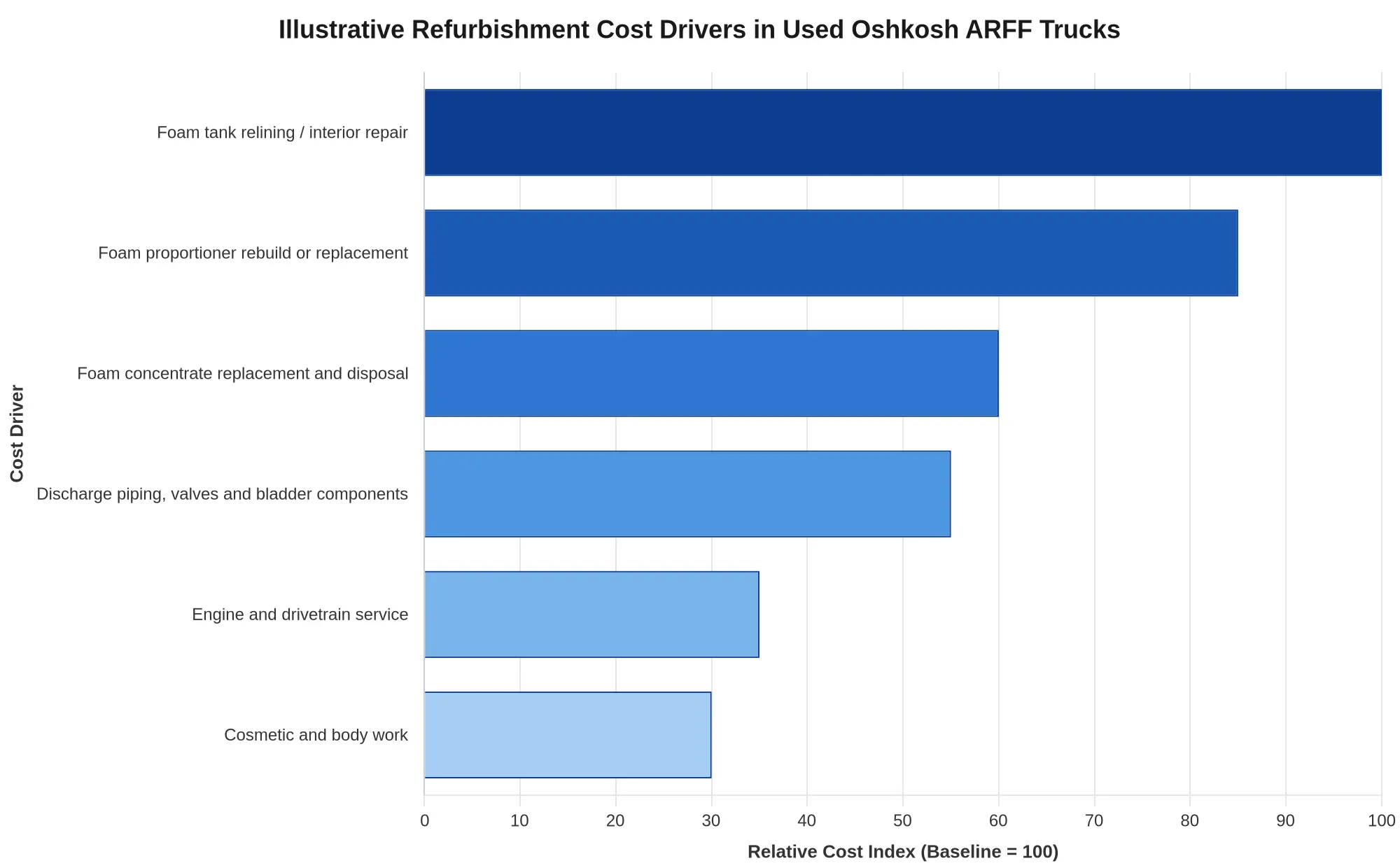
Then turn findings into math. A tank that needs relining, a proportioner that needs rebuilding, and out-of-spec concentrate each add materially to refurbishment cost. Verified gaps become line items you can price and negotiate against instead of vague haggling.
| Verification Item | What to Request | Why It Matters |
|---|---|---|
| Foam tank interior | Inspection report with photos | Lining failure drives relining cost |
| Proportioner | Flow test certificate with percentages | Rebuild or replacement is a major line item |
| Foam concentrate | Type, batch, age, contamination record | Off-spec foam must be disposed and replaced |
| Piping and valves | Replacement log with dates | Seized valves signal wider corrosion |
| Service history | Certified technician reports | Confirms the system was maintained, not just run |
Before comparing quotes, normalize the specifications. Tank and pump capacities vary widely across configurations, so check how water capacity and system specification comparisons work to keep the benchmark fair.
Document everything you find and ask for the same in return. When a seller cannot verify condition, that uncertainty is a legitimate negotiating point, not a reason to walk away. A well-documented foam system rarely lowers the asking price; it protects you from discovering the true cost after purchase.
For buyers and brokers alike, evidence beats a confident sales pitch. If you want a second set of eyes on a pre-purchase ARFF inspection, our team can read the records and price the risk.
FAQ: Foam System Condition and Refurbishment Cost on Used Oshkosh ARFF Trucks
1. Why does foam system condition matter more than engine hours when evaluating used Oshkosh ARFF trucks?
Engine hours measure how long a chassis and powertrain have run, but they say almost nothing about the internal health of the foam system. Foam concentrate is chemically aggressive: AFFF and fluorine-free agents attack seals, corrode steel tanks, crystallize inside proportioners, and degrade hoses even when a truck sits idle in a bay. A low-hour unit that was never foam-flushed can hide thousands of dollars of internal corrosion, while a high-hour truck with disciplined maintenance may need only routine service. For buyers of used Oshkosh ARFF trucks, foam condition is the truer signal of rebuild exposure.
2. How much of a refurbishment budget typically goes to foam system work?
On a full refurbishment, foam system work is usually the single largest line item. The system itself commonly accounts for 25-40% of total refurbishment cost, and concentrate replacement adds more on top; together they typically push foam-related spending past half the budget. That range covers tank inspection and relining, proportioner and pump overhaul, valve and piping replacement, concentrate, and recertification testing. Engine and chassis work, the category buyers watch most closely, is often the smallest contributor.
| Refurbishment Category | Typical Share of Budget |
|---|---|
| Foam system (tank, proportioner, piping, valves) | 25-40% |
| Chassis and drivetrain | 15-25% |
| Pump and water plumbing | 10-15% |
| Electrical and controls | 8-12% |
| Body, structural, and paint | 10-15% |
3. Can a degraded foam system be repaired without full replacement?
Often, yes. Minor issues – sticky valves, worn seals, a fouled proportioner, or crystallized concentrate residue – usually respond to cleaning, seal kits, and component-level overhaul. Full replacement is generally required only when the foam tank is structurally compromised, the piping is extensively corroded, or the proportioner cannot hold accurate ratios at test. A certified fire apparatus pump service can pressure-test and flow-test the system to determine which path is justified.
4. How do foam system issues affect ARFF compliance certification?
ARFF trucks must meet performance standards for foam proportioning accuracy and discharge rates, typically verified through periodic testing. A degraded foam system can fail these tests outright, and the vehicle cannot be certified as compliant until the fault is corrected. The truck may be out of service during remediation while the airport must maintain minimum response capability, so foam condition affects both compliance and operational readiness.
5. What documents should buyers request to verify foam system condition?
Request the foam system maintenance log, concentrate type and batch records, the most recent proportioning and flow-test results, tank inspection or relining reports, and any certification documentation. Service invoices for the proportioner, pump, and valves reveal the maintenance history. If records are missing, budget for independent testing before finalizing refurbishment cost estimates on used Oshkosh ARFF trucks.
6. Does a higher-hour truck always mean a higher refurbishment cost?
No. Engine hours and refurbishment cost do not move together reliably. A high-hour ARFF truck kept on a rigorous foam-flush and testing schedule can be a stronger financial bet than a low-hour unit with an untreated foam system. Buyers should weigh documentation and test data far more heavily than the hour meter.
Conclusion: Price the Foam System, Not the Odometer
One point holds from the first walkaround to the final spreadsheet: on used Oshkosh ARFF trucks, foam system condition, not engine hours, determines refurbishment cost. Engine hours describe how hard the drivetrain has worked. They reveal almost nothing about the corrosion, proportioning accuracy, tank integrity, and plumbing health that drive five- and six-figure remediation bills.
A low-hour truck with a neglected foam system can cost more to return to service than a high-hour truck that was properly maintained.
Actionable Recommendations
- Re-rank your shortlist by foam system condition. Commission an independent inspection of the proportioner, tank and bladder integrity, piping, valves, and pump seals before you compare asking prices. Reputable certified pump and foam system service providers can benchmark calibration and catch hidden issues early.
- Budget for remediation, not just acquisition. Set a realistic refurbishment cost reserve tied to the inspection findings rather than assuming engine hours predict the bill.
- Verify compliance documentation. Confirm current ARFF compliance records, foam concentrate type and certification, test logs, and pump performance data. Missing paperwork becomes both your liability and your cost.
Decision Framework
| Priority | What to check | Why it matters |
|---|---|---|
| 1 | Foam system condition (proportioning, tank, plumbing) | Primary driver of refurbishment cost |
| 2 | Compliance and test documentation | Confirms readiness for ARFF service |
| 3 | Refurbishment budget vs. inspected findings | Prevents surprise cost overruns |
| 4 | Engine hours and drivetrain | Secondary – useful context, not decisive |
Key Takeaways
- Foam system condition, not engine hours, is the true cost driver on used Oshkosh ARFF trucks.
- Budget for remediation based on inspection findings, and treat refurbishment cost as a planned line item.
- Confirm ARFF compliance paperwork and foam certification before closing, or absorb the cost of fixing them later.