

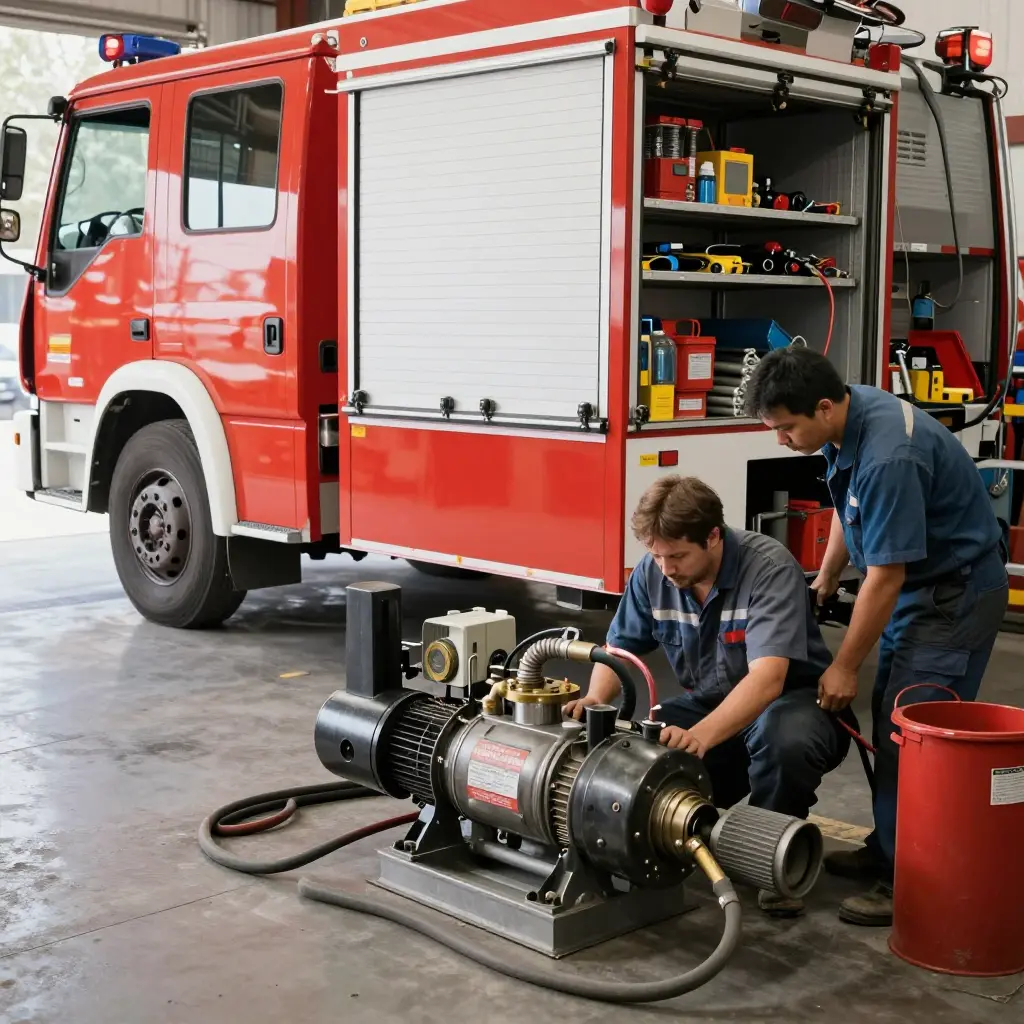
Why Proximity Is the Wrong Filter for Fire Truck Repair
Search “fire truck mechanic near me” and the results come back sorted by driving distance. For a fire department or fleet manager, that ranking looks like the reasonable place to start. It isn’t. What decides how fast an apparatus goes back in service is not the mileage to the shop, but whether the shop can actually do certified pump service.
Geography is the default because it looks efficient on paper: shorter tows, quicker pickups, less downtime. In practice, driving distance explains very little about repair turnaround. Certification and service depth explain most of it. A shop ten minutes away that sends certified pump testing out to a subcontractor puts your engine in someone else’s queue. A facility farther out that runs the certification in-house and knows how pump ratings hold up on steep terrain will often hand the truck back sooner.
The Proximity Misconception: Why “Near Me” Is an Assumption, Not a Guarantee
When a pump fails, the instinct is to search for a fire truck mechanic near me and call the closest shop. A short drive feels reassuring, because it maps to a quicker pickup and simpler logistics. But distance and repair capacity are two different variables.
Proximity does not control fire pump service turnaround. Capability does.
The cause-and-effect chain is short. A pump has to be tested and repaired to recognized standards. If the nearby shop lacks that certification, one of three things happens:
- It outsources the pump to a qualified facility, adding transit days.
- It delays diagnostics while sourcing outside expertise.
- It declines the job entirely.
Either way, the convenience of the short drive disappears once the work actually starts.
A shop three miles away without certified pump testing capability will not beat a qualified provider thirty miles away.
So screen for certification and test-bench capacity before geography. Ask what pump-related work the shop performs in-house, and read pump ratings and service considerations next to the quote. Pick the provider that controls the work itself, and the shorter turnaround follows from that.
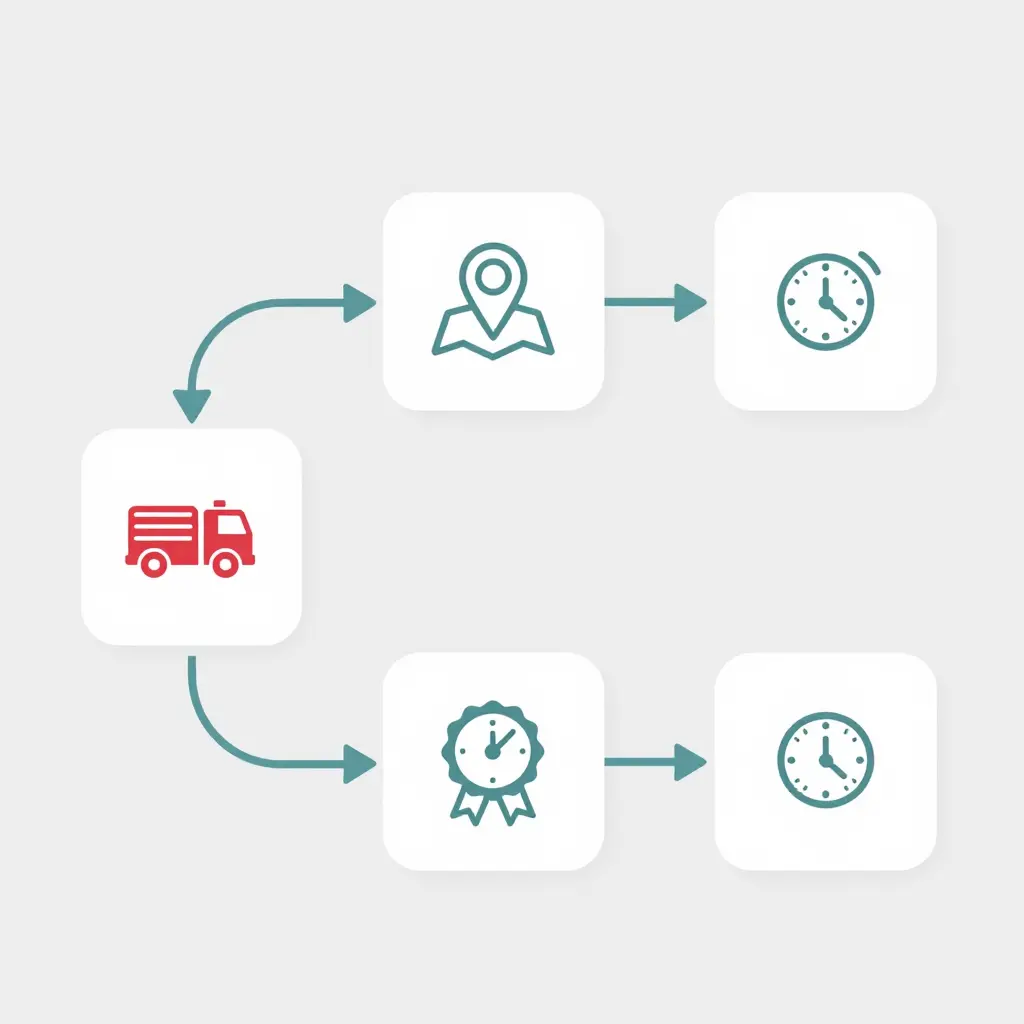
What “Certified Pump Service” Really Means
Certified pump service is a capability you can define, not a marketing label. It comes down to four things, and each one takes time out of the job.
- Certified technicians. Manufacturer-trained techs know the failure patterns on your specific pump model, so diagnosis starts with answers instead of guesses.
- Calibrated test equipment. Pressure gauges and flow meters with traceable calibration produce numbers you can trust, so a pump that fails NFPA pump testing is identified correctly the first time.
- Documented performance testing. Verifiable records aligned with NFPA standards prove the repair restored rated capacity – no ambiguity, no return trip.
- In-house repair. When teardown, machining, and reassembly happen under one roof, there is no shipping delay and no finger-pointing between vendors.
Together, those four remove diagnostic time and cut the repeat visits that a distance-based decision does nothing to prevent. If you run wildland engines, verify pump ratings against real operating conditions before you sign off on test data.
The payoff is straightforward: certified pump service shortens turnaround by getting the pump right the first time, which cuts downtime your crew cannot afford.
What Actually Determines Fire Pump Repair Turnaround
Fire pump repair turnaround has far less to do with a shop’s distance from your station than with the operational strengths behind its doors. These are the things that separate predictable certified pump service from open-ended guesswork.
- In-house certified testing capability – On-site NFPA-compliant flow and pressure testing verifies repairs immediately instead of waiting on third-party scheduling, following the same logic behind wildland engine pump ratings.
- Parts availability – Stocked impellers, seals, and control valves keep certified pump service moving without weeks lost to supplier backorders.
- Pump-specific diagnostic equipment – Dedicated flow meters and vibration analyzers pinpoint faults fast, cutting trial-and-error teardown time.
- Documented service history – Complete fire apparatus maintenance records expose recurring failures and correct root causes the first time.
- Qualified technician capacity – Enough trained staff means your rig isn’t queued behind a backlog of unrelated jobs.
- Scheduling prioritization for emergency apparatus – Front-of-line triage returns frontline units to service while backup coverage holds.
NFPA Compliance and Certification
Certified fire pump service is what makes repair turnaround predictable. Shops that test and document to NFPA standards catch problems before they immobilize a rig. Non-certified shops tend to leave compliance gaps that surface at the worst possible moment.
Annual NFPA pump testing puts a pump under load and measures flow and pressure, with a vacuum check on priming. When the records are continuous, technicians catch declining performance early – a slow-sealing valve, a worn impeller – and schedule the repair instead of scrambling to an emergency call-out. A written fire pump service history also lets a shop pre-order the correct parts, which trims diagnostic time on every job.
A non-certified provider may skip load testing or leave documentation incomplete, so subtle faults go unnoticed until a pump fails mid-incident. Those gaps force rushed, reactive repairs and longer downtime. Sound fire apparatus maintenance follows the same discipline, including the fire engine water capacity checks that keep rated pump performance honest.
For decision-makers the call is direct: prioritize certified providers with verifiable NFPA records. For procurement teams balancing tight budgets, that reliability lowers total cost of ownership. Compliance is not paperwork – it is what actually shortens repair cycles.
| Dimension | Proximity-First Selection | Certified-Service-First Selection |
|---|---|---|
| Diagnostic capability | Generalist shop may lack flow test rigs meeting NFPA 1911 requirements and calibrated pump-curve software, extending diagnosis | Certified pump service centers use dedicated test stands and factory-trained technicians, pinpointing faults in the first session |
| Parts access | Relies on generic aftermarket or special-order parts, causing unpredictable wait times | Holds OEM impellers, seals, relief valves, and manifold kits in stock for same-day replacement |
| Compliance documentation | Testing records may not satisfy NFPA 1911 or ISO requirements, risking failed audits | Issues traceable pump test reports and certification paperwork accepted by auditors and insurers |
| Expected turnaround | Short travel time masks long bench time; a 20-minute drive can still mean a week-long wait | Faster overall cycle because accurate diagnosis and stocked parts compress the repair window |
| Repeat-visit risk | Misdiagnosis or unproven parts often trigger a second, third, or fourth trip for the same fault | Verified repairs and calibration reduce callbacks, keeping the apparatus in service |
| Total cost of ownership | Lower hourly rate is offset by repeat labor, downtime, and re-testing costs across the pump’s life | Higher skill and compliance upfront lowers lifecycle spend and protects the fleet’s readiness |
| Accountability | Limited warranty coverage and unclear service scope increase long-term risk | Documented warranty, torque specs, and test data give fleet managers a defensible paper trail |
Evaluating a Certified Provider
Distance is easy to measure; competence is not. Before you choose a fire truck mechanic near me purely on proximity, verify the certification itself instead of assuming a general repair license qualifies a shop for pump work.
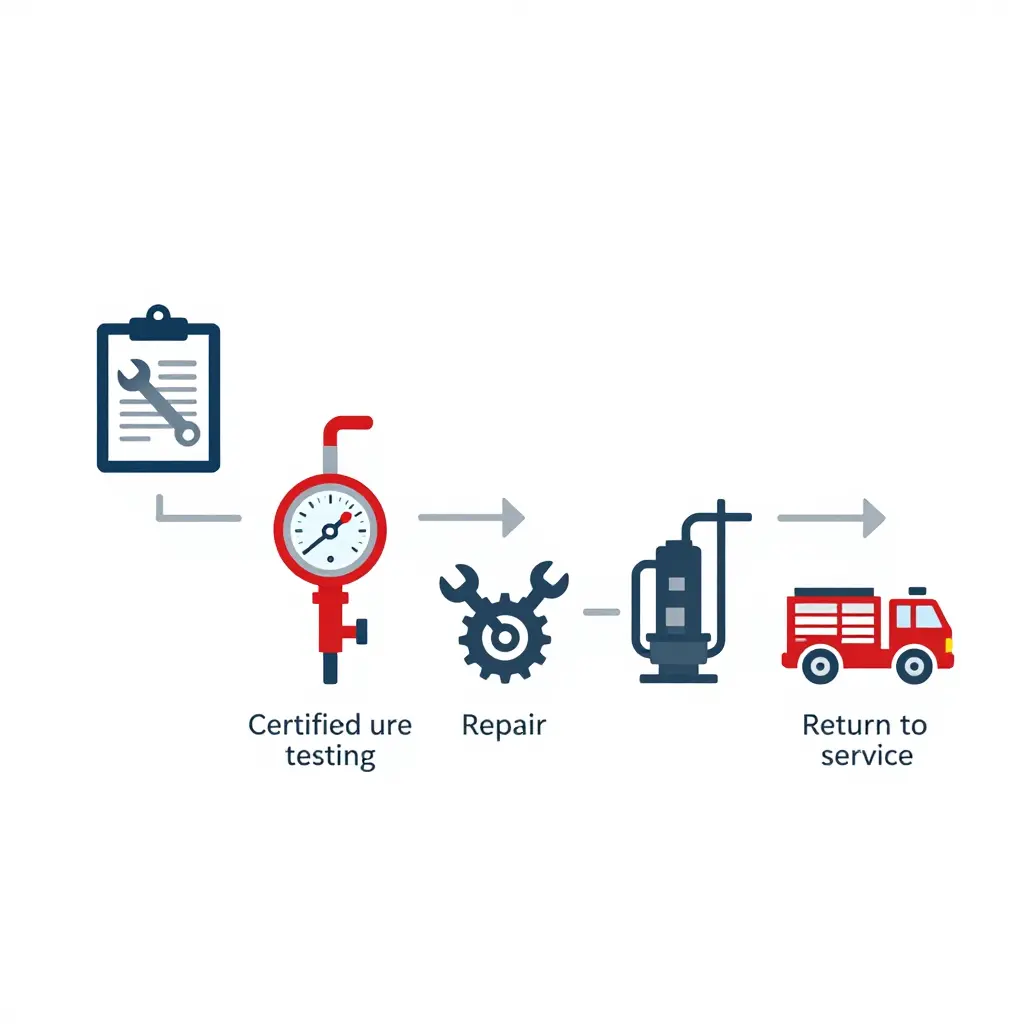
Ask which certifications the technicians hold. NFPA 1911 and manufacturer pump credentials are the baseline, because pump service demands specialized training that general mechanics rarely possess. Confirm the flow meters and gauges used in pump verification testing are themselves calibrated on a set schedule; uncalibrated instruments produce results that look precise but mean nothing. Request written, dated NFPA-compliant test records instead of verbal assurances, since insurers and auditors require traceable documentation. Verify in-house pump repair capability, because shops that outsource rebuilds introduce delay and dilute accountability. Finally, request references from fire departments that depend on the provider for annual testing.
A provider that answers all five points with evidence delivers certified pump service worth the drive. One that deflects them does not.
Average Repair Turnaround Time by Service-Approach Choice
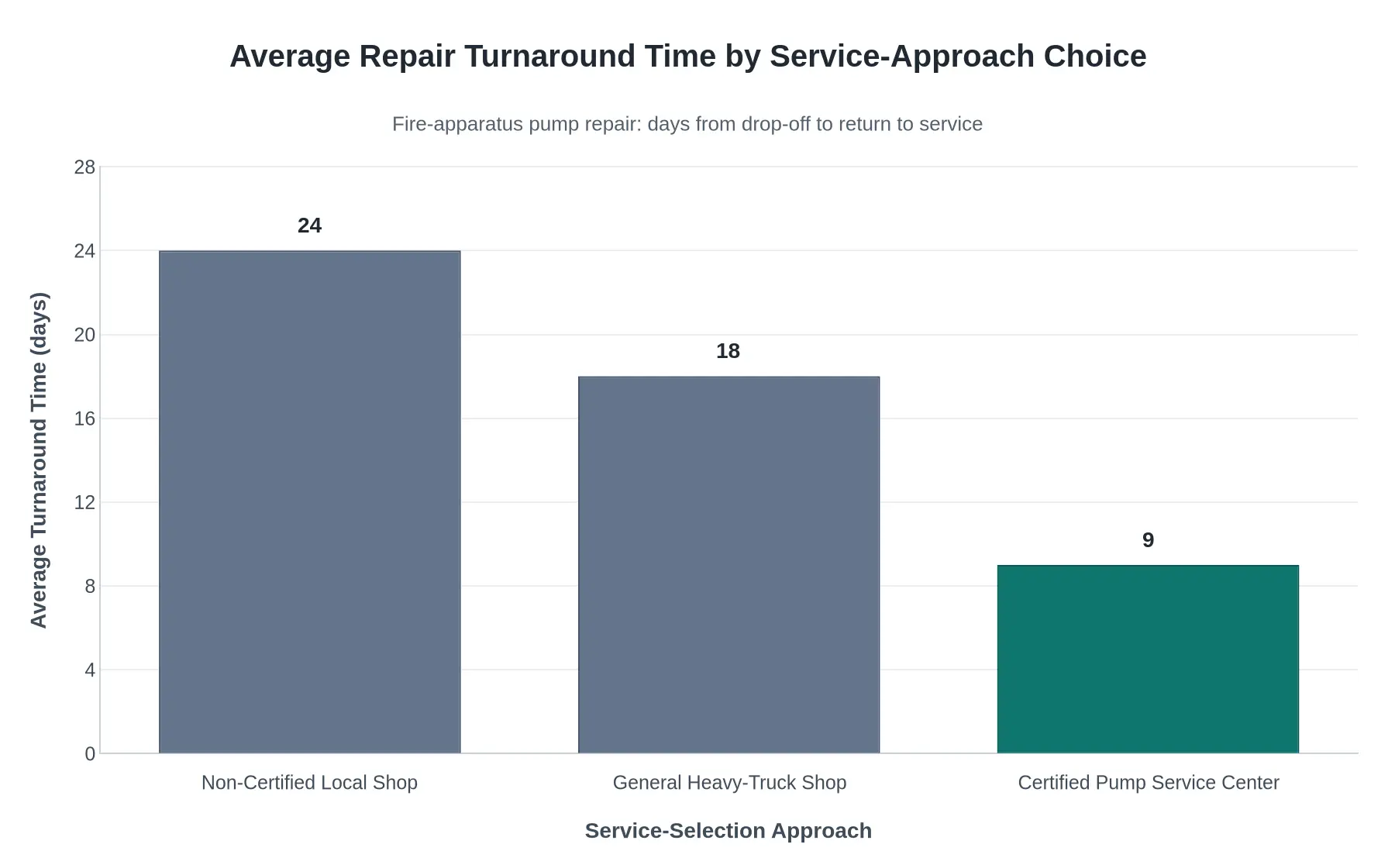
The chart makes a point that proximity hides: where a pump repair gets done matters far more than how far you drive to get there. A non-certified local shop, convenient as it is, averages 24 days from drop-off to return to service. A general heavy-truck shop – closer to the pump’s world but still without factory pump certification – lands around 18 days. A certified pump service center, even when it sits further down the road, brings the same repair home in about 9 days.
| Service-Selection Approach | Average Turnaround Time |
|---|---|
| Non-Certified Local Shop | 24 days |
| General Heavy-Truck Shop | 18 days |
| Certified Pump Service Center | 9 days |
That gap is not luck. Certified centers carry OEM pump parts on the shelf, run calibrated flow-test equipment, and know the exact torque and clearance specs before the truck rolls in – so diagnosis, approval, and repair all happen in one pass instead of three. In fire-apparatus terms, that difference is the space between a rig that is back on the first-due line this week and one that misses calls for the better part of a month.
Cost Versus Value: Why the Nearest Shop Isn’t Always the Cheapest
Basing a fire pump service decision on mileage alone overlooks the cost that matters most: downtime. A certified provider an hour farther away frequently returns your apparatus to service sooner than a closer shop that is learning on your equipment.
Whatever mileage you save disappears into repeat repairs. Untrained technicians misdiagnose pump problems, order the wrong parts, and schedule a second visit, each one adding idle days your department can never bill back. Certified shops work to manufacturer and NFPA standards the first time, lowering callback rates and protecting your compliance record.
That reliability compounds across every fire apparatus maintenance cycle: fewer emergency callouts, longer component life. The same principle drives smart fleet planning, down to details like fire truck water tank placement – get the fundamentals right once.
Recommendation: weigh turnaround time, certification, and warranty support above proximity. The lowest total cost of ownership belongs to the shop that fixes it right the first time.
Frequently Asked Questions
Does a closer mechanic always mean faster repair?
No. Turnaround depends on capability, parts access, and certification, not driving distance. A nearby general shop may lack pump-specific tooling and still wait days on parts. A certified pump service team diagnoses the fault correctly the first time, which shortens total downtime.
What certifications should a fire pump service provider hold?
Look for factory pump training, NFPA 1901 and 1911 familiarity, and documented NFPA pump testing capability. Ask how pump ratings are validated; those credentials confirm technicians understand flow targets, pressure relief, and the compliance documentation your department must keep.
How does NFPA pump testing affect repair schedules?
Testing is planned work, not an interruption. Certified providers reserve calendar time for annual tests and sequence repairs around them, so pumps stay compliant without surprise delays or costly re-tests.
Does traveling farther for certified service increase downtime?
Rarely. Driving an hour to a qualified shop often saves days compared with repeated failed repairs at a closer, uncertified one. The deciding factor is expertise, not a search for a “fire truck mechanic near me.”
Can mobile service replace a qualified shop?
For minor adjustments, yes. But full pump refurbishment and complete NFPA pump testing usually require a certified facility with calibrated equipment and proper documentation.