

Average Fire Truck Cost: Pump Capacity Sets the Price, Not Chassis Class
Two fire trucks can sit on the same commercial or custom chassis – same wheelbase, cab, and GVWR envelope – and still land six figures apart, because one carries a 1,250 GPM pump and the other a 2,000 GPM pump. The chassis sets the platform and the legal weight limits. It rarely explains the largest line on the quote. A bigger pump pulls a bigger engine, cooling package, drivetrain, and plumbing along with it, and each of those steps carries its own premium.
Impeller design, manifold sizing, intake and discharge configuration, and the horsepower needed to hold rated flow all move the price up or down. Budget around those, and the number lands closer to the invoice – the same reason buyers who benchmark pump ratings on steep terrain get a more accurate figure than buyers who shop by chassis class alone.
Why Pump Capacity, Not Chassis Class, Drives the Fire Truck Price
On the same commercial chassis, two apparatus can diverge by six figures once the water pump package changes. The cab-and-chassis class is not what sets the price; the pump does. The engineering logic behind the gap:
- GPM ratings: Stepping from 1,000 to 2,000 GPM roughly doubles flow, which demands larger impellers, heavier shafts, and bigger intakes.
- Impeller design: Single versus two-stage, high-pressure impellers require tighter tolerances and premium metallurgy.
- Drive configuration: A midship split-shaft pump adds a transfer case that divides engine torque; a PTO drive is cheaper but caps output and duty cycle.
- Pump materials: Bronze, stainless, and ductile-iron wetted parts resist corrosion but cost far more than cast iron.
- Priming systems: Reliable vacuum priming for hard suction lifts adds extra pumps, valves, and controls to the bill.
- Integrated plumbing: Larger discharge manifolds and relief valves cascade into the body build and tank.
Buyers pay for guaranteed flow under load, not a nominal figure, which is why pump rating behavior on steep terrain matters. Tank size follows the same logic: the tank and pump must be matched, so on-board storage decisions depend on the flow target.
Fix the required flow first, then size the tank and chassis to feed it. Spend the money on the chassis and skimp on the pump, and you pay more for less real capability.
Pump Capacity vs. Price Impact: Tier-by-Tier Comparison
Each step up in pump rating (GPM) reshapes the final invoice. Chassis class climbs modestly across the tiers, while the price band widens much faster – the pump package, not the frame underneath it, is the dominant cost lever. Buyers validating pump performance on specialized units can also review pump ratings for Type 6 wildland engines before finalizing a spec.
| Pump Rating (GPM) | Representative Chassis Class | Typical Price Band | Dominant Cost Drivers | Procurement Notes |
|---|---|---|---|---|
| 750-1,000 (single-stage) | Class 4-5 commercial (14,001-19,500 lb GVWR) | $350K-$520K | Single-stage midship pump, 300-500 gal tank, light plumbing | Entry WUI/urban interface; chassis is minor next to the pump package |
| 1,000-1,250 (single-stage) | Class 6 commercial (19,501-26,000 lb GVWR) | $450K-$680K | Single-stage pump, 500-750 gal tank, basic foam + panel | Standard municipal pumper; step cost driven by pump + tank |
| 1,250-1,500 (single-stage) | Class 7 commercial/custom (26,001-33,000 lb GVWR) | $600K-$900K | High-flow single-stage, 750-1,000 gal tank, stainless plumbing | NFPA 1901 baseline; pump + body outweigh the chassis upgrade |
| 1,500-2,000 (two-stage) | Class 8 custom pumper (33,001-54,000 lb GVWR) | $850K-$1.2M | Two-stage pump, relief valve, 1,000 gal tank, large body | Two-stage surge lifts the price sharply; chassis stays similar |
| 2,000-2,500 (two-stage) | Class 8 heavy custom (54,000+ lb GVWR) | $1.2M-$1.6M | High-capacity pump, 1,000-1,500 gal tank, integrated foam | Pump + tank geometry push up axle ratings and body cost |
| 3,000+ (multi-stage/industrial) | Class 8 industrial (ARFF-style / heavy custom) | $1.6M-$3.0M+ | Multi-stage high-capacity pump, deck monitor, large foam tanks | Price set almost entirely by pump and water/foam delivery |
Across the first four tiers the price band more than doubles, from $350K-$520K to $850K-$1.2M, while the chassis moves from Class 4-5 to Class 8 – a bounded change in the frame, not a six-figure swing. The same pattern holds between the two-stage tiers: identical Class 8 chassis architecture, but adding 500-1,000 GPM and its supporting plumbing can add several hundred thousand dollars. Chassis class sets the floor; pump capacity drives the ceiling.
Why Chassis Class Is a Secondary Cost Factor
Buyers scanning bids often fixate on the chassis first, yet it moves the average fire truck cost far less than the pump specification does.
Compare the tiers. A commercial chassis keeps the base price modest, a custom chassis adds premium cabs and comfort features, and a severe-duty chassis raises entry cost again. The spread across all three is real but bounded, usually a fraction of the final fire truck price.
Pump capacity scales differently. Every jump in flow rating, from 1,250 to 1,500 to 2,000 GPM, forces larger impellers, stouter drivelines, and heavier water tank placement that protects rear axle limits. Payload and axle ratings then cascade upward, dragging brakes, suspension, and tires along with them.
Chassis class nudges the number; pump capacity multiplies it. The resale market points the same way, since the largest, highest-flow apparatus hold stronger demand and value regardless of the badge under the cab. Budget around the pump, and the chassis becomes a secondary line item.
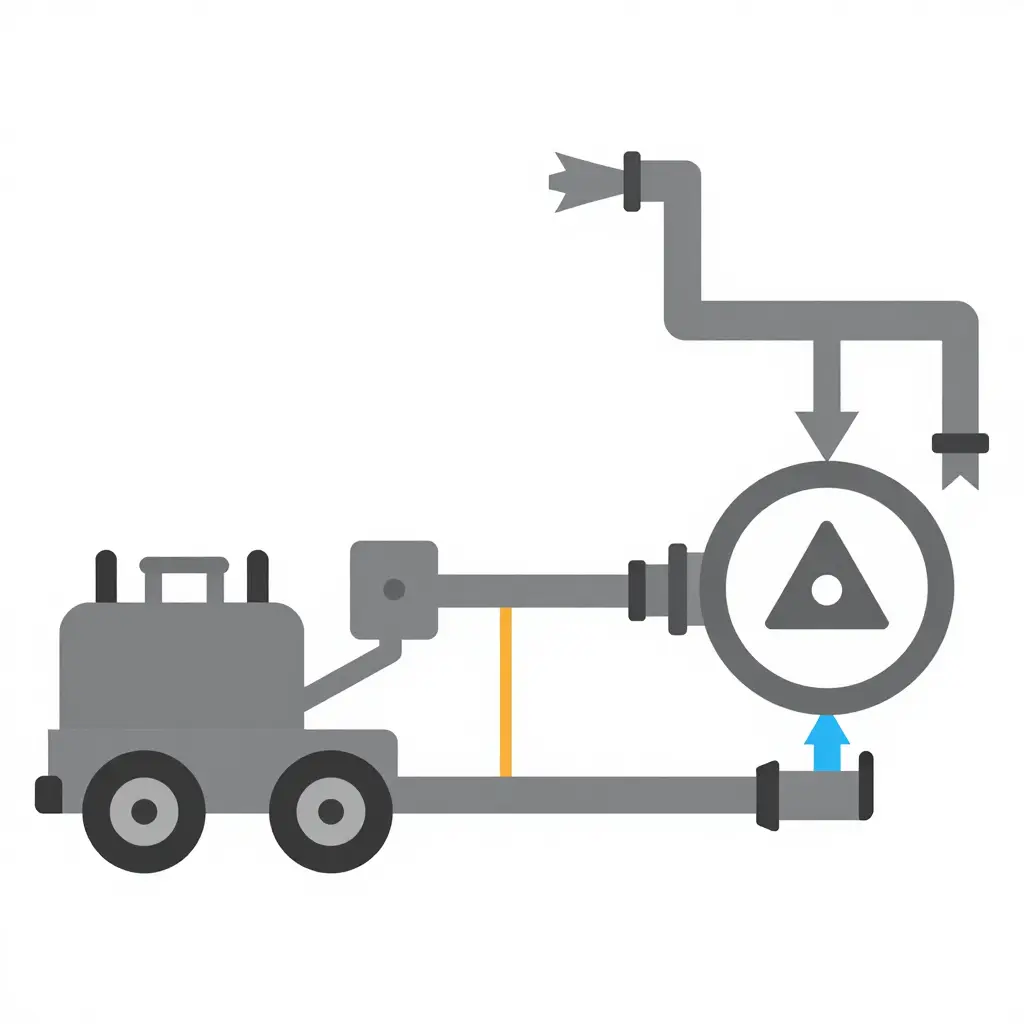
Reading the diagram
The schematic traces the mechanical chain that governs the price. On the left, the chassis engine sends power through a PTO (power take-off) gearbox and a drive shaft to the fire pump. Inside the pump housing, a triangular impeller spins to move water.
- Orange arrows trace the mechanical drive path: engine to PTO to shaft to pump.
- Blue arrows trace the water path: the intake pipe feeds water up into the pump, while the discharge manifold routes it out to the fireground.
The geometry is the point: as rated pump capacity rises, the impeller, shaft, and manifold must scale up together, adding stages, larger piping, and heavier mountings. That added system complexity, not the chassis class underneath it, drives the final cost. For operators planning long-term reliability of these components, see our guidance on certified pump service for fire apparatus.
Pump capacity anchors the base specification of any pumper or engine, so procurement teams forecast spend around flow ratings. Several secondary factors still nudge the average fire truck cost up or down around that baseline, without ever displacing the pump as the primary driver.
- Tank construction – Poly, stainless, or mild-steel tanks with internal baffling and rear-axle load limits change material and fabrication cost. The volume they hold is still set by the pump they feed.
- Foam systems – Proportioners, concentrate tanks, and CAFS compressors add tens of thousands in hardware and plumbing. They only matter once a pump is specced to drive them.
- Aerial devices – Ladders, platforms, and outriggers bring torque-box reinforcement and stabilizer geometry. They raise the build cost and depend on chassis and pump packaging for their operating envelope.
- Chassis upfit hours – Custom wiring, bracket fabrication, and body mounting consume skilled labor. Those hours scale with build complexity, not with the flow the pump delivers.
- Emissions compliance – Post-treatment, DEF dosing, and certification testing raise the base cost of every engine, regardless of pump output.
- Electronics and telematics – Multiplex harnesses, scene lighting, and remote diagnostics add integration cost and long-term service risk that a larger pump does not offset.
- Delivery and certification costs – Freight, pump acceptance testing, and NFPA documentation are flat add-ons tied to the completed spec, not to flow capacity.
Together these line items can swing the invoice by a meaningful percentage. Treat pump capacity as the baseline and layer each secondary factor on top.
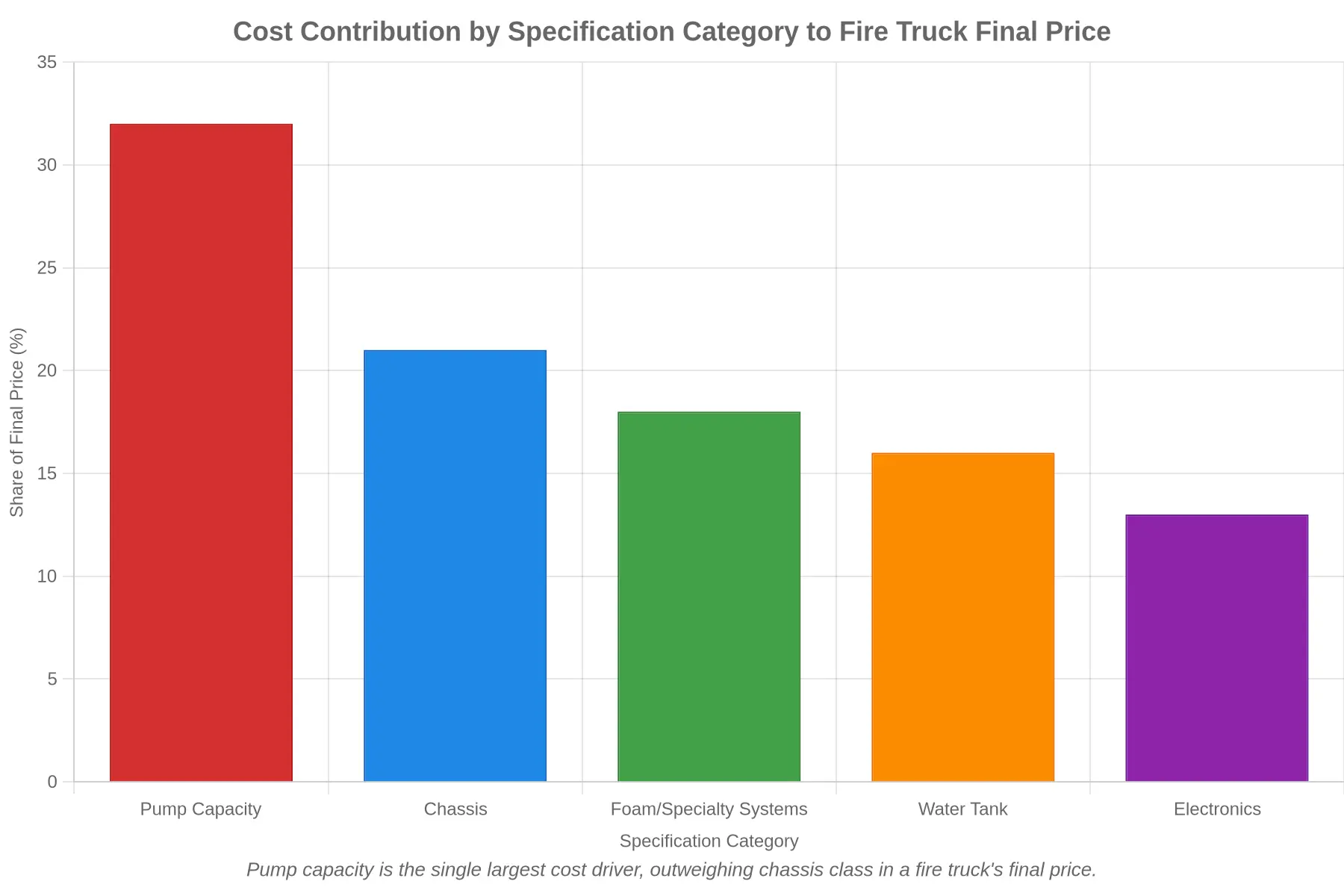
Figure: Cost Contribution by Specification Category to Fire Truck Final Price
Pump capacity leads at roughly 32% of the final price, followed by chassis (21%), foam and specialty systems (18%), water tank (16%), and electronics (13%).
| Specification Category | Share of Final Price (%) |
|---|---|
| Pump Capacity | 32 |
| Chassis | 21 |
| Foam/Specialty Systems | 18 |
| Water Tank | 16 |
| Electronics | 13 |
Caption: Pump capacity is the single largest cost driver, well ahead of chassis class in a fire truck’s final price.
Procurement and Budget Planning: Start With Flow, Not the Chassis
Municipal budget managers should reverse the usual buying sequence. Instead of anchoring a purchase order to a favored chassis class and hoping the pump fits, define the required pump capacity first. Ask what flow the response area demands, and at what pressure. That number sets the procurement conversation and the budget line behind it.
Once the flow target is locked, pick the smallest adequate chassis class that can carry the pump, water, and crew without overloading the axles. This is where the average fire truck cost is actually controlled. Oversized chassis inflate price, fuel, and upkeep without improving fireground performance, while undersized ones force costly compromises later.
Write specifications around measurable pump performance instead of brand prestige. Require documented flow curves, pressure ratings, and witnessed acceptance tests, and weight pump efficiency and long-term service support in bid evaluation. Plan maintenance from day one, because certified pump service protects that investment across its full service life. For most departments, a modest rise in pump capacity costs far less than a jump in chassis class. Fund the flow, then right-size the platform.
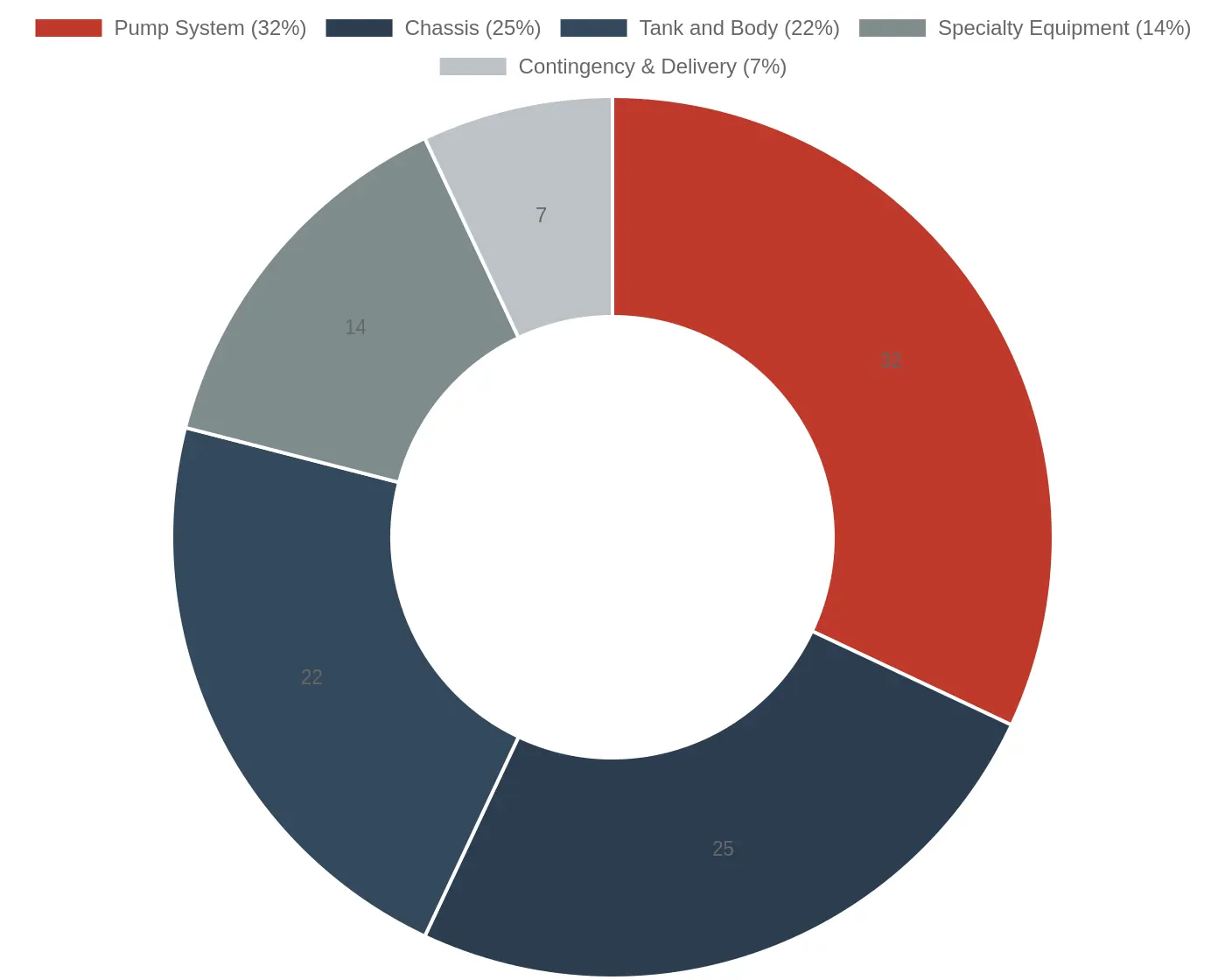
Typical Fire Truck Cost Breakdown
Grouped differently – with tank and body combined and delivery and contingency broken out – the same pattern holds:
| Cost Component | Share of Total |
|---|---|
| Pump System | 32% |
| Chassis | 25% |
| Tank and Body | 22% |
| Specialty Equipment | 14% |
| Contingency & Delivery | 7% |
Pump capacity dominates the total cost, making the pump system the single largest line item in a fire truck’s price.