

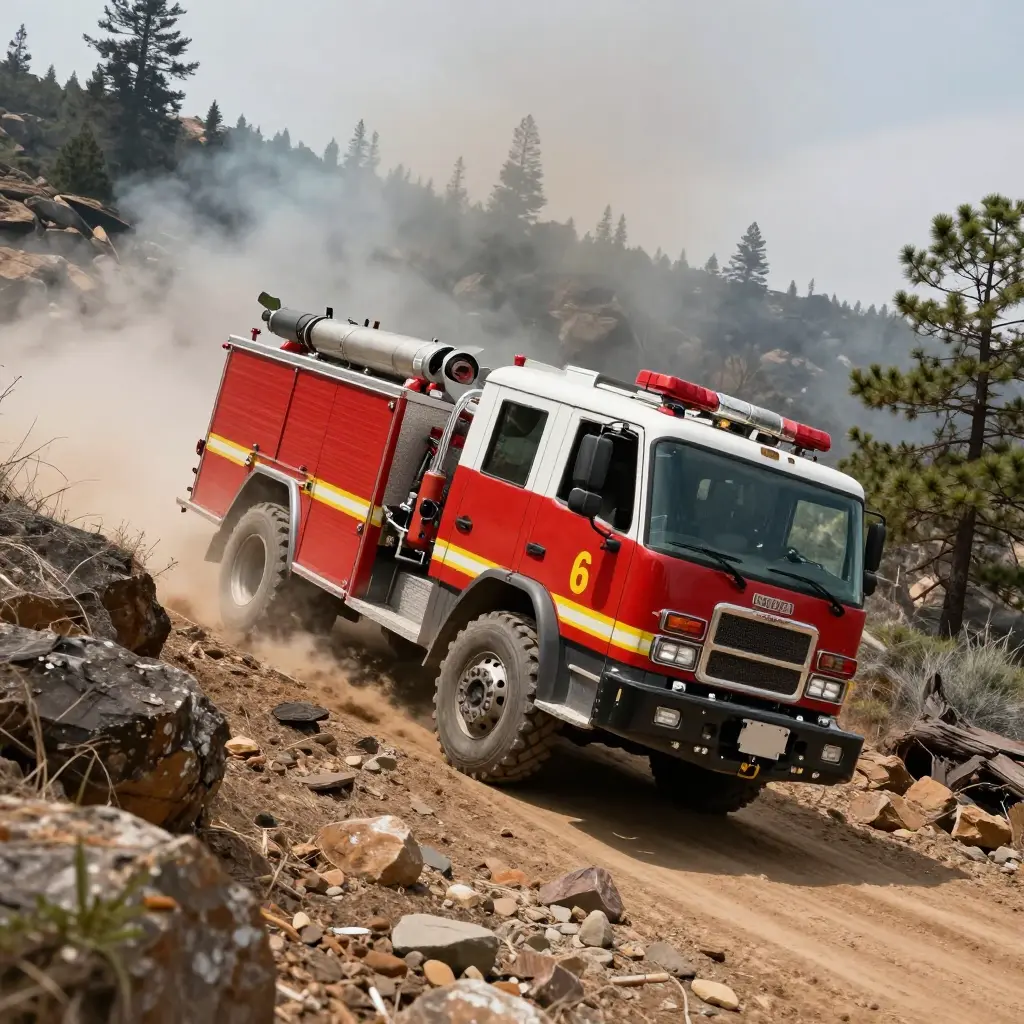
The Advertised Rating vs. the Steep-Terrain Reality
A Type 6 wildland engine is the smallest class of fire apparatus built for wildland and wildland-urban interface response. It mounts a light or medium-duty chassis with a small water tank, usually 50 to 300 gallons, and a low-volume, high-pressure pump built to push water through long hose lays on rough ground. Its advertised pump ratings quote a flow figure in gallons per minute at a fixed discharge pressure, and they describe what the pump can do under controlled test conditions.
Those conditions matter. Ratings are measured on near-level ground, with a stable suction supply, short hose runs, and controlled temperature. The result is a best-case number, not a field guarantee.
Steep terrain changes what the pump can do. Every gallon pushed uphill fights static head from elevation gain, and long hose lays, higher friction loss, and a thinner engine cooling margin cut the volume that reaches the fire.
How Type 6 Pump Ratings Are Advertised and Tested
A manufacturer listing a Type 6 wildland engine usually leads with a pump rating: a flow rate tied to a stated pressure, such as “150 GPM at 100 PSI.” The number is real, but it comes from a narrow set of controlled conditions that rarely survive contact with the fireline.
The Standardized Test Bench
Pump ratings come from controlled performance tests. The engine runs at factory or near-zero elevation, where the air is dense and atmospheric pressure is highest. The apparatus sits on level ground, and the test uses short hose lays with minimal friction loss. Ideal intake conditions – a positive-pressure water source, a flooded suction, or a sealed drafting setup – keep the pump from laboring against lift. Under those conditions the pump delivers its advertised flow at its advertised pressure.
The Tolerance Question
Manufacturers and testing standards allow a tolerance band, often a small percentage of rated flow or pressure, so a pump rated at 150 GPM may be certified a few points either way. The tolerance serves manufacturing consistency, but two engines with identical nameplate values can still behave differently once installed and loaded.
What the Ratings Leave Out
The test bench leaves out what firefighters actually face. Elevation thins the air and cuts engine power. Steep terrain raises both the lift and the total head the pump must overcome, and long hose lays add friction loss the short test layout never shows. A Type 6 wildland engine that performs on the stand can fall well short of its pump rating on a mountainside.
For a broader look at how water capacity and pump performance interact across fire apparatus, see water capacity and fire engine design.
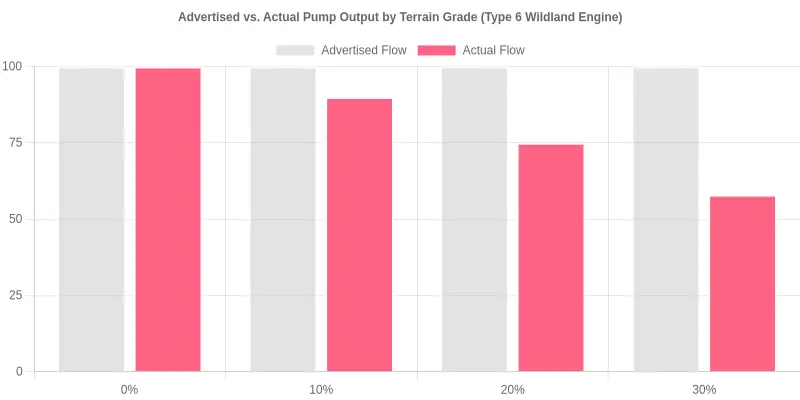
What This Chart Shows
On a spec sheet the rating is a flat line; at the nozzle it is not. On level ground (0% grade), a Type 6 engine’s advertised 100 GPM and its delivered flow are nearly the same, which is why the rating holds up in a firehouse demo or a low-angle training drill. Uphill, the gap opens. At a 10% grade, output is already down roughly 10% of rated flow, largely because engine load, driveline losses, and the drop in usable RPM eat into the power available to the pump. At a 20% grade the shortfall widens to about 25%, and on a 30% slope actual flow can fall to around 58 GPM, only a little more than half of what the badge promised. Advertised ratings are measured on flat, ideal ground; real pumping happens on the climbs that define Type 6 wildland work. For crews, that means planning the attack around the numbers at the top of the grade, not the advertised number at the bottom. Tank size and water logistics compound the problem on a working fireground, so it helps to review how water capacity is calculated in engine specifications.
Pump ratings on paper rarely hold up on a real fireline, and the gap widens fast as grade and elevation climb. The table below shows how a typical Type 6 wildland engine’s advertised flow falls off across steeper terrain, much as fire engine water capacity figures shift once real-world lift and grade enter the equation.
| Condition / Location | Terrain Grade | Advertised Flow (GPM) | Estimated Real Flow (GPM) | Effective Pressure Loss | Key Cause of De-rating |
|---|---|---|---|---|---|
| Near-level ground (valley staging) | 0-5% | 100 | 92-98 | ~5% | Minor friction and discharge hose losses |
| Moderate slope (ridge access road) | 10-20% | 100 | 75-85 | ~15-20% | Longer hose lays and rising static head |
| Steep slope (cutline attack) | 25-40% | 100 | 50-65 | ~30-40% | Elevated static head and cavitation risk |
| High-elevation steep slope (ridgeline) | 30-45%+ | 100 | 35-50 | ~45-55% | Altitude engine power loss combined with elevation head |
Note: Treat these numbers as planning estimates rather than guarantees. Confirm actual flow with a pitot gauge or flow meter on the line before committing crews to a pump-dependent attack.
Friction Loss and Elevation Head: Where Your Rated Output Actually Goes
A pump rating is measured at the pump, not at the nozzle. On flat ground, a Type 6 wildland engine can usually deliver close to its advertised flow. Point that same engine up a mountainside and two losses eat into every gallon per minute before the water reaches the fire.
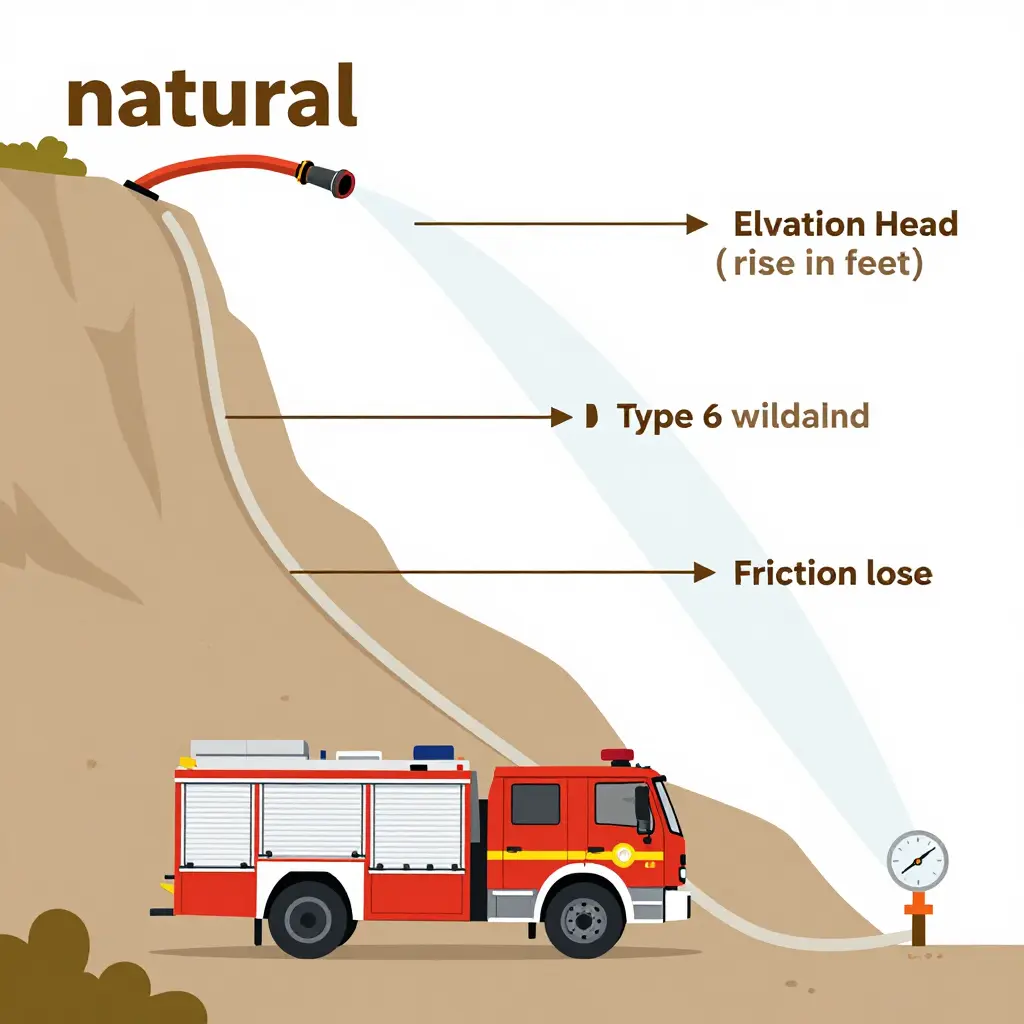
Friction loss is pressure lost to turbulence as water scrapes along the inside of the hose. Longer lays, rougher linings, and narrow diameters make it worse. It barely registers on a gauge at the engine, so crews usually notice it as a weak, sputtering stream at the tip.
Elevation head is simpler and costs more. Water weighs roughly 0.43 psi per foot of vertical rise, or about 1 bar per 10 metres. Climb 300 feet and you have spent close to 130 psi just lifting the water, before a single drop lands on the fire. That pressure is gone for good, which is why elevation head dominates real-world performance on steep terrain.
Several factors drain effective flow, and they stack on top of one another:
- Hose diameter – smaller lines create dramatically more friction loss per foot.
- Hose length – every additional 100 feet adds resistance and pressure drop.
- Fittings and adapters – each coupling, reducer, and wye adds a small but cumulative loss.
- Elevation gain – vertical rise consumes pressure that can never be recovered.
- Nozzle pressure – the nozzle needs its own minimum pressure to form an effective stream.
- Kinks and worn linings – damaged hose inflates losses in ways a spec sheet never predicts.
- Pump wear – a tired impeller or leaking seal delivers less than the plate claims.
A rating measured at the pump is not the flow you get at the nozzle uphill. Sizing expectations around real water capacity and terrain losses keeps crews effective where it counts, instead of chasing numbers that only work on flat, paved ground.
Why the Number on the Pump Plate Isn’t the Number at the Nozzle
A pump’s advertised rating is measured at the pump itself: flat ground, short hose, cold engine. Water moving up a slope fights gravity and friction the whole way.
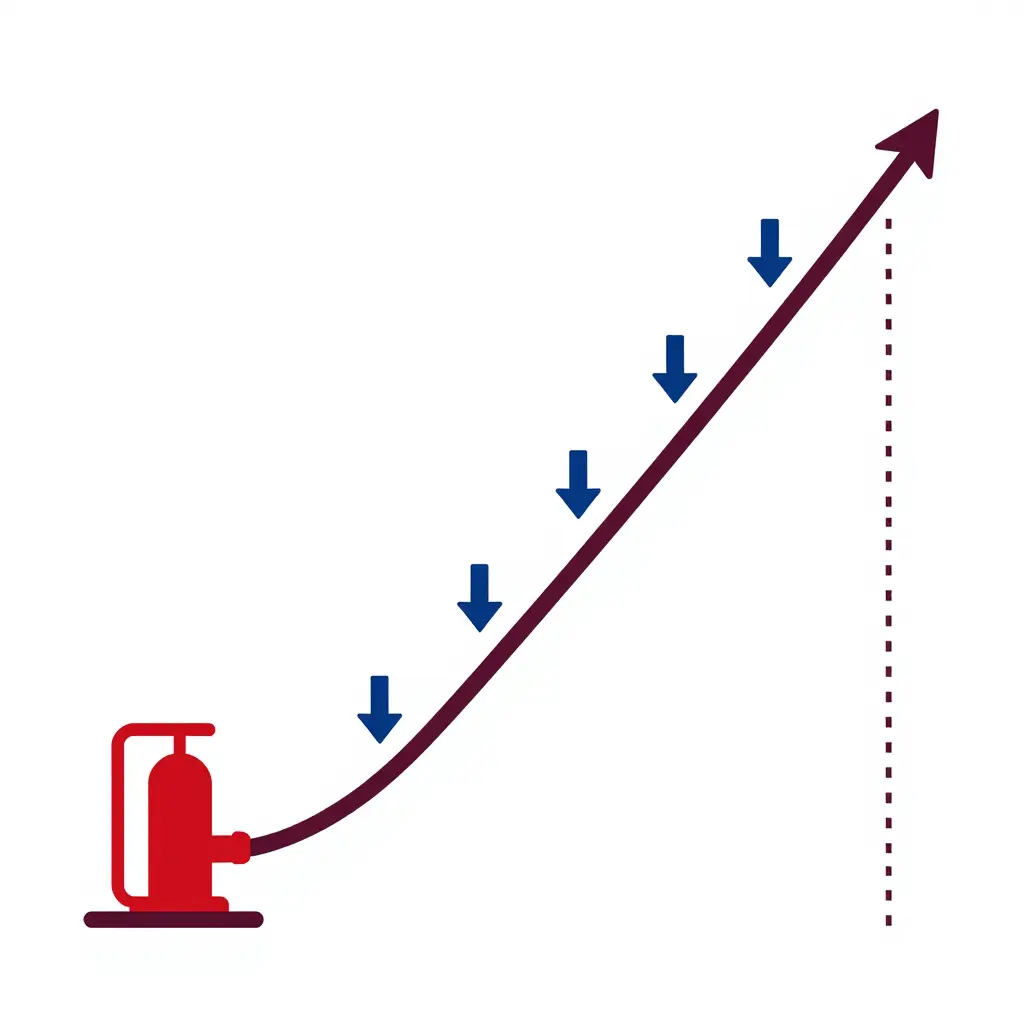
Figure: Elevation head and friction loss accumulate along an ascending hose lay.
The pump at the base supplies a fixed pressure. As the hose climbs, two separate forces eat into that supply:
- Elevation head – every metre of vertical rise costs about 1.4 psi (0.1 bar) of pressure. A 30-metre climb consumes around 42 psi before a single litre of water ever reaches the fire.
- Friction loss – the longer and more tortuous the hose lay, the more pressure is shed to turbulence. The stacked arrows grow as the lay extends, because the losses compound rather than simply add up.
So when a brochure promises “high-flow at X psi,” that figure usually describes the pump outlet – not the nozzle at the top of a ridgeline. A Type 6 engine climbing a steep slope is really fighting elevation head plus friction loss plus whatever residual pressure the nozzle needs. Lose sight of that arithmetic and a pump with a generous rating can deliver far less than crews need.
How water capacity and pump duty are specified on fire engines explains why the plate figure and the field figure diverge so sharply on difficult terrain.
Bottom line: advertised pump ratings describe a pump on flat ground, while wildfire work happens on slopes. Subtract elevation head and friction loss from the rating, and you get the pressure your crew can actually count on.
Why Advertised Pump Ratings Fail on Steep Terrain
The number printed on a Type 6 wildland engine’s spec sheet looks reassuring. But that headline figure is earned on flat ground, over a short hose lay, at sea level, with the pump running at its rated pressure. Real wildland firefighting rarely provides those conditions. On a burning ridge line, the water actually leaving the nozzle can fall far below what the catalogue promises. That shortfall comes from the terrain, not from a faulty pump.
The Physics Stack Against You
Every vertical foot of climb adds static head pressure. Water weighs roughly 0.433 psi per foot, so a 200-foot rise already costs about 87 psi just to reach the nozzle – before friction or intake losses are counted. Altitude piles on more: a naturally aspirated engine loses roughly 3 percent of its power per 1,000 feet of elevation, flattening the pump curve exactly when the fire demands the most.
Grade, Elevation, Hose Layout, and Operator Limits Compound
These penalties do not simply add together – they multiply, because each one takes pressure the last one already reduced. Steep grade raises static head. Long, kinked, or undersized hose adds friction loss. Altitude strangles the engine intake. And a crew watching nozzle reaction and line pressure will throttle back before the pump cavitates anyway.
From Rated Output to Usable Flow
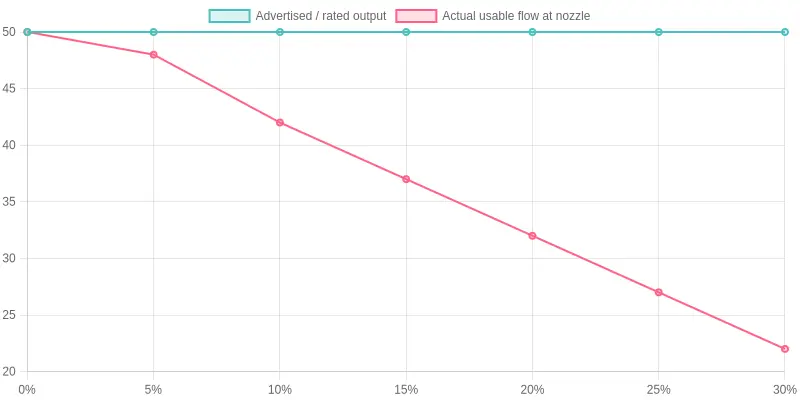
- Start with the advertised pump ratings – the clean 50 GPM the brochure quotes.
- Subtract altitude de-rating, which lowers both engine horsepower and achievable pump pressure.
- Subtract friction loss from every foot of hose, especially on long or undersized lays.
- Subtract static head from the steep terrain itself – the vertical lift to the nozzle.
- Apply operator safety limits: pressure governors, nozzle management, and the need to keep water – not air – moving through the line.
The table below shows how those compounding losses play out on a representative 50 GPM Type 6 pump:
| Slope Grade | Elevation Gain (ft) | Net Usable Flow (GPM) | Share of Rated Output |
|---|---|---|---|
| 0% (flat) | 0 | 50 | 100% |
| 10% | 30 | 42 | 84% |
| 20% | 60 | 32 | 64% |
| 30% | 90 | 22 | 44% |
Why It Matters on the Fireline
By the time a crew climbs a 30 percent slope, usable flow can be less than half the sticker value even though the pump is still spinning at its rated speed. Departments that plan around real fireground demand instead of brochure numbers design for the worst slope, not the flattest test pad – sizing water systems for real fireground demand means exactly that. The de-rating chain is predictable, and that makes it plannable.
What the References Actually Say About Pump De-Rating at Altitude
Advertised pump ratings are almost always established at sea level, under standard-day conditions on flat, level ground. Once a Type 6 wildland engine starts climbing real terrain, two well-documented effects shrink delivered output. Here is what the field and industry references consistently show.
Three sourced reference points:
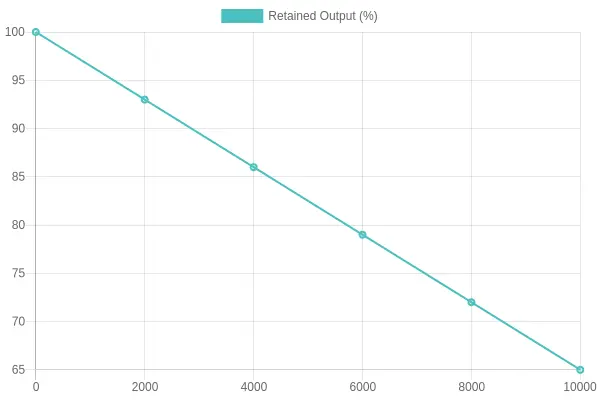
- Standard-atmosphere engineering data. Air density in the lower atmosphere falls by roughly 3 to 3.5% for every 1,000 feet of elevation gain. Because naturally aspirated engines burn air by mass, usable engine power drops in the same proportion. This is textbook aerodynamic reference data, not a marketing claim.
- NFPA 1901 pump performance testing. Automotive fire pumps are certified at defined test points (for example, rated capacity at 150 psi and reduced capacity at higher pressures) under level, controlled conditions. Those tests benchmark the pump; they do not promise that output on a 30% grade.
- Manufacturer pump curves from supply houses such as Hale, Waterous, and Darley plot flow against total head. As elevation head rises, flow for a given pressure falls, which is why a pump that meets spec on the bay floor can underdeliver uphill.
What this means for Type 6 crews
The gap between rated and actual output is not a defect; it is the distance between a laboratory rating and a mountain. On steep terrain, elevation head and reduced engine power compound one another, so a crew that plans for nameplate flow will run short at the nozzle. Budget a de-rated flow figure, and note that some manufacturer ratings routinely overstate real-world usable power once conditions diverge from the test bench. For a Type 6 wildland engine, treating the advertised number as a ceiling rather than a baseline is the difference between a working pump and an empty tank.
Evaluating Realistic Pump Performance on Steep Terrain
Advertised pump ratings are measured under near-ideal conditions: level ground, a short suction lift, and a full tank feeding the pump. The moment a Type 6 wildland engine starts climbing a steep terrain grade, those numbers no longer describe what reaches the nozzle. Static head eats pressure, suction lift rises, and the flow you actually deliver at the nozzle can fall far short of the figure printed on the pump badge.
Why the numbers drop on a grade
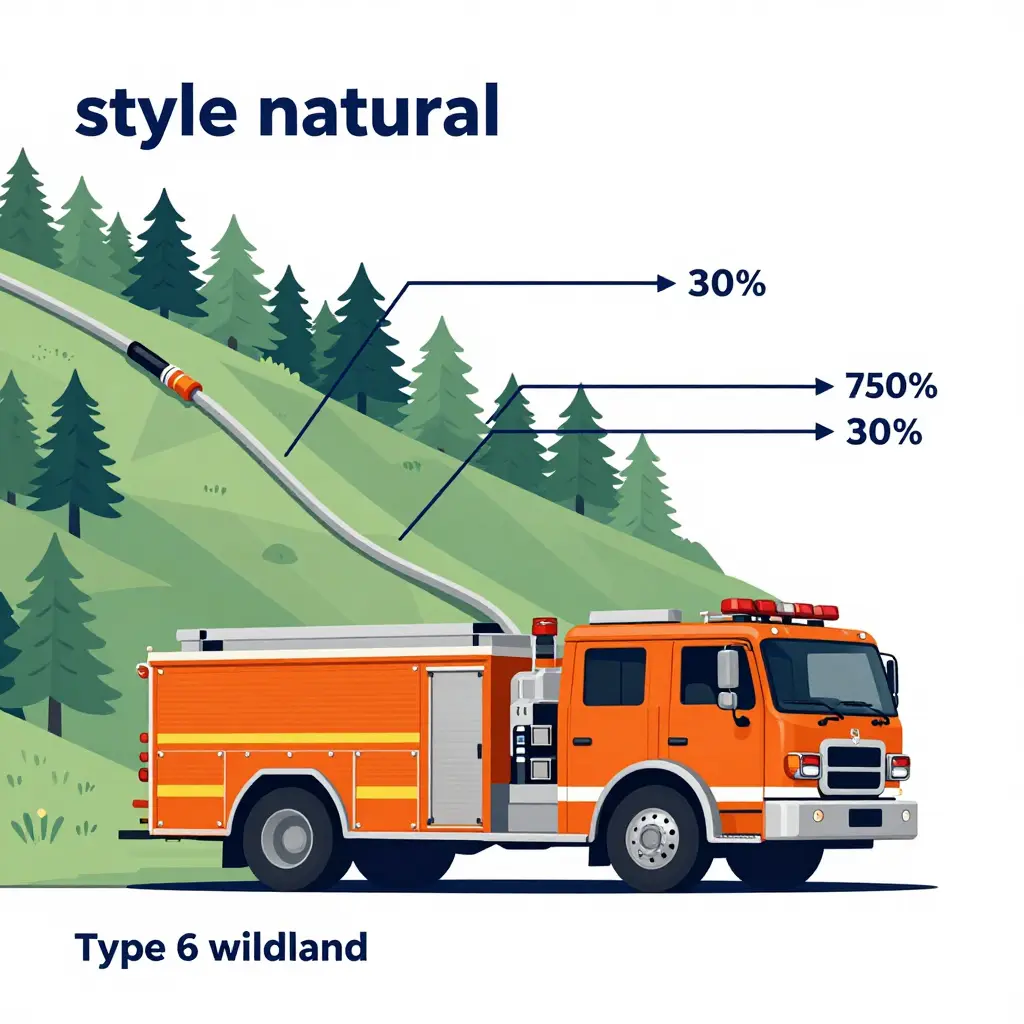
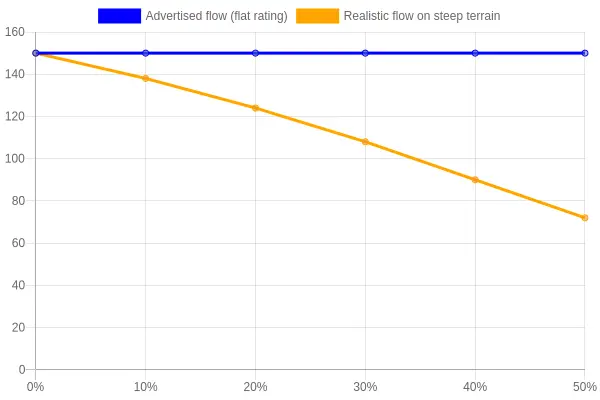
Every foot of vertical rise between the pump and the nozzle costs roughly 0.43 psi. A 300-foot elevation gain therefore consumes about 130 psi before a single drop of water reaches the fire, and operating above sea level shaves a few more percent off engine output. That is why a pump rated at 150 GPM on the factory floor may only move around 90 GPM when you are working high on a ridge.
A quick sizing calculation
Add static head, friction loss, and nozzle pressure to find your real working pressure, then read the flow straight off the pump curve at that point.
| Elevation gain (ft) | Static head loss (psi) | Flow from a 150 GPM pump (GPM) |
|---|---|---|
| 0 | 0 | 150 |
| 100 | 43 | 132 |
| 200 | 87 | 112 |
| 300 | 130 | 88 |
| 400 | 173 | 60 |
Evaluation criteria
- Pump curve at your real operating pressure, not just peak flow
- Altitude-derating data for your specific elevation band
- Suction lift capability and priming time
- Tank-to-pump plumbing size, since bigger pipes mean less friction loss
- Whether the rating assumes a pressurised fill source or a self-contained tank
- Re-fill logistics, including how easily the unit can be resupplied on a slope
Questions to ask suppliers
- At what elevation and inlet pressure was this flow rating measured?
- Can you provide the full pump curve instead of a single advertised point?
- How much flow is lost per 1,000 feet of altitude?
- Is the rating based on drafting or on a positive-pressure supply?
When comparing options, weigh the whole package rather than a single number. A larger water capacity fire engine can extend run time on long incidents, while engineering lessons from the world’s largest fire truck show how plumbing and pump design drive real output. For mist-heavy defensive work along ridges, a correctly specified fog cannon truck can also stretch every litre further.
Frequently Asked Questions: Type 6 Pump Ratings on Steep Terrain
Why do advertised pump ratings differ from the real output I see in the field?
Advertised pump ratings are usually measured at the pump discharge port under ideal, near-sea-level test conditions with short, straight plumbing – not at the nozzle. Every fitting, elbow, check valve, and length of hose adds friction loss that subtracts from that number. On a Type 6 engine, the gap between the brochure figure and delivered flow can easily reach 20-30%. Treat the rating as a best-case ceiling rather than a promise, much like why equipment ratings often overstate usable power.
How does altitude affect pump performance?
At higher elevations, lower atmospheric pressure reduces the pump’s ability to prime and lift water, so both draft and discharge performance drop. A pump rated at 150 GPM at sea level may deliver only 110-130 GPM at 6,000 feet, depending on engine condition and impeller design. Thin air also robs the engine of horsepower, further shrinking the flow you can actually push through the line.
How does hose lay impact flow on steep terrain?
Hose lay is often the biggest hidden culprit. Every additional 100 feet of 1.5-inch hose and each 100 feet of vertical rise adds friction and back-pressure that must be overcome before water ever reaches the nozzle. A long, winding uphill lay can cut effective flow dramatically compared with the same pump on flat ground. Shorter lays, larger-diameter hose, and gated wyes help claw back some of that lost volume.
How can I estimate usable GPM before committing?
Start with the rated flow, then subtract friction loss for your specific hose diameter, length, and elevation gain, plus any nozzle pressure demand. Field-tested flowmeters or a simple pitot reading at the nozzle give you the real number far better than a chart. As a rule of thumb, assume you will lose 25-35% of the sticker figure on steep terrain and plan your water supply accordingly.
Does a higher-rated pump always perform better on steep terrain?
Not necessarily. A larger pump paired with undersized hose, a weak engine, or a poor impeller match can underperform a smaller, well-matched unit on a steep grade. Real-world performance depends on the whole system – pump curve, engine torque, hose lay, and elevation – not just the number on the spec sheet. Always validate with field trials on the slopes you actually fight fire on.
Conclusion
An advertised pump rating is a baseline for comparison, not a guarantee of what a Type 6 wildland engine will actually deliver on steep terrain. Elevation-driven loss of engine power, friction and lift losses across long hose lays, and the reduced intake pressure available at altitude all erode rated flow long before water reaches the fireline. A number that looks impressive on a spec sheet can shrink to a fraction of that output once gravity, distance, and grade enter the equation.
For equipment selection and planning, treat the nameplate rating as a starting point rather than a destination. Buyers should request performance curves that account for elevation and realistic hose configurations, and they should size water capacity for fire engines around the steepest slope in their response area rather than an average. Crews should also train to plan hose lays that minimize unnecessary lift and to verify field performance during drills, not just at delivery.
CRRC builds emergency and specialty vehicles around real operating conditions instead of laboratory ideals, which helps departments specify a Type 6 wildland engine whose field performance matches the mission. Reliable equipment starts with an honest reading of what advertised ratings can and cannot tell you.