

Introduction: What Actually Determines Fire Tanker Performance
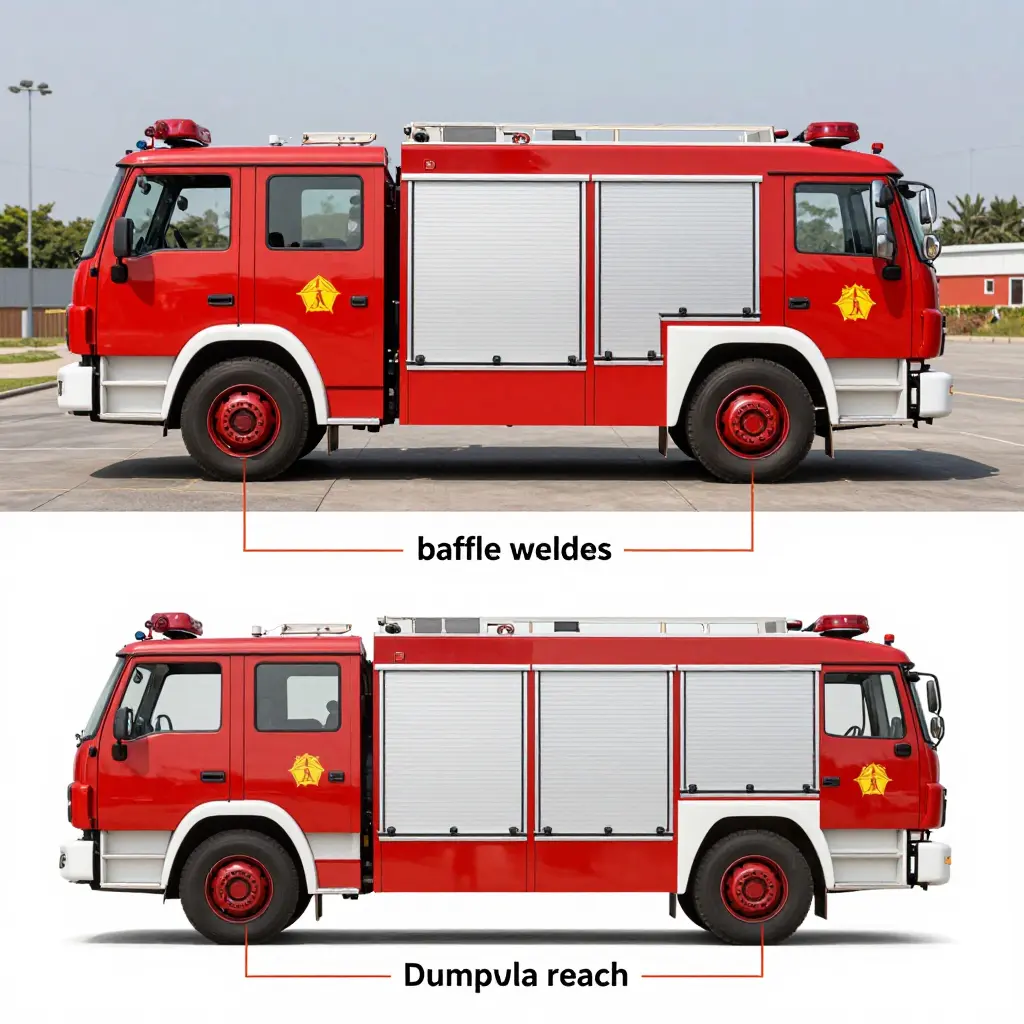
On a fire tanker, baffle weld integrity and dump valve reach decide how well the rig performs at a fire, far more than tank size does. Most buyers comparing fire tankers for sale miss this.
The first specification fire chiefs, procurement officers, and fleet managers reach for is tank size. A 3,000-gallon unit looks more capable than a 2,000-gallon unit, and for many buyers the comparison stops there. The number says much less than it appears to.
Tank size is the nominal volume of water a tender can carry. It is static. It says nothing about how fast that water can be discharged, how safely the chassis handles a part-full load, or how long the tank shell will survive years of service. Nominal capacity is a starting point, not a performance guarantee. For how these ratings are derived, see how water capacity is measured on a fire engine.
Two engineering details decide the outcome on the fireground.
Baffle welds tie a tank’s baffle plates to the shell. They resist the fore-and-aft and side-to-side surge of a partially filled tank as the truck accelerates, brakes, and corners. Weak or poorly executed welds crack under repeated surge loading, and a cracked baffle speeds up shell fatigue, leakage, and downtime.
Dump valve reach is the effective distance and geometry over which a tanker can empty its load: through a rear, side, or portable dump, into a drop tank, or directly onto the fire. A large tank paired with a short, badly placed dump valve is functionally smaller on the fireground, because water that cannot be delivered fast enough is not fighting the fire.
Departments that must justify capital spending and then live with the consequences should evaluate tenders on the criteria that decide suppression outcomes. The rest of this guide covers baffle weld design, dump valve geometry, and tank sizing together.
Dump Valve Reach: The Geometry That Decides Shuttle Speed
Dump valve reach is the effective horizontal and vertical throw of a rear or side dump valve, measured from the discharge outlet to where the water actually lands. It is a separate specification from valve diameter. A wide rear dump valve mounted low on the frame may clear the apparatus body by only a short distance, which forces operators to park the water tender so close to a portable dump tank that clearance or ground slope becomes unworkable.
Three geometry variables set the practical reach:
- Vertical discharge height. The outlet’s height above grade controls throw distance. A higher outlet throws water farther, but it can overshoot the portable dump tank or splash back over the apparatus.
- Ground slope. On a crowned road or a soft shoulder, water follows the fall line. A side dump valve on the uphill side of a sloped dump site loses reach quickly.
- Tank placement. How far the portable dump tank can sit from the apparatus without blocking traffic or sinking into soft ground.
These variables decide where the portable dump tank can safely sit. When reach is short, crews nudge the tender forward, drag the tank, or spill water over the lip. Those minutes repeat on every one of dozens of round trips in a single water shuttle. Narrow lanes and soft shoulders leave little room to reposition, which is why the sizing logic in fire truck sizing for narrow rural lanes applies directly to dump site setup.
How Reach and Dump Rate Govern Turnaround
Reach and dump rate set turnaround time together. The shuttle loop is fill, travel, dump, return. Dump time equals usable volume divided by dump rate in gallons per minute, so a slower valve adds minutes to every cycle.
| Tank / Valve Setup | Dump Rate | Usable Volume | Dump Time |
|---|---|---|---|
| Oversized tank, short reach valve | 600 GPM | 3,000 gal | 5.0 min |
| Mid-size tank, side dump valve | 750 GPM | 2,500 gal | 3.3 min |
| Matched tank, full reach valve | 1,000 GPM | 2,000 gal | 2.0 min |
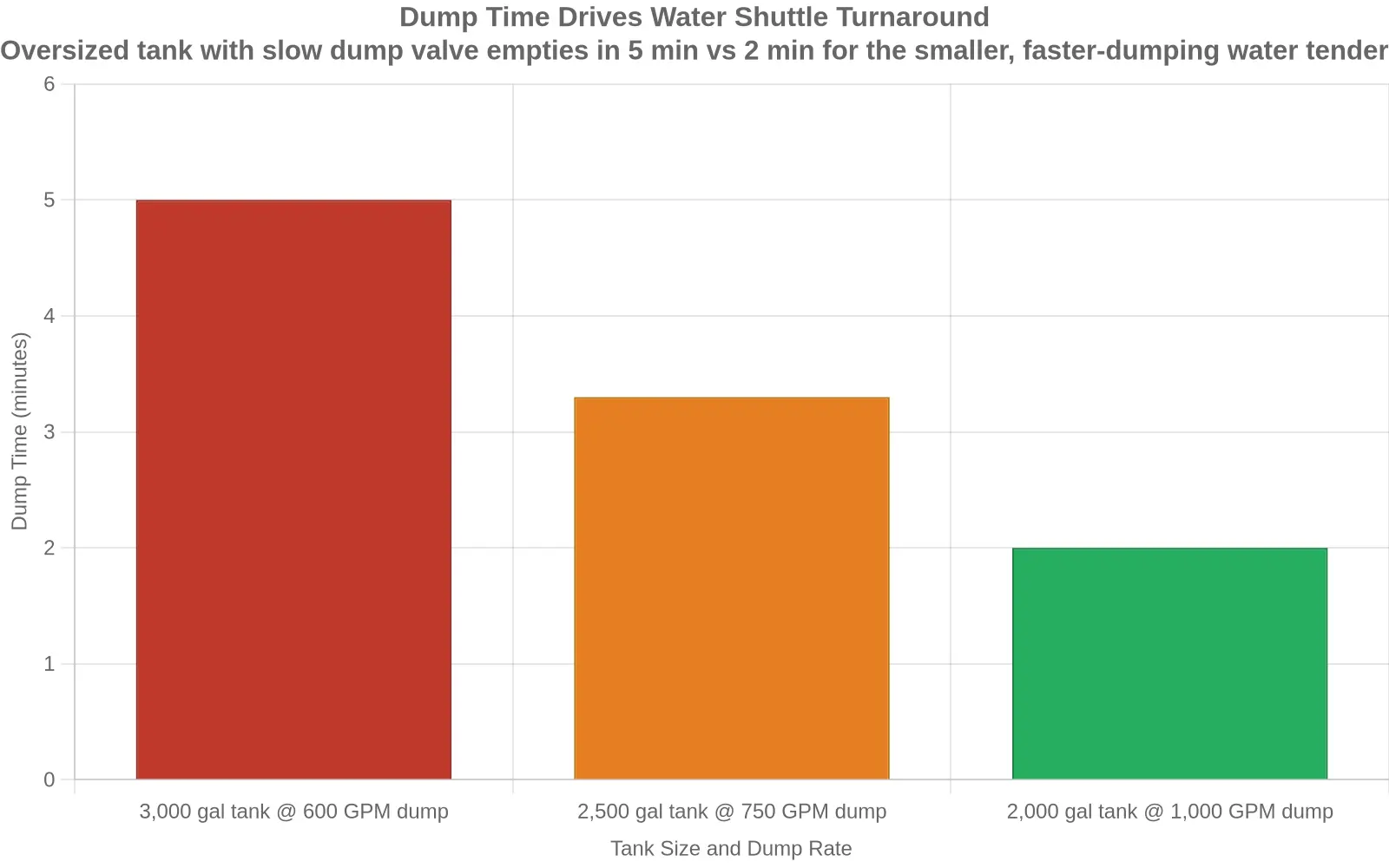
An oversized tank with poor dump valve reach pays twice: it carries more water but empties it more slowly and needs tighter positioning, which inflates dump time and stretches the whole cycle. When comparing fire tankers for sale, treat dump valve reach and dump rate as primary specifications. A correctly sized water tender that dumps fast and reaches a portable dump tank cleanly will out-cycle a larger tank that cannot empty efficiently.
Fire Tanker Spec Trade-Offs: What Actually Decides Performance
Line up fire tankers for sale and the spec sheet pulls you toward the biggest tank number. In the field, the fabrication details, baffle weld integrity and dump valve reach, decide whether the rig keeps a water shuttle running or becomes a slow, unstable liability. Constraints like fuel tank placement and rear-axle loading limits show how geometry, not gallon count, governs what the chassis can legally and safely carry.
The matrix below weighs each factor against what it controls on the fireground, the myth around it, and how urgently it should drive a procurement decision.
| Specification Factor | What It Controls in Real Operations | Common Misconception | Priority for Buyers |
|---|---|---|---|
| Nominal tank size | Total water available before resupply; sets the refill/turnaround rhythm of the shuttle | “Bigger is always better” | Medium – match to available water supply, terrain, and access, not to the largest number printed |
| Baffle weld quality/type | Load stability, slosh control, and structural integrity of the tank and chassis in transit | Any baffle will do; the number or size of baffles is what counts | High – continuous vs. stitch welds, weld penetration, and baffle layout drive safety and longevity |
| Dump valve reach | How quickly you can position the rig and dump into a portable tank or draft point; how far the stream clears the body | Reach only matters for off-road or hard-to-access sites | High – reach governs setup speed and where the rig can actually empty itself |
| Dump/discharge rate | Speed of transferring water at the dump site to keep the shuttle cycling | Tank size sets the effective flow rate | High – rated gpm/L-min at the valve determines shuttle throughput, not capacity |
| Chassis payload/axle limit | Legal and safe weight distribution; how much tank, water, and equipment the rig can carry | GVWR is just registration paperwork | Critical – per-axle loading caps usable water regardless of the nominal tank size |
The Bottom Line
Baffle weld quality and dump valve reach outrank nominal tank size because they control safety, stability, and how fast water leaves the rig. A 3,000-gallon tank with poor baffle welds or a short-reach, slow dump valve is worth less on the fireground than a smaller, well-built tender that empties cleanly and reliably. Spec the welds and the valve first, then size the tank to your water supply and chassis limits.
Dump Valve Reach & Baffle Weld Inspection Checklist for Fire Tankers
On a used water tender, the tank size stamped on the spec sheet tells you far less than the plumbing and internal structure deliver on scene. Work through this checklist to judge dump valve reach and baffle welds before you commit public funds. The load-distribution reasoning in fire truck water tank placement and rear axle limits applies here as well.
- Measure dump valve reach from the rear frame edge to the valve outlet, confirming it clears the chassis and any ground obstacle during a gravity dump.
- Verify dump valve seal condition by filling the tank at least half and watching for weeping, drips, or seat erosion at the valve body.
- Observe the actual discharge rate against the manufacturer’s rated flow, timing a full dump and noting any restriction from a seized or undersized valve.
- Confirm baffle weld continuity by raking a light along each internal seam, checking for gaps, incomplete fusion, or voids that let water surge between compartments.
- Inspect every weld toe for cracking, especially where baffles meet the tank shell, since stress risers here reveal fatigue first on a hard-used tender.
- Look for slosh-induced wall deformation along the tank sides and baffle faces, which signals repeated surge loading and weakened internal bracing.
- Test valve actuator and handle travel through the full stroke from the operator position, ensuring reach, linkage, and lubrication allow reliable one-person operation.
- Record baffle spacing and compartment layout against the tank’s rated capacity to confirm the internal structure truly matches the documented water volume.
Dump Cycle Time vs. Tank Size: Why Reach Beats Volume
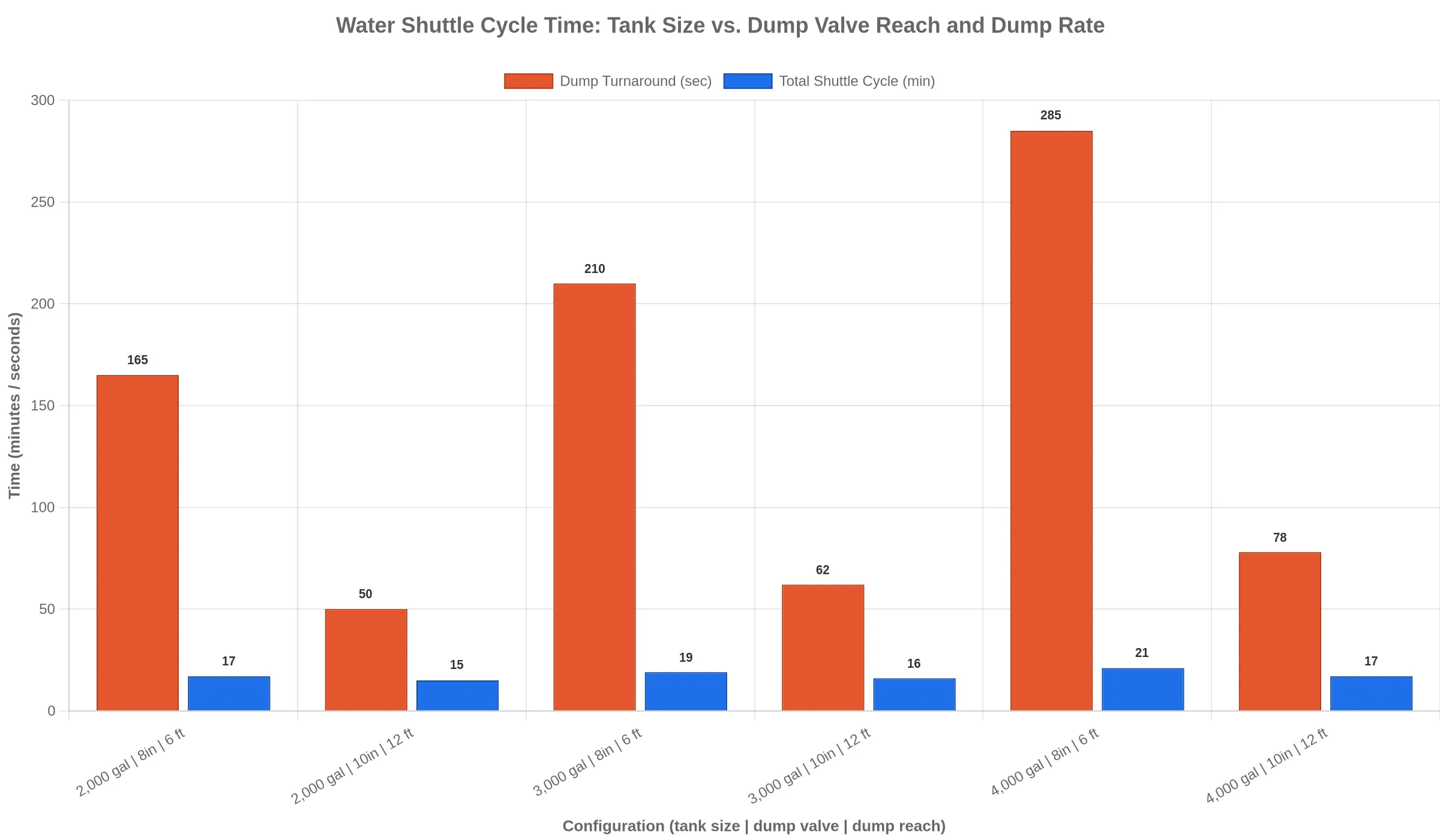
Buyers comparing fire tankers for sale almost always start with tank size. A 4,000-gallon body sounds like it will out-perform a 2,000-gallon body every time. In a real water shuttle, that assumption falls apart. Cycle time depends on how quickly you can empty the tank and how easily the dump valve reaches the portable tank or drop point. The chart below uses benchmark figures across six representative spec configurations.
Reading the Chart
The orange bars track dump turnaround time in seconds: the span from parking at the drop point to a fully emptied tank. The blue bars track total shuttle cycle time in minutes, which bundles fill time, travel to and from the fireground, and that dump turnaround. The pattern:
| Configuration | Dump Turnaround | Total Cycle Time |
|---|---|---|
| 2,000 gal, 8 in valve, 6 ft reach | 165 sec | 17 min |
| 2,000 gal, 10 in valve, 12 ft reach | 50 sec | 15 min |
| 3,000 gal, 8 in valve, 6 ft reach | 210 sec | 19 min |
| 3,000 gal, 10 in valve, 12 ft reach | 62 sec | 16 min |
| 4,000 gal, 8 in valve, 6 ft reach | 285 sec | 21 min |
| 4,000 gal, 10 in valve, 12 ft reach | 78 sec | 17 min |
What This Means on the Fireground
Scale the tank from 2,000 to 4,000 gallons and keep a weak dump setup (8-inch valve, 6-foot reach), and the cycle actually grows from 17 to 21 minutes. The bigger tank cannot empty fast enough, so the water sits in the body while the fireground waits. Pair that same 4,000-gallon tank with a 10-inch valve and 12-foot reach and the cycle drops 4 minutes (a 19% improvement) with no change in tank volume.
That 4-minute gap compounds on every round trip. Over thirty shuttle cycles, it is the difference between roughly 8.5 hours and 10.5 hours of tanker time. Reach and dump rate compound; they do not simply add.
Where Baffle Welds Fit In
Dump valve reach only pays off if the tank structure survives repeated high-rate dumps. Every time you empty a tank through a large valve, the shifting water loads the internal baffles hard. Poorly welded baffles fatigue and crack, and once they fail, water surges forward, the vehicle becomes unstable, and dumping has to slow or the tanker leaves service entirely. A generous dump reach bolted to an under-built tank is a liability, not an advantage.
The Procurement Takeaway
When you evaluate how tank placement interacts with rear axle limits, treat dump valve size, dump reach, and baffle weld quality as primary specifications rather than afterthoughts behind the gallon count. A moderately sized tank with a long-reach, large-bore dump system will out-shuttle a giant tank that cannot get out of its own way.
Why Tank Size Misleads Buyers
Scan fire tankers for sale and the headline figure on most listings is tank size. The focus is understandable, but it is also where procurement decisions quietly go wrong. Nominal capacity is a sales number. It does not describe how much water the apparatus can legally haul, where it can travel, or how fast it can dump at the fireground.
Payload and rear-axle limits set the true ceiling
Water is heavy. At roughly 8.34 pounds per gallon, a 3,000-gallon tank adds about 25,000 pounds of liquid before pump, hose, tools, and crew are counted. Most of that mass sits behind the cab and lands on the rear axle. If the chassis rear-axle rating cannot carry it, the tank is over-spec, and the truck is overloaded every time it fills. The consequences show up as accelerated spring and brake wear, longer stopping distances, and lower safe speed on grades. Buyers who compare fire truck tank size against chassis payload ratings learn quickly that a modest tank on a correctly rated chassis outperforms a large tank on an overloaded one.
Route and bridge restrictions erase paper capacity
A tanker must reach both the water source and the fire. Bridge weight limits, narrow rural lanes, soft shoulders, and tight turnarounds often cap usable capacity well before the tank does. A truck too heavy for a posted bridge is not a high-capacity asset; it is a parked one. Weight-driven redesigns and upfit delays compound the problem; see brush fire truck manufacturing and upfit capacity constraints for how those delays play out.
The components that actually determine performance
Real-world results depend on details the spec sheet buries. Baffle welds control slosh and protect the chassis from cyclic loading. Dump valve reach determines how quickly a crew can empty the tank at the drop point. A large tank with poor baffling destabilizes the truck in motion; a large tank whose dump valve the operator cannot safely reach empties slowly and wastes the water the department paid for. Either defect undercuts the capacity on the brochure.
| Over-weighted factor | Under-weighted reality |
|---|---|
| Nominal tank size | Payload and GVWR limits |
| Gallons on the brochure | Rear-axle rating |
| Maximum fill volume | Bridge and route restrictions |
| Advertised capacity | Baffle weld integrity |
| – | Dump valve reach |
Fire chiefs and procurement officers should specify tankers around payload, axle, and route realities first, then size the tank to fit within them. Anything else is buying a number rather than a working tool.
Pre-Purchase Inspection: The Tank and Dump System Tell the Real Story
A used fire tanker’s advertised capacity says little about how much water it will deliver on scene. A 3,000-gallon tank with cracked baffle welds and a half-seized dump valve pours out less usable water, and more operational risk, than a well-maintained 2,000-gallon unit. Inspect the tank and dump system the way an engineer would, not the way a spec sheet reads. The checks below separate an apparatus with real service life left from one that merely looks the part.
Baffle Weld Integrity: Visual, Dye Penetrant, and Tap Testing
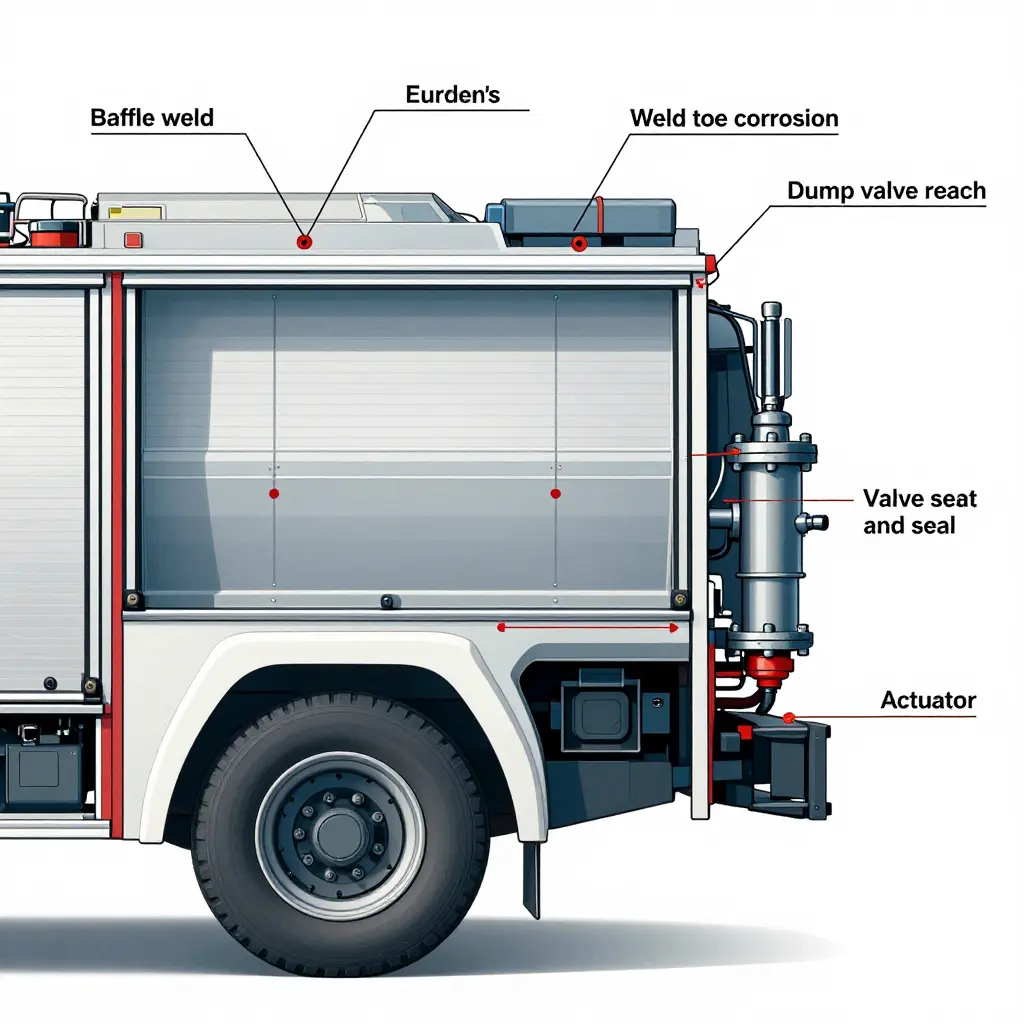
Baffles divide the tank into compartments so water does not surge in transit, and they carry much of the structural load on the shell. Their welds are where tankers age first.
- Visual pass: Look for rust streaks, fretting, discolored paint, and weeping seams at baffle-to-shell junctions. Vertical rust trails usually trace a crack that has been leaking.
- Dye penetrant testing: Applied to suspect welds, this reveals surface-breaking cracks that are invisible to the eye. It is cheap, fast, and worth requesting on every baffle joint.
- Tap testing: Strike the weld and surrounding plate with a hammer. A dull, rattling tone signals a disbond, void, or through-wall thinning; a clean ring indicates sound metal.
Weld Toe Corrosion: The Slow Failure
The weld toe, where the weld bead meets the parent plate, is both a stress riser and a corrosion magnet. Pitting here is the earliest sign of fatigue. Probe the toe for thinning and check whether recoating was cosmetic or structural.
Dump Valve Reach: Measure It, Don’t Assume
Dump valve reach is the horizontal projection the valve can deliver, and it decides whether you can empty the tank onto a drop tank or into a pump intake without spilling. Measure from the tank outlet face to the valve’s discharge centerline, and confirm the dimension against your dump-site geometry. A valve that cannot clear the tank shell wastes the volume you paid for.
Valve Seat, Seal, and Actuator Function
Inspect the valve seat and seal for scoring, hardening, and chemical swelling; a leaking seal turns a fast dump into a slow drip. Cycle the actuator through full open and full closed several times, watching for slow travel, air loss, or sticking. Seals and other fluid-handling components age in ways that echo the problems seen in used ARFF foam systems, so treat containment hardware as a reliability indicator, not an afterthought.
Discharge Rate Testing
Time the actual dump. Fill, then open the valve and measure how long it takes to evacuate a known volume. A tank that should empty in under a minute but takes two has flow restrictions, a partially blocked outlet, or a worn valve that no capacity rating will ever disclose. If the numbers fall short, arrange certified pump and plumbing service before negotiating final price.
Why These Checks Beat a Stated Tank Capacity
Capacity is a static number; weld, seal, and flow condition determine usable water. A quick summary:
| Inspection Check | Method | What It Reveals |
|---|---|---|
| Baffle weld integrity | Visual, dye penetrant, tap | Structural cracks, voids, disbonds |
| Weld toe corrosion | Probe and thickness check | Fatigue onset, thinning, remaining life |
| Dump valve reach | Physical measurement | Real-world dump usability |
| Valve seat and seal | Visual and cycle test | Leak risk, sealing integrity |
| Actuator function | Full open/closed cycling | Response speed and reliability |
| Discharge rate | Timed volume dump | True flow, not rated flow |
A stated tank size can be accurate and still misleading. Weld condition and dump-system performance tell you how much of that water you can actually put on a fire, and for how many more seasons. When a seller’s numbers and your measurements disagree, trust the measurements. If your inspection turns up problems, our fire truck mechanic and certified pump service guide covers the remediation.
Conclusion and Procurement Recommendations
Weigh fire tankers for sale against one another and the specification that most reliably predicts fireground performance is not nominal tank size. It is the quality of the baffle welds and the working dump valve reach. Tank size tells you how many gallons leave the station; baffle welds decide whether you can haul that water safely, and dump valve reach decides how quickly you can put it on the fire.
These priorities trade off against each other. A bigger tank adds weight, lifts the center of gravity, and strains the chassis, which is why baffle welds and how tank placement interacts with rear axle limits matter so much. A longer, well-routed dump valve reach lets crews unload fast without repositioning, often the difference between a contained fire and a total loss.
Procurement Recommendation Checklist
| Priority | What to Verify | Why It Matters |
|---|---|---|
| 1 | Baffle weld geometry and inspection records | Weld quality controls slosh load, rollover risk, and tank service life |
| 2 | Dump valve reach and discharge height | Confirms fast, repositioning-free unloading at the scene |
| 3 | Tank size vs. chassis payload and axle limits | Prevents overload and unstable handling on rural routes |
| 4 | Weld material, coating, and corrosion protection | Determines durability in wildland, ag, and industrial use |
| 5 | Dump cycle time under a full load | Measures real delivery, not brochure gallons |
Guidance for Fire Chiefs and Procurement Officers
Buy on structure and reach first, capacity second. Request baffle weld inspection and non-destructive test documentation before you sign. Measure dump valve reach and discharge height on the actual unit, at the height you will deploy it, never from the spec sheet alone. Then confirm tank size against the chassis payload rating and verify dump cycle time under a full load.
A large tanker with weak baffle welds or a short dump valve reach will underperform a smaller, better-built unit every time. Write your evaluation criteria around baffle welds and dump valve reach, and treat tank size as the outcome of those decisions, not the starting point.