

The Thesis: What Actually Governs a Tiller’s Turning Radius
On a narrow street, a tiller fire truck turns on its rear steering axle alignment, not on the reach of its ladder. Get that alignment right and the tractor and trailer swing through the corner as one coordinated unit. Get it wrong and the trailer tracks wide regardless of how good the aerial is. Procurement teams reviewing tiller fire truck listings for historic districts and narrow lanes should check this specification first.
Rear steering axle alignment is the angular relationship among the tractor’s rear axle, the trailer’s steering axle, and the kingpin pivot that links them. When they line up on a tight, predictable path, the trailer’s wheels follow the tractor around the corner instead of cutting across it. That is what sizing apparatus for narrow lanes comes down to in practice.
The Misconception Buyers Keep Making
Most procurement teams sort tiller fire truck listings by ladder reach and vertical extension, as though those figures said something about maneuverability. They don’t. Ladder reach describes how high and how far the aerial can work. It says nothing about how tightly the chassis can turn. A long ladder can sit on a truck with a tight turning radius, and a short ladder on one with a terrible radius.
Reach is a vertical, aerial-performance figure. Turning radius is a ground-level steering-geometry figure. Optimizing one does nothing mechanical to the other, which is why reach-ranked listings mislead buyers so reliably.
Turning Radius Geometry: Why the Rear Axle Steers the Story
Three measurements do most of the work when you judge a tiller’s maneuverability.
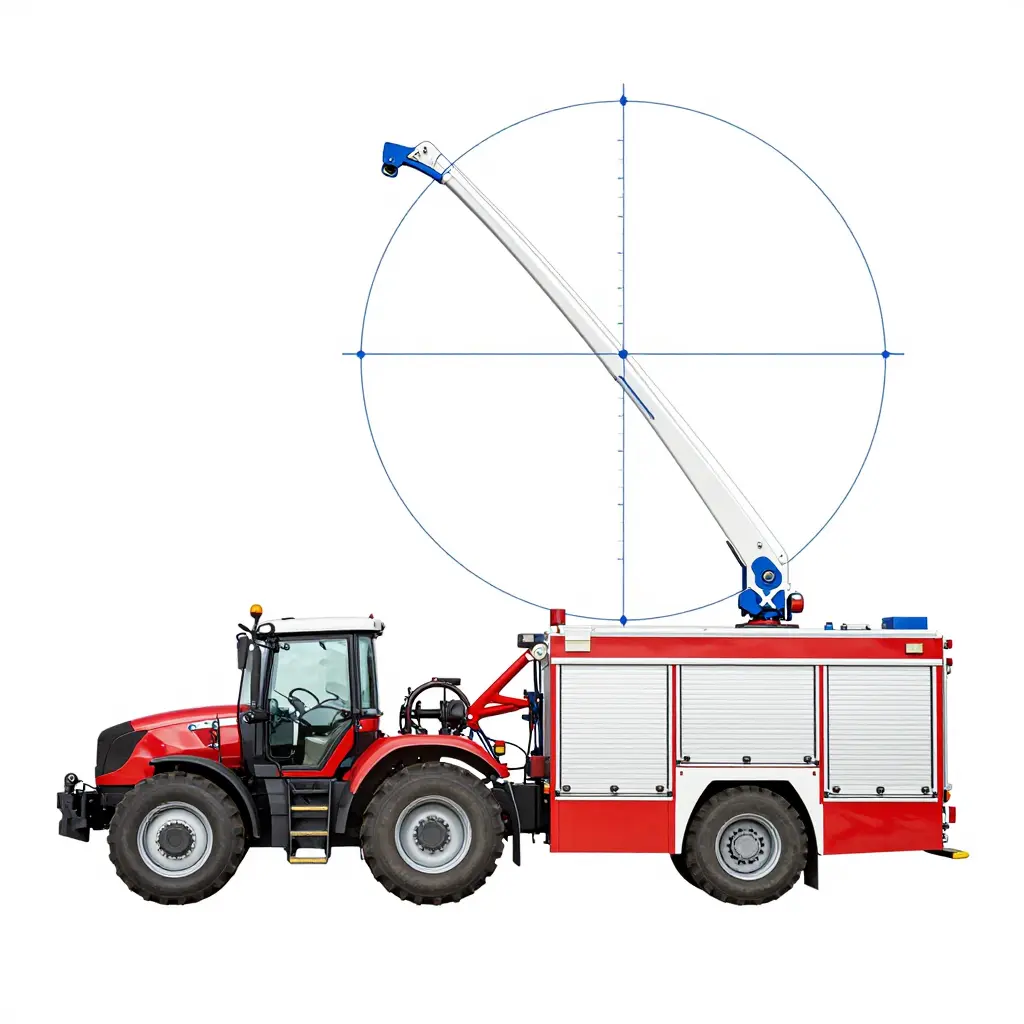
Turning radius is the radius of the smallest circle traced by the outermost point of a vehicle during a full-lock turn. Wheelbase is the distance between a vehicle’s front and rear axles. Overhang is the distance from the rear axle back to the rearmost point of the body. In a conventional truck these three numbers behave predictably. A tractor-drawn aerial does not, because it is not one rigid vehicle; it is two.
The Geometry of a Tractor-Drawn Aerial
A tractor-drawn aerial (a tiller) is a tractor and a trailer joined at a single articulation point. That joint changes the arithmetic, because the two halves can pivot relative to each other.
Three elements drive the turn:
- The tractor’s front steering pivot controls where the lead half goes and sets the initial arc.
- The articulation point is the hinge that lets the trailer follow a tighter or wider path than the tractor.
- The trailer’s rear steering axle lets a second driver steer the back end, shortening the turning circle instead of dragging it wide.
How the Geometry Produces Vehicle Response
When the tractor’s front pivot turns, the tractor begins an arc defined by its own wheelbase. Without the articulation point, the trailer would simply be towed behind on a wider path, and its overhang would sweep far outside the tractor’s track. That sweep is what clips curbs, poles, and parked cars.
Add the rear steering axle and the numbers change. The tiller driver at the back rotates that axle in the desired direction, pulling the trailer’s rear inward. The articulation point lets the trailer pivot independently, so the two halves trace different radii inside the same envelope. The result is not a tighter tractor but a tighter combination.
For a procurement manager, the number that matters is therefore not the tractor’s turning radius on the spec sheet. It is the effective turning envelope: the union of the arcs traced by every outer corner of the articulated unit at full lock. Two tillers with identical tractors can post very different effective envelopes depending on rear-axle alignment and steering angle range.
Conclusion: Maneuverability Is a Systems Number
Maneuverability in a tiller comes from coordinated steering, not a single measurement. The front pivot sets the arc, the articulation point allows the deviation, and the rear steering axle closes the circle. If any one of the three is misaligned or limited, the envelope expands and the advantage disappears. Verify the rear steering axle’s alignment and range before you trust a quoted turning radius, and before you take the truck down a narrow street.
For more on matching apparatus to constrained roadways, see sizing small fire trucks for narrow rural lanes.
Turning Radius by Rear Axle Alignment Setting
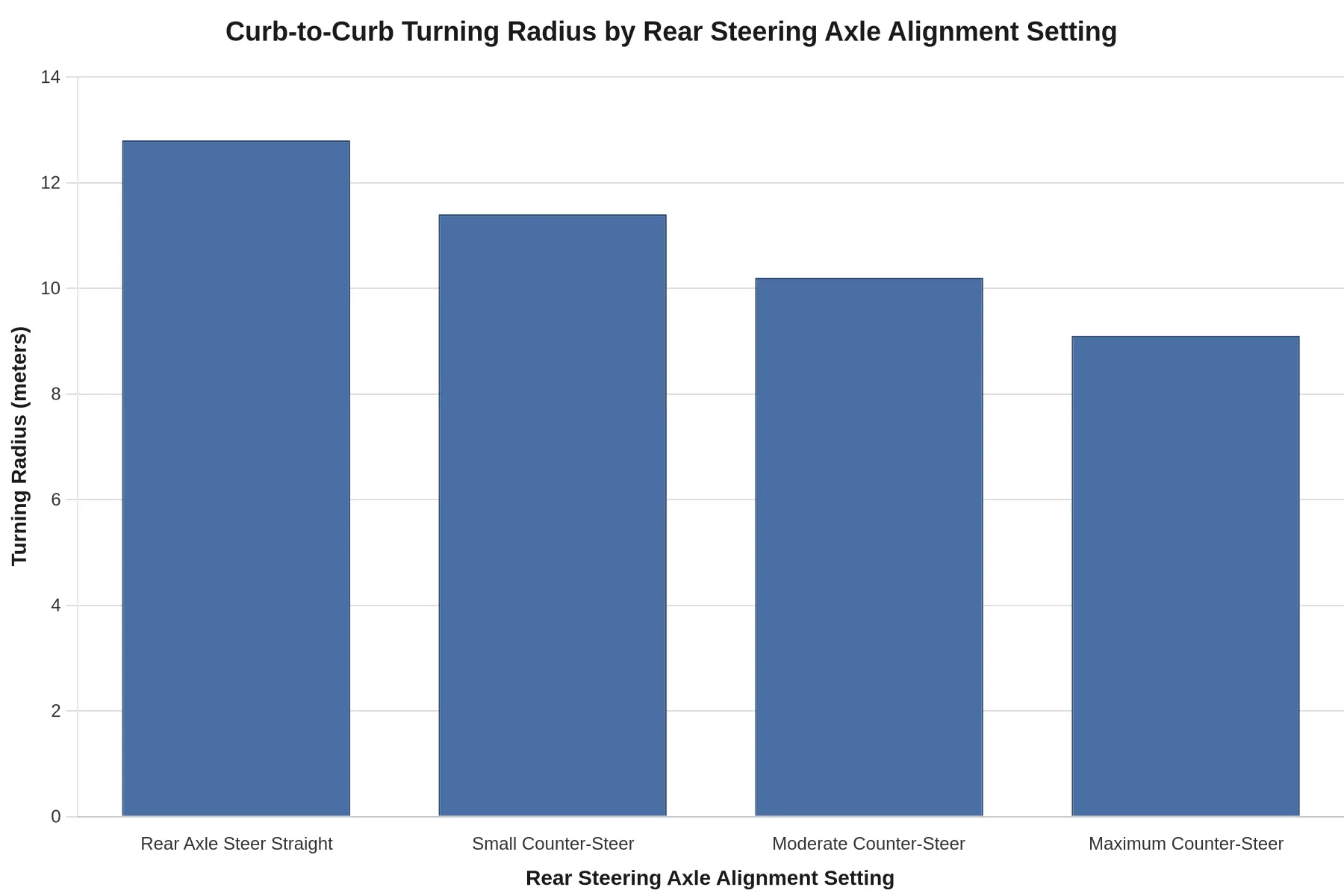
Figure 1: Curb-to-curb turning radius of a tiller apparatus across four rear steering axle alignment settings.
| Rear Steering Axle Alignment Setting | Curb-to-Curb Turning Radius (m) |
|---|---|
| Rear axle steer straight | 12.8 |
| Small counter-steer | 11.4 |
| Moderate counter-steer | 10.2 |
| Maximum counter-steer | 9.1 |
With the rear axle held straight, the tractor-drawn aerial carves the widest arc: 12.8 meters curb to curb. A small counter-steer tucks the tail inward and shaves 1.4 meters off that figure. Moderate counter-steer pulls it down to 10.2 meters. At maximum counter-steer the apparatus rotates in 9.1 meters. The ladder is the same length across all four bars; only the rear steering axle alignment changes. That 3.7-meter spread is roughly a full traffic lane, and on a narrow street or a tight cul-de-sac turnaround it decides whether the tiller completes the turn. When you evaluate listings, insist on the alignment specification and a demonstrated turning radius, then check both against the streets the apparatus will actually serve. Buyers weighing options for tight routes can find the broader context in small fire truck sizing for narrow rural lanes.
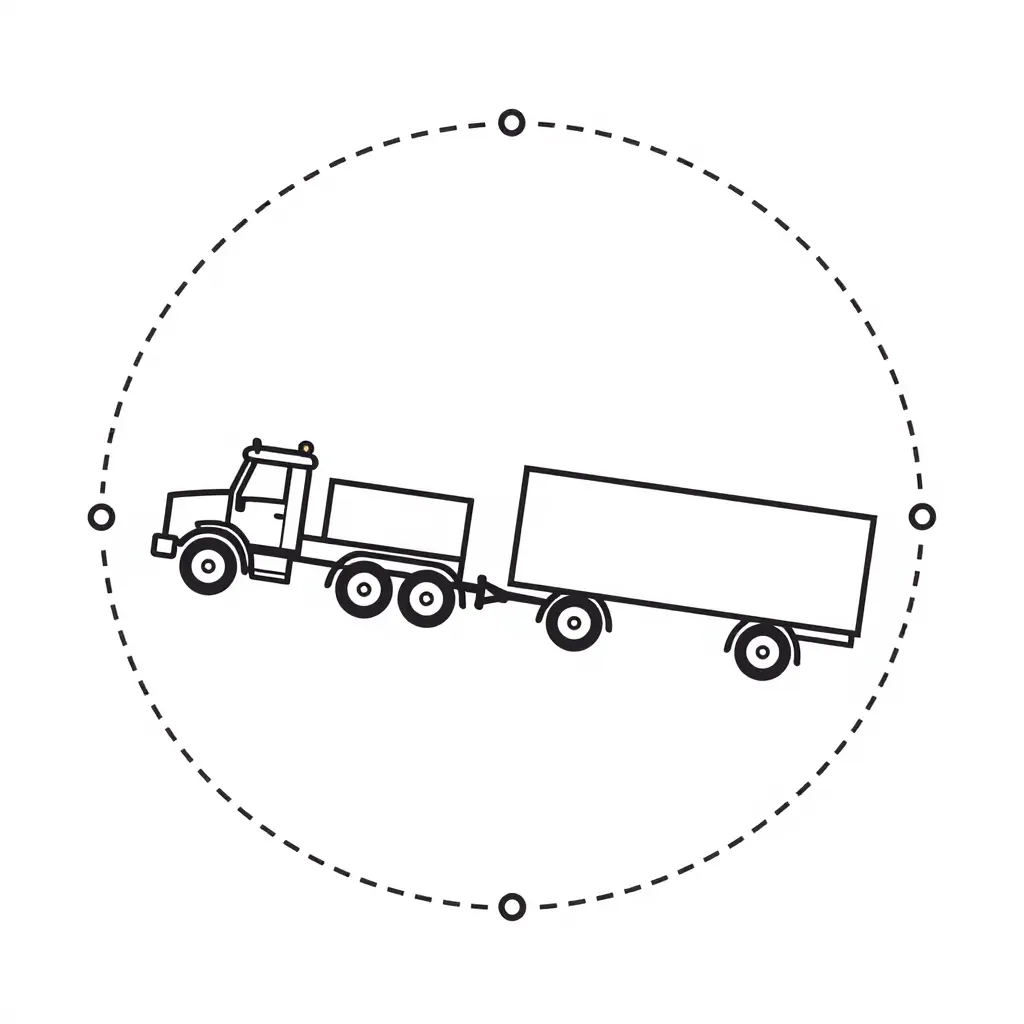
Figure 2. The turning geometry of a tiller aerial – not a scene, just the geometry.
Seen from directly overhead, this flat schematic reduces a tiller rig to the three reference points that govern how it corners. The three marked circles and two dashed arcs are enough to read the steering principle:
- Tractor front axle (leading pivot). The steering input that starts the turn. Whatever radius this axle follows, everything behind it has to accommodate.
- Articulation / pintle point (middle joint). The hinge between tractor and trailer, and the mechanical translator where steering commands from the cab and the tiller station meet. The angle it carries sets how sharply the rear can be pulled around.
- Trailer rear steering axle (trailing pivot). The point that decides real-world turning radius on a narrow street. Aligned and counter-steered to track inside the front arc, the rig “cuts the corner” cleanly. Misaligned, it swings wide, and the outer dashed arc is what clips parked cars and hydrants.
- Dashed sweep paths. The two curved dashed lines trace the envelopes swept by the front and rear as the truck negotiates the turn. Their lateral offset, not the ladder’s reach, determines whether a given listing will fit a given block.
How to read it: the front dashed path is the arc the tractor follows; the rear dashed path is where the trailer’s last axle actually goes. A well-set-up tiller keeps the two arcs closely nested, which tightens the swept path. That geometry, not boom length, is what you should verify first, whether you are comparing apparatus or working through the fundamentals of sizing a fire truck for narrow rural lanes.
Set ladder reach aside for a moment. When a tiller threads a tight corner, chassis geometry is the real limit, and these are the levers that decide its true turning radius:
- Rear steering axle alignment angle – the trailing axle’s steering angle relative to the tractor’s path is the single biggest factor. A properly phased rear steering axle alignment lets the trailer cut inside the tractor instead of scrubbing wide, which is what actually shrinks the effective turning radius.
- Trailer wheelbase length – the distance between the tiller trailer’s axles and the articulation point sets how much the rear end can be steered into the corner. Shorter trailers swing tighter; longer ones drag the tail outward.
- Tractor wheelbase – the tractor’s own wheelbase governs the lead-in arc. A long tractor wheelbase pushes the initial turn wider before the trailer even begins to follow.
- Articulation point position – where the fifth-wheel or hitch sits fore-and-aft changes the leverage between tractor and trailer and shifts how much yaw the tiller driver can command.
- Rear overhang – tail length behind the last axle turns overhang into swept width, so an over-long overhang offsets gains made elsewhere. This is a key point in small fire truck sizing for narrow rural lanes.
- Tire scrub and steer mode selection – scrub radius, tire width, and the chosen steer mode (crab, coordinated, or manual tiller) determine how much the rubber resists or assists the turn at low speed.
- Steering ratio and input speed – how fast the rear axle steers per degree of tractor turn, plus driver timing, decides whether the geometry is used well or wasted.
Tiller Steering Modes and Their Effect on the Turning Envelope
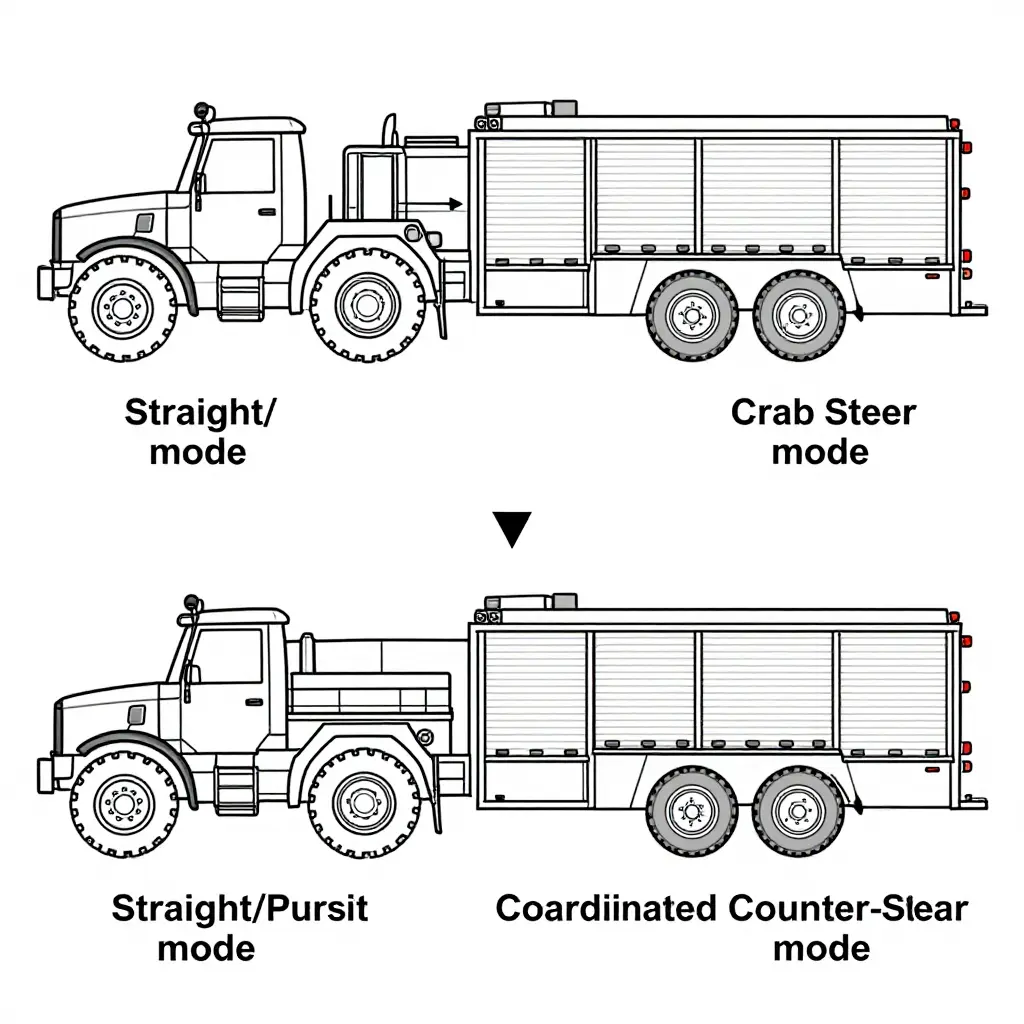
A tiller truck earns its maneuverability from a second, independently steerable axle on the trailer, commanded by a tiller operator rather than the front driver. That rear steering axle is the lever that reshapes the turning envelope, and it is used in three common modes.
Every mode follows the same causal chain: mode selection determines rear steering axle alignment, and axle alignment determines the resulting turning radius.
Straight / Pursuit Mode
The trailer’s rear wheels are held parallel to the tractor’s path, so rear steering axle alignment simply mirrors the tractor chassis. The combination then behaves like one rigid vehicle whose equivalent wheelbase equals the full tractor-to-trailer length. On narrow streets this mode produces the widest outer sweep of the three.
Crab Steer
Here both axles angle in the same direction, so the trailer translates laterally without changing its heading. Rear steering axle alignment stays parallel but laterally offset from the tractor. On narrow streets, crab steer is the tool for shifting the body sideways to improve clearance or line up with a dock face.
Coordinated Counter-Steer
The trailer’s rear wheels steer opposite to the tractor, so the trailer pivots inside the tractor’s arc. This alignment shortens the effective turning radius substantially, which is precisely why a tiller truck can negotiate tight corners that stall a rigid aerial.
Because the tiller operator continuously adjusts the rear axle angle through steering input, that input is itself a dynamic form of alignment control, not a fixed geometric setting.
| Mode | Axle Alignment Response | Effect on Turning Radius |
|---|---|---|
| Straight / Pursuit | Rear wheels parallel to tractor | Widest sweep; rigid-vehicle behavior |
| Crab Steer | All wheels parallel, laterally offset | Heading unchanged; sideways translation |
| Coordinated Counter-Steer | Rear wheels opposite to tractor | Shortest effective radius; tighter corners |
For procurement teams weighing a tiller against a rigid chassis, fitting the apparatus within constrained corridors is often the deciding factor. See the guidance on narrow rural lanes.
Comparing Tiller Configurations by Turning Performance
When procurement teams line up tiller fire truck listings, the specification that governs street maneuverability is not the ladder reach printed in bold at the top of the ad. It is the alignment and control of the rear steering axle. Two apparatus with identical 100-foot aerials can post curb-to-curb turning radii that differ by more than 15 feet, purely because of how that trailer axle is designed and aligned.
The comparison below sets representative tractor-drawn configurations against the alignment-relevant specifications that decide whether a rig can thread a narrow street or alley.
| Configuration / listing type | Trailer wheelbase | Rear steering axle alignment capability | Typical curb-to-curb turning radius | Narrow-street suitability |
|---|---|---|---|---|
| Rigid single-chassis aerial (non-tiller) | N/A – rigid frame | Fixed rear axle, no rear steer | 50 – 55 ft | Poor – wide tail sweep will clip parked cars |
| Tractor-drawn tiller, passive self-steer axle | 30 – 34 ft | Self-tracking, minimal field adjustment | 42 – 46 ft | Fair – improved, but no operator control |
| Tiller with tillerman-controlled active rear steering | 26 – 30 ft | Active hydraulic, full manual alignment | 37 – 40 ft | Good – tillerman can correct mid-turn |
| Tiller with electronically controlled rear-axle steering (dual mode) | 24 – 28 ft | Programmable alignment, crab and tight-turn modes | 34 – 38 ft | Excellent – best for tight urban grids |
| Straight tractor-drawn aerial trailer, no rear steer | 32 – 36 ft | None – fixed caster only | 48 – 52 ft | Poor – behaves like a rigid truck |
Caption: Before you shortlist any tiller fire truck listing, evaluate it on rear steering axle alignment capability and control type, not on the advertised ladder reach. Ladder length tells you how high you can go; axle alignment tells you whether you can get there.
For departments weighing a compact rig against a full tiller on genuinely tight lanes, our guide to small fire truck sizing for narrow rural lanes offers complementary context.
Reading the Geometry Off a Listing
Ladder reach sells apparatus, but on a tiller the rear steering axle decides where the truck can actually go. Read every listing as a geometry problem: how tight can the tractor-and-trailer combination truly turn? Axle loading and weight balance matter here too, and they are the same variables behind fire truck water tank placement and rear axle limits.
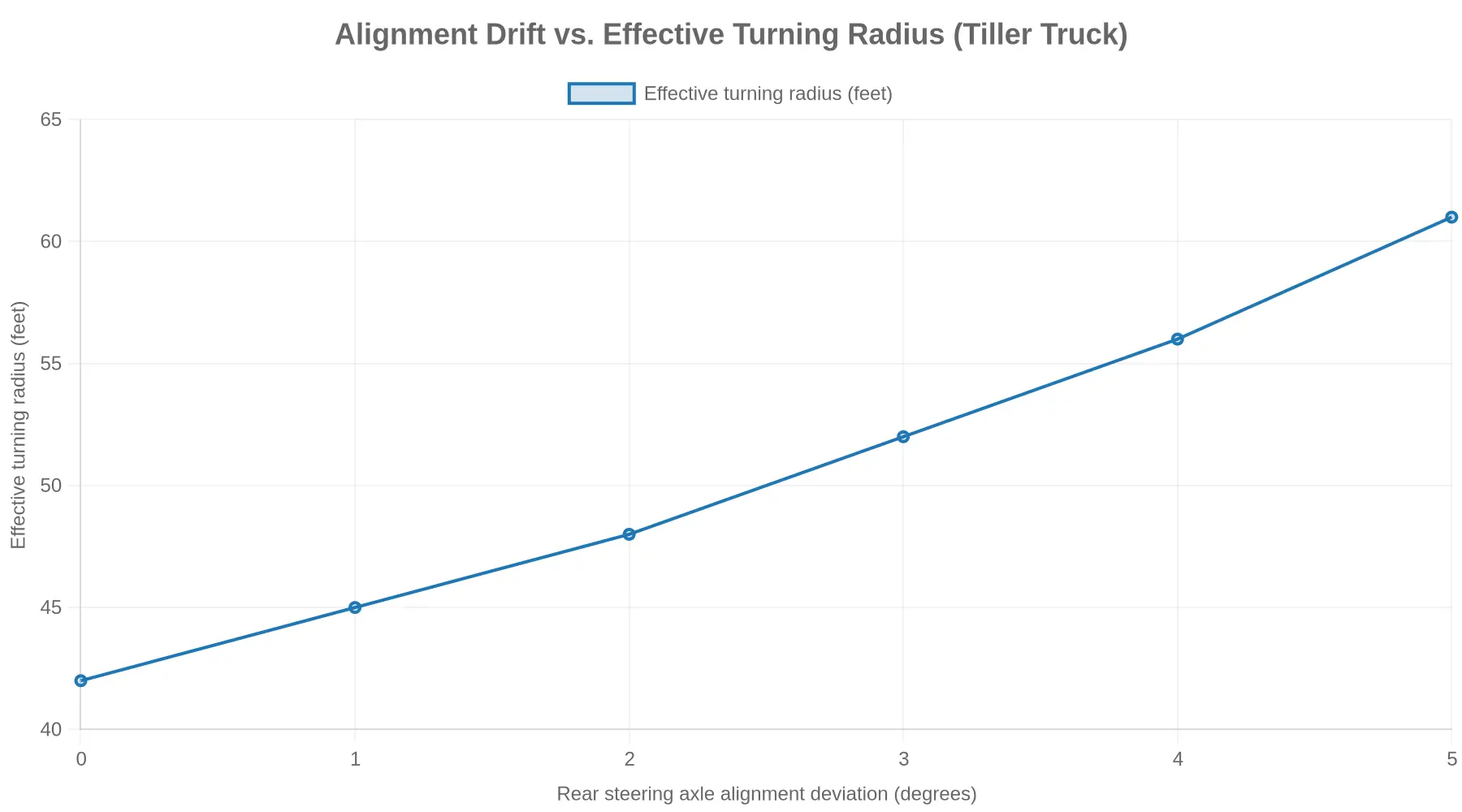
The failure chain is straightforward: alignment degrades, effective turning radius grows, and narrow-street access fails. A truck that turns cleanly in the yard can still wedge itself at a tight corner once rear steering geometry drifts by only a couple of degrees.
What to Verify on Tiller Fire Truck Listings
| Verification point | What to check | Failure signal |
|---|---|---|
| Rear axle steering angle range | Max steer lock left and right vs. OEM spec | Unequal or reduced angle |
| Sensor / actuator calibration | Position sensors, controller fault logs, freeplay | Recalibration needed, stored faults |
| Tie-rod and linkage wear | Ball joints, kingpins, drag-link play | Looseness, grease leaks, cracked boots |
| Alignment verification at delivery | Independent toe and thrust measurement before payment | “It drove fine” with no printout |
Each row feeds the same chain. A rear steering angle short of spec, a sensor that has drifted from calibration, or a worn tie-rod all add subtle toe error, and the turning radius grows with it. On a narrow street, a meter of extra radius is the difference between clearing the corner and blocking the block – the same unforgiving margin described in sizing small fire trucks for narrow rural lanes.
Never accept a used tiller on a verbal “it drove fine in the yard” – the rear steering axle alignment and the resulting turning radius must be independently measured and documented at delivery, not assumed.
The Alignment-to-Turning-Radius Decision Path
The whole debate reduces to one logical chain. Rear steering axle alignment sets the geometry, that geometry fixes the effective turning radius, and the effective turning radius governs narrow-street maneuverability. Ladder reach never enters the chain, which is why it cannot decide how tightly a tiller pivots in a congested historic district.
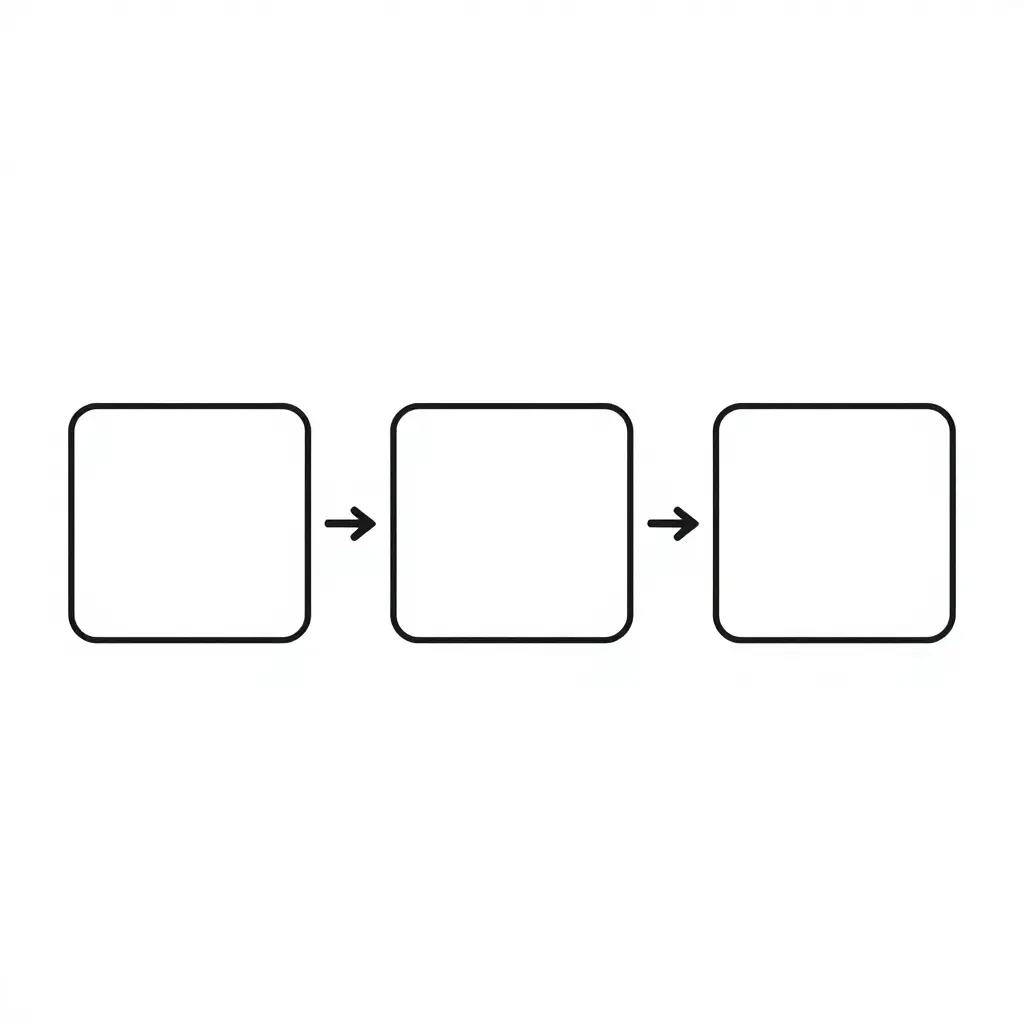
Figure 3: A flat, text-free three-node flow diagram illustrating the causal sequence only, not a real scene. Node one represents rear steering axle alignment, node two represents effective turning radius, and node three represents narrow-street maneuverability.
Each arrow marks a real dependency, not a loose association. Misalign the trailing axle by even a small angle and the tractor and trailer no longer track a shared path, so the effective turning radius the driver experiences grows larger than the specification sheet suggests. Specifying a tiller for tight downtown streets therefore means trusting the axle geometry rather than the aerial’s maximum reach. The considerations overlap with those covered in the guidance on small fire truck sizing for narrow rural lanes.
Restructure Your Tiller Evaluation Around Axle Alignment
Most buyers scan tiller fire truck listings and lock onto a single number: ladder reach. It feels decisive, it is easy to compare, and it is almost always the wrong first filter. On narrow streets, reach rarely decides whether a truck can reach the fire. Geometry does.
The Problem: Mispriced Priorities
When procurement scoring rewards the longest aerial, you overpay for capability the streetscape cannot use. A tractor-drawn aerial with impressive vertical reach but a neglected rear steering axle alignment will scrub its trailer tires, drift wide through corners, and force three-point turns that burn response seconds. The premium went to the wrong column.
The Fix: A Corrected Evaluation Framework
Rebuild your scoring around three verifiable requirements.
- Request alignment calibration records. Ask for documented toe, camber, and caster settings for both tractor and trailer axles, plus the trailer-tracking calibration history. Missing records are a negotiating lever, not a footnote.
- Require a turning-radius demonstration. Do not accept a spec-sheet radius. Have the seller articulate the trailer through a simulated narrow-turn corridor and measure the actual swept path.
- Weight rear-axle capability in scoring. Assign meaningful points to rear-axle steering condition and articulation range, not just to ladder reach.
This mirrors the discipline buyers already apply to load distribution in rescue trucks for sale chassis payload ratings, where the frame, not the headline feature, governs real-world performance. The same logic applies to the largest fire truck platforms, where axle loading and turning geometry decide whether a rig can actually deploy.
The Payoff: Better Narrow-Street Outcomes
When alignment records and rear-axle capability drive your scoring, tiller listings surface the trucks that genuinely turn tight, not the ones that merely reach high. That is how you buy response time instead of brochure numbers.
What Actually Governs a Tiller Truck’s Turning Radius
When a fleet weighs a tiller (tractor-drawn aerial) for tight urban streets, the conversation usually drifts toward ladder reach. But reach is a specification, not a steering variable. The number that decides whether the rig can thread a narrow corner is the effective turning radius, and that is a geometry problem. The doughnut chart below breaks down the estimated proportional contribution of each factor to that effective turning radius. It is a planning-level model meant to reframe where procurement attention should go, not a substitute for a site-specific turning template.
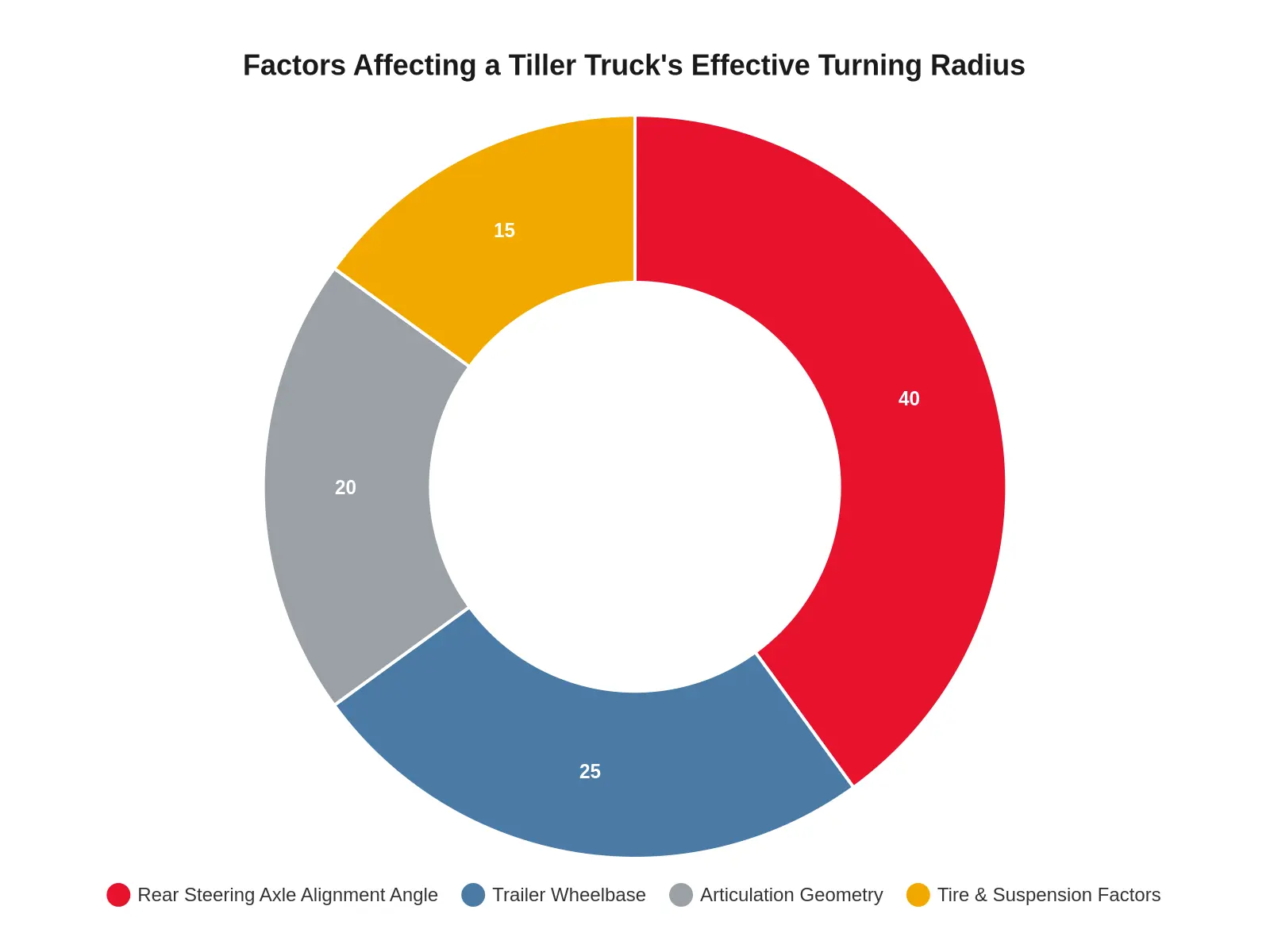
Figure 4: Estimated contribution of each factor to a tiller truck’s effective turning radius. Rear steering axle alignment is the single largest and most controllable lever a fleet can pull. Trailer wheelbase and articulation geometry are largely locked in at the specification stage, while tire and suspension effects are comparatively modest.
Reading the Chart
| Factor | Share (est.) | Controllable after delivery? |
|---|---|---|
| Rear steering axle alignment angle | 40% | Yes – routine service lever |
| Trailer wheelbase | 25% | No – fixed by spec |
| Articulation geometry | 20% | No – fixed by spec |
| Tire & suspension factors | 15% | Partial |
The takeaway: roughly two-fifths of the effective turning radius sits with the rear steering axle alignment angle, and unlike wheelbase or articulation geometry, it can drift out of tolerance over time and be corrected in the shop. That makes alignment a recurring maintenance concern rather than a one-time design choice. If your aerial is being evaluated for genuinely tight routes, pair this with the guidance on sizing small fire trucks for narrow rural lanes so the geometry assumptions hold up against real operating conditions.
FAQ: Tiller Turning Radius and Rear Steering Axle Alignment
Does ladder reach affect turning radius?
No. Ladder reach is an aerial operating parameter covering vertical extension and horizontal placement, while turning radius is governed by wheelbase, track width, and steering geometry. On a tiller, the rear steering axle alignment determines how tightly the trailer-mounted aerial follows the tractor’s path. Ladder length changes the aerial envelope, not the ground-track pivot geometry that dictates the swept path.
What rear steering axle alignment angle is best for narrow streets?
There is no single universal angle. The correct rear steering axle alignment is set to the manufacturer’s steering geometry to balance cut-in and tail-swing within the legal swept path. On narrow streets, alignment is tuned so the rear wheels track just inside the front-wheel path, keeping tail swing clear of parked cars and curbs. Follow the OEM specification rather than a generic figure pulled from an unrelated chassis.
How often should rear axle alignment be verified?
Rear steering axle alignment should be verified at every annual service interval and immediately after any hard curb strike, axle repair, or steering-linkage replacement. High-cycle urban departments often check alignment quarterly, because repeated full-lock maneuvers accelerate tie-rod and kingpin wear. Drift in thrust angle or toe beyond spec directly widens the effective turning radius and degrades driver confidence.
Can a longer ladder truck still navigate narrow streets?
Yes, provided the chassis and rear steering axle alignment are engineered as a matched system. Because the rear axle steers, a long tiller can achieve a smaller swept path than a shorter rigid aerial that lacks rear steering. Length is not the limiting factor; the coordinated steering angles between tractor and trailer determine real-world maneuverability, a principle that also applies to sizing apparatus for narrow rural lanes.
How does steering mode interact with axle alignment?
Steering mode (crab, coordinated, or rear-lock) changes how the rear axle responds, but its accuracy depends entirely on correct rear steering axle alignment. If alignment is off-spec, crab mode drifts sideways while coordinated mode cuts corners unpredictably. When reviewing tiller fire truck listings, confirm the alignment service records and the steering-mode calibration are current before comparing quoted turning radii.
The Bottom Line: Alignment Decides the Turn, Not the Ladder
Geometry recap
The physics does not change. A tiller’s effective turning radius is set by how the rear steering axle is positioned and aligned relative to the tractor and trailer pivot points, not by how far the aerial ladder extends. Ladder reach adds vertical working height; it says nothing about whether the rig can thread a 90-degree corner between parked cars on a narrow street. Get the rear steering axle alignment wrong and the trailer tracks off-line, sometimes cutting the inside line and clipping curbs, sometimes swinging into parked cars. Get it right, and even a long tractor-drawn aerial pivots cleanly.
Procurement implication
That distinction should reshape how every buyer reads a spec sheet. When you review tiller fire truck listings, treat the steering axle geometry as a primary filter, not a footnote. Two listings can advertise identical ladder lengths and still deliver wildly different maneuverability.
| What buyers fixate on | What actually dictates the corner |
|---|---|
| Ladder reach | Rear steering axle alignment |
| Overall length | Steering axle position and steer angle |
| Aerial height rating | Trailer tracking through the turn |
Ask sellers for steering geometry data, rear-axle steer range, and any alignment or repair history before you compare price. A rig with a clean alignment record on a short wheelbase will outmaneuver a longer one every time on tight municipal streets.
Final conclusion
Reach belongs in the operational brief; rear steering axle alignment belongs in the buying decision. Build your shortlist around cornering geometry first, verify maintenance records (including a recent certified pump service inspection) second, and let ladder length settle the tie only after both trucks can actually make the turn.
CRRC’s industrial engineering background, built across heavy transit and specialty vehicle platforms, shapes how these chassis are aligned and validated before delivery. For apparatus buyers who want more context on specification and service, crrcvehicles.com is a useful reference.
Actionable takeaway: Before you sign on any tiller, request the steering axle alignment geometry, walk the rig through a simulated tight corner, and reject any listing that cannot prove its turning radius on paper and on pavement.