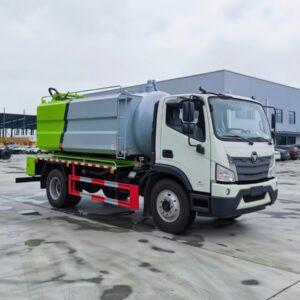
Liquid Waste
Vacuum, Jetting and Combination Trucks for Sewer and Septic Work
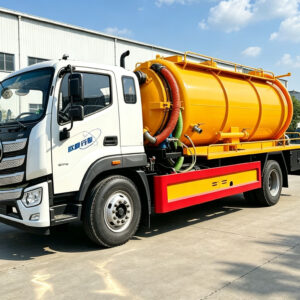
Liquid waste is the hardest municipal duty to spec, because the same truck is asked to empty a septic tank at 8 metres, clear a grease-blocked main at 24 MPa, and then drive 40 kilometres without dripping. A vacuum truck that only sucks is half a tool; a jetter that only flushes leaves the spoil in the street. This category covers all three configurations — pure vacuum suction, high-pressure jetting with a clean-water tank, and true combination units that carry both circuits on one chassis, from 4 m³ tankers for lane access up to a 15,000 litre combination unit for arterial sewer networks.
Tanks are Q235B carbon steel at 6 mm body and 8 mm shell, with stainless steel available for saline or chlorinated duty. Vacuum pumps run from 6,000 to 35,000 litres per minute and pull to −97,000 Pa; jetting pumps deliver 16 to 24 MPa at 75 to 275 litres per minute through an 80-metre reel with 40 metres optional. Pumps are specified by brand — JUROP, MORO, BP, PINFL, Weilong — so a fleet manager in Mombasa can order the same spare kit as a depot in Lima.
Where Cheap Liquid-Waste Trucks Lose Money
Sewer work punishes shortcuts. A pump rated at atmospheric pressure cannot lift a 4-metre sludge column. A tank without an internal coating becomes a corrosion cell within two wet seasons. A jetter without a reel and a foot valve becomes a hose on the pavement. These are the six specifications that decide whether the unit earns.
An ultimate pressure of −97,000 Pa and a suction hose of 8 metres plus 4 metres optional is what lifts heavy sludge out of a deep inspection chamber. Tank litres are irrelevant if the pump cannot pull the column.
Combination builds carry a clean-water tank and a sewage tank on the same frame — 4 m³ plus 8 m³ on the 10,000 litre unit, or a single 15,000 litre body on the CSJ15BJ245L5. Intercommunicating tanks let the operator rebalance water without a second vehicle on site.
Liquid-full unloading plus press-fit discharge empties the tank without residue, so the next job does not start with a shovel. Air-blow assistance clears the last of the line before the truck leaves the site.
Vacuum side: JUROP, MORO, BP or Weilong at 6,000–35,000 L/min. Jetting side: PINFL 215 LPM or equivalent at 16–24 MPa. Named components mean the seal kit is a phone call, not a fabrication job.
A sealed tank with a tested outlet valve and a full set of assembled pipelines is the difference between a compliant transfer and a licence suspension. Overflow valves and oil-water separators are standard, not optional.
Q235B carbon steel at 6 mm body and 8 mm shell, with internal anti-corrosion coating available and stainless steel as an option for saline or chemical duty. Hydrogen sulphide destroys an untreated mild-steel tank from the inside out.
Which Configuration Fits Which Job
Septic emptying, sewer jetting and industrial liquid transfer are three different businesses that happen to share a chassis class. Buy for the job you do most, and specify the optional circuit for the job you want next.
Pure vacuum units from 4 to 12 m³ with a large-bore suction hose and a self-discharge valve. The 12 m³ fecal suction build is the volume workhorse for residential rounds.
High-pressure jetting at 16–24 MPa through 80 metres of reel hose, with a rear or side water tank feeding the pump. Add the optional 40-metre extension for long interceptor runs.
Combination units break the blockage and remove the spoil in the same visit, which removes the second call-out and the traffic-management cost that comes with it.
Stainless steel or internally coated tanks for chemical, food-processing and plating effluent, with a vacuum pump chosen for continuous duty rather than intermittent emptying.
High-flow vacuum at 35,000 L/min with an 8-metre hose set clears standing water and silt from culverts and underpasses faster than a low-flow unit can start.
4 to 5 m³ builds on short-wheelbase 4×2 chassis reach courtyards and alley ends where a 15,000 litre unit physically cannot turn.
Fleet-standardised combination units with documented pressure and vacuum test records, because utility tenders ask for test certificates, not brochures.
Water-cooled and air-cooled pump options let you trade pump noise against duty cycle; specify the quieter cooling arrangement where the depot sits inside a housing area.
The Paperwork Behind A Registrable Tanker
Pressure equipment and waste transport are both regulated. These are the documents and tests that come with the vehicle, not after the fact.
Tank fabrication and final assembly under an ISO 9001 certified system, with a per-unit inspection record covering welds, valves and pipeline assembly.
China Compulsory Certification for the Foton chassis, the base compliance document most import authorities request at registration.
Tank tightness and system pressure tested before release, with the jetting circuit run at working pressure and the vacuum pump checked to its rated ultimate pressure.
Euro 3 to Euro 6 powertrains, from the 210 hp Weichai WD6 unit to the 245 hp Euro 5 build, so the tank can be matched to the emission bracket your authority registers.
Certificate of Conformity, Certificate of Origin, invoice, packing list and bill of lading issued per shipment, with an English operation manual and parts list.
PVoC, KEBS, SONCAP and EAC conformity paperwork prepared with the order where the destination runs a pre-export verification programme.
Pump brand and tank material change the certificate list. Confirm both before the deposit, not at the port.
Five Tank Builds, One Comparison Table
Volume, circuit configuration and pump output decide the duty. Read across each row, then open the model page for the full parameter sheet.
| Configuration | Tank capacity | Pump and performance | Best-fit duty |
|---|---|---|---|
| Combination jetting and suction CSJ15BJ245L5 |
15,000 litres, carbon steel, single sealed body with access ladder | 245 hp Euro 5, 8-speed manual, vacuum pump plus high-pressure pump and hose reel, self-suction and self-discharge | Arterial sewer networks, municipal dredging, septic and industrial liquid collection |
| Jetting plus vacuum, split tanks SJT10BJ210L3 |
4 m³ clean water plus 8 m³ sewage, cylindrical Q235B, 6 mm body and 8 mm shell | Weichai WD6.210E32 210 hp, 6-speed, vacuum 6,000–35,000 L/min at −97,000 Pa, jetting 16–24 MPa at 75–275 LPM, 80 m reel plus 40 m | Blocked mains, interceptor cleaning, drain and culvert work with one crew |
| Fecal suction, high volume BJ5042GXEE6-P1 |
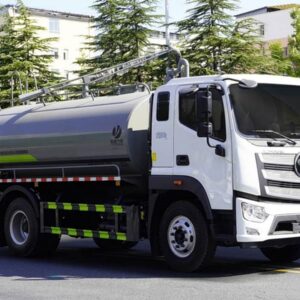
12 m³ sealed tank, large-bore suction inlet for pit and tanker emptying | Foton chassis, vacuum pump with overflow valve and oil-water separator, self-discharge outlet | Septic tanks, latrine pits, residential and institutional emptying rounds |
| Sewage suction, mid-size BJ5072GXWE6-P1 |
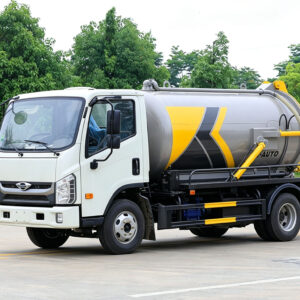
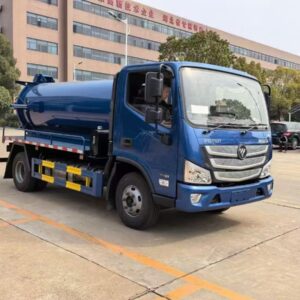
5 m³ tank, compact 4×2 footprint for constrained access | Vacuum pump with inspection window and ball valve control, gravity discharge | Urban districts, courtyard access, small municipal contracts |
| Vacuum suction and cleaning BJ5124TWJE6-P1 |
4 m³ working volume, suction and cleaning circuits on one chassis | Engine-driven vacuum pump with PTO-driven cleaning circuit, sealed tank with level inspection | Narrow streets, mixed suction and wash-down duties, first-line response units |
Litres are nominal tank volumes. Usable capacity is lower once the baffle and pump clearances are accounted for, and the difference matters on routes planned to the last cubic metre.
One Supplier For Chassis, Tank, Pumps and Export Papers
A jetting truck has two hydraulic circuits, two pumps, a reel, a foot valve and a tank that must stay sealed under negative pressure. When the tank comes from one workshop and the jetting kit from another, the first warranty claim becomes an argument about whose flange failed. We quote the complete unit and take responsibility for the interface between chassis, tank, pump and reel.
The chassis base is the Foton Auman programme, produced through the Daimler-Foton joint venture in Beijing — a partnership documented by Reuters and Automotive News Europe — which is why the cab layout, brake architecture and axle ratings follow European conventions. Engines come from Beijing Foton Cummins Engine Company, Cummins' largest engine joint venture, alongside Weichai and Yuchai options where a market prefers those service networks.
Component choice is deliberately non-exotic. Vacuum pumps are JUROP, MORO, BP or Weilong; jetting pumps are PINFL or equivalent; tanks are Q235B with stainless steel as an option. Every unit ships with a one-year or 30,000 km warranty, 24-hour online after-sales support, an English manual and a numbered parts list. Drawings are reviewed against your sewer depth and climate before production, because a 4-metre suction lift and an 8-metre one are not the same truck.
Coverage of CRRC as the world's largest rolling-stock manufacturer by revenue, the industrial base behind the CRRC Vehicles name.
Reporting on the Daimler and Foton joint venture in Beijing and the Auman heavy-truck platform it produces.
Beijing Foton Cummins Engine Company described as Cummins' largest engine joint venture, supplying the ISF and F2.8 platforms.
Delivery reporting on Foton's African network — 220+ outlets, 12 KD plants, 43 parts warehouses, 8 training centres.
Municipal Sewer Contracts, With The Numbers Attached
Publicly documented deliveries of jetting and vacuum trucks. Client type, date, quantity, value and source are given so the record can be checked.
50 combination cleaning and suction trucks awarded through a local dealer against a public tender budget of about CNY 10 million, contracted at roughly CNY 9.6 million. Thirty units shipped from Shanghai in December 2025, cleared Mombasa and entered service in February 2026. High-pressure jetting plus vacuum suction, 20 MPa or higher, KEBS PVoC certification and SGS inspection. The department reported blockage clearing about 40 percent faster than its previous equipment.
10 units of the CLW5110GQW configuration ordered by a water company for drainage network maintenance: twin vacuum pumps for independent jetting and suction, 8 m³ tank, cleaning pressure to 24 MPa, 8-metre suction depth. Delivered in two batches, six units in August and four in December 2025, with a three-engineer commissioning team and two weeks of operator training. The utility reported around 40 percent higher working efficiency.
8 units ordered by a sanitation contractor that had just won a municipal sewage management contract covering Nairobi, Mombasa and Kisumu. Each unit carries an 8 m³ sewage tank plus a 3 m³ clean-water tank, MORO or BP vacuum pump, 18 kPa maximum vacuum, 9-metre effective suction range and a suction time under three minutes, with first and second level overflow valves and oil-water separators.
What Buyers Ask Before Signing
Fourteen questions from municipal buyers, utilities and private contractors, answered with numbers rather than sales language.
Do I need a combination truck or two separate vehicles?
ANSWERIf your crews clear blockages and remove spoil on the same visit, a combination unit removes a second call-out and the traffic management that goes with it. If your work is predominantly septic emptying with occasional jetting, a pure vacuum unit plus a jetting trailer is usually cheaper to buy and cheaper to run.
What vacuum level do I actually need?
ANSWERDeep chamber work needs high ultimate vacuum, which is why the 10,000 litre unit is quoted at −97,000 Pa. Shallow pit emptying on flat ground is a flow problem rather than a pressure problem, so a 6,000 to 35,000 L/min pump range with a wide-bore hose matters more than the last few kilopascals.
How far can the jetting hose reach?
ANSWERThe standard reel carries 80 metres, with a further 40 metres available as an option — 120 metres in total. Working pressure is set between 16 and 24 MPa and flow between 75 and 275 litres per minute, so the nozzle choice, not the hose length, usually limits how far a blockage can be pushed.
What tank material stops corrosion from sewage gas?
ANSWERQ235B carbon steel at 6 mm body and 8 mm shell with an internal anti-corrosion coating is the standard answer for municipal sewage. For saline groundwater, chlorinated effluent or food-processing waste, specify stainless steel — the upcharge is smaller than replacing a tank at year four.
Which pump brands can you supply?
ANSWERVacuum side: JUROP, MORO, BP and Weilong, in water-cooled or air-cooled versions. Jetting side: PINFL, quoted at 215 litres per minute on the 10,000 litre build, or an equivalent specified to your pressure and flow requirement. If your workshop already stocks one brand, order that brand.
Can the truck empty its own tank without a pump station?
ANSWERYes. Self-discharge through the outlet valve is standard, and the 10,000 litre build adds full liquid unloading plus press-fit discharge so the tank empties without residue. An air-blow function clears the last of the line, which matters where discharge points are far from the working site.
Is a 15,000 litre tank legal on my roads?
ANSWERThat depends on your axle-load rules, not on the tank. The CSJ15BJ245L5 is quoted at 15–20 t GVW with an 80 km/h maximum speed. Where a 15,000 litre body would breach a rear-axle limit, the 4 m³ plus 8 m³ split-tank build keeps the same working capability inside a lighter envelope.
Left-hand drive and cabin configuration?
ANSWERLeft-hand drive is standard. The combination unit is offered with a single-row or double-row cabin for different crew sizes, with air conditioning as an option — worth taking in hot climates, because a two-man crew working a full shift in a sealed cab is a retention issue, not a comfort one.
What is the lead time and minimum order?
ANSWEROne unit, and mixed builds in a single batch are accepted. Lead time is around 15 working days in the low season and one to three months at peak. Pump brand and tank material are the two options that most often move the date, so fix them at quotation.
How is a 15-metre tanker shipped?
ANSWERRoRo or break-bulk for the large combination units, because of overall height and length. Smaller 4 and 5 m³ builds can be containerised or shipped on flat rack. We quote CIF or DAP, and handle the inland leg to landlocked destinations.
What safety devices are fitted as standard?
ANSWEROverflow valve, oil-water separator, pressure gauge, inspection window, ball valve and a full pipeline set. Combination units add a high-pressure relief path and a reel with a controlled hose guide. Secondary overflow protection is specified on request and is worth having on any tank worked by rotating crews.
What warranty applies?
ANSWEROne year or 30,000 km, whichever comes first, with 24-hour online after-sales support and factory-cost spare parts for the life of the unit. Chassis coverage follows the Foton policy where that is longer.
Can you supply a tank body for an existing chassis?
ANSWERYes, where local assembly or duty structures make a complete vehicle impractical. Send the chassis drawings, PTO take-off details and rear-axle rating, and we quote the tank, pump set and mounting kit as a body-only package.
What information do you need to quote?
ANSWERWorking depth of your deepest chamber, pipe diameter and typical blockage type, daily number of jobs, discharge point distance, emission bracket and destination port. With those five we can fix tank size, vacuum level, jetting pressure and hose length and issue drawings.
Tell Us Your Deepest Chamber And Your Worst Blockage
Those two answers set vacuum level and jetting pressure more reliably than any catalogue. Send them with your emission bracket and destination port, and the engineering team returns drawings and a landed-cost quotation.
Tank material, pump brand, cabin configuration and hose length are all fixed before production, not after.
-
Liquid Waste
Foton 5CBM Sewage Suction Truck
-
Liquid Waste
Foton 4CBM Vacuum Sewage Suction Truck
-
Liquid Waste
Foton 12CBM Fecal Suction Truck