Cargo Box
Enclosed Bodies and Covered Tippers for Loads That Cannot Get Wet
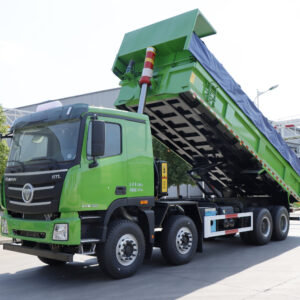
Every cargo body answers one question: how much protection does the load need? A pallet of electronics needs a sealed composite box with a locking rear door. A load of grain or biomass needs a tipper that can be covered before it leaves the yard, without adding height that breaks the local vehicle envelope. Regulated goods need a body built around segregation and placarding rather than cubic volume. This family covers all three: 4 and 5 metre dry van and hazardous-goods bodies in composite panel, plus 15 and 20 m³ tipper bodies with rocker-arm or horizontal-push tarpaulin systems.
Volumes run from an 18 CBM van body at 4,140 × 2,100 × 2,100 mm up to a 20 m³ tipper with a 7,600 mm inner length. Materials are deliberate: KPS composite panels with XPS cores and 2 mm fibreglass skins for vans, 30 to 40 percent lighter than steel at the same strength; T700, WKC800 or NM450 wear plate with 6–8 mm sides and 8–10 mm floors for tippers. Both are built to be weighed, loaded and repaired in a normal workshop.
Six Ways An Enclosed Body Pays For Itself
A body is not a box on a chassis. It is the part of the truck that touches the customer's goods, and the part that determines whether you can take a contract in the first place.
Composite panels are 30 to 40 percent lighter than a steel body of equal strength. On a 4,495 kg GVW chassis, every kilogram saved in the body is a kilogram of invoiced cargo — and the 4 m van is quoted at 1,690 kg rated payload with the standard body.
Closed sandwich panels, integrated rubber door seals, waterproof sills under the side and rear doors and rain deflectors above them. This is the difference between a dry load in July and a claim in August.
Horizontal-push and rocker-arm tarpaulin systems close the body without raising the side board height, so the truck stays inside the covered-load rules that many jurisdictions enforce at the weighbridge.
Aluminium alloy pattern plate inside the van, 50 mm wood deck on the lowboy, 8 to 10 mm wear plate in the tipper. Floors fail from point loading, not from tonnage, and the specification should say which one it was designed for.
Aluminium profile framing, stainless hinges and locks, and panels that can be replaced individually. A bonded one-piece body looks better in a brochure and becomes a write-off after a loading-bay impact.
The same Foton chassis range carries both the composite van body and the tarpaulin tipper, so a fleet running both shares brakes, filters, springs and wheel bearings across the whole depot.
Match The Body To The Loading Dock
The same 18 CBM of cargo can need three different bodies depending on how it arrives at the door.
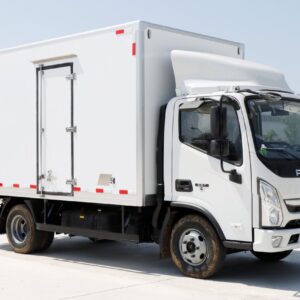
4 m dry van with a single swing side door and a double swing rear door, aluminium pattern-plate floor, and a 3,360 mm wheelbase that turns in a residential street.
Sealed composite body with stainless locks and door frames, reflective strips, and no external fasteners that can be defeated with a screwdriver.
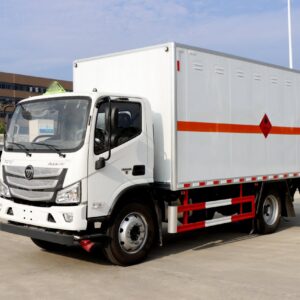
5 m hazardous materials body with a dedicated load compartment, sealed floor and defined placarding area, built to the segregation requirements of the destination market.
20 m³ tarpaulin tipper with a U-shaped body and horizontal push cover, loaded from a silo or grab and discharged by rear tip without manual sheeting.
15 m³ 8×4 rocker-arm tipper, where the cover arm pivots over the load from one side and the body stays within the height envelope.
NM450 wear plate at 8 mm sides and 10 mm floors, for loads dropped from a conveyor rather than placed by a machine.
Covered tipper with a hydraulic rear-door lock for tight sealing, used where the load is odorous or dusty and the route passes residential areas.
Insulated-panel bodies using the same sandwich construction, for short urban runs where an active refrigeration unit is not economic.
Conformity, Weight And Load Security
Cargo bodies are inspected against the declared weights and the body's own construction, not just the chassis. These are the documents and tests supplied.
Panel bonding, frame assembly and hydraulic fitment under an ISO 9001 certified system, with a documented inspection record per body.
China Compulsory Certification for the Foton chassis, the baseline document for registration in most export markets.
GVW, kerb weight, rated payload and front and rear axle ratings stated per unit, so the body can be checked against local load rules before fabrication.
Euro 6 on the 4 m van with common-rail injection and a DPF-DOC-SCR package; Euro 3 to Euro 6 available across the tipper range.
Certificate of Conformity, Certificate of Origin, invoice, packing list and bill of lading, plus an English manual and parts list.
Hydraulic cycle test under load for tipper bodies, door seal and lock check for van bodies, and photographs of the loaded unit before departure.
Body weight must be declared on the registration document in most markets. Undeclared body weight is the most common reason a loaded van is stopped at a weighbridge.
Four Bodies, One Selection Table
Volume, material and covering system decide the fit. Each row links to the model page with its parameter sheet.
| Body | Volume and dimensions | Construction | Best-fit cargo |
|---|---|---|---|
| 4 m dry van 8H0410000 · 18 CBM | Body 4,140 × 2,100 × 2,100 mm; overall 5,995 × 2,180 × 3,140 mm; 1,690 kg payload | KPS composite sandwich, XPS core, 2 mm FRP skins, aluminium frame, alloy pattern-plate floor | Parcels, palletised freight, electronics, dry goods requiring a sealed body |
| 5 m hazardous materials body Regulated cargo | 5 m body length, dedicated load compartment with defined placarding area | Sealed construction, segregated compartment, reinforced floor for drum and cylinder loads | Paints, solvents, LPG cylinders, industrial chemicals under placard |
| 20 m³ tarpaulin tipper Horizontal push cover | Inner body 5,200–7,600 × 2,300/2,350 × 800–1,500 mm; 280/300/320 mm frame height | T700 / WKC800 / NM450 wear plate, 6 mm sides with 8 mm floor or 8 mm with 10 mm, 2 or 4 longitudinal beams | Grain, feed, biomass, construction material in covered-load markets |
| 15 m³ rocker-arm tipper 8×4 chassis | 15 m³ nominal body on an 8×4 chassis for higher legal payload than a 6×4 | Rocker-arm tarpaulin that pivots over the load, high-strength steel U-shaped body, Jiaheng or Haiwo hydraulics | Sand, gravel, aggregate and site material requiring a covered load |
Body volume is measured inside the side boards. Quoted payload assumes the standard body, a full tank and no tail lift; any addition reduces the legal cargo weight.
Body, Cover System And Chassis Engineered As One Unit
A tarpaulin tipper is a hydraulic machine bolted to a road vehicle. If the body builder never spoke to the chassis supplier, the PTO take-off, the subframe height and the rear-door lock all become site modifications. We quote chassis, subframe, body, cover system and hydraulics together, with one drawing set and one warranty contact.
The chassis base is the Foton programme, produced through the Daimler-Foton joint venture in Beijing — documented by Reuters and Automotive News Europe — so cab, brake and axle architecture follow European conventions. Engines come from Beijing Foton Cummins Engine Company, Cummins' largest engine joint venture worldwide: the F2.8NS6B156 in the 4 m van is a 2.78-litre four-cylinder making 450 Nm between 1,500 and 2,400 rpm, which is why the van pulls a full 18 CBM load without working the clutch at every junction.
Every unit ships with a one-year or 30,000 km warranty, whichever comes first, 24-hour online after-sales support and factory-cost parts for its service life. Body colour is free to any RAL reference, and reflective striping and fleet numbering are applied before shipment. Drawings are reviewed against your loading method and local height rules before fabrication, not after delivery.
Coverage of CRRC as the world's largest rolling-stock manufacturer by revenue, the industrial base behind the CRRC Vehicles name.
Reporting on the Daimler and Foton joint venture in Beijing and the Auman heavy-truck platform it produces.
Beijing Foton Cummins Engine Company described as Cummins' largest engine joint venture, supplying the ISF and F2.8 platforms.
Delivery reporting on Foton's African network — 220+ outlets, 12 KD plants, 43 parts warehouses, 8 training centres.
Cargo Body Fleets On Record
Publicly documented cargo-truck fleet deliveries on this chassis platform. Client type, date, quantity and source are given so each record can be verified.
100 Foton Auman heavy trucks delivered in Addis Ababa to a multinational working in transport, construction and mining, specified for African road conditions with an emphasis on fuel efficiency, durability and load capacity. The same customer has taken more than 400 Foton vehicles since 2013 and signed a further large-volume purchase memorandum at the ceremony.
150 Auman R trucks, the largest single truck order in Ghana that year, delivered to a major industrial customer. Units ran Cummins engines with roughly 5 percent better fuel efficiency than comparable models, some fitted with ZF automated manual transmissions, and every vehicle included telematics at no additional cost for fleet management.
100 medium and heavy trucks delivered to a Senegalese construction company working across building, roadwork, public projects and urban planning, mixing Auman R and Auman C models. Selected for load capacity and performance on West African road conditions, in a market where infrastructure spending was driving demand for heavy equipment.
What Buyers Ask Before Signing
Fourteen questions on body material, payload, cover systems and registration, answered with the parameters.
Composite panel or steel for a dry van body?
ANSWERComposite for anything on a weight-limited chassis. KPS sandwich panels with 2 mm fibreglass skins over an XPS core are 30 to 40 percent lighter than steel at the same strength, do not corrode and do not deform permanently after a knock. Steel still wins where the body has to absorb repeated heavy impact, such as scrap handling.
How much can the 4 m dry van actually carry?
ANSWER1,690 kg rated payload against a 4,495 kg GVW and a 2,805 kg kerb, inside a 1,575 kg front and 2,920 kg rear axle rating. The body volume is 18 CBM, so the practical limit is usually cargo density rather than weight: lightweight parcels cube out long before they weigh out.
Will the body stay watertight in heavy rain?
ANSWERThe specification includes integrated rubber door seals, waterproof sills at the bottom of the side and rear doors, and rain deflectors above them to stop water tracking through the door gaps. Panel joints are closed sandwich construction with aluminium wrap angles rather than riveted overlaps.
Horizontal push or rocker arm — which cover system?
ANSWERHorizontal push for longer bodies and higher daily cycle counts, because the sheet runs on a rail and does not need clearance at the side. Rocker arm for shorter bodies and simpler maintenance, because there are fewer moving parts. Neither raises the side board height, so both stay inside covered-load rules.
Which wear plate for abrasive loads?
ANSWERNM450 where rock or slag is dropped from height, WKC800 for mixed construction material, T700 for general bulk where weight matters more than abrasion resistance. Thickness pairs run 6 mm sides with 8 mm floors as standard, or 8 mm with 10 mm for the heaviest duty.
What does "U-shaped body" actually change?
ANSWERIt discharges more cleanly, because there is no square corner for wet material to pack into, and the convex mid-side profile resists the outward bulging that flat sides develop under load. The trade-off is slightly less usable volume at the same external width.
What is included in a hazardous-goods body?
ANSWERA dedicated sealed load compartment, a reinforced floor for drums and cylinders, defined placarding surfaces and load-securing points. The exact configuration must follow the dangerous-goods rules of the destination country, so we ask for the cargo class before quoting rather than after.
Can the body be fitted to a chassis I already own?
ANSWERYes, where the frame width, PTO take-off and rear-axle rating match. Send the chassis drawing, wheelbase and rear overhang and we quote the body as a knock-down kit with mounting hardware, which also avoids finished-vehicle duty in some markets.
What emissions are available?
ANSWERThe 4 m van is Euro 6 with a 2.78-litre Cummins at 115 kW and 450 Nm, using common-rail injection with DPF, DOC and SCR. Tipper chassis run Euro 3 through Euro 6 depending on model. Fix the bracket at order — changing it afterwards is a re-homologation.
Left-hand drive and cab specification?
ANSWERLeft-hand drive is standard. The van uses a 1,880 mm Ollin day cab with three seats, power windows, central locking and air conditioning. Tipper chassis offer wider GTL cabs with sleeper options where the route requires overnight work.
What is the minimum order and lead time?
ANSWEROne unit, with mixed body types in one batch. Allow around 15 working days in low season and one to three months at peak, from deposit and drawing approval. A composite van body is quicker to build than a hydraulic tarpaulin tipper.
How are the vehicles shipped?
ANSWERVans and light tippers are containerised or shipped on flat rack; heavy 8×4 tippers go RoRo or break-bulk because of height. Bodies can also ship as knock-down kits for local assembly. We quote CIF or DAP and handle inland transport.
What do you need to price a body accurately?
ANSWERCargo type and density, how it is loaded (forklift, grab, silo, manual), maximum legal axle loads, any height restriction on your route, the local covered-load rule, emission bracket and destination port. Those six answers fix body volume, material and cover system.
Tell Us How The Load Arrives And How It Leaves
Loading method and discharge method decide more about the body than any volume figure. Send those with your cargo density, axle limits and destination port for drawings and a landed-cost quotation.
Panel material, wear plate grade, cover system and fleet livery are fixed before fabrication.
- Cargo
FOTON 4m Dry Van Truck