

Ford Fire Trucks, Parts Commonality, and Service Access in Municipal Fleets
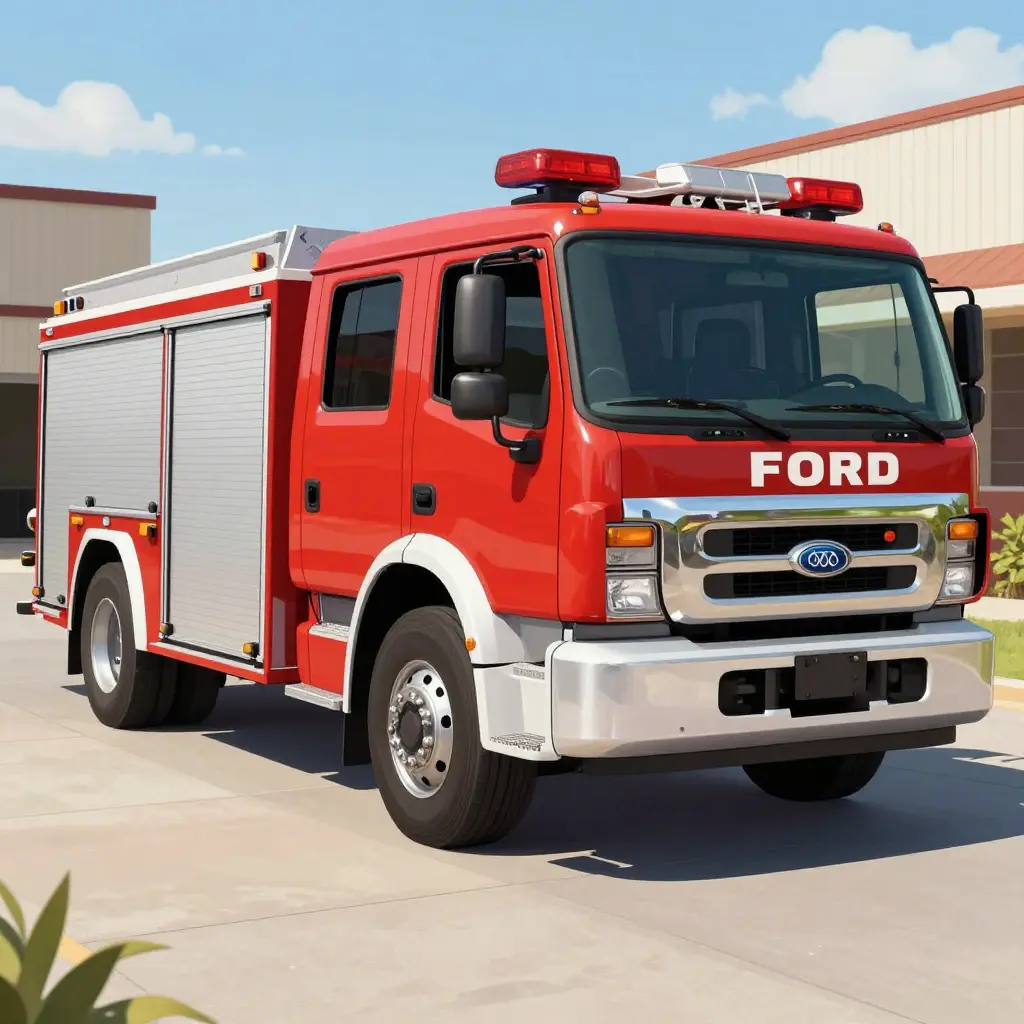
Ford does not build fire apparatus. It builds the chassis cab (frame, powertrain, brakes, wiring) and a body builder mounts the pump, tank, compartments and emergency lighting on top. That division explains why two questions decide what a municipal fleet costs to run. The first is parts commonality: how much of the chassis and drivetrain is shared across your units, including interchangeable engines, transmissions and brake assemblies, plus the electrical interfaces that let lighting, pump controls and telematics connect the same way on every truck. The second is service access: how readily those parts and repairs can actually be obtained, which covers distributor stock, diagnostic coverage for the electronic systems, and how far away the nearest dealer or qualified service point sits.
For a fleet manager, both show up in the same two places: the parts budget and the number of trucks available for a call. More commonality means fewer part numbers on the shelf and shorter turnaround when a unit goes down. Better service access means less time lost to a backordered component or a technician two counties away.
Neither is settled by the purchase order alone, but both can be written into it. Buyers comparing municipal fleet vehicle programs can score commonality and service access instead of assuming them.
Shared Platform Architecture: How Ford Fire Trucks Build Parts Commonality
Platform sharing starts at the frame. Ford commercial chassis used for Ford fire trucks are built around defined frame and axle families, so a pumper, a tanker and a rescue unit in the same weight class inherit the same rail cross-section, hole spacing, spring hangers and axle ratings. The powertrain repeats the pattern: a small set of engine and transmission families (the 6.7L Power Stroke diesel and the 7.3L gas V8, both backed by TorqShift automatics) means bell housings, engine mounts, accessory drives and PTO provisions get carried over rather than engineered per unit. The second and third truck you buy arrive mechanically familiar.
Electrical and cooling interfaces carry that repeatability into the upfit. Chassis builders publish fixed upfitter connection points (battery positive, ignition feeds, pass-through circuits, defined harness routing), and the cooling package occupies a known envelope, with radiator, charge-air cooler and hose mounts in consistent locations. Body builders then mount to the same body brackets, subframe attachment points and driveline take-offs, so a pump module, water tank body or equipment box can be planned against a repeatable drawing set instead of a one-off survey.
The inventory effect is the part that reaches the parts room. Standardization collapses dozens of part numbers into interchangeable categories: filters, belts, hoses and clamps, brake pads and rotors, wheel seals, batteries, work lights, fasteners. All of them fit any truck in the class. One filter line and one brake set replace a separate bin per apparatus, reorder points get simpler, and a technician who rotates between units stops relearning the same job.
Parts Lead Times by Component Group: A Comparative Snapshot
Commonality does not make every part equally easy to get. Some sit on a regional distributor’s shelf; others are built to order and ship from a single production line. The chart below gives typical lead-time ranges, in calendar days, for six component groups municipal fleets order most often.
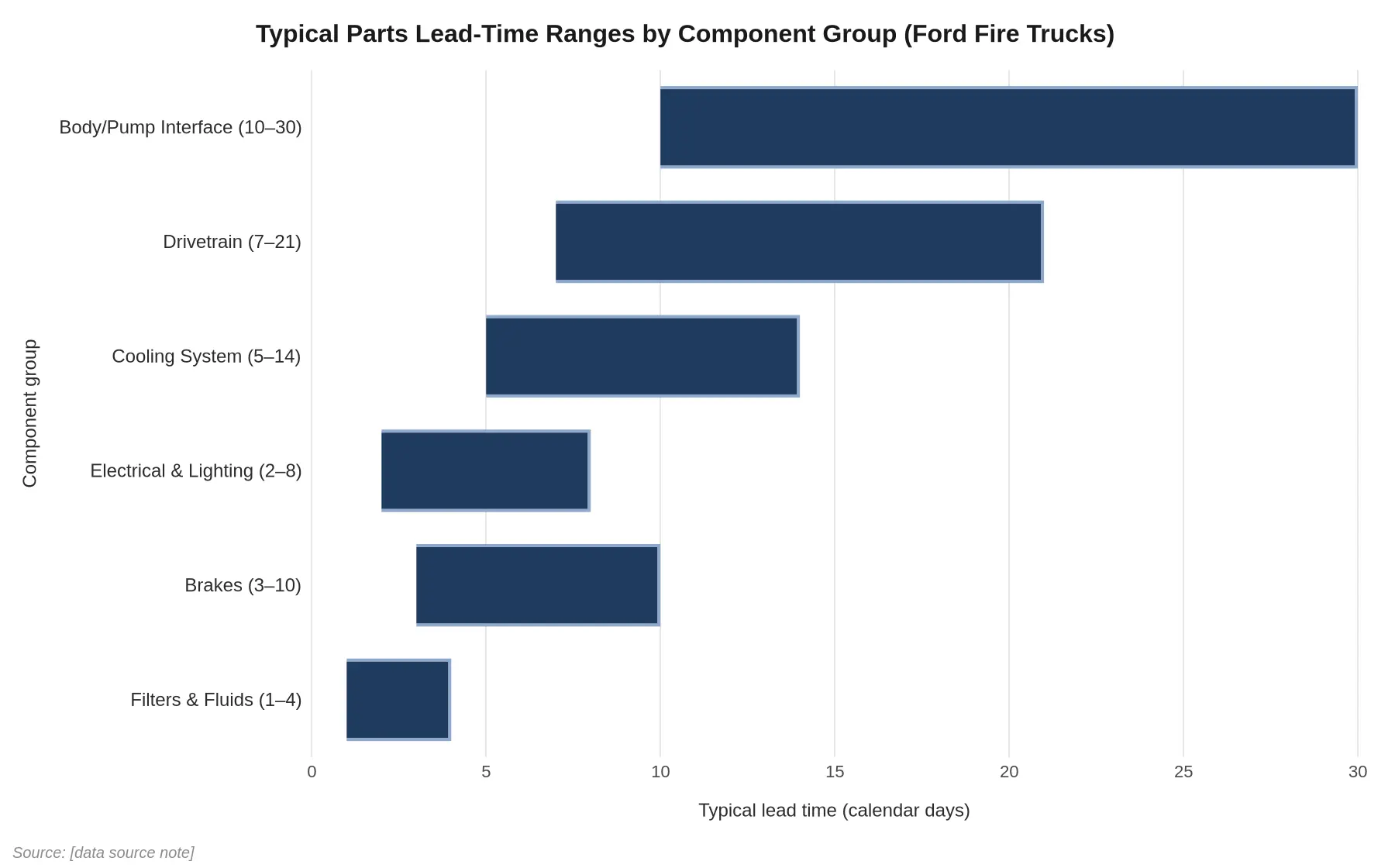
Chart caption: High-commonality consumables (filters, fluids, brakes, lighting) stay within days of availability. Drivetrain and body/pump interface parts stretch into multi-week ranges, which means service access depends less on the Ford chassis than on the specialty builder’s supply chain.
Data note: the figures shown are typical planning ranges, not guaranteed delivery times. Replace them with your own procurement data, dealer quotes or work-order records.
How to Read the Ranges
The bars show a low-to-high span rather than a single number, because lead time moves with order size, season, and whether a part is stocked locally or drop-shipped from a regional depot. A brake caliper may arrive tomorrow; a pump-mounting bracket for a specific body configuration can take a month.
| Component group | Typical lead time (days) | Stocking pattern |
|---|---|---|
| Body/Pump Interface | 10-30 | Built to order, builder-specific |
| Drivetrain | 7-21 | Mixed: dealer stock plus factory order |
| Cooling System | 5-14 | Dealer and regional warehouse |
| Electrical & Lighting | 2-8 | Common cross-reference part numbers |
| Brakes | 3-10 | Widely stocked, high turnover |
| Filters & Fluids | 1-4 | Shelf stock at most distributors |
What This Means for a Fleet Budget
Budget your downtime reserve around the long bars, not the short ones. Fast-moving consumables rarely strand a truck, so a modest on-hand cushion is enough; the planning effort belongs with the two groups whose ranges run widest. Departments that also run support units alongside pumpers and aerials can look at municipal vehicle platforms the same way, since shared chassis families tend to put common parts behind a single service counter.
One habit pays for itself: log actual days-to-delivery on every repair order for a year, then replace the ranges above with your own numbers. Your own records beat any industry average, and they give you something defensible when you negotiate stocking agreements or ask for a critical-spares budget.
Shared Component Families That Drive Parts Commonality
Standardizing on Ford chassis does not make commonality a fleet-wide property. It lives in a handful of component families that wear on a predictable rhythm, and knowing which ones overlap most lets you size stock against service demand instead of a vendor catalog. Fleets running mixed equipment can check the same families against the municipal fleet vehicle solutions they already support.
- Friction and brake components. Pads, rotors and calipers on the hydraulic-brake chassis, plus air-brake hardware and chambers on the medium-duty trucks, wear fastest on heavy stop-and-go response runs. A shared friction family lets you hold one deeper brake shelf instead of five shallow ones, and a mid-shift pad swap does not stall the rig waiting on a special order.
- Filters and fluids. Oil, fuel, air and hydraulic filters, plus the fluids behind them, are the highest-frequency line items in any preventive maintenance schedule. Common part numbers turn a sprawling filter wall into a compact bin system a technician can pull from without checking the VIN.
- Belts and hoses. The classic roadside-failure parts. Shared sizing means one serpentine belt or coolant hose can rescue more than one truck, which shortens recovery when a unit fails away from the station.
- Batteries and charging components. Batteries, alternators and charging leads age together and fail in clusters, so grouping them under one specification keeps jump-starts and swap-outs fast. Standardized group sizes also simplify warranty tracking across the fleet.
- Lighting and electrical connectors. Emergency lighting, marker lamps and connector pigtails take a beating and get replaced constantly, which makes connector standardization one of the cheapest wins available. A stocked pigtail turns a field repair into minutes of work instead of a splice and a prayer.
- Sensors and diagnostic modules. Wheel-speed sensors, pressure sensors and diagnostic modules decide how fast a fault becomes a repair order. A common diagnostic family lets one scan tool and one sensor kit cover the whole fleet, cutting both diagnostic time and misdiagnosis.
- Fasteners and body-mount hardware. Body mounts, brackets and fasteners are the quiet inventory hogs: cheap individually, ruinous to source mid-job. Standardizing thread and mount patterns keeps a small hardware cabinet sufficient for body repairs and pump-panel adjustments.
Those seven families are also where to put inventory depth and training hours if commonality is going to show up as uptime rather than as a tidier shelf.
Parts Commonality and Service Reach Across Ford Chassis Families
Before writing a purchasing spec, work out how much of each chassis is genuinely shared across your fleet and how far your technicians are from a qualified service point. The chassis label matters less than the component overlap underneath it, a point readers weighing municipal fleet vehicle options tend to arrive at on their own.
Ford Chassis Families: Common Parts and Service Access at a Glance
The table compares chassis families on shared components, dealer support, and what each choice asks of your parts room.
| Chassis family or weight class | Typical apparatus role in municipal fleets | Commonly shared component groups | Diagnostic and service-network access notes | Inventory planning implication |
|---|---|---|---|---|
| Class 3-4 (F-450) | Utility support, light rescue, EMS response | Brakes, wheels, cab trim, electrical connectors | Wide dealer coverage typically; quick turnaround on diagnostics | Consolidate consumables with Class 5 units where possible |
| Class 5 (F-550) | Brush trucks, quick-attack, light rescue | Brakes, hubs, 6.7L Power Stroke, cooling, harnesses | Commonly dealer-serviced; engine diagnostics via Ford network | Stock filters, brake pads, and common sensors locally |
| Class 6-7 (F-650) | Tankers, tenders, heavy rescue, support units | Cab, brakes, wheels, driveline, cooling modules | Medium-duty coverage varies by region; confirm service access early | Hold cab and brake parts; plan dealer routes in advance |
| Class 8 (F-750, legacy F-800) | Pumpers, large tankers, heavy rescue | Frame, axles, brake systems, electrical architecture | Specialized service often needed; rural dealer density thinner | Prioritize shared wear items; schedule preventive service early |
| Super Duty (F-250 / F-350) | Command vehicles, EMS, light utility support | Cab interiors, lighting, brakes, electrical connectors | Broad dealer coverage typically; fast diagnostic cycles | Standardize light-duty consumables across all units |
Fewer chassis families usually means a smaller parts shelf and less downtime when something fails. For Ford fire trucks in municipal fleets, service access depends less on the chassis badge than on dealer proximity and technician familiarity, so map the service network before you lock the specification.
Service Access Infrastructure: What Keeps Ford Fire Trucks Ready for Call
Apparatus availability is a maintenance-engineering problem before it is a purchasing problem. For a municipal fleet, service access is the sum of the tools, information, people, locations and parts that determine how fast a unit returns to service after a fault or a scheduled intervention. The three pillars below show how that infrastructure is put together and where each one removes time from the repair queue and the fleet maintenance backlog behind it.
Diagnostics, Software, and Service Information
Factory-level diagnostic software, supported scan tools and complete service information give a technician a route from symptom to root cause instead of a trial-and-error teardown. For Ford fire trucks, published wiring diagrams, torque specifications, diagnostic trouble code trees and calibration data remove the guesswork that turns a two-hour job into a two-day one. Reflashing matters as much as hardware: module reprogramming can clear drivability and aftertreatment faults without replacing a component. The result is shorter diagnostic dwell, fewer repeat repairs and a higher first-time-fix rate, which leaves fewer units in queue and a shorter backlog behind them. Fleets that standardize on platforms with broad information coverage also spend less time chasing undocumented procedures; comparable municipal vehicle platforms can be scored on the same criteria.
Technician Training, Certification, and Service Point Reach
Certification matters because software access is only worth the workforce qualified to use it. Structured training on chassis, electrical and emissions systems, paired with OEM certification levels, cuts repair time by reducing escalation and rework. Dealer and authorized service-point density decides how fast a unit reaches a facility with the right tooling; a broader network shortens transit and lets jobs be scheduled in parallel instead of in sequence. Qualified technicians and reachable service points together turn a repair from a multi-day disruption into a planned interval, which protects reserve apparatus availability and keeps scheduled fleet maintenance from slipping.
Parts Distribution Channels
Parts access is the last constraint on out-of-service time. Stocking tiers (dealer inventory, regional distribution centers, aftermarket supply for wear items) let a fleet source at the tier that matches the urgency instead of defaulting to the longest lead time. Commonality within a Ford fire trucks chassis family means the same filters, brake components and electrical parts serve more than one unit, which reduces stock-keeping complexity and dead inventory. Faster sourcing shortens the wait between diagnosis and repair authorization, and that wait is where most backlog actually accumulates. It also lowers holding costs for the fleet’s own parts room.

Caption: Navy blue marks the chassis and drivetrain base, teal the shared interface and electrical layer, amber the apparatus-specific equipment layer, so the stores team can see at a glance which stock items serve every truck and which serve one. The lower two layers are common across the fleet, so they carry the bulk of shared inventory and keep routine service fast; the amber layer is where you budget for specialist parts and dedicated bay time. Our municipal fleet vehicles show how that layering works on real builds.
What Drives Out-of-Service Time and Maintenance Cost on Ford-Chassis Fire Apparatus
The doughnut chart below splits an illustrative year of downtime and maintenance spend into five buckets. Treat it as a starting point for a budget conversation with finance, not a benchmark.
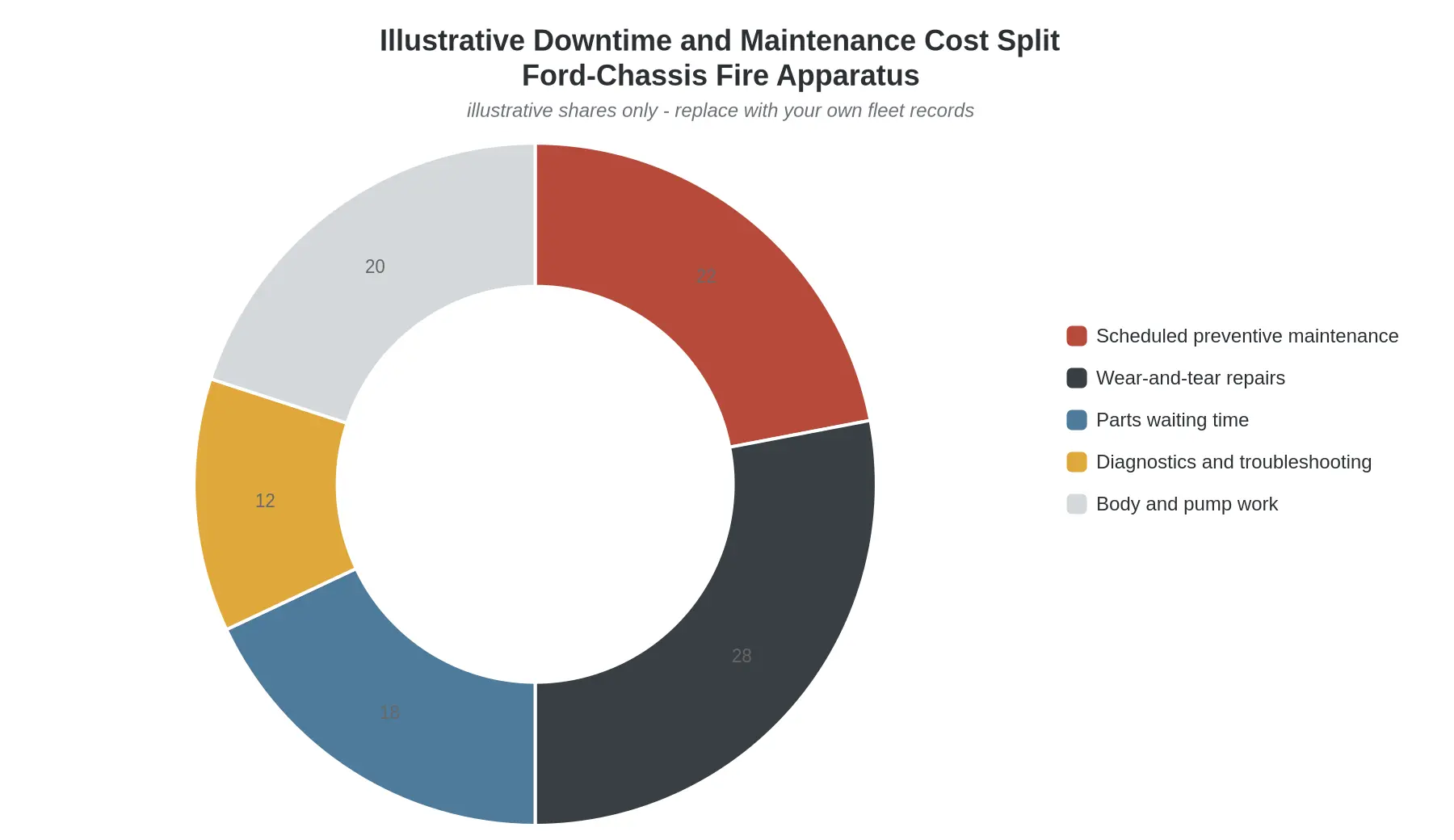
Spend does not divide the way hours do. Scheduled preventive maintenance (fluids, filters, brakes, tires, cooling, driveline inspection, annual pump testing) is calendar-driven and mostly priced in advance. Wear-and-tear repairs follow duty cycle instead: call volume, idle hours, terrain, and how hard the pump and drivetrain are worked. Body and pump work sits apart from both, because it burns specialty labor at specialist rates and runs on its own lead times (pump rebuilds, valves, plumbing, compartment fabrication, scene lighting), and it rarely lands on the chassis service calendar. That mismatch is what catches owners out.
The two remaining buckets leak money without much noise. Waiting on parts is pure lost availability, and commonality is the direct fix: when the chassis shares filters, belts, hoses, brake components and driveline parts with the rest of your municipal fleet vehicles, you stock one shelf instead of five and pull same-day from a local dealer rather than waiting on a builder-specific part shipped across the country. Service access goes after the diagnostic line: reachable components, an accessible diagnostic port and documented wiring cut the hours a technician spends hunting the fault before the wrench ever turns.
Both levers move cost out of unbilled downtime and into planned work, and both move total cost of ownership further than purchase price does. Read the chart for proportion: parts waiting and fault-chasing together come to about a third of out-of-service hours in the breakdown further down, which is precisely the share chassis and specification choices can compress. The shares shown are placeholders; put your own work-order records in before quoting any of it.
Where Out-of-Service Hours Actually Go
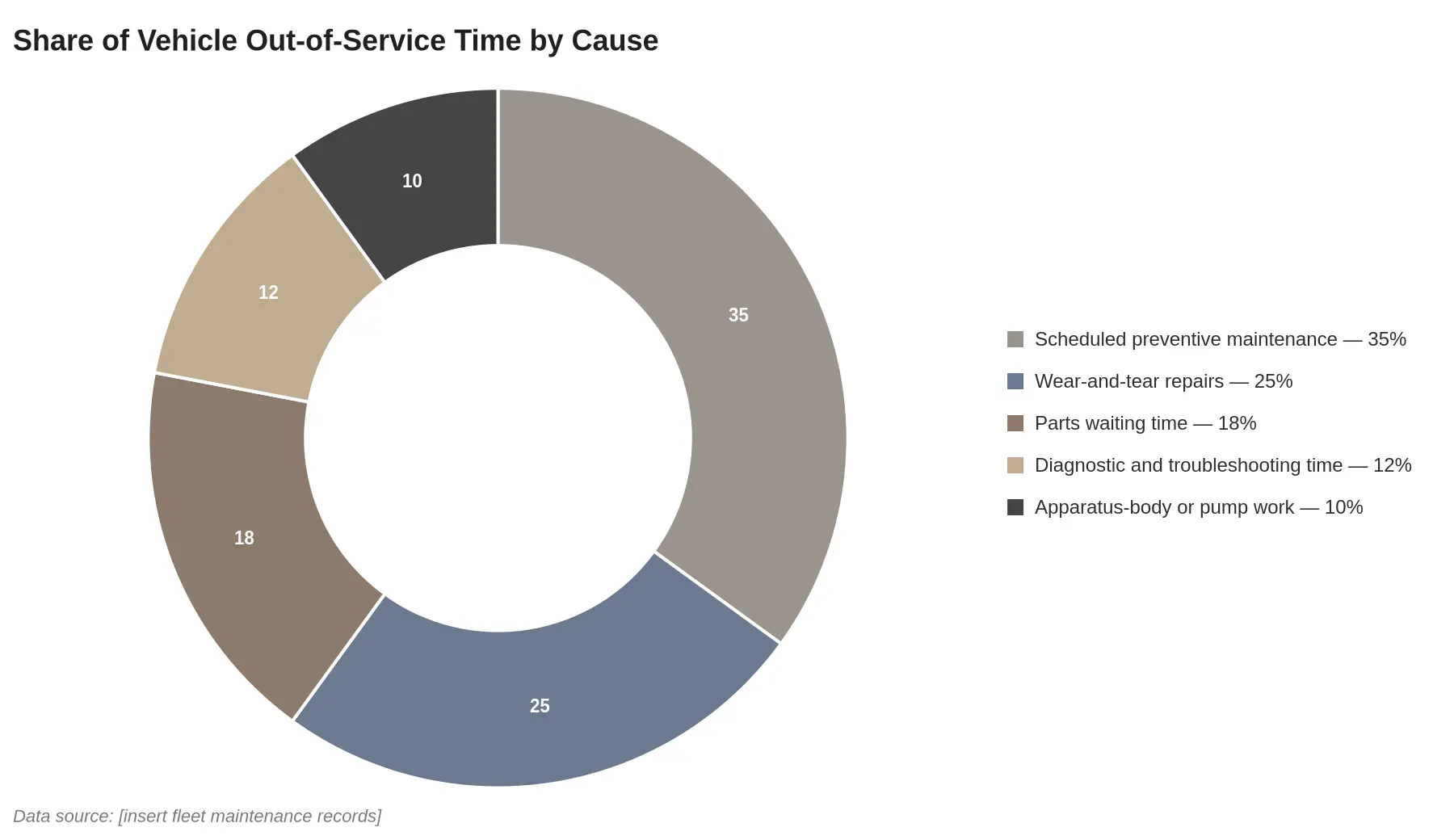
Shop managers usually have a working theory about why apparatus sits idle. The chart below puts rough numbers on it, splitting total vehicle out-of-service time into five buckets a maintenance supervisor can act on.
How to read the slices
- Scheduled preventive maintenance (35%) – planned and predictable, easy to schedule around shift coverage.
- Wear-and-tear repairs (25%) – brakes, suspension, bushings and driveline work that scales with call volume.
- Parts waiting time (18%) – the hidden cost center, where a truck is healthy but grounded.
- Diagnostic and troubleshooting time (12%) – technician hours spent identifying the fault, often spent twice when a fault recurs.
- Apparatus-body or pump work (10%) – tank, body and pump repairs that need a specialist bay.
Data source: [insert fleet maintenance records / CMMS export, city or department name, reporting period]
Caption: About 30 percent of out-of-service hours goes to waiting on parts and chasing diagnostics, the slice that standardizing on shared component families across a Ford-based lineup is designed to shrink. Fleets reviewing replacement cycles can compare options in our municipal vehicle lineup.
Procurement and Specification Decisions That Improve Parts Commonality and Service Access
The cheapest maintenance program is written in the procurement office, not the workshop. Buy fire apparatus and support trucks across a dozen chassis variants and every filter, brake set and diagnostic cable becomes a part number nobody can find on a Sunday night. Consolidating to two or three chassis families (say, one shared chassis for tanker tenders, rescue support units and utility pickups) cuts inventory lines and shortens every repair. Before signing, map the chassis, engine and transmission combinations already in your yard against what you are buying; that overlap is the cheapest service access you will ever buy. The discipline holds when comparing municipal fleet vehicle categories too, where a short approved list beats a long catalog.
Specifications matter as much as the purchase. Requiring shared component lists in bid documents, and holding suppliers to common brakes, lamps, hose fittings and fasteners, turns a collection of one-offs into a maintainable standard. The same logic travels into adjacent municipal road-cleaning vehicle programs, whose sweepers and carriers share hydraulic, electrical and chassis service routines with fire apparatus, so one tool set and one stocking plan cover the whole yard. Write it into the tender, not into a memo that gets filed after award.
- Consolidate chassis families across the fleet, and cap the number of approved engine and transmission pairings per vehicle class.
- Require bidders to submit a shared component list naming interchange part numbers for filters, brakes, lamps and hose fittings.
- Name the scan tool, software licence and connector protocol in the specification so one laptop serves the fleet.
- Set stocking levels by consumption rate: fast movers on site, slow movers on guaranteed supplier call-off.
- Add a service-access clause requiring documented maintenance intervals, lifting points and component locations before delivery.
Visualizing the Service Access Path for Ford Fire Trucks
A diagram usually beats a paragraph when you are walking a fleet manager or a finance committee through shop workflow. The five blocks below follow a fault from the first radio call to the crew rolling out of the bay.
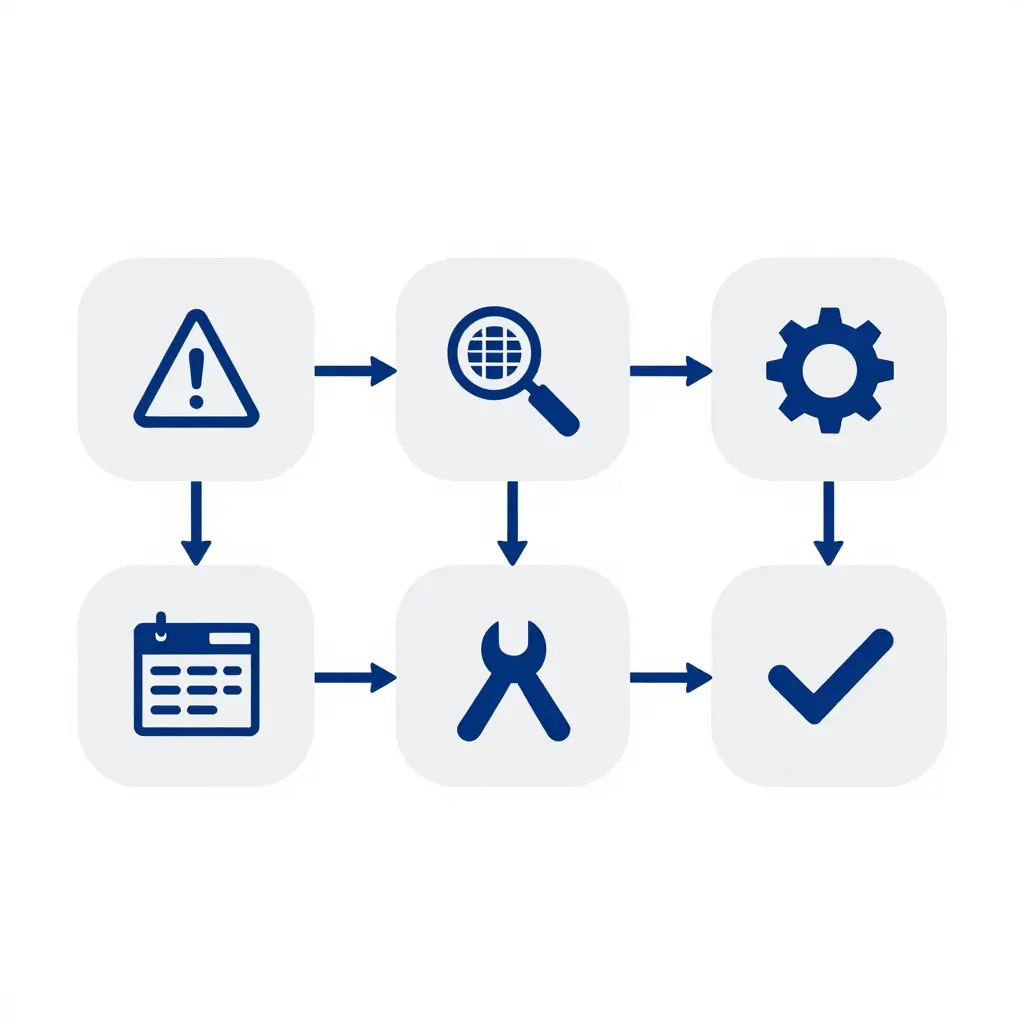
Left to right: fault reported, diagnostic scan, parts identified against a shared component catalog, repair, return to service. The third block is where this article’s two subjects meet. It draws on a shared catalog rather than a one-off vendor list, so parts commonality compresses the gap between diagnosis and wrench time across a municipal fleet.
That gap is where the money lives. When a pumper, a tanker and a service truck share the same brake, cooling and electrical components, one shelf serves all three, and a technician never has to explain to a fire chief why a two-hour repair became a two-week wait. Consistency like that starts at the specification stage, which is why it pays to review municipal vehicle platforms built around shared, serviceable components.
FAQ: Parts Commonality and Service Access on Ford Fire Trucks
Does parts commonality apply across different apparatus body types on Ford chassis?
Yes. Ford fire trucks built on the same chassis family share engines, transmissions, brake components, cooling packages and electrical architecture whether the body is a pumper, tanker or rescue unit, so a municipal fleet can stock one set of filters, belts and wear parts instead of a separate inventory per apparatus type. Body-specific items such as pump panels, compartments and plumbing stay unique to each builder.
How is service access affected when apparatus is built by third-party body builders?
Third-party builders mount their own pump modules, plumbing and electrical panels on the Ford chassis, and those additions decide how quickly a technician reaches the engine, transmission and chassis wiring. Fleets that specify documented service access (removable access panels, labeled harnesses, clear routing) cut diagnostic time on the chassis side. Requiring as-built schematics at delivery keeps chassis-level repair inside the normal shop workflow.
What diagnostic tooling should a municipal fleet budget for?
A Ford-compatible diagnostic platform with full CAN bus access, J1939 and OBD-II coverage, and bidirectional controls for module testing. Add a scan tool that reads third-party body builder modules, a laptop loaded with each builder’s service software, and a subscription to wiring diagram updates. Mixed apparatus fleets get better value from one shared tool set than from a kit per vehicle.
How should a fleet evaluate parts availability during procurement?
Ask each bidder for the fill rate, average delivery time and stocking location of the top 100 wear parts on the specified chassis, and require those figures in writing. Confirm that common components carry Ford part numbers any dealer can cross-reference, which removes single-source dependency on the body builder. Fleets can also compare municipal vehicle platforms that standardize on one chassis family and simplify the supply chain.
How do shared components affect total cost of ownership?
Commonality lowers total cost of ownership three ways: less inventory carrying cost, shorter repair turnaround, and volume pricing across the fleet. Fewer unique part numbers mean less shelf stock, fewer emergency orders, and less downtime per repair event. Better service access compounds the savings by cutting labor hours per job.
Operational Takeaways for Buyers
Both factors point the same direction. Commonality lowers the inventory burden: fewer unique part numbers, less capital tied up in slow-moving spares, shorter waits when a truck is down. Service access decides how fast a diagnosis becomes a repair, since a technician who can read the fault, source the component and finish the job without a long queue keeps the vehicle in service. Neither is a maintenance problem to solve after delivery. Both belong in the procurement specification, written as requirements rather than assumed outcomes: ask about component overlap with the vehicles already in your yard, and about realistic service response in your operating area, before the order goes out.
- Commonality cuts both the spares you hold and the time a vehicle waits for a component.
- Service access is what turns a diagnosis into a completed repair, so its speed belongs in the specification.
- For municipal fleets, both are procurement requirements to state before purchase, not issues to handle afterward.
Buyers comparing options can review municipal vehicle programs with those two criteria in hand.