

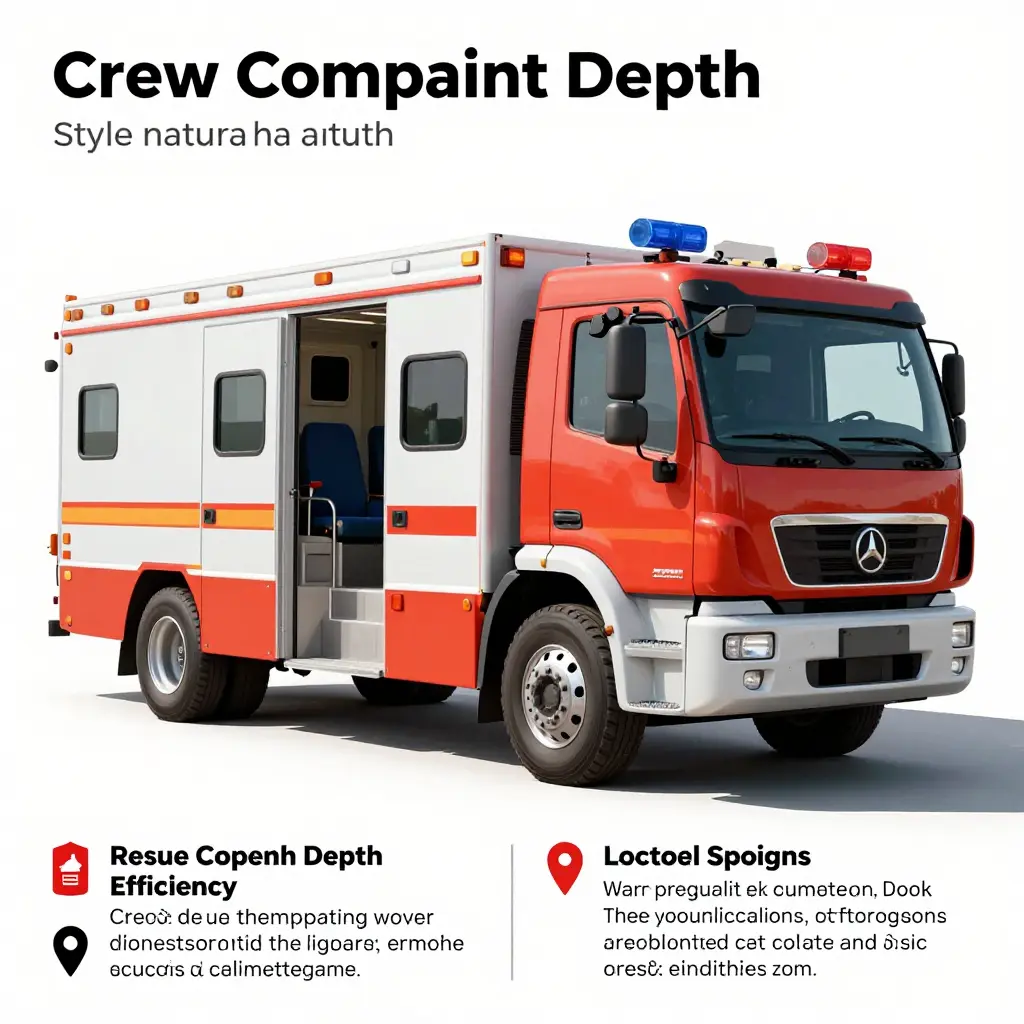
Crew Compartment Depth, Not Chassis Age
When you compare two used squads, the model year stamped on the frame tells you very little about how fast your crew gets out of the door. The depth of the crew compartment tells you most of it.
Crew compartment depth is the usable space, fore and aft and vertically, that a seated crew occupies in turnout gear with SCBA packs on: the distance from the back of the front seats to the rear bulkhead, plus the height from seat cushion to headliner, measured where members actually sit. That space sets how quickly four people strap in, how much gear stays within arm’s reach, and whether the last one out clears the cab without turning sideways past a shoulder.
Chassis age is a proxy, and a weak one. It is easy to read off a listing and easy to compare across listings, which is exactly why it gets used as shorthand for condition. But a ten-year-old chassis with a deep, well-planned compartment will still out-turn a three-year-old with a shallow box, because age says nothing about whether your crew boards in eight seconds or forty.
Buy on model year and you pay for depreciation. Buy on depth and you get a squad that clears the bay on the first attempt, with everything stowed.
This article covers how to measure that depth, where the published figures mislead, and how to write a depth requirement into a tender so a supplier cannot deliver a cab your crew cannot work in.
You can start with the municipal rescue and crew vehicles and a tape measure, rather than a model-year filter.
What Crew Compartment Depth Measures
Depth is not one figure. It is three clearances inside the cab, and each one maps onto something the crew has to finish before the vehicle moves.
The three dimensions
Seat-to-bulkhead fore-aft depth. The clear distance from the front face of the seat backrest to the rear bulkhead or partition. It decides whether a seated member can wear a self-contained breathing apparatus and still reach tools, radio and door handle without twisting out of the seat. When fore-aft depth is tight, gear gets pulled on in stages instead of in one motion, and that costs seconds.
Seated headroom above the cushion. Measured from the compressed seat cushion to the lowest point of the headliner. This figure limits helmet clearance and torso rotation, and it is what lets a belted member reach a tool belt or a mask without unbuckling.
Stowage depth for breathing apparatus and hand tools. The usable cavity behind or under the seat, sized and braced for cylinders, masks and hand tools. Where it exists, the crew exits equipped. Where it does not, they gear up on the pavement.
| Dimension | Measured as | What it enables |
|---|---|---|
| Fore-aft depth | Seat backrest to bulkhead | Shorter donning time |
| Headroom | Compressed cushion to headliner | Unrestricted limb movement |
| Stowage depth | Usable cavity aperture and reach | Exiting already equipped |
Those three numbers are what response readiness means in practice: seated, equipped, and moving the moment the vehicle stops. Depth is fixed by the body structure, so it cannot be added later without reworking the bulkhead, floor pan and seat mounts.
If you are specifying a vehicle for a rescue or service fleet, put all three dimensions into the RFQ and require each bidder to answer them in writing. The municipal vehicle range shows how those dimensions are packaged across different body types.
Chassis Age Is a Weak Proxy for Readiness
A late-model, low-hour chassis can still produce sluggish turnout if the space where the crew sits and works was designed badly. What sets response speed is how quickly a belted crew can reach its tools and step out.
Engine hours and model year measure mechanical condition: drivetrain wear, service intervals, emissions compliance. On those questions they work reasonably well. Neither one describes the geometry of the crew compartment, because the body builder fixed that at the design stage, and bolting a newer chassis underneath does not change it. A shallow compartment has nowhere to put equipment except outside the seated crew’s reach.
The consequence runs against intuition: a newer chassis can be the slower one to empty. Members unbelt, twist and stretch for gear stowed behind the seat or in an exterior locker before they can begin to move, and that extra motion repeats on every call and gets worse under time pressure, which is when reach matters most. Read the compartment drawing before the odometer.
Judge a rescue unit by depth first. Treat chassis age as a maintenance note, not a readiness score.
Depth bands and what a seated crew can reach
Before you sign anything, look at the crew compartment as a working space rather than a line on a spec sheet. Depth decides whether a seated member can reach their breathing apparatus, a radio handset or a medical bag without unbuckling. In our own specification reviews with fleet buyers, the difference between a clean turnout and a fumbled one is often 60 mm of usable depth, not the model year on the chassis.
The bands below measure usable seated depth within a row: from the seat back to the first obstruction behind it, whether that is the next row, a partition or the rear bulkhead. They are not comparable with the whole-compartment figures quoted in tender documents, which run from the front of the cab to the rear wall and are covered further down.
| Compartment depth band | Usable seated depth (mm) | Equipment stowage within reach | Readiness impact |
|---|---|---|---|
| Shallow (compact squad cab) | 480 – 540 | Helmet, torch and gloves only; breathing apparatus stored behind or beside the seat | Crew steps out of the cab to kit up; the delay is most obvious on night calls |
| Standard (typical municipal cab) | 560 – 620 | Seat-integrated breathing apparatus, radio handset, first-aid pouch, small tool roll | Meets routine response targets; adequate for medical and first-response duties |
| Deep (rescue squad spec) | 640 – 700 | Full PPE donned while seated, hydraulic rescue tool pack, spill kit, scene lighting controls | Three to four members deploy without delay; the practical baseline for rescue work |
| Extra-deep (command and heavy rescue) | 720 – 800 | All of the above plus incident board, comms console, spare cylinders and rope bags | Adds sustained on-scene command; also adds wheelbase and weight, so check braking and turning circle |
Use the table in specification review: sit in the cab, extend an arm, and confirm that everything your crew needs in the first sixty seconds sits inside the band.
Seating Ergonomics and Equipment Staging
On a rescue vehicle, depth decides whether a squad turns out fast or fights its own cab. A current-model chassis under a shallow body still gives you cramped seating and improvised gear storage, and that costs seconds on every call.
Seat pitch and knee clearance. Depth sets usable fore-aft pitch. Each row needs enough rail to hold roughly 650 to 750 mm of pitch plus a full footwell; trim depth to fit a shorter body and knees meet the dash panel while footwells flatten. Members then perch on the seat edge, which slows the stand-and-move that starts every response.
Torso rotation in protective gear. A bunker coat and SCBA add roughly 250 to 300 mm of profile at the chest and back. Turning toward a harness, radio or door latch needs lateral clearance and staggered seat mounting. Without it, members unbuckle and step outside just to turn around their own equipment.
Staging depth for cylinders and tool bags. Crews board already dressed when cylinders, tool bags and medical kits sit at the door and behind the seat riser instead of in the aisle. Plan a storage band of roughly 300 to 450 mm along the compartment wall, so gear is found by touch, in the dark, without reaching over a seated member. Treat that band as fixed equipment, not leftover space.
Specify depth and layout around the dressed member’s footprint, then confirm it on a demo unit. Chassis age tells you about maintenance history; depth tells you whether crews board ready to work.
Depth is the hidden bottleneck on a used squad, so measure it with the same care you give mileage or chassis condition. Seven measurements will tell you most of what you need:
- At the driver and officer seats, with each seat set to the fleet’s standard position, measure knee clearance and record the smallest gap between knees and the dash or partition.
- From the rear face of each front seatback to the forward face of the bulkhead at hip height, measure seat-to-bulkhead depth and note the smallest value across both positions.
- Measure the narrowest walk-through clearance to the rear exit at floor, hip and shoulder height, then score the vehicle on the smallest figure.
- In every compartment, measure usable tool stowage depth from the back wall to the latch line, excluding hinges and latches that intrude, and confirm the longest tool fits with the door closed.
- Measure cylinder rack reach from the rear doorway threshold to the farthest bracket, and note the reach height, so you can judge whether a member can secure a cylinder without stepping into the aisle.
- Calculate airflow per seat by dividing measured supply airflow in cubic feet per minute by the number of designated crew seats, and record it at the highest and lowest fan settings.
- Above each seat, measure from the seat cushion to the ceiling at the seating reference point, and flag any position below your team’s helmet clearance target.
Record every value in the same units on one sheet, so the shortlist reflects measured depth rather than showroom impressions.
Usable Depth, Visualised
Two silhouettes: same seat, same bulkhead, same stowage blocks. The only difference is the gap between them, and the gap is what decides the outcome when a call lands.
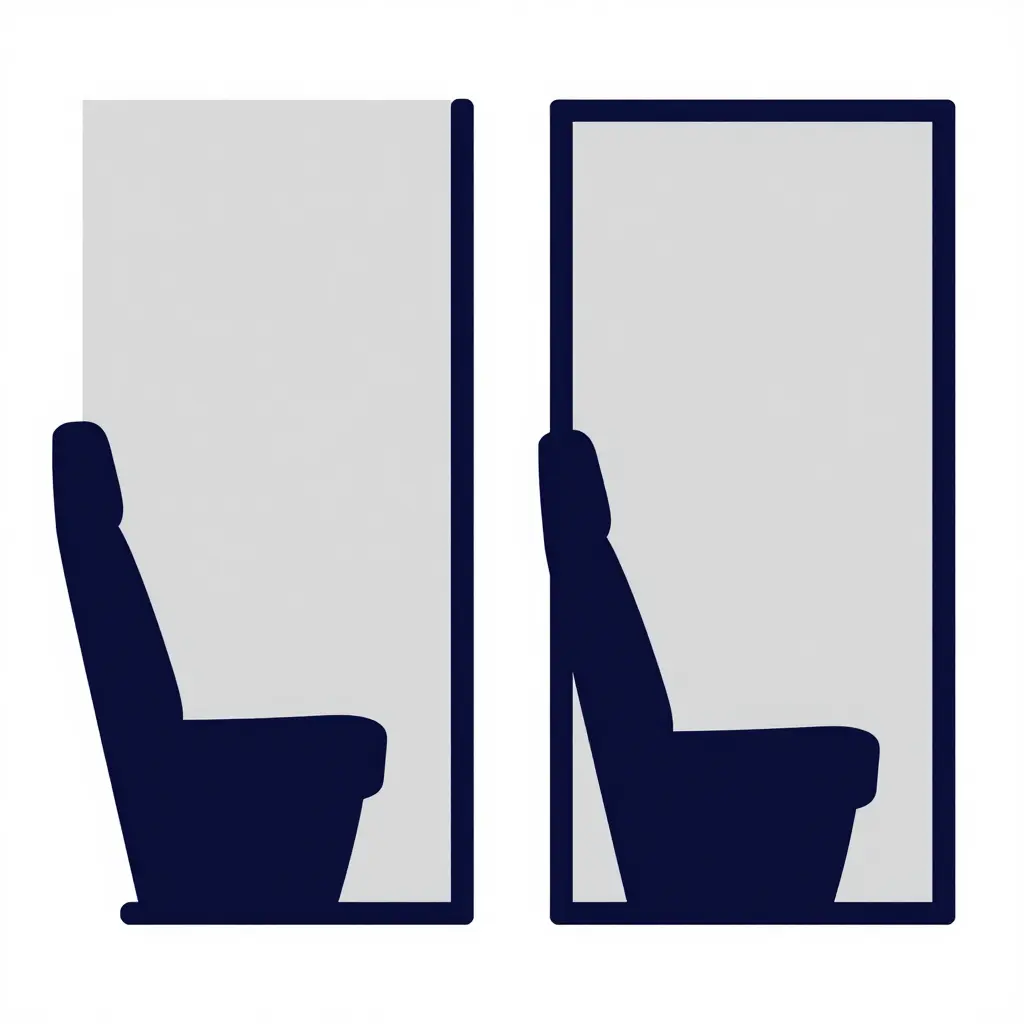
The left silhouette is the trap. The seat exists, the stowage exists, and the paperwork says the vehicle seats a full squad. But the geometry is stacked against the crew: helmets and turnout gear crowd the knees, air packs push shoulders forward, and whoever climbs in last hands gear forward like a bucket line. Nothing is broken. There is simply not enough depth to work in.
The right silhouette shows what the extra span buys. Bodies sit upright, bags and tooling ride in blocks that stay out of legroom, and the crew dons gear inside the box instead of on the tarmac.
Why this matters to an owner, not just a driver
- Turnout time. Crews that can dress and reach equipment in place shave time off every response, and response time is what the public measures you on.
- Retrofit room. Deep layouts absorb radios, breathing apparatus and medical bags without a re-engineering project two years later.
- Resale. Buyers can read chassis age and discount for it. Layout quality is harder to fake and easier to live with.
Treat depth as a layout principle, not a line on a brochure. When you review municipal vehicle platforms for rescue and response duty, measure the space a seated, fully kitted member occupies, then check whether the compartment still has room to spare.
What the published documents say about crew space
Body-builder guidance and municipal tender documents rarely give a single tidy figure for crew space. They give clusters, and the clusters disagree with each other. The ranges below summarise what appears across that material; they are not a quoted standard, and no single document contains all of them.
Ranges that recur
- Crew compartment depth benchmarks (front seating area to rear bulkhead): roughly 1,400 mm to 2,100 mm, with the majority of published documents landing somewhere between 1,600 mm and 1,900 mm.
- Crew cab dimensions (interior width at shoulder height): approximately 1,450 mm to 1,720 mm.
- Crew cab interior height (floor to headliner): around 1,300 mm to 1,560 mm.
- Crew seating positions: commonly 4 to 8 seats, arranged as single or dual bench rows, with per-seat shoulder allowance quoted anywhere from 480 mm to 600 mm.
- Walk-in or pass-through openings between cab and body: typically 600 mm to 900 mm wide in documents that specify them at all.
- Rear crew areas behind the cab (where specified separately): about 900 mm to 1,500 mm of clear depth.
Where the specifications disagree
Published figures are genuinely inconsistent. Some documents measure depth from the seat backrest to the rear wall; others measure from the dashboard to the rear wall. Some quote internal clear space, others external body dimensions that quietly include wall thickness and insulation. Rescue vehicle documents often borrow language from earlier municipal tenders, so near-identical wording can conceal measurements taken from different reference points. A handful state no depth figure at all and leave the bench layout to the builder’s discretion.
Interpretation
Read these ranges as a design envelope, not a guarantee. The question is not which number sits in the document but how much usable depth remains once self-contained breathing apparatus, medical bags and turnout gear are stowed. Depth governs whether a crew can don equipment inside the vehicle, exit without shuffling past each other, and reach the scene ready rather than still adjusting kit. If you are comparing municipal vehicle platforms for response duty, screen on compartment depth first and treat chassis age as secondary.
Before you commit, confirm with each supplier exactly how depth, width and height are measured, whether the figures are internal clear space or external dimensions, and what remains after standard equipment is installed.
Procurement and Total Cost of Ownership
Depth is fixed at build. It is engineered into the body structure alongside floor height, body mounts and the cab-to-body interface. Once the vehicle is delivered you are not buying a deeper compartment; you are buying a new body. That puts depth in the capital plan next to price and financing terms, not in the accessories column.
Retrofits are structural, not cosmetic. A later stretch or reconfiguration touches frame rails, axle ratings, gross vehicle weight rating, braking performance and weight distribution. It usually means re-engineering the cab-to-body joint, re-checking occupant protection and arranging re-certification in many jurisdictions. Cost is unpredictable, the vehicle leaves service for weeks, and the result may still fall short of the depth the crew needed on day one.
Depth also protects resale value. A crew-configured body attracts a wider pool of second owners, because the space carries a full crew with turnout gear, breathing apparatus and tools without crowding. Shallow compartments narrow that pool and invite price concessions at trade-in, so a lower acquisition price today can be partly repaid on resale.
Compare bids on delivered cost, then add fuel, maintenance, downtime and resale over the service life. Ask each supplier to quote usable depth, seat count with the crew fully equipped, and payload remaining after the body is fitted. Buyers assessing recovery and tow configurations should apply the same logic to rear body space. The municipal vehicle range sets out the fixed build parameters behind each configuration.
Before you sign, get three items in writing: measured depth at the deepest usable point, payload remaining after body and equipment, and the certification basis for the body on that chassis. Those three numbers decide whether the vehicle is still fit for purpose in year eight, long after the invoice is paid.
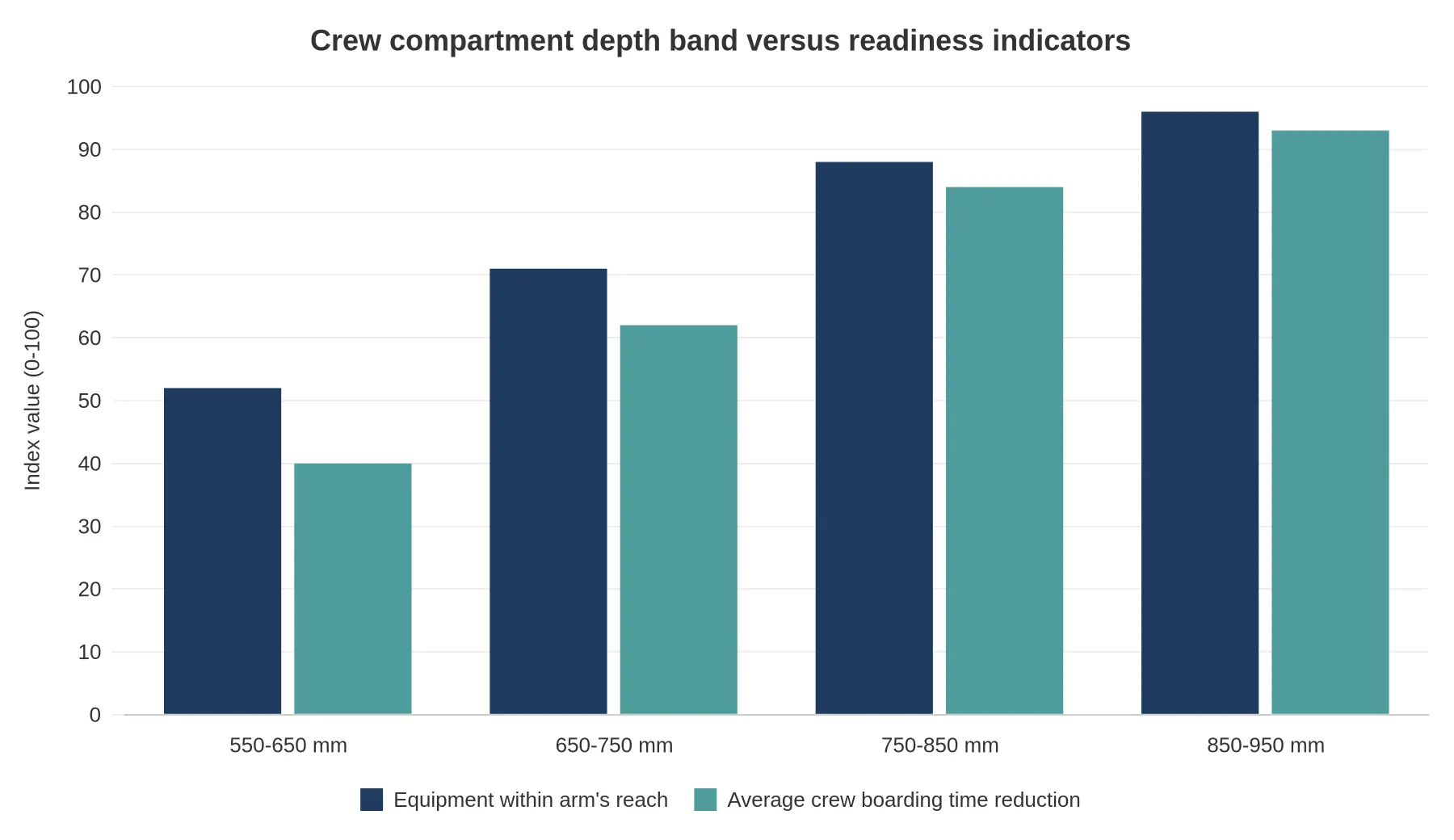
The chart plots the four depth bands against two readiness indicators. It shows a relationship pattern, not a product ranking: across the four bands, both indicators move upward together rather than diverging. Read it as a directional signal about how space shapes response speed, not as a scorecard for any single vehicle.
Writing Crew Compartment Depth Into a Specification or Tender Document
A dimension clause converts a comfort preference into a contractual term. Written tightly, it protects rescue response readiness for the whole service life of the vehicle. Written loosely, it lets a supplier meet the letter of the tender with a cab that crews cannot work in.
State dimensions as minimum values with a tolerance
Write every internal dimension as a minimum, never as a nominal figure. Specify “not less than 1,800 mm internal clear crew compartment depth, measured at floor level from the rear face of the front seat base to the inside face of the rear bulkhead, with a tolerance of 0/+20 mm”. Then define the method: which plane is used, which fittings are excluded, and whether seat squabs are compressed. A minimum with a tolerance stops a low bidder from delivering a body that quietly shrinks to the lower edge of the drawing.
Require a dimensioned drawing at bid stage
Do not accept a brochure. Ask every bidder for a dimensioned side and plan drawing of the crew compartment, annotated with clear internal depth, and require those figures to be restated in the compliance schedule. The drawing becomes part of the contract and gives your inspector a reference point later. This matters most where a body is adapted from a shared platform, such as road-cleaning bodies whose equipment bays and hose lockers tend to creep rearward into crew space.
Require acceptance measurement at delivery
Name the measurement as a delivery acceptance test. State the instrument (tape or laser), the datum points, who witnesses it, and the remedy if the body fails: rework before payment, or rejection. An unmeasured clause is an unenforced clause, and a vehicle specification without a delivery test is only a suggestion.
Separate crew space from cargo or waste tank volume
Prohibit the use of crew space to satisfy other volume requirements. Write explicitly that crew compartment depth is measured to the bulkhead and excluded from tank or body capacity calculations, so a supplier cannot claim a larger waste tank by shortening the compartment. On liquid-waste bodies, tank length is the easiest number to grow, which makes this firewall clause essential rather than optional.
| Weak wording | Contract-ready wording |
|---|---|
| “Adequate space for a three-person crew” | “Internal clear crew compartment depth not less than 1,800 mm, tolerance 0/+20 mm, measured per clause 4.2” |
| “Tank capacity approximately 6,000 litres” | “Tank capacity 6,000 litres minimum, exclusive of crew compartment volume” |
| “Drawings available on request” | “Dimensioned crew compartment drawing submitted with the bid and appended to the contract” |
Copy the same three-part structure into every body type you buy, including cargo box bodies, where the crew area competes directly with load volume. Standardise it once and every later purchase starts from a stronger position.
When buyers weigh a rescue squad, chassis age tends to dominate the conversation, yet it explains only a small slice of how fast a crew responds. The municipal vehicle range is built around the variables that carry more weight in that equation.
Where readiness really comes from: cabin depth and crew practice together account for well over half of the response picture, which leaves chassis condition a comparatively minor influence.
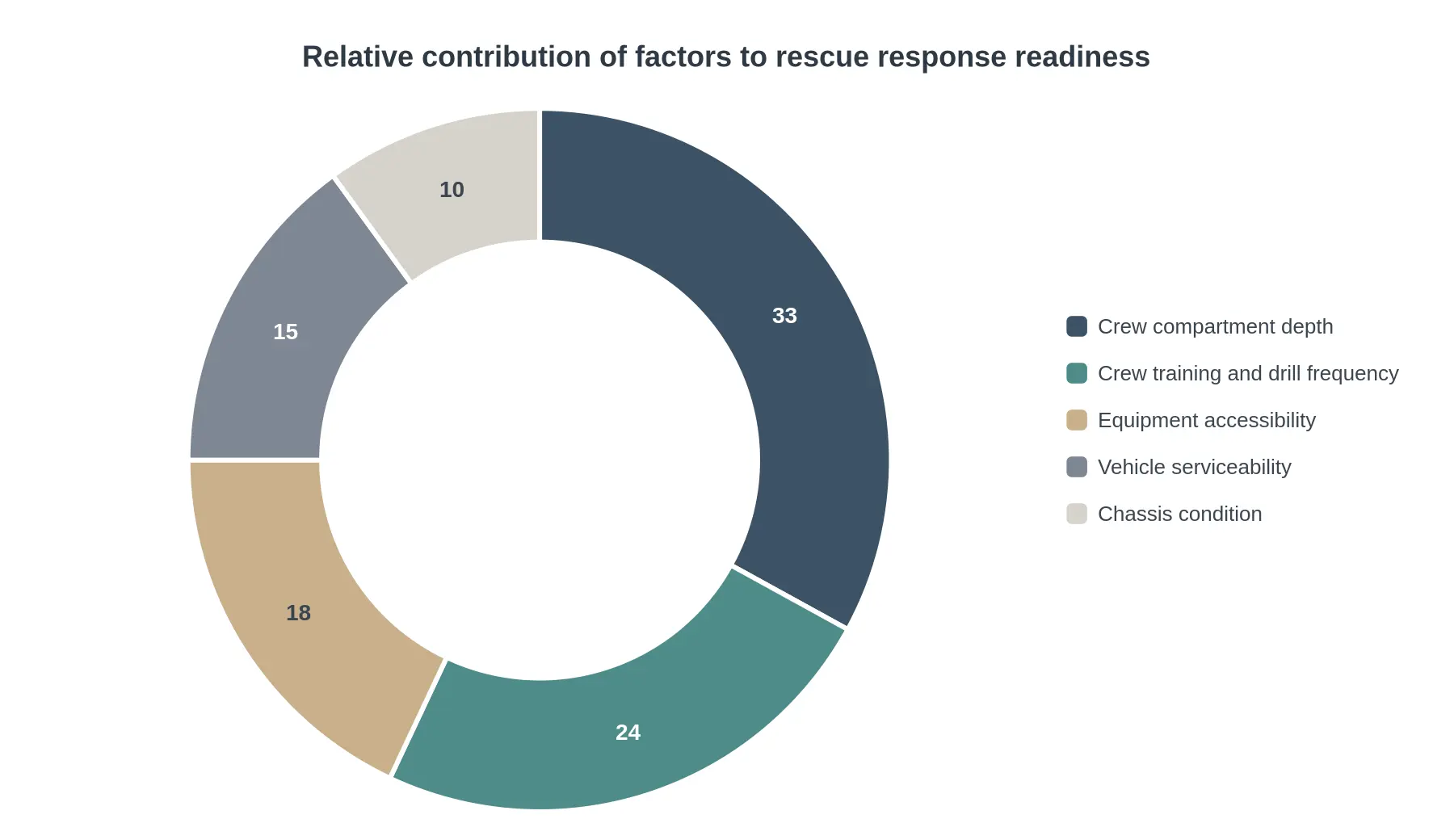
These percentages are an illustrative weighting model created to frame the argument in this article, not the result of a measured audit or field study. Treat them as a way of thinking about where readiness is won or lost, then validate the priorities against your own fleet data before committing capital.
FAQ: Crew Compartment Depth and Chassis Age
Does crew compartment depth matter more than chassis age?
Yes. Depth sets how quickly a full crew can board, don gear and exit with equipment in hand, and that speed is the core of rescue response readiness. Chassis age reflects accumulated driveline wear, which is measurable and serviceable against published intervals. Depth is fixed at the build stage, so it caps usable capability on every call for the life of the vehicle.
Can a shallow crew compartment be modified after delivery?
Not in any practical sense. Depth is defined by the body structure, the cab-to-axle layout and the rollover protection geometry, so cutting or extending it after delivery weakens the structure and shifts weight distribution. Order the correct depth at specification stage instead of budgeting for a rebuild later, and review dimensioned drawings before signing, especially when comparing squad vehicles for sale across suppliers.
How does depth interact with payload and body length?
Every additional increment of depth moves crew weight forward and consumes body length that would otherwise carry equipment, water or foam. Total gross weight is fixed by the chassis rating, so deeper compartments reduce the payload left for tools and liquid. Specify depth, body length, wheelbase and target payload as one set of numbers, not four separate choices.
What measurements should I request from a supplier?
Ask for interior depth at floor level, measured from the rear of the cab to the front bulkhead, plus width, standing height, seat pitch, step height and door clear opening. Ask for the same drawing to include wheelbase, gross axle weight ratings and curb weight, so depth can be checked against payload.
| Measurement | Why it matters |
|---|---|
| Interior floor depth (cab to bulkhead) | Confirms seated crew and gear clearance |
| Interior width and seat pitch | Defines seated crew count |
| Step height and door clear opening | Controls exit speed with equipment |
| Wheelbase and axle ratings | Ties depth to legal payload |
Does depth affect operating cost?
Yes, both directly and through cycle time. A deeper compartment usually adds body weight, which raises fuel consumption slightly and lowers remaining payload. It also shortens turnaround between calls, because crews board and exit without repacking equipment, so cost per response can fall even where fuel cost rises marginally.
Conclusion: Let Depth Lead the Decision
Depth sets how people move through the vehicle. Age sets what you will be repairing. With air packs, helmets, tools and a full kit on, a shallow box makes firefighters shuffle, twist and delay, while a deeper one lets them mount and dismount in the order and posture their equipment demands. Chassis age only describes mechanical condition: service history, engine hours, brake wear, rust, inspection records. That is a maintenance question, and it belongs in the maintenance budget.
Three things to do when you evaluate a vehicle:
- Measure the compartment. Take a tape to the door opening, record usable depth, and check it against the seats and equipment brackets you intend to install.
- Board the vehicle in full kit. Walk through entry and exit with your own crew and gear, timed, rather than judging from photos or a specification sheet.
- Treat chassis age as a maintenance question. Ask for service records and an inspection, price the needed work, and keep that figure out of the readiness judgment.
For buyers comparing options across these categories, the municipal vehicle lineup and the cargo vehicle categories are starting points, including dump trucks whose chassis and body configurations are worth reviewing against the same depth criteria.