

Why Fleet Acceptance Hinges on NFPA 1901 Certification
In the United States fire apparatus market, a purchasing committee reads the specification before it reads the invoice. A low chassis price gets a supplier onto the shortlist. A certified apparatus, with the test records and drawings behind it, is what clears the technical review and produces a purchase order.
That changes how a fire truck USA market entry plan has to be built. Suppliers who lead with chassis cost are competing on one line of a quotation. Suppliers who lead with certification are competing on the conditions the fleet actually has to meet, and those conditions reach past the chassis sheet into service coverage, parts availability and operating cost.
NFPA 1901 covers pump performance, water and foam capacity, hose bed layout, warning devices, seating and restraints, and the labeling that ties each component back to its test result. Compliance is checked against documents rather than taken on trust, so the paperwork carries as much weight as the vehicle. A supplier entering through municipal vehicle platforms should assume the review starts there.
Cost arrives later, in a different form. Service intervals, parts lead times and resale position decide whether a low price was low. Quotations that win on chassis price often lose once those numbers are added up.
What follows tracks the order a reviewer works in: what the standard covers, what the documents have to show, what the vehicle costs to own, and how procurement weighs the decision.
What NFPA 1901 Certification Actually Covers
NFPA 1901, the Standard for Automotive Fire Apparatus, applies to the finished vehicle. No bare chassis is “NFPA 1901 certified”; the certificate belongs to the completed, integrated fire truck as delivered, tested and documented. Buyers who compare chassis invoices are pricing the wrong item.
A note on editions: NFPA 1901 was folded into NFPA 1900 in the 2024 consolidation. Purchasing documents in circulation still cite NFPA 1901, usually the 2016 edition, and NFPA 1900 carries those requirements forward, so the mechanics below apply either way. NFPA itself issues no apparatus certificates; the builder certifies the unit and third parties verify the claim, so a certificate is only as good as the test records behind it.
Because the scope is vehicle-level, the standard requires each subsystem to be tested after assembly. Integration, testing and paperwork are where the cost and the risk sit, and they are the items a fleet specification committee reviews before signing acceptance.
Performance Requirements Verified on the Completed Vehicle
- Chassis and body integration. Subframe design, body mounting, compartment loading and the interaction between the chassis manufacturer’s ratings and the installed body are treated as one system. Added weight and structural modifications must stay within published limits and be documented.
- Pump performance ratings. Rated capacity is proven at 100%, 70% and 50% of rating at the specified net pump pressure, along with intake, tank-to-pump and priming checks. The figure on the plate has to be reproducible on the installed pump with the installed piping, not on a test stand alone.
- Water tank capacity and baffling. Usable tank volume must match the stated capacity, and tanks above the threshold size need baffles spaced no wider than the standard permits, to control liquid surge during braking and cornering.
- Aerial device structural and load testing. Ladders, platforms and water towers go through static and dynamic load tests at rated capacity plus a margin, and through operational tests of rotation, elevation, extension and hydraulics.
- Warning lights and audible devices. A required complement of optical warning devices with defined zones of coverage, plus audible devices meeting minimum sound-level performance.
- Weight distribution and axle loading. Individual axle loads are measured with full water, fuel, crew and equipment, then compared against axle and gross vehicle weight ratings to confirm balanced loading.
Documentation and Third-Party Verification
The standard does not stop at a passing test. Delivery has to include a documentation package: the manufacturer’s certification of compliance, pump performance test results, aerial test records, a certified weight record, as-built drawings, component lists, and operating and maintenance manuals.
Purchasing authorities also frequently require independent third-party inspection and acceptance testing, usually to the test procedures in NFPA 1901 or, for apparatus already in service, NFPA 1911. Results are filed with the delivery documents, and that record set is the audit trail showing fire apparatus standards were met.
For a supplier entering the U.S. market this is the gate that matters. A competitive chassis price with an incomplete NFPA 1901 package stalls in review; an integrated, tested and documented fire apparatus goes through to delivery.
The acceptance sequence: a bare chassis goes in, the body and pump are integrated, the unit is tested and documented, and only then does it join a fleet.
Chassis Price vs. Total Cost of Ownership: The Number That Actually Decides Fleet Acceptance
The quotation in hand covers a frame, a driveline and a cab. It says nothing about what it costs to turn that platform into an accepted vehicle. Total cost of ownership starts where the chassis invoice stops, and for a business owner weighing fire apparatus for the US market it is the only figure that shows whether a program is commercially viable. Municipal and specialty platforms can be reviewed here, but compare them on delivered capability rather than on the frame alone.
Body and pump integration labor, third-party NFPA 1901 testing, specification change orders, documentation preparation, insurance and liability exposure, downtime during rework and end-of-service resale value all sit outside the chassis quote, and each one scales with the complexity of the build rather than with the discount on the frame.
A discount on the frame cannot offset a non-compliant finished apparatus, because the cost of non-compliance lands after delivery, in failed acceptance, forced retrofit and restricted bidding eligibility. The discount is recorded at purchase. The cost arrives later.
The table below sets out what a chassis quotation captures and what it leaves out.
| Cost element | What a chassis quotation shows | What it leaves out of total cost of ownership |
|---|---|---|
| Body and pump integration labor | Bare frame, cab and driveline | Fabrication hours, pump plumbing, wiring, fit-out and QA rework |
| NFPA 1901 certification testing | Nothing | Third-party test fees, failure remediation and repeated test cycles |
| Specification change orders | Base specification only | Engineering hours, re-approval loops and schedule slip on each change |
| Documentation preparation | Nothing | Compliance files, test reports, as-built drawings and acceptance paperwork |
| Insurance and liability exposure | Vehicle value at delivery | Coverage for units placed in service out of compliance, plus claim and recall exposure |
| Downtime during rework | Nothing | Lost service days, idle crew cost and late-delivery penalties |
| Resale value at end of service | Nothing | Depreciation driven by certification status and documented compliance history |
The next table lines up a chassis-price-led review against one aligned with NFPA 1901 certification, criterion by criterion.
Table 1: Chassis-price-led evaluation versus NFPA 1901 certification-aligned evaluation
| Evaluation criterion | Chassis-price-led evaluation | NFPA 1901-aligned evaluation |
|---|---|---|
| Primary decision metric | Lowest chassis bid price | Verified compliance plus total cost of ownership |
| Scope of supplier quotation | Chassis and basic body only | Complete apparatus with pump, aerial, and documentation |
| Pump and aerial test evidence | Manufacturer self-declaration with limited test data | Third-party witnessed pump and aerial certification tests |
| Documentation package | Basic specification sheet and invoice | Full compliance file with test reports and certification records |
| Change-control process | Informal, price-driven substitutions | Documented engineering change approvals with re-certification |
| Lifecycle cost visibility | Purchase price only, hidden operating costs | Maintenance, staffing, and residual value modeled upfront |
| Acceptance outcome | Price advantage with later rejection risk | Fleet acceptance with lower long-term risk exposure |
The left column wins the opening meeting. The right column survives inspection, which is where these decisions are usually lost.
Six Steps to a Bid Package That Survives Technical Review
Technical reviewers do not reward the cheapest chassis. Assemble the submission in the order below and let the paperwork answer most of the questions before they are asked.
- Map each bid specification line to the exact NFPA 1901 requirement it triggers, then flag every gap before submission.
- Collect pump performance and aerial test data from accredited facilities, documenting flow rates, pressures and ladder load results for reviewers.
- Document weight and axle loading calculations against fire apparatus standards, showing per-axle ratings, water tank loads and remaining payload margins.
- Define the change-order process up front, with approval authority, pricing rules and schedule impacts written into the bid specification package.
- Compile certification and warranty documentation into one indexed set covering NFPA 1901 certification letters, chassis warranties and component serial records.
- Schedule pre-delivery verification with the buyer, the dealer and a third-party inspector, confirming every fire apparatus standards checkpoint before signing acceptance.
A supplier who already works in this format, such as the municipal vehicle lineup, will close these gaps faster than one learning the process on your order.
The chart below plots relative cost weight across five elements for two apparatus profiles. Read it against your own municipal fleet vehicle planning assumptions: the compliant profile puts spend into chassis, body and pump integration, and certification testing, while the non-compliant profile trades a lighter certification line for heavier rework, downtime and resale loss.
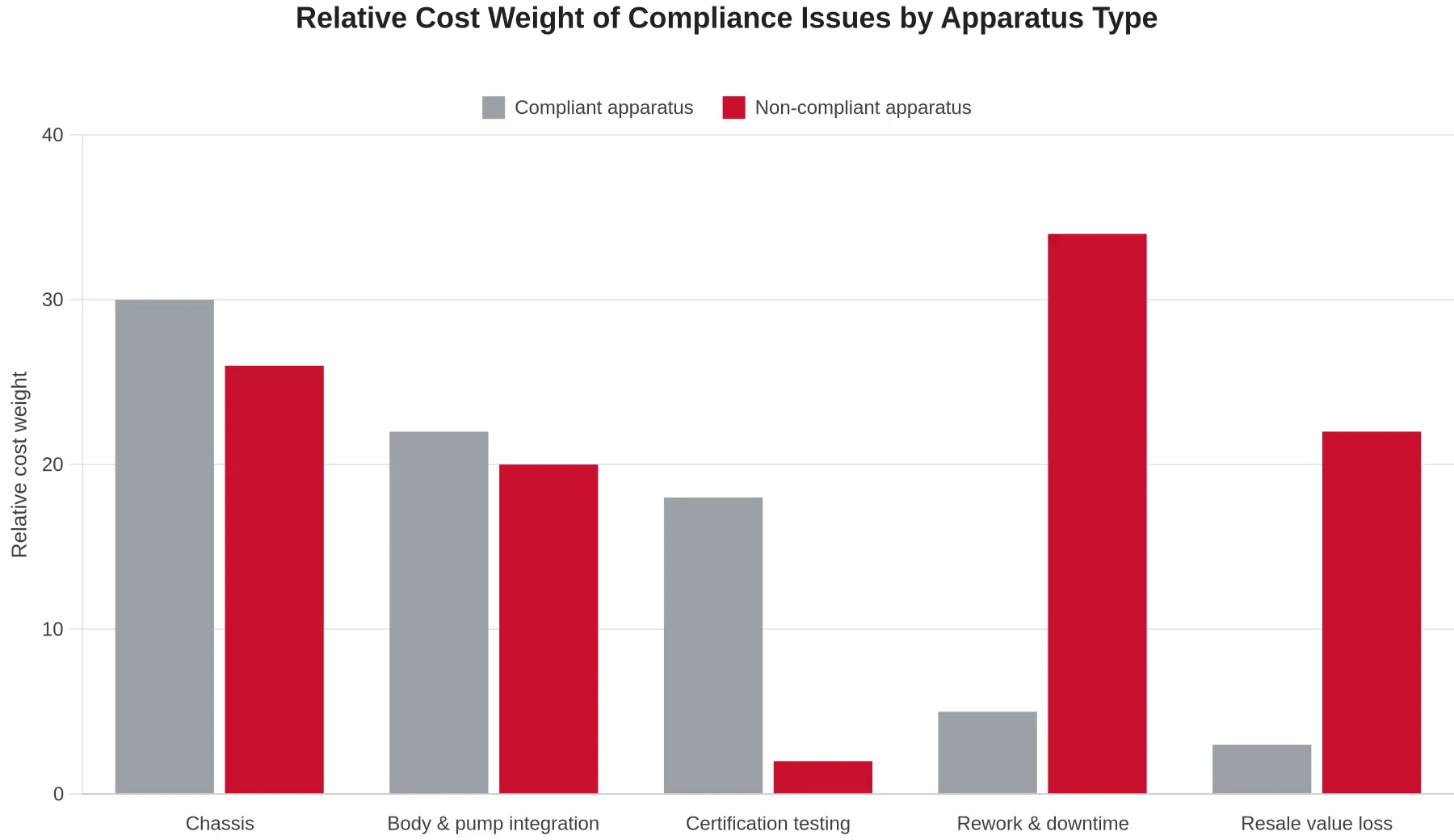
Relative cost weight by cost element for compliant and non-compliant apparatus profiles: certification cost is front-loaded, while the cost of non-compliance is deferred into rework, downtime, and resale value loss.
Specification Alignment and Documentation: The Real Acceptance Test
A demonstration does not decide a bid in the US fire apparatus market. The written answer to the specification does. A municipal purchasing committee, an outside consultant or a fleet engineering group reads the submission line by line against the published spec, ticks each requirement, and asks for the evidence behind it. NFPA 1901 certification counts for something only when it is documented: test reports, design calculations, material certificates, traceable component listings. A price advantage disappears on the page where the reviewer cannot find proof of compliance.
The Documents That Decide Approval
A complete package usually rests on four documents, and any one of them can stall a bid on its own:
- Third-party test reports mapped to specific specification clauses, not gathered in a generic binder.
- Signed change orders for every deviation from the spec. Unsigned change orders read as non-compliance rather than flexibility, and approval pauses until they are countersigned.
- Traceability records linking installed components to approved manufacturers and part numbers.
- A document index that matches the reviewer’s checklist order, so nothing has to be hunted down mid-review.
Missing paperwork rarely comes back as a rejection letter. It comes back as a query, and a query resets the review clock. A complete file turns a multi-round review into a single pass. Reviewers read documentation quality as a proxy for engineering discipline, and in practice that inference is usually right.
Municipal fleet buyers apply the same test to every category they procure, including municipal vehicle platforms such as refuse and liquid-waste units, and to road-cleaning equipment where water-tank capacity, spray-bar geometry and pump ratings all have to be proven on paper. The specification is the contract. The documentation package is how a supplier shows it can meet one.

The four layers stand for components bought separately (chassis, body, pump, equipment). The single enclosing outline is the assembled apparatus, and the checkmark outside it is NFPA 1901 verification of the whole build, not of any one part.
Supplier Readiness: What to Verify in a Manufacturer Before You Commit
Chassis pricing is easy to compare. Whether the fleet clears acceptance testing and stays serviceable for fifteen years or more depends on things that sit behind the quote. Treat supplier readiness as its own due-diligence track, and ask for evidence rather than assurances.
The stated scope of certification
- Request the exact standard, edition and apparatus types covered, in writing.
- Ask which items are third-party listed and which are self-declared.
- Confirm the certificate holder’s legal entity matches the contracting party.
- Note any option, body configuration or component excluded from scope.
In-house test and inspection capability
- Ask for the equipment list: pump performance rig, aerial load stand, electrical and pressure checks.
- Confirm whether tests run on the finished apparatus or on components only.
- Request sample inspection records with serial numbers and sign-off names.
- Verify calibration schedules for the instruments used.
Engineering documentation practice
- Expect as-built drawings, bills of materials, wiring schematics and pump curves.
- Ask who controls revisions and how field copies get updated.
- Confirm documentation language and units match US operating norms.
Change-control discipline
- Ask how a component substitution is approved, recorded and communicated.
- Request the engineering change notice process, including customer notification timing.
- Confirm that post-delivery changes cannot silently invalidate test results.
After-sales parts support
- Ask for parts availability, lead times and stocked consumables in your region.
- Request the warranty administration path and a named escalation contact.
- Confirm training and technician support in years, not intentions.
Export and homologation experience
- Request evidence of US-bound deliveries: customs paperwork, EPA and CARB positions, DOT lighting and brake compliance.
- Ask which entity holds the import bond and files the entry.
- Confirm prior homologation work on municipal service vehicles and tow truck platforms for regulated markets.
Read the manufacturer profile
Corporate depth tells you whether the discipline above is institutional or improvised. CRRC’s published profile describes the group behind the vehicle portfolio as founded in 2016, headquartered in Suzhou, and run as a state-owned mixed-reform enterprise with assets above RMB 50 billion and close to 10,000 employees, across five business sectors including smart manufacturing and new energy vehicles, with two listed companies and operations in Asia and Europe. Those figures are company-reported and speak to engineering resources and supply stability. They are not evidence that any individual apparatus meets NFPA 1901, and should not be read that way; that answer comes from the certification scope document you requested first.
Compliance Risk, Insurance, Grant Eligibility and Mutual Aid
Passing a registration check is the first gate, not the last. A fire apparatus that meets road-legal requirements but lacks documented conformance still carries commercial consequences, and they surface in dispatch rosters, underwriting files, grant paperwork and claims handling.
Four Downstream Consequences of an Unverified Specification
- Mutual-aid exclusion. Mutual-aid agreements and automatic-response plans frequently name NFPA 1901 as the minimum apparatus specification. Apparatus that cannot produce evidence of NFPA 1901 certification may be left off the response roster, which narrows both the incidents a department is dispatched to and the cost-sharing that follows from those responses.
- Insurance underwriting questions. Commercial, municipal and volunteer-department underwriters ask for the specification sheet, pump test results and certification records when rating a policy. An incomplete answer set is treated as a coverage condition, an exclusion or a rated surcharge, not as a neutral omission.
- Grant and funding eligibility. Federal, state and local vehicle funding programs typically make compliance with the applicable NFPA standard an eligibility condition, and release funds only after compliance documentation is submitted. Missing records can disqualify an award that has already been announced.
- Liability exposure. Where an apparatus failure is traced to an unverified specification, the purchasing and operating organization has to show that the vehicle was specified and inspected to a recognized standard. The procurement file becomes the primary evidence in that dispute.
| Consequence | Who asks first | Document that closes the gap |
|---|---|---|
| Mutual-aid exclusion | County or regional dispatch authority | Certification report listing the apparatus by unit and model year |
| Insurance questions | Underwriting department | Specification sheet, pump test data, certification record |
| Grant eligibility | Program administrator | Compliance statement issued at the point of order |
| Liability exposure | Claims handler and legal counsel | Signed fleet acceptance record tied to verified documents |
Exposure accumulates rather than arriving all at once. Each unanswered question adds friction, and the friction lands on the fleet manager who is already balancing replacement cycles against budget approvals. A favorable chassis invoice does very little to help at that point.
The fix is procedural and cheap: get verified certification documentation at the point of order, before the build is released, and file it with the purchase agreement, so that fleet acceptance rests on records rather than on a supplier’s assurance. Buyers comparing municipal apparatus platforms can confirm the paperwork trail during specification, while corrections are still inexpensive.
How Procurement Reviewers Weight Fleet Acceptance Factors
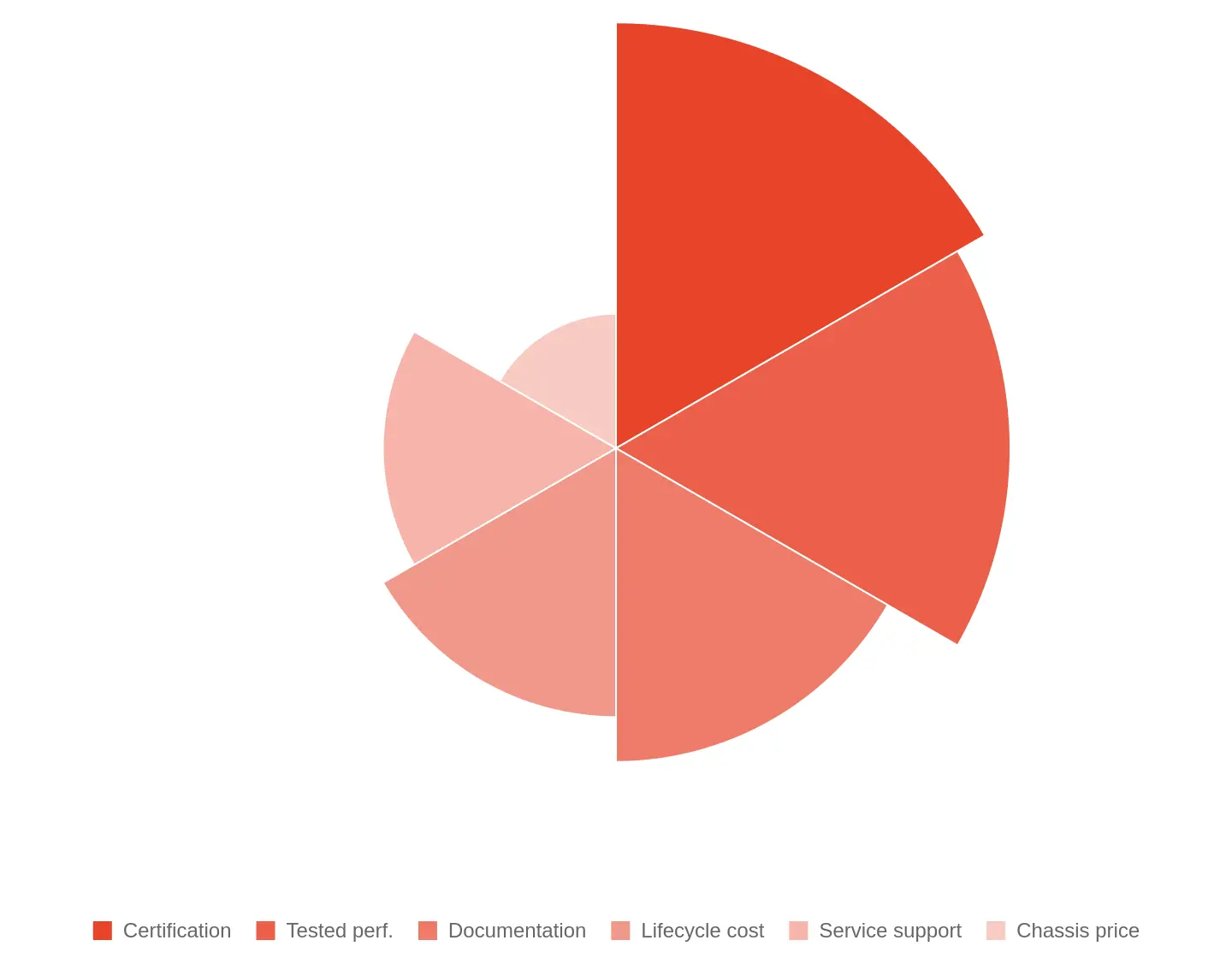
These values are illustrative weightings for comparison, not survey data.
In this weighting, certification evidence and tested performance carry the most; chassis price sits at the outer edge, useful mainly as a tiebreaker when comparing municipal fleet vehicles.
Frequently Asked Questions About NFPA 1901 for Business Owners
Is NFPA 1901 compliance a legal requirement or a market requirement?
NFPA 1901 is a consensus standard, not federal law. Its force comes from being written into state and municipal purchasing specifications and contracts, and since the 2024 consolidation the same requirements usually appear as NFPA 1900. Fire departments and their procurement offices treat certification as pass-or-fail for bid acceptance, which is what makes it a market requirement for anyone working through fire truck USA market entry. An apparatus without a certificate is excluded from most US tender lists, whatever its chassis price.
Does certification apply to the chassis or the completed apparatus?
To the completed apparatus. The standard evaluates the vehicle as an integrated system, covering pump performance, tank integrity, hose bed layout, warning devices, braking, weight distribution and occupant protection in the finished configuration. A certificate naming only a chassis model does not establish compliance for the truck you take delivery of, and municipal fleet buyers generally want documentation that references the final assembled unit.
How does certification affect delivery lead time?
Inspection and documentation review happen on the finished unit, after the body is mounted, and that step commonly adds several weeks to the build schedule. Lead times stretch further when engineering changes are approved late, because any revision to a certified configuration has to be re-verified against fire apparatus standards. Freezing the specification before production starts avoids most of this delay.
Can a lower-cost chassis still reach compliance?
Yes, if it meets the axle ratings, braking performance, electrical capacity and cab structural requirements the standard sets. Chassis price fixes the starting point of the build, not whether the finished apparatus can pass, and a large share of compliant trucks are built on commercial rather than custom chassis. The constraint is engineering capacity, since the builder has to verify component compatibility and document it for the certifying body.
Which documents should a buyer request from a supplier?
The certificate of compliance naming the specific apparatus by unit or serial number, the third-party inspection report, and an as-built specification sheet listing every component the standard references. Add pump test results, weight distribution calculations, and the manufacturer’s written statement covering any approved deviation. Generic or missing paperwork in any of those categories is a compliance gap that will surface at delivery.
A Practical Decision Framework for Fleet Buyers
Acceptance into a US fire apparatus fleet is earned with documentation. Price alone never buys it. Before committing budget, run the purchase through three checks in this order.
Start with certification evidence: the NFPA 1901 test reports, the third-party listing or verification, and the specific apparatus configuration those documents cover, not a generic brochure claim. Then compare total cost of ownership instead of chassis price, including pump and body durability, service intervals, parts availability, downtime, resale value, and the cost of retrofitting a non-compliant unit to meet departmental and insurance requirements. A lower sticker price that leads to rebuilds or a failed inspection is not a saving. Finally, test the supplier’s documentation capability before signing: traceable build records, component certifications, weight and axle load calculations, and a willingness to answer a reviewer in writing. Suppliers who treat paperwork as an afterthought rarely survive an acceptance inspection.
- Certification first: confirm NFPA 1901 evidence covering your exact configuration, not the platform in general.
- Ownership cost second: weigh lifecycle service, downtime and resale against the initial chassis number.
- Documentation third: test the supplier’s ability to deliver traceable records before the contract is signed.
With those three checked, buyers often look wider than fire apparatus. The municipal solid waste range and the dump truck range on crrcvehicles.com show how the same certification and documentation standards apply across a broader fleet lineup.