

Average Cost of a Fire Engine: Pumper Versus Tanker Budgets
A new fire engine in the U.S. typically costs $450,000 to $900,000. Custom apparatus with larger pumps, upgraded chassis, and more water capacity often reaches $1.2 million. Rural fleets usually buy one of two configurations: a pumper, which delivers pressurized firefighting capability from onboard water plus hydrant or draft supply, and a tanker (water tender), built to haul roughly 1,500 to 3,500 gallons to sites without hydrants. The two start from different specification baselines, so buyers evaluating municipal fleet options should compare quotes on a like-for-like basis.
The purchase price covers only part of the outlay. Over the 15 to 25 years a typical unit stays in service, depreciation, insurance, fuel, pump testing, hose and valve replacement, tank inspections, and chassis maintenance add to that figure. Modeling total cost of ownership shows the gap between pumper and tanker budgets before anyone signs a purchase agreement.
What Drives the Average Cost of a Fire Engine
Five items account for most of the difference between quotes. Brand matters less than where a specification lands on each item.
- Chassis: a commercial chassis keeps the base cost down; a custom cab and chassis with more seating, higher GVWR, and a severe-duty drivetrain can add six figures.
- Pump and plumbing: capacity is the biggest single lever in a pumper spec. Moving from 750 gpm to 1,500 gpm brings larger pumps, valves, piping, and a heavier driveline.
- Water tank: capacity affects both the tank you specify (poly or stainless) and the chassis needed to carry it, so a rural tanker’s 2,000-gallon tank reshapes the whole build.
- Body fabrication: compartment count, aluminum or stainless sheeting, and finish drive shop hours.
- Certification and testing: NFPA 1901 compliance, pump tests, and third-party inspection add a fixed line that cannot be negotiated away.
Score each item separately before negotiating a total. Buyers comparing municipal fleet vehicles can use the same breakdown to check whether two quotes cover the same work.
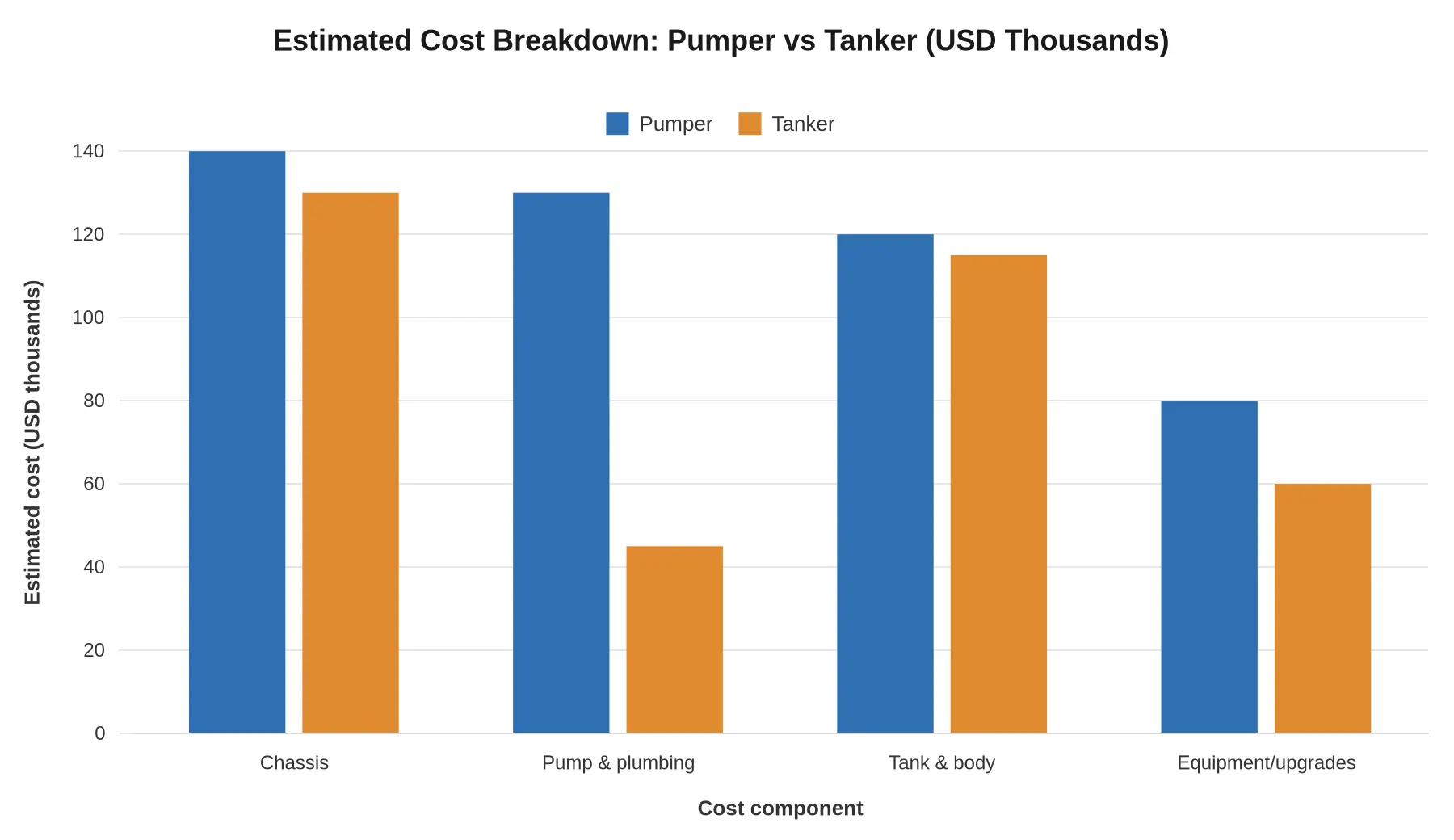
Estimated Cost Breakdown: Pumper vs Tanker (USD Thousands)
Indicative figures: a pumper puts roughly $130K into pump and plumbing where a tanker spends closer to $45K, while the tanker shifts that money into its tank and body package.
The chart shows where the budgets diverge. On a pumper, pump, plumbing, and water-delivery hardware form the second-largest line item, behind the chassis. On a tanker, that line shrinks and the tank plus body assembly absorbs the difference. That is why rural departments often find a tanker cheaper to spec at the entry level but less capable of sustained drafting from a static source. If the same stations also need support vehicles, the municipal vehicle lineup shows how chassis choices carry across a fleet.
Pumper Truck Cost by Tier: What Rural Budgets Actually Buy
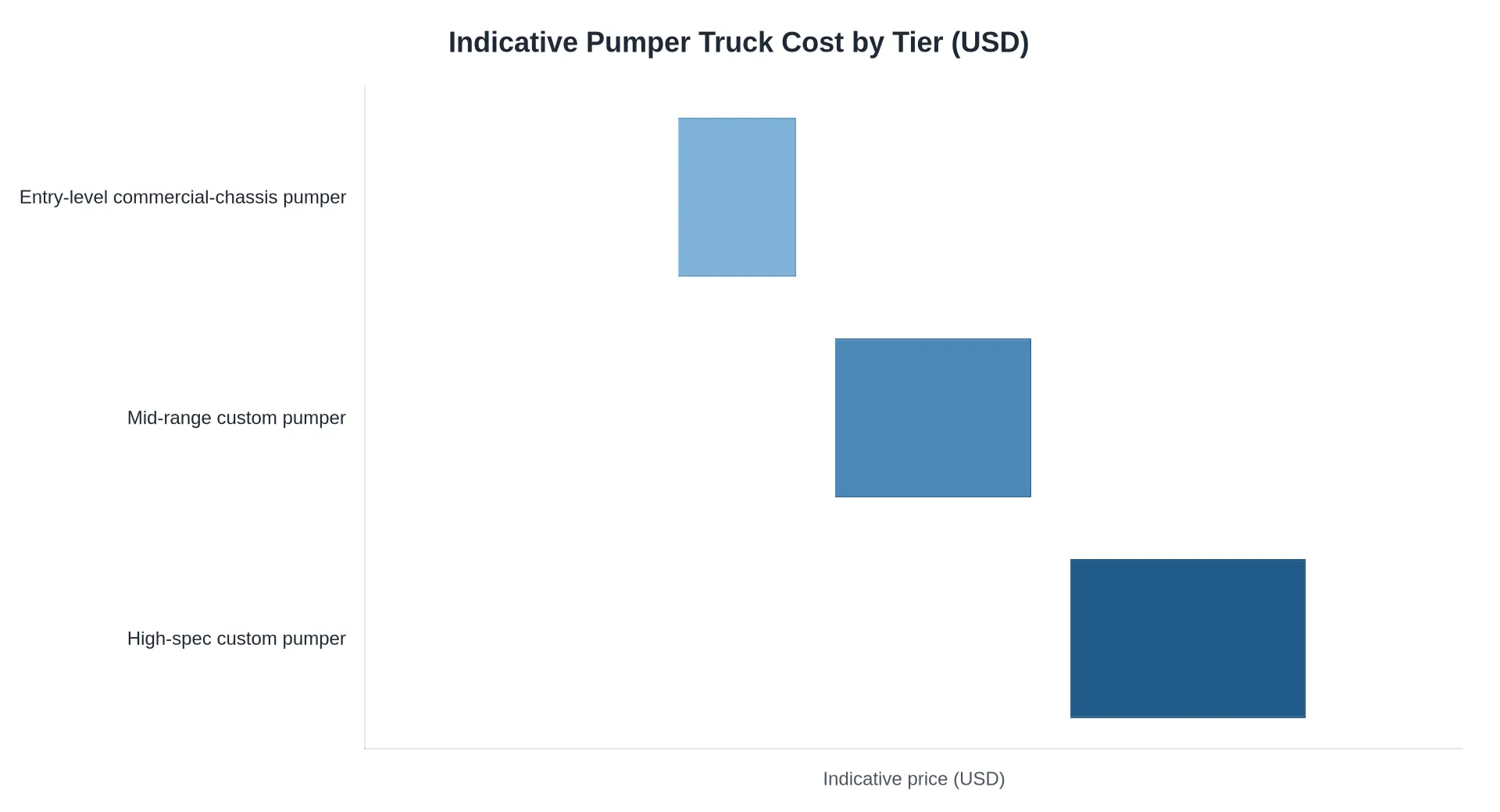
Pumper pricing splits into three tiers, each buying a different tool.
- Entry-level commercial-chassis pumpers, $400,000-$550,000. A 1,000-1,250 gpm fire pump, roughly 1,000 feet of 2.5-inch supply hose, and a stock commercial cab that seats four to six. Simple, quick to deliver, and serviceable by a nearby dealer.
- Mid-range custom pumpers, $600,000-$850,000. A purpose-built chassis, a 1,250-1,500 gpm fire pump, deeper hose beds with more crosslays, and a six-person cab with better ergonomics and scene visibility.
- High-spec units, $900,000-$1,200,000 and up. A 1,500-2,000 gpm fire pump with foam proportioning, 1,500+ feet of hose, side- or top-mount pump panels, and enclosed seating for six to eight.
| Tier | Indicative Price (USD) | Fire pump capacity | Hose load | Crew space |
|---|---|---|---|---|
| Entry-level commercial chassis | 400,000 – 550,000 | 1,000 – 1,250 gpm | ~1,000 ft of 2.5 in supply line | 4 – 6 seated |
| Mid-range custom | 600,000 – 850,000 | 1,250 – 1,500 gpm | 1,200 – 1,500 ft plus crosslays | 6 seated |
| High-spec custom | 900,000 – 1,200,000+ | 1,500 – 2,000 gpm with foam | 1,500+ ft across multiple beds | 6 – 8 enclosed |
Rural fleets gravitate to the smaller end for practical reasons: narrow lanes, weight-restricted bridges, low call volume, and volunteer staffing that struggles to fill a six-person cab. Many pair a compact pumper with a tanker for shuttle work instead of over-specifying one truck, and comparing municipal vehicle platforms before locking a chassis spec can keep the build proportionate. Because most rural purchases land in the entry tier, the fleet-weighted average cost of a fire engine in rural districts sits well below the national figure. That matters when you sanity-check quotes.
Budget for the tier that matches your water supply and crew, not a national average built on big-city specs.
Pumper vs Tanker: Budget Comparison for Rural Fleets
Most rural departments cannot buy every truck they want, so the purchase has to match the district’s water supply. The table compares pumper and tanker configurations on price, tank capacity, pump output, crew space, and annual operating cost. If you are still narrowing chassis options, the municipal vehicle lineup lists reference builds.
| Configuration | Typical purchase price range (USD) | Water tank capacity | Pump output | Crew capacity | Typical operating cost per year | Best-fit fleet role |
|---|---|---|---|---|---|---|
| Compact initial-attack pumper | 250,000 – 400,000 | 500 – 750 gal | 750 – 1,000 gpm | 4 – 6 | 30,000 – 45,000 | First-out structural attack in small districts with hydrants nearby |
| Mid-range pumper | 600,000 – 850,000 | 750 – 1,000 gal | 1,250 – 1,500 gpm | 6 | 45,000 – 65,000 | Primary attack engine supporting mutual aid and multi-company scenes |
| Small tanker | 180,000 – 350,000 | 1,500 – 2,000 gal | 250 – 500 gpm | 2 – 3 | 25,000 – 40,000 | Water shuttle support where hydrants are sparse or absent |
| Large tanker | 320,000 – 500,000 | 2,500 – 3,500 gal | 500 – 750 gpm | 2 – 3 | 40,000 – 60,000 | Bulk water supply and tanker shuttle task force anchor |
| Combined pumper-tanker | 400,000 – 650,000 | 1,800 – 2,500 gal | 1,000 – 1,250 gpm | 4 – 6 | 45,000 – 70,000 | Single-vehicle answer for thin-staffed departments covering large rural areas |
These are planning ranges drawn from typical spec levels, not firm prices. Actual figures move with chassis make, pump brand, tank material, dealer prep, and local grant or financing terms. A written quote is the only number worth committing to.
Tanker Truck Cost Breakdown: Where the Money Actually Goes
Tanker cost rises with water volume. Carrying 2,000-3,500 gallons forces a heavier-rated chassis, dual rear axles, and uprated brakes, springs, and tires, which is why a water tender with the same pump and cab as a pumper usually costs $80,000 to $150,000 more. Tank material is the next swing factor: polypropylene is the economical, corrosion-resistant choice, while stainless steel costs more but resists abrasion and corrosive water. Baffles add cost, but a properly baffled tank keeps the load from shifting, which protects the crew and limits surge that can overload tires and axles.
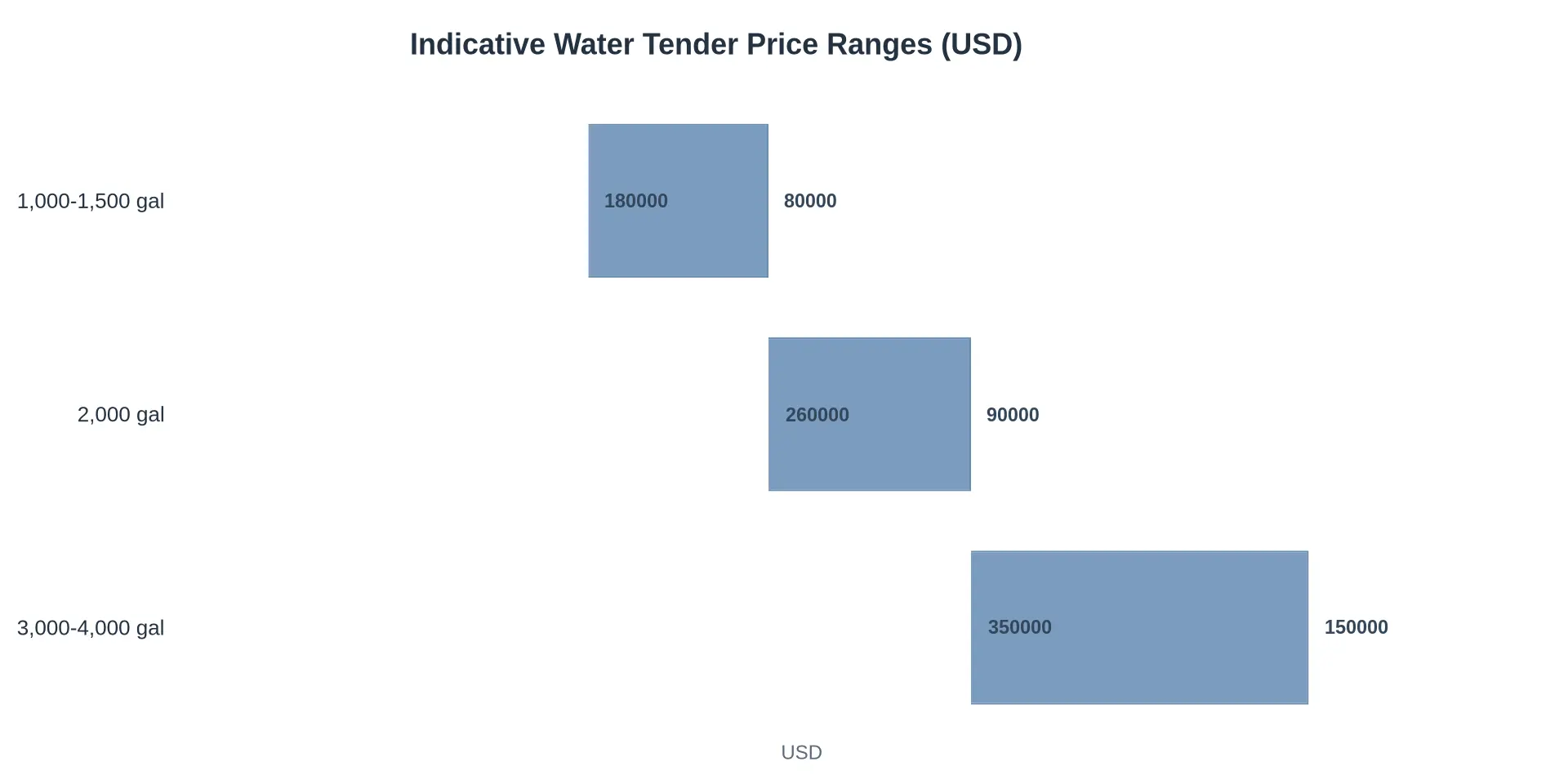
Indicative USD ranges: 1,000-1,500 gal at $180,000-$260,000; 2,000 gal at $260,000-$350,000; 3,000-4,000 gal at $350,000-$500,000.
Water volume is not pump output. A tanker carries a large reserve to the scene but will not flow high gallons per minute at pressure, so it cannot replace a pumper.
A tanker-heavy fleet makes financial sense where a district has few hydrants, long haul distances, and a pumper or two available to do the firefighting.
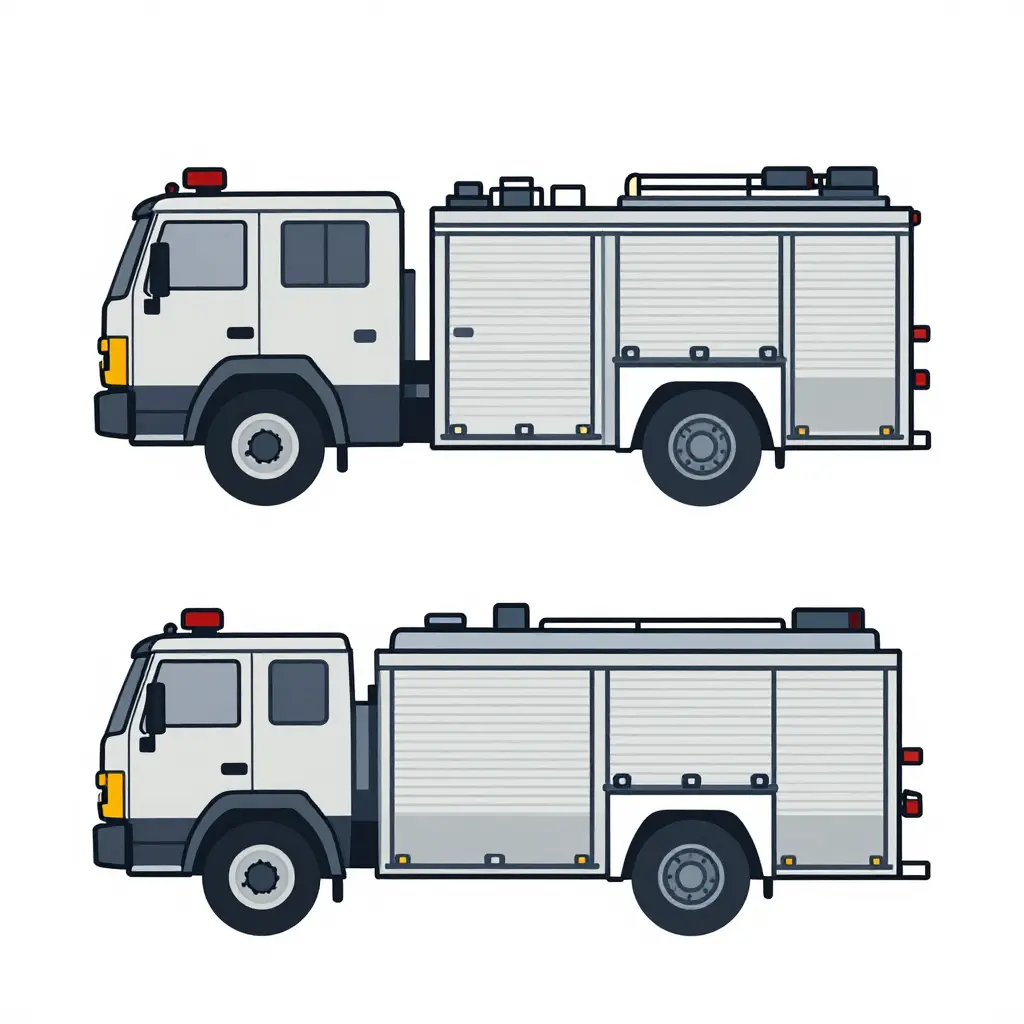
Caption: This simple block diagram shows layout differences only – where the cab, water tank, pump module, and hose/equipment storage sit on a pumper versus a tanker – and does not represent actual dimensions, capacity, or build cost.
Total Cost of Ownership: What the Sticker Price Hides
A fire engine’s total cost of ownership is more than its purchase price. Start with the net capital cost (purchase price minus resale value), then add preventive maintenance, annual pump testing and certification, tire and brake wear, fuel burned during long idle hours on scene, and insurance premiums.
Two trucks with the same sticker price can end up far apart over ten years. A pumper that idles four hours per shift burns more fuel than a tanker running shorter calls, and idle hours accumulate on the engine’s service clock even when the truck never moves. Add the higher fuel and service costs of a heavier pump package, and the gap widens each year.
Start fleet budget planning with duty-cycle data rather than price sheets. Tracking maintenance cost by unit across the municipal vehicle lineup turns estimates into forecastable line items.
Pump testing and certification surprise buyers most often: the cost recurs, it is mandatory, and it rarely appears in the quote at signing.
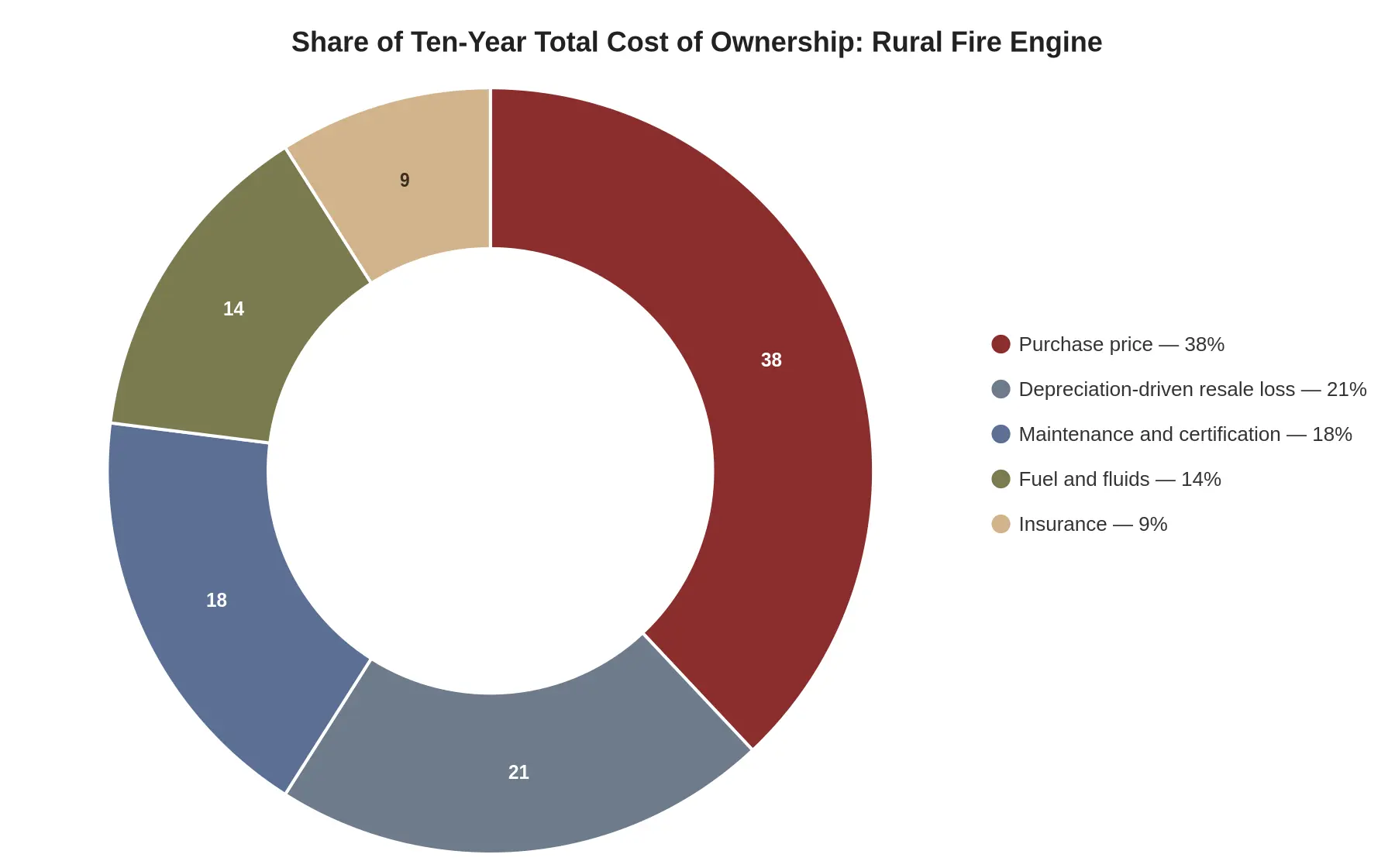
Estimated ten-year total cost of ownership for a rural fire engine: purchase price 38%, depreciation-driven resale loss 21%, maintenance and certification 18%, fuel and fluids 14%, insurance 9% (shares shift with call volume and vehicle age).
Cost-Control Checklist Before Approving a Fire Engine Budget
A pumper or tanker is one of the largest purchases a rural fleet makes. The checklist below covers the decisions that set the final cost.
- Define call types first, matching apparatus to the fires, rescues, and water shuttles the district actually runs.
- Compare rated pump capacity against realistic water availability, including hydrant flow, draft sites, and tanker support.
- Request itemized quotes that separate chassis, body, pump, tank, and equipment so nothing hides in a bundled figure.
- Benchmark at least three builders on identical specifications, and cross-check municipal chassis options before shortlisting.
- Model ten-year ownership costs: fuel, insurance, tires, maintenance, certification, and depreciation.
- Set aside contingency for hose, nozzles, radios, and PPE, which rarely appear in the base price.
- Confirm delivery timelines, warranty terms, and local service coverage before committing.
- Plan residual value and a resale or trade-in route for the next procurement cycle.
Procurement and Financing Options for Rural Apparatus Purchases
Few rural fleets can absorb a pumper or tanker in a single year’s budget. Most departments and private owners consider five funding routes:
- Outright purchase. Lowest total cost over the vehicle’s service life with no interest, but it draws down capital reserves and can push replacement cycles further out.
- Municipal lease-purchase. Payments spread across five to ten years, with the municipality taking ownership at the end of the term, which keeps fire protection inside annual budget ceilings.
- Equipment financing. Commercial lenders and manufacturer-backed programs typically require a down payment at fixed rates, with terms aligned to a pumper’s expected 15- to 25-year service life.
- Grants and subsidy programs. Federal rural fire assistance funds, state forestry grants, and community development allocations can cover part of a tanker purchase, especially where documented water supply gaps or ISO ratings make the case.
- Shared-fleet arrangements. Joint ownership between neighboring townships, or a county-held tanker dispatched across districts, lowers each participant’s capital exposure while preserving coverage.
Chassis platforms built for other municipal duties can cover adjacent fleet needs without a separate procurement cycle. A single platform family often spans solid waste bodies, liquid waste tankers, and road cleaning modules, which lets a fleet standardize parts and operator training. Cargo chassis and trailer configurations handle supply runs and equipment transport, and tow truck builds support recovery and roadside response. Reviewing the full municipal vehicle lineup early in the budget process can show where one platform serves several departments.
FAQ: Fire Engine Costs for Rural Fleets
What is the average cost of a fire engine for a rural fleet?
For rural fleets, a new commercial-cab pumper generally costs $400,000 to $550,000. Compact initial-attack pumpers can start near $250,000. Custom-chassis pumpers commonly cost more than $700,000, and the largest reach $1.2 million. Pump size, tank capacity, and options account for most of the spread.
Do tankers cost more than pumpers?
At the entry level, no. A 1,500-2,000 gallon tanker typically runs $180,000 to $350,000, against $400,000 to $550,000 for a new commercial-chassis pumper. That changes when the tanker carries the same pump and cab as a pumper: the tank, baffles, and heavier chassis can push its price above the pumper’s. Review municipal fleet vehicles to compare chassis configurations side by side.
Is a used apparatus a viable budget option?
A well-inspected used pumper often sells for $75,000 to $200,000, typically less than half the price of a comparable new unit. Budget for pump testing, brake work, and tank relining; deferred maintenance is common in retired apparatus.
How does tank capacity affect insurance and water supply planning?
Larger tanks and more tanker-shuttle capacity can earn credit in ISO’s water supply evaluation, which can affect commercial and residential premiums. Planners also size shuttles around tank capacity: larger tanks cut round trips to draft sites but require roads, bridges, and driver licensing that supports heavier loads.
How often must pump certification be repeated?
Annual pump performance testing is standard practice: a full certification test confirms rated flow at 150 psi, 70% of rated flow at 200 psi, and 50% at 250 psi. Insurers and ISO often expect documented yearly results.
Can a single combination vehicle replace two units?
In many districts, yes. A combination pumper-tanker with 1,000-1,250 gpm and 1,800-2,500 gallons fits many rural response plans and frees budget and bay space. It cannot cover simultaneous structure and shuttle calls the way two dedicated units can, so check call volume first.