


What Actually Decides Whether a Brush Truck Fits an Orchard
Buyers comparing a brush fire truck for sale usually start with the biggest number on the spec sheet: tank size. Tank size matters, but it rarely settles whether the vehicle can work an orchard or a narrow-row block. That comes down to row spacing, aisle width and turning envelope, which between them decide how close the truck can park and how much ground a crew covers on foot.
Four terms carry most of that argument:
| Term | Working definition |
|---|---|
| Brush fire truck | A compact, high-clearance firefighting vehicle built to carry water, a pump, and hose into unpaved, tight, or off-road terrain. |
| Orchard row spacing | The clear distance between adjacent tree rows, measured trunk to trunk or canopy edge to canopy edge. |
| Hose reach | The usable length of hose a crew can lay from the truck’s parked position to the fire edge. |
| Crew access | The space a crew needs to dismount, unload equipment, and work safely around the vehicle. |
Tank size sets how long you can fight a fire; row spacing and turning envelope set whether you can fight it there at all.
A truck with a generous tank and a body wider than the aisle delivers nothing except a long walk. Tight orchard row spacing pushes the vehicle further from the burn, and every extra metre turns into more hose to lay, more friction loss, and more minutes before water reaches the seat of the fire. Crew access fails the same way. Doors that swing into low canopy, or a deck with no room to stage a nozzle and a hand tool, slow a trained crew to a crawl. Most of these vehicles ride on configurable municipal vehicle platforms, so layout is something you settle on the order form rather than inherit.
Row Spacing Sets the Limits Before Tank Size Does
Orchard row spacing is the first number to check, long before the tank specification sheet. The inter-row corridor in a mature block, often 3 to 4 metres in a narrow-row orchard and wider in older citrus or almond plantings, is fixed. No pump upgrade negotiates it. Body width plus mirror clearance has to fit inside that corridor with margin to spare, because a mirror clipping a limb at speed damages the tree and rattles the driver for the rest of the pass. Measure your tightest row first, then treat the published body width plus roughly 0.4 metres of mirror overhang as the real footprint. Chassis width and mirror geometry are set at the factory on municipal and specialty platforms, so the fit decision gets made before the purchase order, not after it.
Headland width governs the second constraint, turning. A truck with a 7 to 9 metre curb-to-curb radius needs a comparable clear apron at each row end, and plenty of orchards were laid out for tractors that turn in far less. Short headlands leave the driver unable to reposition in one sweep, and safe travel speed on unpaved inter-row paths falls to walking pace, which costs minutes you do not have on a moving fire front.
The geometry then shows up on every fire. Distance from the nearest travel lane to the fuel load is fixed by row width and row length, not by how much water the truck carries. Stand a nozzle crew in a 4 metre row and it reaches roughly two metres into the canopy; in a 6 metre row that reach covers less of the fuel volume, and a single lane serves fewer rows per pass. Narrower rows also mean more parallel lanes, so a compact truck often covers the same block with shorter hose lays and faster repositioning than a wide, high-capacity unit that cannot enter at all.
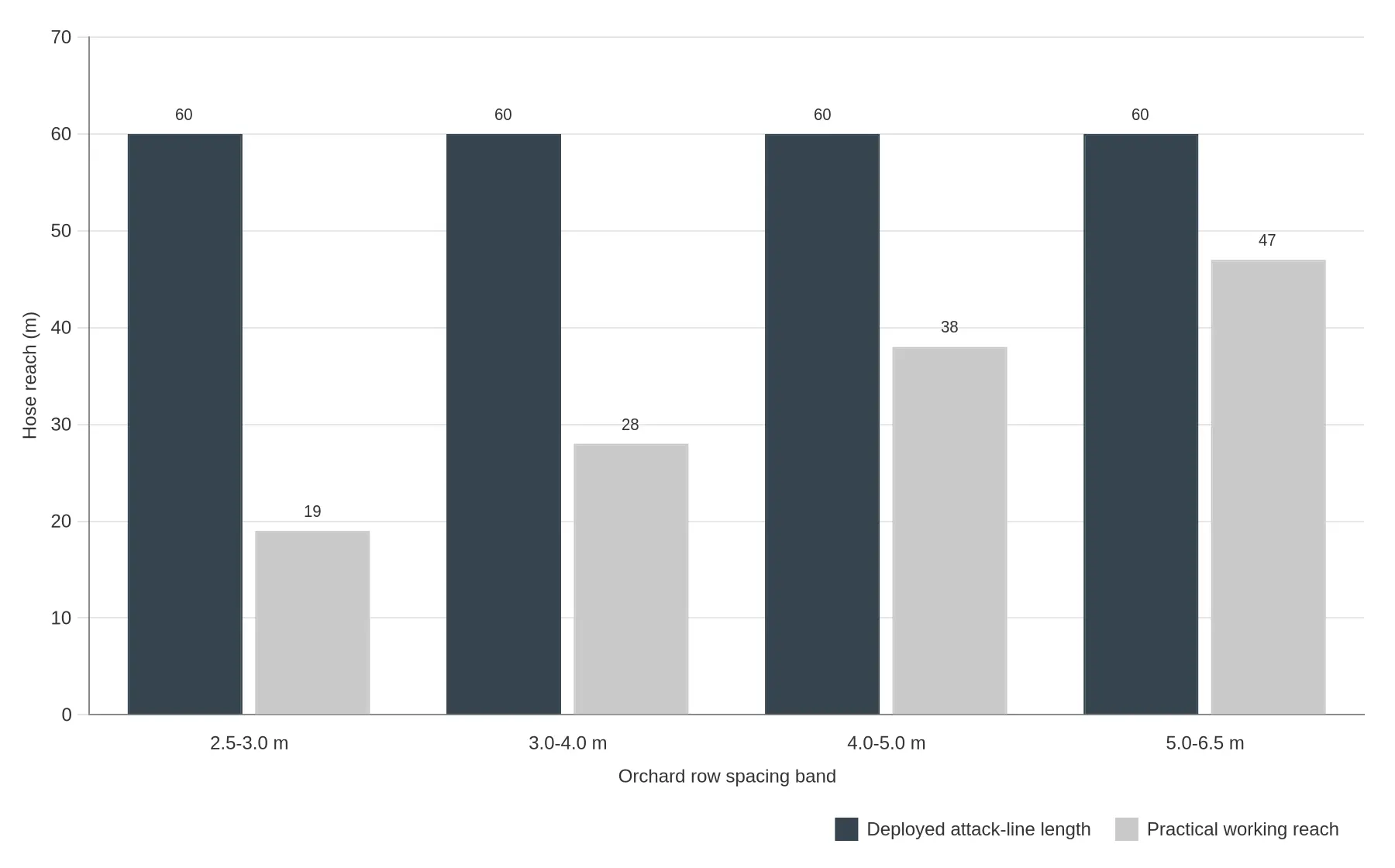
Figure: Deployed attack-line length stays flat across row spacing bands, while practical working reach falls sharply as rows tighten.
A reel carrying 60 m of attack line is not 60 m of usable suppression coverage. In narrow 2.5-3.0 m plantings, snaking around trunks, laterals and irrigation risers burns most of that length and leaves roughly 19 m of genuinely workable reach. Open the rows to 5.0-6.5 m and practical reach climbs to about 47 m, with far fewer couplings to drag around obstacles.
That gap is why sizing should start with row geometry rather than tank volume. Match the hose and pump to the lanes you actually drive and you get a truck that works on day one instead of one that needs re-speccing after the first season. If you are comparing chassis for mixed orchard and municipal duty, it is worth browsing municipal-grade truck builds before you commit to a layout.
Hose Reach Mechanics: Where the Water Actually Goes
Hose Reach Is a Pressure Budget
Hose reach is a pressure budget, not a volume of water. Water leaves the pump because discharge pressure is higher than the pressure the nozzle needs to form a usable stream. Everything between those two points spends pressure: friction inside the hose, couplings, elbows, kinks, and every foot of vertical rise. Reach ends at the length where the remaining pressure can no longer meet the nozzle’s operating requirement.
So the useful question is not how much water the truck carries. It is: how far can this pump push the flow this nozzle needs before the budget runs out?
What Eats the Pressure
Friction loss is the dominant drain, and it rises with the square of flow. The standard field form is FL = C × Q² × L, where Q is flow in hundreds of gpm, L is length in hundreds of feet, and C is a coefficient fixed by hose diameter. Double the flow and loss quadruples. That single relationship explains most of what buyers find confusing about fire pump flow rate ratings.
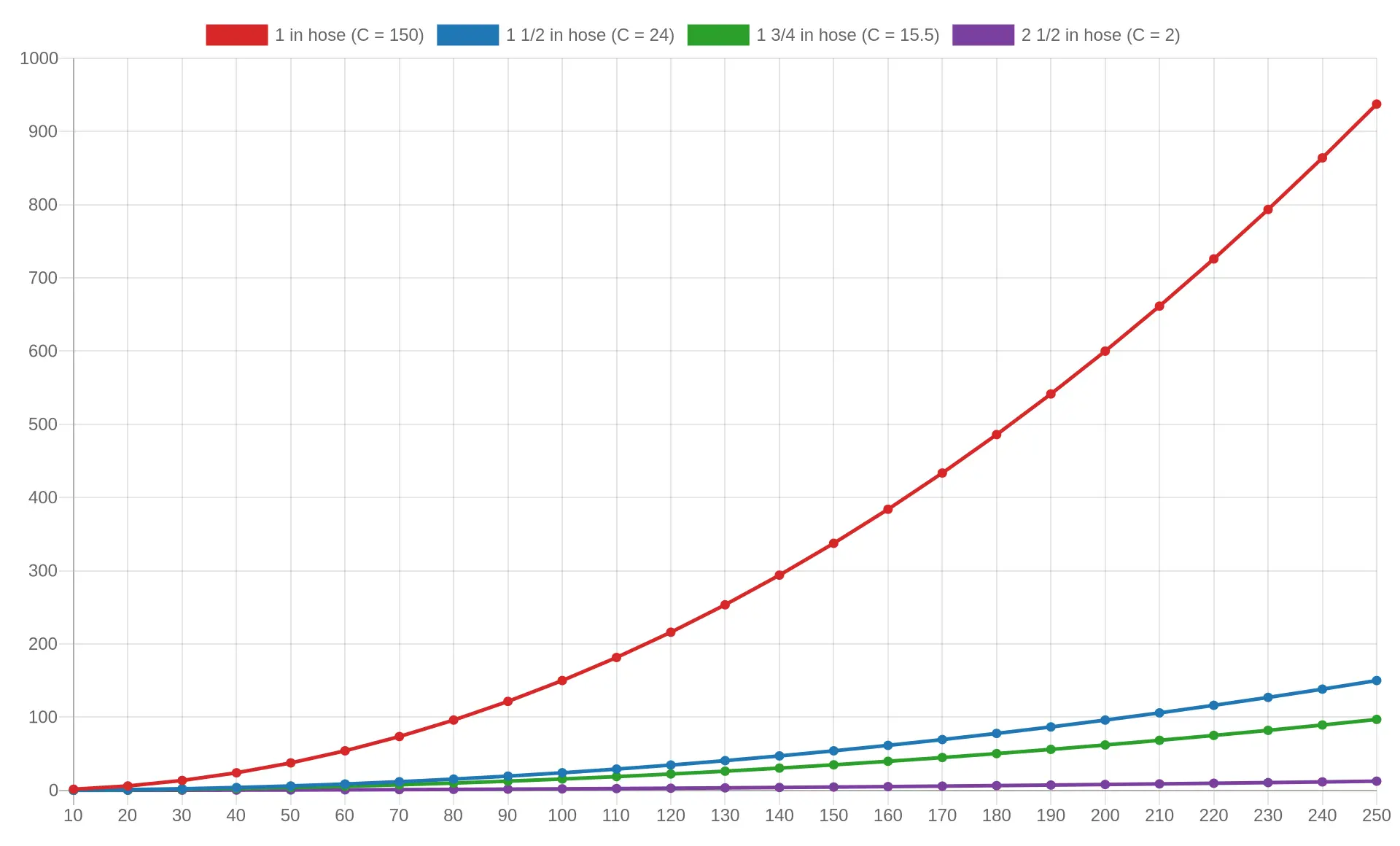
| Hose diameter | C factor | Loss at a typical attack flow |
|---|---|---|
| 1 in | 150 | 6 psi per 100 ft at 20 gpm |
| 1 1/2 in | 24 | 22 psi per 100 ft at 95 gpm |
| 1 3/4 in | 15.5 | 24 psi per 100 ft at 125 gpm |
| 2 1/2 in | 2 | 8 psi per 100 ft at 200 gpm |
Elevation is a fixed tax. Water costs about 0.43 psi per foot of rise, and most crews round to 0.5 and stay safe. A 30 ft climb through a terraced block therefore costs around 15 psi, the same as adding 250 ft of 1 in hose at 20 gpm. Reach shrinks on uphill ground even when the lay length does not change.
Nozzle flow sets the floor for pressure. A small forestry nozzle may be satisfied with 10 to 25 gpm at 100 psi, while a 1 1/2 in combination nozzle wants 95 to 125 gpm. You cannot cut flow to buy reach without losing knockdown, so the nozzle, not the tank, defines the demand.
Diameter is the tradeoff lever. Narrow hose holds pressure over long distances but chokes flow. Large hose moves volume cheaply but needs more water and heavier couplings. Most brush rigs resolve this with a high-pressure reel for long, low-flow lines plus a short 1 1/2 in or 1 3/4 in lead for attack.
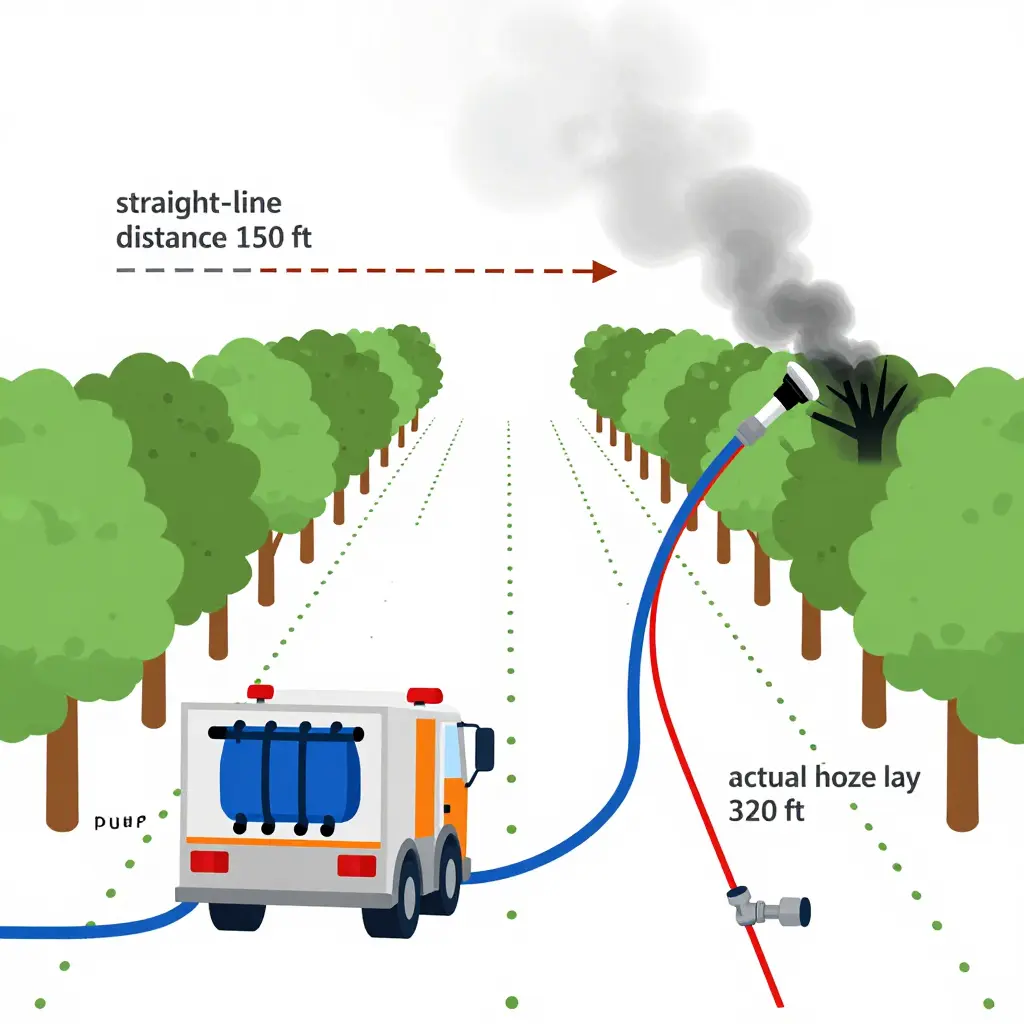
Routing around tree rows changes the arithmetic. If the truck can only travel the headland alley, hose leaves the pump, runs along the row ends, then turns 90 degrees into the planted block, and each turn adds equivalent length plus a kink risk at the coupling. A fire 150 ft away as the crow flies can easily need 300 to 350 ft of lay. That multiplier, driven by row spacing, is what actually decides whether the crew reaches the fire line.
What This Means When You Specify
A larger tank on a brush fire truck for sale does not extend hose reach by a single foot. Capacity buys operating time once the line is charged, and nothing in pressure. Push the tank size far enough and the spec drifts toward a heavier chassis, a lower-pressure transfer pump and a shorter hose load, all of which cost access in tight rows.
An undersized pump or narrow hose on a large-tank unit leaves crews standing in the alley with hundreds of gallons they cannot deliver where it matters. Ask for the pump curve rather than a headline gpm figure, and confirm the pressure available at the nozzle’s rated flow. Then measure your longest realistic lay, add the turns around row ends, add the elevation, and check the budget still clears the nozzle requirement.
Specify hose diameter and pump pressure first, tank size second. Set municipal-grade chassis and pumping packages side by side and the question stops being how much water the truck holds and becomes how hard it can push what it holds.
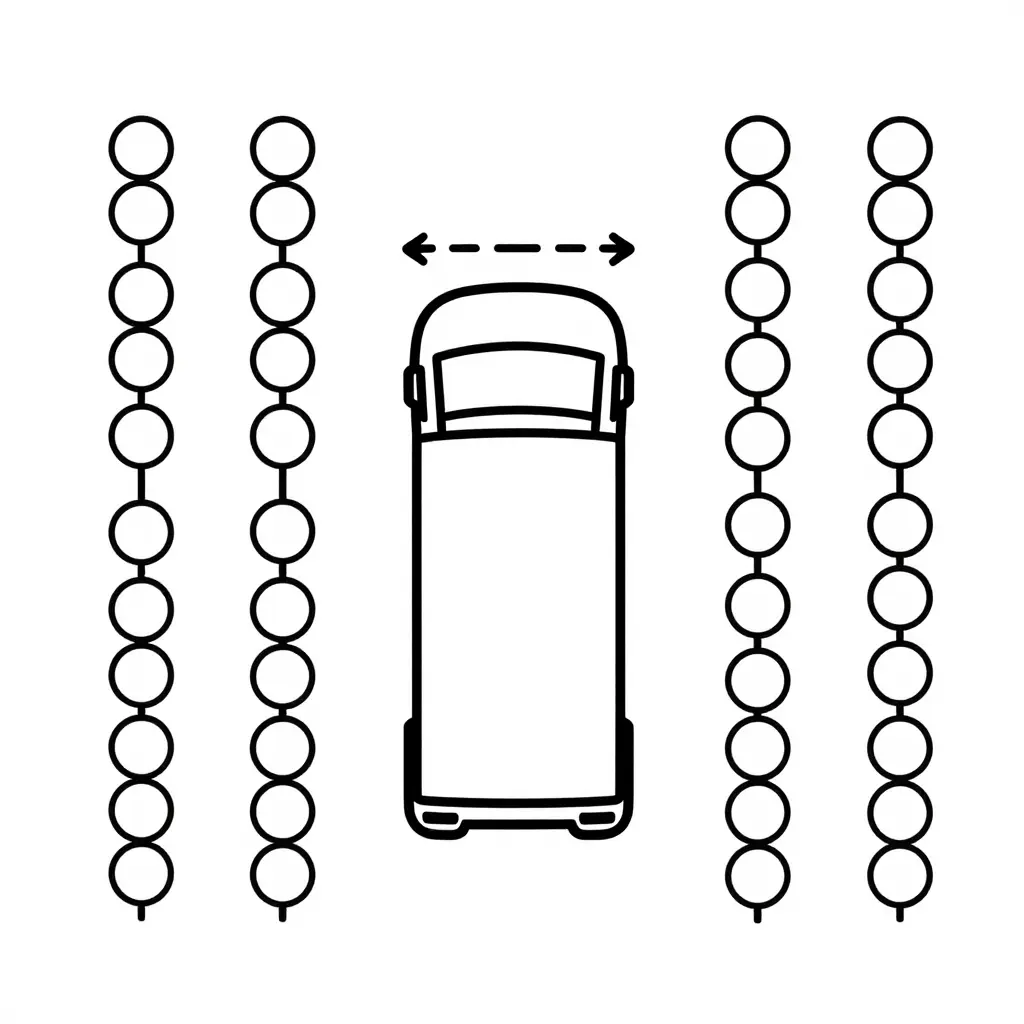
Schematic: the clear operating corridor is set by mirror-to-mirror width and the headland turning envelope, not by tank capacity.
Truck configurations compared against row-spacing fit
The table below scores fit and reach against row geometry rather than tank size, so you can judge a brush fire truck for sale on the numbers that decide whether it drives a row cleanly and how far its crew can work from the pump. Layouts are listed by chassis and body configuration, not by brand.
| Configuration (layout) | Vehicle width (body) | Mirror-to-mirror width | Turning radius (curb-to-curb) | Hose capacity | Practical reach, open rows | Pump flow rate | Tank size | Row spacing band suited |
|---|---|---|---|---|---|---|---|---|
| Compact 4×2 single-cab orchard unit | 1.95 m | 2.30 m | 6.4 m | 2 x 30 m of 25 mm | 45-50 m | 400 L/min at 10 bar | 500-700 L | 2.5-3.0 m |
| Short-wheelbase 4×4 single cab | 2.10 m | 2.45 m | 6.9 m | 2 x 45 m of 25 mm | 70 m | 600 L/min at 10 bar | 800-1,200 L | 3.0-3.5 m |
| 4×4 crew cab with rear hose tray | 2.25 m | 2.60 m | 7.6 m | 4 x 30 m of 25 mm | 90-100 m | 800 L/min at 10 bar | 1,200-1,800 L | 3.5-4.0 m |
| Wide-track 6×4 tender with front monitor | 2.45 m | 2.85 m | 8.8 m | 6 x 30 m of 38 mm | 140 m | 1,000 L/min at 10 bar | 2,000-3,000 L | 4.0 m and above |
Read that reach column as the best case, with the rows opened up. In the tightest band a 60 m reel can shrink to about 19 m of usable line once the lay has to turn around row ends and obstacles.
In practice, mirror-to-mirror width is the parameter that disqualifies a unit most often, because mirrors usually add 35-40 cm across the width and are the first thing to strike trellis posts, irrigation risers and low limbs. They hit long before body width or turning radius becomes the limiting factor.
Crew Access, Egress, and Safe Positioning
A brush fire truck is judged in the first thirty seconds after it stops. Not on litres carried, but on whether three people in PPE can get out, get water and get moving again without tripping over a berm, ducking a branch, or walking around the rig to find the pump panel. Crew access is an operational requirement, and it is settled long before the fire by the geometry of the ground you park on.
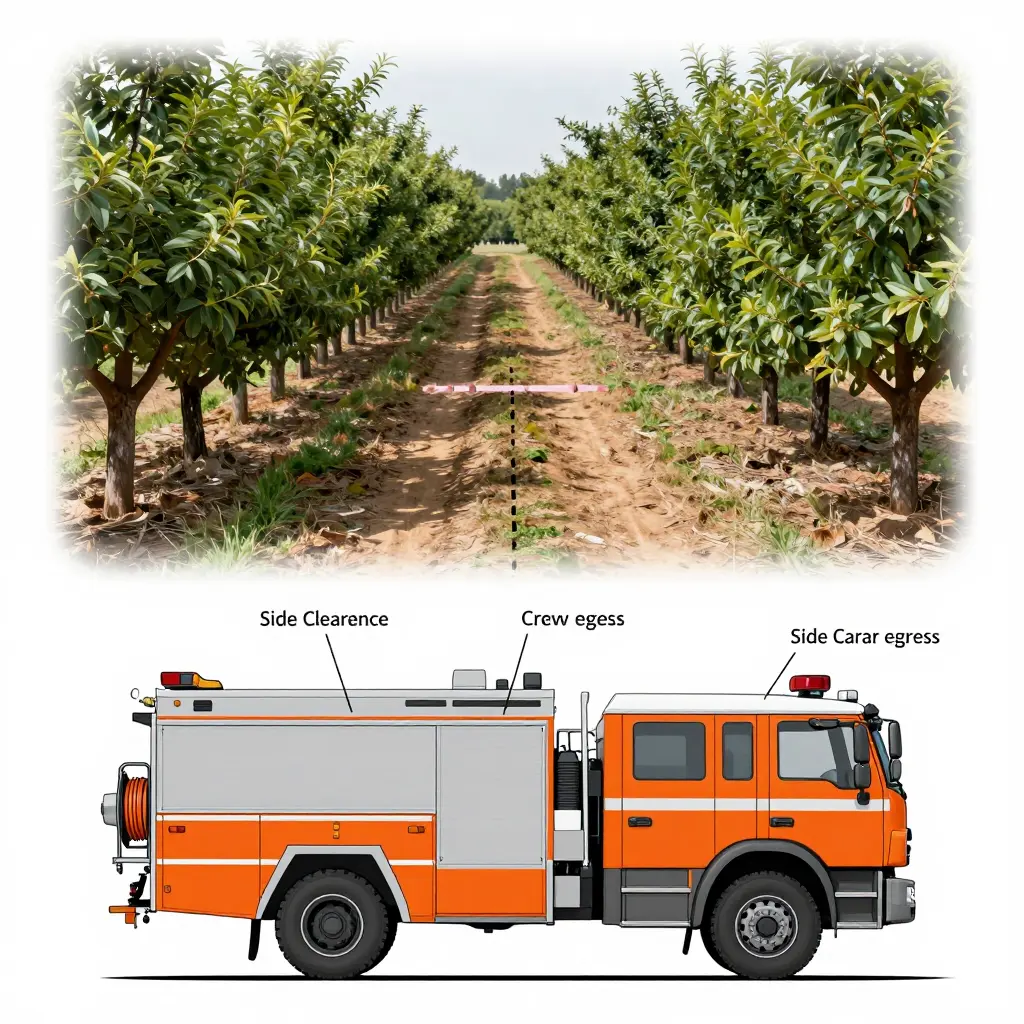
Mounting and dismounting at the fire line
Crews mount and dismount in a hurry, with gloves on, on soft dirt, on slopes, and often beside an irrigation riser or a mown windrow. That sets a few non-negotiables:
- Door swing clearance. A door needs a clear arc on the ground plus headroom. Parked tight against a trunk or a trellis post, it opens half way and the crew exits sideways into a branch.
- Step height and grab handles. A high first step slows a tired crew and turns a quick exit into a controlled fall. Two well-placed steps and a full-height grab handle matter more than interior trim.
- Firm, level footing. A berm or ditch on the working side turns egress into a hazard, especially with a charged line already lying across the ground.
Access to hose reels and pump controls without crossing the vehicle
Layout earns or loses seconds here. Put the hose reel on the working side and the pump controls on the opposite side and every pressure adjustment becomes a lap around the truck. In smoke, in heat, in a row where you cannot see the far side, that lap is a real risk. The right layout keeps the reel, the pump panel and the discharge controls on the same side, reachable from ground level, so one operator can charge, adjust and shut down without losing sight of the nozzle. Walk the vehicle and trace that path with your hand before you trust a listing, because it tells you more than the spec sheet. Buyers reviewing body and chassis options can use these municipal vehicle platforms as a reference for how a working side gets laid out.
Repositioning and reversing out of a row under load
A loaded tank raises the centre of gravity and lengthens stopping distances. In a blind row with canopy overhead, reversing means mirrors, a rear camera, and a spotter protocol agreed before the wheels turn. Turning radius matters for the same reason: a truck that cannot swing out of a row without a three-point shuffle blocks the access it came in by.
Vegetation clearance: mirrors, lights, and exposed fittings
Branches do not negotiate. Low limbs shear off light bars, fold mirrors back into the cab, tear at exposed fittings and snag hose trays. On orchard row spacing of three to four metres, a 2.2 m wide chassis can leave well under a metre of side clearance per side, sometimes less than a door needs.
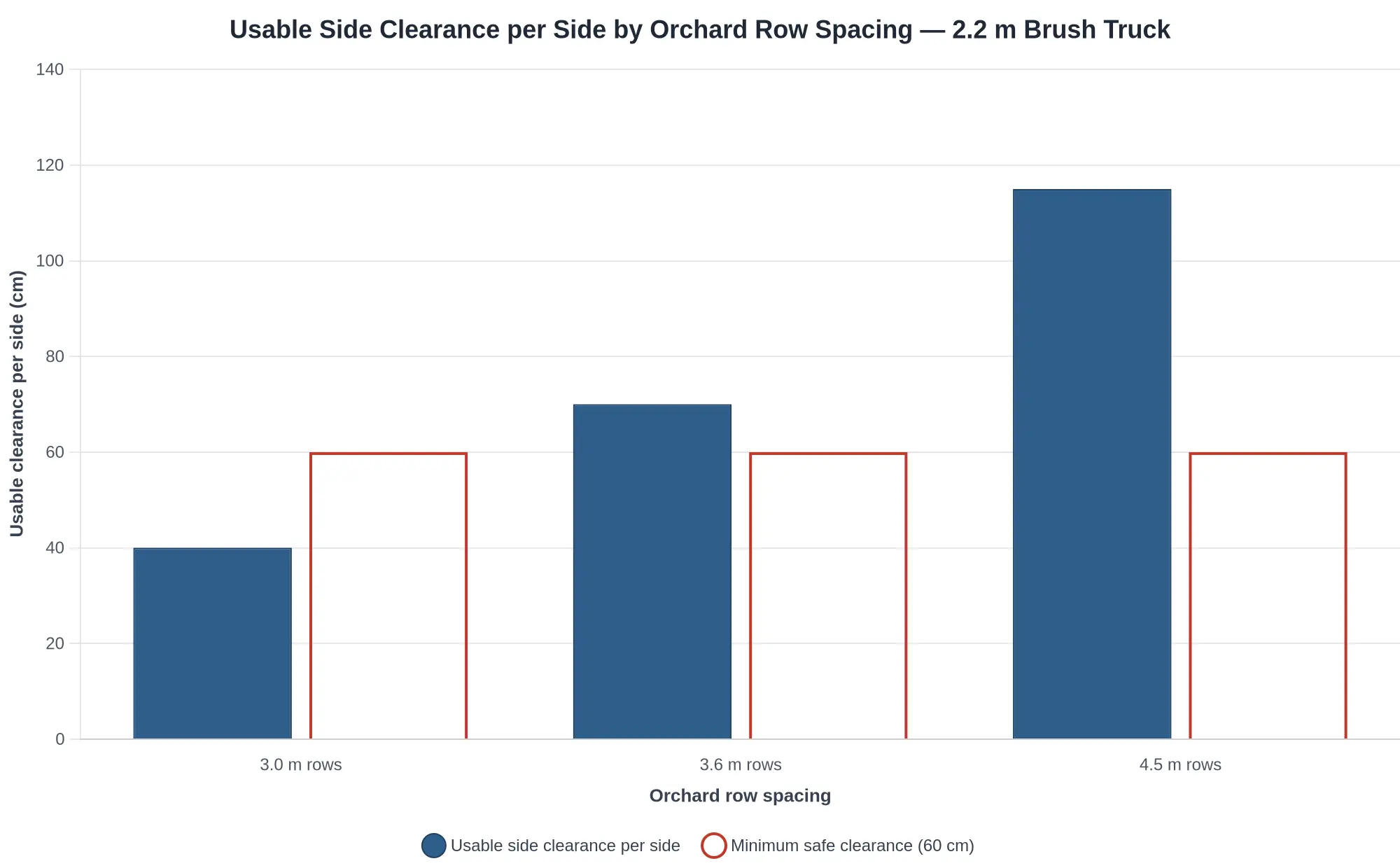
How narrow rows force compromises in crew deployment
Tight rows push you into choices: single-side deployment instead of a two-sided attack, a smaller diameter hose reel, remote-mounted controls, a shorter wheelbase. Each one is manageable if you plan for it and expensive if you discover it at the fire line. During wildland fire response the usable width of the row, not the tank, sets how many crew can work safely and how fast the truck can be repositioned.
| Access question to ask | Why it decides usability |
|---|---|
| Does the door open fully on the working side? | Egress with PPE and a charged line |
| Are reel, panel and discharges on one side? | No laps around the vehicle under load |
| Does the truck reverse out cleanly? | Exit route if the fire turns |
| Is the clearance envelope clear of limbs? | Mirrors, lights and fittings survive |
| Can a second crew member work at the rear? | Two-sided deployment in wide rows only |
Crew access succeeds or fails on row geometry: door swing, working-side layout, clearance. Tank volume does not enter into it.
Seven Site Measurements to Take Before You Commit
Before you sign anything, walk the property with a tape measure, a clipboard and an honest sense of your worst-case terrain. The numbers you record will eliminate half the wrong trucks for you.
- Measure your tightest orchard row spacing at chest height. Run a tape between trunks on your narrowest row and write down the minimum figure. A chassis wider than that gap turns every pass into a pruning job and pushes you toward a narrower-track, lower-profile unit instead of a full-size commercial chassis.
- Record headland depth at every row end. Measure from the last tree to the fence or ditch line. If the turning arc does not fit inside that number, you need a shorter wheelbase or a tighter radius than a standard brush fire truck for sale normally offers.
- Check gate and culvert clearances in three dimensions. Measure the narrowest gate opening, the lowest limb or bridge, and the culvert width, then compare against body width plus mirror allowance. A truck that cannot reach the back block protects nothing.
- Test surface load capacity and slope on your worst track. Use a penetrometer or a loaded-vehicle pass and a clinometer on your steepest grade; soft sand or a 20 percent slope can rule out a heavy tanker and point you toward a lighter skid or high-flotation unit.
- Map every water source and the refill distance between them. Note GPS points, hydrant flow, dam capacity, and the drive time from the farthest row to the nearest refill. Long refill runs change the math on tank size far more than badge horsepower does.
- Walk and measure your hose lay routes around obstructions. Time a 100-meter lay around post-and-wire fences, sheds and headlands, then compare that path against the rated reach of the reel you are considering. An obstruction that adds 30 meters of route can leave your nozzle dry at the fire’s edge.
- Survey crew access and egress points on foot. Confirm door swing, step height and a safe dismount zone at each likely stop. A truck that forces crews to exit into live traffic or dense canopy slows every response and creates its own safety incident.
Bring those seven numbers to the dealership and you will be choosing between trucks that fit your orchard rather than retrofitting one that never will. A reasonable place to start the shortlist is municipal fire apparatus built for tight-access work.
Tank Size Is a Logistics Question, Not a Reach Question
On a brush fire truck for sale, tank capacity buys minutes. It does not buy hose reach, and it does not buy a millimetre of clearance between trees. Reach and crew access are geometry problems, settled by orchard row spacing, hose bundles and how far a nozzle crew will drag line. Duration is a logistics problem, settled by one ratio: tank volume divided by the length of a single refill cycle.
Which turns the question from how big the tank is into how many gallons per hour this truck can actually put on a fire, given where your water sits.
Two trucks, same rows, very different cycles
Take two buyers working identical 10-foot rows. The first fits a 300-gallon skid unit and fills it in two minutes from a high-flow hydrant, so a full cycle including hookup and the run back to the row takes about eight minutes. That is 2,250 gallons an hour. The second buys an 800-gallon tanker that has to draft from a silty pond at low flow: 30 minutes to pull a load plus turnaround puts the cycle near 38 minutes and delivery near 1,250 gallons an hour. Instinct says the big tank wins. Over the first hour it loses badly, and the small truck cycles three or four times while the big one is still wrestling its suction hose.
Now move the water. Stretch the one-way distance to the fill point and the curves cross, in the illustrative model below somewhere near the two-mile mark. Beyond that the truck that carries more and fills slowly starts to win, and the penalty for a small tank becomes the drive itself.
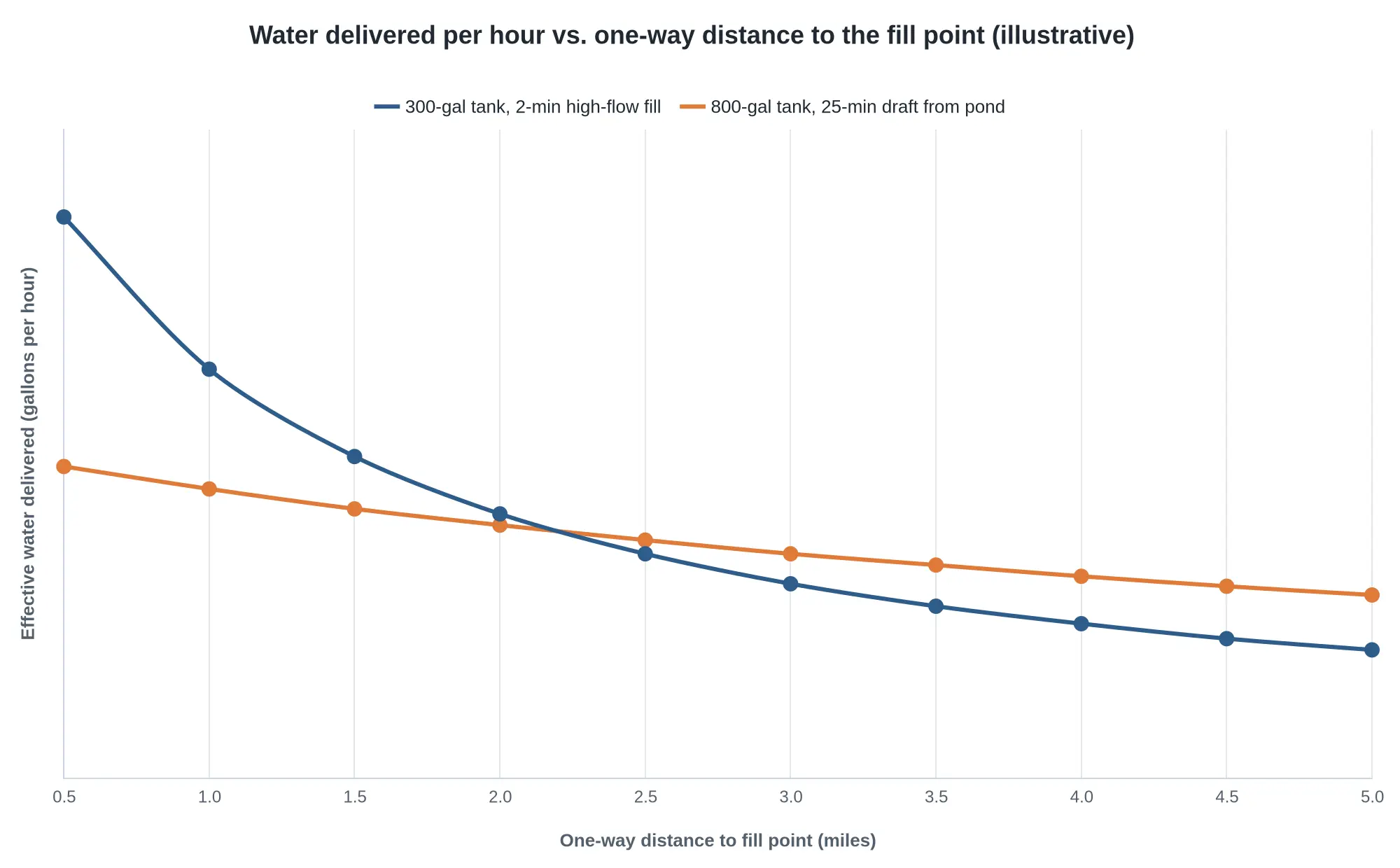
Fill rate, shuttle time and distance decide which truck performs, not tank volume. Run your own numbers against the four variables that matter:
| Factor | What to measure | Why it decides the tank size |
|---|---|---|
| Distance to water | One-way miles to hydrant, pond, or canal | Long hauls reward tank volume; short hauls reward speed |
| Fill rate | Gallons per minute at the source, timed with your own pump | A slow source makes extra tank capacity nearly irrelevant |
| Shuttle time | Round trip plus hookup and turnaround, in minutes | Cycle time, not tank size, sets your gallons per hour |
| Support vehicle | Tender or nurse tank available or not | A tender can substitute for capacity you don’t have to carry |
When a bigger tank earns its width, weight, and cost
A larger tank justifies its penalties when the refill cycle is genuinely slow and long: a two-to-three-mile haul to water, no dependable hydrant, low-yield draft points, or a single-truck operation with no tender in rotation. It also pays on wind-driven grass fires where sustained flow has to protect an exposure for twenty minutes rather than five. Price the penalties honestly, because they are real. Wider track, higher centre of gravity, derated payload, softer orchard floors after irrigation, more rutting on turns, higher axle and tyre costs, and a chassis that may not fit a narrow headland at all.
When a smaller tank with faster refill wins
In tight orchard row spacing, say eight to twelve feet with low limbs and short headlands, a compact body carrying 250 to 400 gallons that fills fast is usually the better machine. It turns inside the row, backs out without clipping trunks, keeps weight off saturated soil, and gets back to the fire before a bigger truck has finished its first draft. Pair it with a tender, or with a nurse tank parked at the row end, and the capacity gap drops out of the arithmetic. If your plan depends on that shuttle, browsing liquid waste and water-handling vehicle categories is a useful way to see how tender and tank bodies are configured before you commit to an attack truck.
The buyer’s conclusion
Tank size is a duration specification, and duration only matters against water refill logistics. Measure your narrowest row and headland turn, then time one real refill with your own pump at your own source and multiply out gallons per hour. If that number holds up at 300 gallons, spend the budget on a shorter wheelbase and a faster fill instead of sheet-metal capacity you will drive around all afternoon. If it collapses beyond two miles, buy the volume, and budget for the width and weight that come with it.
Where the Water and the Clock Go
Buyers walk into a spec meeting convinced that reach and crew access are the hard constraints. On a working orchard block they are not. The bottleneck is how long the truck can keep nozzle pressure alive before somebody has to go find water. The doughnut below splits a typical suppression cycle into four segments, as a share of total cycle time and water moved.
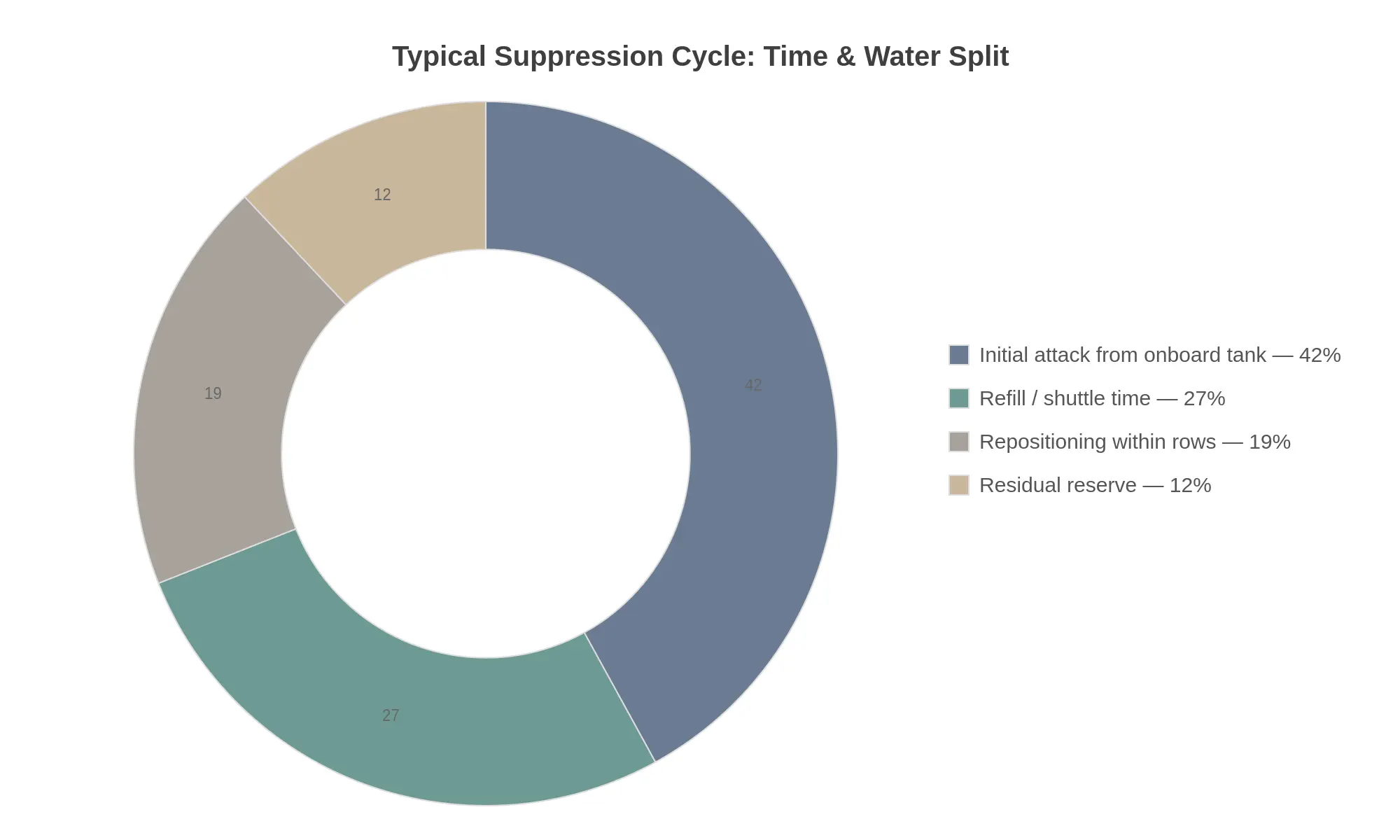
What the four segments tell you
The biggest slice is the work you bought the truck to do: initial attack straight off the onboard tank. Everything after it is overhead. Refill and shuttle time is logistics. Repositioning between rows is geometry. Residual reserve is the discipline of never running the pump dry, which matters more than most operators expect, because a dry pump and an empty line cost minutes rather than seconds.
| Segment | What drives its share | What barely moves it |
|---|---|---|
| Initial attack from onboard tank | Tank size, pump output, nozzle discipline | Hose length |
| Refill / shuttle time | Tank size relative to distance to a hydrant, pond, or draft point | Row width |
| Repositioning within rows | Turning radius, wheelbase, row spacing | Tank capacity |
| Residual reserve | Operator policy and tank size headroom | Hose reach |
The slice you actually paid for
Notice what the table leaves out. Hose reach and crew access appear as geometry problems, never as anything that shortens the attack. A longer hose does not put one extra litre on the fire. A bigger tank does, and it also cuts the number of times per shift a crew disengages to refill. Anyone who has watched a two-hundred-gallon unit cycle four times on a block while a six-hundred-gallon unit cycled once already knows which number shows up on the invoice at the end of the day.
Which is why the cycle is worth breaking down instead of quoting litres in isolation. The right capacity for your property depends on water access, block length, and how long each row takes to walk. Ground with a reliable draft point can run leaner. Ground at the end of a long dirt track cannot, and no amount of clever hose routing fixes that. When you compare municipal-grade chassis and body configurations, ask for the refill interval, not just the tank size.
A note on the numbers: the percentages above are illustrative for a mid-sized orchard operation. They move substantially with site, fuel load, water source distance and row layout. Recalculate the split for your own property before you use it to size a purchase, and treat the doughnut as a framework for the conversation rather than a fixed benchmark.
Procurement and Due Diligence: How to Evaluate a Brush Fire Truck for Sale
Most buyers open a listing, see the tank size and start comparing litres. That is backwards. On orchard blocks, narrow lanes and tight service roads, the row spacing band you actually operate in decides everything downstream: how much hose reach you genuinely get, how fast the crew can dismount and reach the fire, and which chassis can get past the gate at all.
Step 1: Fix the mandatory row spacing band first
Before you talk to a seller, write down the tightest row and the widest row across the properties you protect. The gap between them is your mandatory band, and everything you inspect afterwards is tested against it rather than against the brochure.
Step 2: Screen out units that fail the width and turning tests
A truck that cannot clear the tightest row with mirrors folded and margin for wheel ruts is out. No tank size justifies a vehicle that idles at the headland while the crew walks in. Test turning radius wall-to-wall, loaded, on the widest row you expect to work, and confirm track width leaves room for ruts and irrigation risers. If the operator has to reverse out of every third row, the unit has failed, whatever the spec sheet says. Buy from a supplier whose wider municipal vehicle range is built for repetitive, narrow-access work rather than highway duty.
Step 3: Compare hose reach, pump flow, and crew access
Only shortlisted units deserve this comparison. Measure hose reach in practice, meaning hose length minus what obstacles eat, and check whether the reel or bed layout lets one person deploy it alone. Match pump flow to your realistic attack line rather than the maximum rating. Then judge crew access: how many steps, how wide the doors, whether a firefighter in gear can reach the deck and the pump controls without squeezing past a tank.
Step 4: Compare tank size and fire truck total cost of ownership
Tank size is now a trade-off rather than a headline. Size it to the duration of your typical first attack, then run the fire truck total cost of ownership: fuel per operating hour, tyre and brake wear, insurance, training, and the downtime cost of a chassis with thin local support.
| Stage | Question to answer | Document to request |
|---|---|---|
| Row band | Which rows must the truck clear? | Site survey, gate and row dimensions |
| Width and turning | Can it clear the tightest row loaded? | Turning radius, track width, weight |
| Reach and flow | Does the attack line suit the layout? | Pump curve, hose layout, reel spec |
| Crew access | Can a geared crew exit fast? | Cab and deck photos or a walkaround |
| Cost of ownership | What does five years of service cost? | Service history, parts lead times |
Serviceability: maintenance access, parts, and chassis choice
Before signing, open the engine cover, reach the grease points, and check whether filters, batteries and pump drains are serviceable without removing bodywork. Ask for parts lead times on the items that actually fail: seals, hoses, lamps, brake components. Chassis choice matters here too, since a common, locally supported platform is easier to service than an orphan; reviewing dump truck chassis options helps you spot which frames and drivelines local workshops already know. A supplier with coverage across road-cleaning platforms and tow and recovery units usually carries the parts channels and workshop know-how that keep a seasonal fire unit working when the season starts.
Frequently Asked Questions
Does a bigger tank improve hose reach?
No. Tank size changes how long you can flow water before refilling. It does not change how far a line can be laid, so it cannot solve a reach problem, and the extra weight raises the centre of gravity and can make the truck harder to place close to the work. Treat tank capacity and hose reach as two separate specifications and test each against the property.
What minimum row spacing does a brush fire truck need?
Roughly 10 to 12 feet, or 3 to 3.7 metres, of clear width between trunks, measured at the tightest point on the property rather than at the entrance. That figure has to account for low limbs below about six feet and for irrigation risers and trellis posts. Leaving two feet of clearance per side gives the driver room to steer and turn without clipping wood, and in most orchards that matters more than overall truck length.
How is crew access assessed before purchase?
Walk the property and note where crews would actually dismount, how far they must carry hose and tools from that point, and whether doors open fully on both sides. Footing, slope and the ability to exit away from traffic or flame all belong in that assessment. Check it at night or in poor light too, since visibility changes which exit points are usable.
How should hose reach be calculated for a given property?
Start from where the truck can safely park, then measure along the actual path rather than in a straight line. Add roughly 10 to 15 percent for elevation change and fittings, and keep in mind that long 1.5-inch lines lose pressure well before they run out of hose. A workable rule of thumb is 150 to 200 feet of effective line per attack point, so a property needing three points may want more hose than one long lay suggests.
Can a standard municipal or cargo chassis be adapted for brush fire duty?
Often yes, provided the gross vehicle weight rating, frame length, PTO provisions and rear suspension can carry the pump, water and hose load. Commercial chassis adaptations are common because parts and service are widely available, and the resulting vehicle is simpler to maintain than a purpose-built cab. Where a deck or trailer-mounted unit suits the terrain better than a fixed body, cargo and trailer options are worth a look, and confirm axle ratings before committing to a tank size.
Conclusion: Matching Vehicle Specification to Orchard Geometry
Three specifications decide whether a brush truck works an orchard, and they stack in order. Row spacing sets the reachable zone and the access conditions a crew can realistically work in. Hose and pump configuration set how far suppression effort extends once the vehicle is parked. Tank size sets how long that effort continues before a refill interrupts it. Evaluate them out of sequence and you get a specification that reads well and underperforms in a working block.
A short decision sequence keeps it honest: measure the rows, screen candidates for fit, verify reach against the measured geometry, confirm crew access at row ends and turnarounds, then compare tanks and cost. Run that sequence before you open a pricing conversation. Orchard row spacing quietly removes vehicles that look capable in a brochure, and a confirmed hose reach is what turns a spec sheet into a workable suppression plan.
Buyers who want to see the full picture can start with the municipal vehicle range.