


Defining the Two Sides of the Decision
Fire apparatus refurbishment restores an in-service chassis, body, and system set to dependable operating condition instead of replacing the unit. For owners and fleet managers the choice usually narrows to two things that get blurred together in the bid packet: the protection attached to the work, and how long the vehicle sits unavailable.
Refurbishment warranty terms are the written commitments a specialist rebuilder such as Fenton Fire Equipment Inc attaches to the job: how long coverage runs, which components are included, whether exclusions apply to wear items, and how a claim is filed and resolved. Local shop turnaround is a scheduling measure, the number of weeks between drop-off and return to service when a regional provider handles the work. One describes what happens after a failure; the other describes how many weeks your crew works without the rig. Fleets that keep them on separate lines and compare municipal vehicle platforms on both get a consistent evaluation.
What a Refurbishment Warranty Typically Covers
Coverage tends to follow the scope of work performed rather than a vehicle-wide promise. Common inclusions:
- Workmanship. Labor and installation quality on everything the rebuilder touched, including correction of defects traced to how a component was fitted or assembled.
- Structural repairs. Frame reinforcement, cross member replacement, body mounting, and weld integrity on repaired sections of the apparatus body and chassis.
- Pump and plumbing components. Pump rebuilds, seals, valves, piping, manifolds, and tank connections installed or reconditioned during the project.
- Electrical systems. Harnesses, control panels, warning lights, scene lighting, and wiring runs that were replaced or re-terminated.
- Paint and body. Finish adhesion, corrosion treatment, panel work, and cosmetic defects appearing within the stated coverage window.
Coverage length, transferability, and claim response time vary by rebuilder and should be read line by line before signing. Items such as tires, batteries, and consumables are commonly excluded.
How Turnaround Time Is Actually Built
Turnaround is rarely one repair duration. It accumulates from queue time before the truck reaches the bay, teardown and inspection, parts procurement (often the least predictable stage on older or discontinued apparatus), reassembly, pump and electrical testing, final inspection, and the return to service. A shop with quick bench work but a long queue or a slow parts channel can still keep a truck longer than a competitor that looks busier.
The two measures describe different risks. Warranty terms cover what happens after delivery; turnaround covers the gap before it. Fleets need both in the same comparison, and neither stands in for the other.
How Refurbishment Warranty Terms Are Structured
Warranty language on a refurbishment follows a fairly fixed scaffold, and every clause answers the same pair of questions: what will the shop fix, and who pays. Read the structure first, then compare schedules.
- Duration and the start of the clock. Terms typically run 12 to 24 months. The clock usually starts at delivery or the date the unit returns to service, not the contract signing date. Get that start date in writing.
- Labor versus parts. Many programs cover parts for the full term but labor for a shorter window. Confirm the labor rate cap, overtime rules, and whether diagnostic time is billed.
- Structural and frame exclusions. Frame straightening, cab structural welds, and corrosion repairs are often excluded or capped. These are usually the costliest fixes in the job.
- Pump, plumbing, and electrical work. Coverage varies most here. Pumps, valves, tanks, and wiring harnesses may sit under separate terms from the body warranty. Have each subsystem listed by name.
- Transferability on resale. Some terms transfer to the next owner; most do not. If resale is likely, request the transfer clause and any transfer fee in writing.
- Claims administration. Note who you call, the response window, the approval steps, and whether outside technicians are allowed to do the work.
Exclusions deserve as much reading as the duration. A 24-month label means little when the parts that fail most sit outside the list. Ask for the exclusion schedule and check it against the unit’s age, pump hours, and duty cycle. A short term with clear coverage often protects the budget better than a long one full of carve-outs. For fleets that fold refurbished units into municipal service programs, confirm the warranty travels with the asset.
Where Warranty Language Meets Shop-Floor Reality
When a department or fleet owner sends an apparatus in for refurbishment, two promises arrive at once. One is written: the warranty terms, the labor clause, the documentation package. The other never reaches the contract, yet it is felt every day the truck is gone, in the queue, in whether the quoted price held, in who answers the phone three months later. A refurbishment program built around fire apparatus work tends to define both. A local shop more often competes on proximity and on how quickly it can take the truck in.
The comparison below is illustrative. The ranges are planning figures, not quotes from any specific business.
| Attribute | Specialist Refurbishment Program (Fenton Fire Equipment Inc style) | Local Service Shop |
|---|---|---|
| Scope of work | System-level rebuild scoped in one contract: cab, body, pump, wiring, and apparatus-specific components, with an intake inspection on record. | Often limited to the reported fault or visible failure; adjacent wear items handled as separate jobs. |
| Warranty duration | Illustrative: a multi-year program warranty, roughly 12 to 24 months depending on scope and contract terms. | Illustrative: often 30 to 90 days on workmanship, sometimes parts-only with no labor term. |
| Labor coverage | Labor typically bundled into the warranty for covered repairs under the program. | Labor frequently excluded or capped; return visits may be re-billed at shop rate. |
| Parts sourcing | OEM or OEM-equivalent parts with traceable part numbers and supplier records on file. | Mixed sourcing; may include aftermarket or salvaged components with limited traceability. |
| Pump and plumbing certification | Pump performance test and plumbing pressure verification documented against a written standard. | Testing performed where test equipment and trained staff allow; results may be reported informally. |
| Documentation package | As-built file: test sheets, torque and calibration records, parts list, and service history. | Invoice plus a short note; documentation depth varies widely by shop and by job. |
| Queue and turnaround time | Illustrative: scheduling lead time of several weeks, then a planned in-bay window, with date certainty as the selling point. | Illustrative: intake within days, but completion can drift with parts availability and walk-in demand. |
| Pricing transparency | Itemized quote by system, with change orders approved in writing before work continues. | Quoted by job or by hour; scope changes are often agreed verbally and invoiced later. |
| Post-service support | Named service contact, a defined warranty claim process, and a follow-up inspection included in the program. | Support depends on the owner or manager; no formal claim channel or follow-up routine. |
| Resale value impact | Documented refurbishment history tends to support stronger resale positioning and buyer confidence. | Receipts help, but thin documentation can leave resale value on the table. |
The pattern holds across the rows. Specialist programs accept a slower front end in exchange for coverage after delivery; local shops trade coverage depth for faster intake and shorter transport.
How to Put This Comparison to Work
Treat the table as a question list, not a scorecard. Ask any provider to put warranty duration, labor coverage, and parts traceability in writing, then ask what happens to the quote if the pump needs more than the intake inspection suggested. A local shop is often the right answer for a single failed component on a tight budget. A specialist program is often the right answer when the apparatus has to hold front-line service for another decade. The expensive mistakes sit in between: specialist prices for undocumented work, or workmanship-only coverage on a job that reaches the whole driveline.
If the apparatus belongs to a wider equipment plan, look at how the rest of the fleet is specified and supported. Owners who are replacing or supplementing apparatus often start with available municipal fleet vehicles before committing refurbishment budget to one unit.
Whichever route you take, one rule holds: if a warranty term, a turnaround estimate, or a coverage limit is not written into the contract, plan as though it does not exist. Get every figure confirmed in writing before the truck rolls into the bay.
How Local Shop Turnaround Time Actually Accumulates
A truck parked at a nearby shop rarely loses weeks to a single repair. The clock starts in the queue, behind jobs already on the lift, and the first billable hour often arrives days later as diagnostic time. On older chassis, parts become their own delay: a pump component, a body panel, or a harness is backordered or discontinued, the shop orders it, and the truck waits. Sublet work adds a handoff, because pump overhauls and body or paint repair usually leave the building. The unit returns for re-inspection, and any finding sends it back through part of the sequence. Each step looks reasonable alone. Stacked together they turn a two-day repair into a multi-week absence, and every one of those days is a day your crew has no apparatus.
A refurbishment program runs as a staged pipeline rather than a queue: similar chassis models are batched, so teardown, chassis work, pump work, body repair, paint, and re-inspection move through defined stations in a set order, and parts for a familiar model group are ordered before the truck arrives. That structure makes the timeline predictable, which matters as much for municipal fleet planning as for the shop floor. It also makes three numbers worth tracking: calendar days out of service, shop labor hours billed, and days between approval and return to service.
Compare quotes on those three numbers, not on the repair estimate. The estimate rarely reflects how many days the truck is actually unavailable.
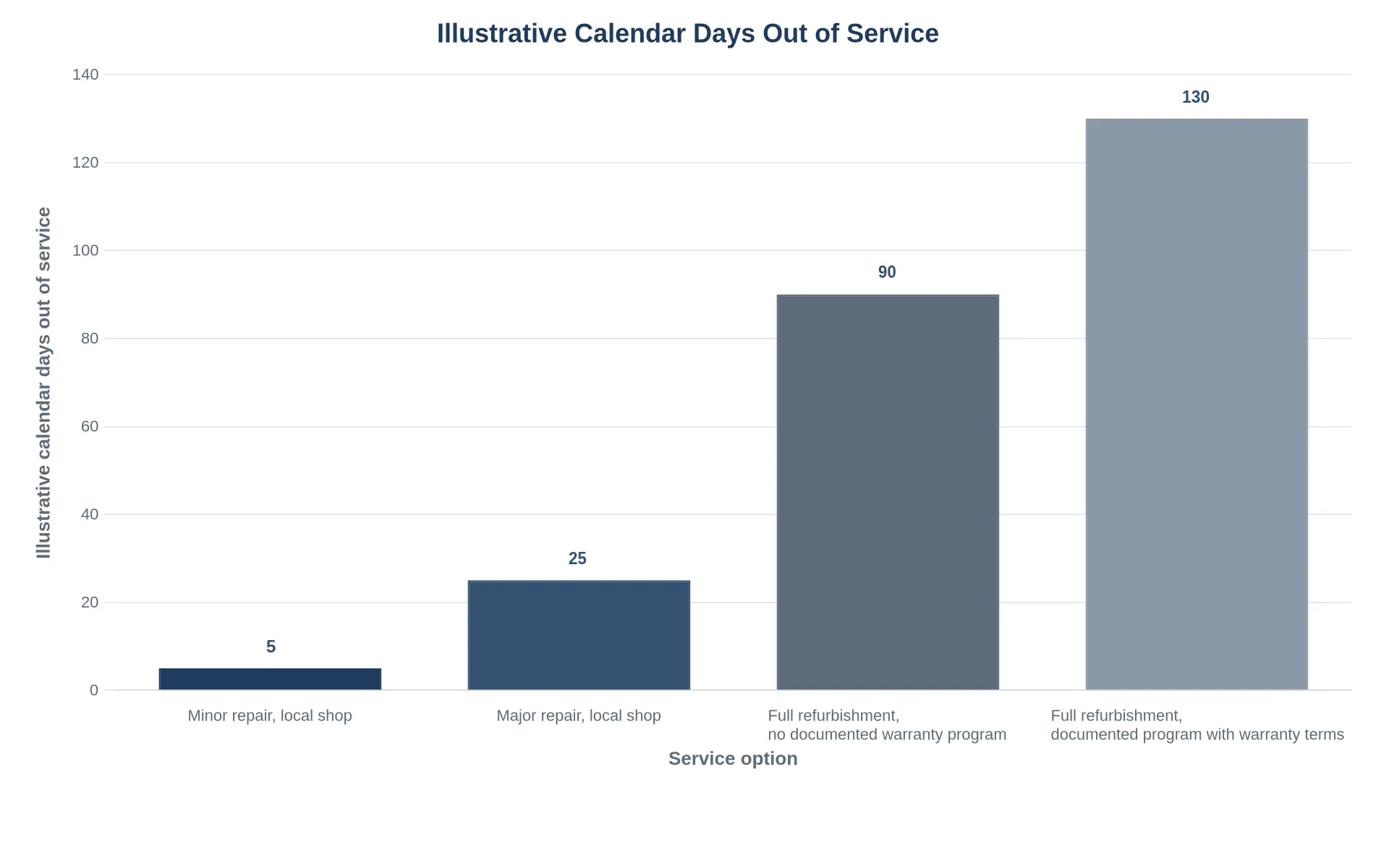
Days out of service is the cost line that never appears in a quote. A short repair keeps a rig in the bay; a full refurbishment takes it off the run board for months. The chart puts both ends side by side and adds the distinction that decides budgets: a refurbishment with documented warranty terms usually runs longer up front than an informal rebuild, because inspection, staging, and sign-off take calendar time.
Caption: The values shown are illustrative planning ranges rather than audited figures; your own timeline will depend on parts availability, shop backlog, and inspection findings.
Cost and Downtime Trade-Offs: Warranty Depth vs. Local Speed
When capital planners weigh a factory-backed program against a nearby shop, the invoice price tells them the least. Total cost of ownership across the unit’s service life is the number that matters, and it moves with four things.
Lost Service Coverage Is a Recurring Operating Expense
Every day an apparatus sits in a bay, the department either pays for replacement coverage or absorbs weaker response. Rental standby, mutual aid reimbursements, and overtime for stretched crews come out of the operating budget, not the capital one. A shop two hours away with stronger refurbishment warranty terms may finish later than the local vendor, but the coverage gap during the rebuild is a dollar figure you can forecast. A fire during that gap is not.
Thin Coverage Converts Into Rework Risk
Warranty depth is prepaid labor. Where coverage is narrow, or excludes the components most likely to fail after a rebuild, the second repair lands on your books as an unplanned expense, often at emergency rates. Emergency vehicle refurbishment under a well-defined warranty moves that risk to the builder. A fast turnaround with minimal coverage only postpones the cost by a few months.
Predictability Beats Optimism in Budgeting
| Cost factor | Fixed-scope refurbishment | Open-ended repair |
|---|---|---|
| Invoice certainty | Quoted and capped | Hourly, scope drift |
| Reserve planning | Single-year capital line | Rolling contingency |
| Approval cycle | One board vote | Repeated supplements |
| Audit trail | Documented scope | Reconstructed afterwards |
Fixed scope lets a business owner put one number in the capital plan and defend it. Open-ended repair looks cheaper at bid time, then eats the contingency reserves set aside for fleet growth.
Residual Value Follows the Paperwork
At disposal or resale, buyers price risk. A unit with transferable warranty documentation and a recorded scope of work holds value; one rebuilt on a handshake and a stack of hourly tickets gets discounted hard. Owners comparing platforms such as municipal apparatus configurations should treat documentation as an asset that depreciates like any other.
A shorter local turnaround buys weeks of uptime, but it pushes rework, coverage, and resale risk onto your balance sheet. Price the warranty as the insurance it is.

Caption: This schematic maps the four-step decision path owners should follow when weighing a refurbishment warranty against a local shop’s turnaround – inspect condition, compare scope and terms, count the calendar days out of service, then choose the service route.
Choosing between a national specialist and a local shop is a test of documentation, not salesmanship. Whether you run one engine company or manage wider municipal fleet purchases, put the same questions to every provider and compare the answers side by side.
- What is the warranty duration, and does it start at delivery or first dispatch?
- Which components and repairs sit inside that warranty, and which are excluded?
- Do exclusion clauses void coverage for wear items, corrosion, or operator error?
- Is warranty labor included, or billed separately at current shop rates?
- Can you document the provenance of every part, including pumps and valves?
- Will you supply pump test results and plumbing pressure-test records at handover?
- May we review your inspection records and technician certifications before signing?
- What delivery date do you commit to in writing, and what remedy covers slippage?
- How are change orders approved, priced, and documented once work is underway?
- What payment milestones do you require, and how much is held until acceptance?
- What post-delivery support do you provide, including field response times?
Get every answer in writing. A service contract you can reread next year is worth more than a promise you only remember.
Fleet Planning and Portfolio Fit: Why Municipal and Commercial Buyers Decide Differently
Refurbishment choices rarely hinge on the wrench alone. They hinge on what a downed vehicle costs the organization behind it. A city street department and a private hauling contractor can run identical trucks and reach opposite conclusions about accepting a warranty or handing the work to a local shop that promises a faster turnaround.
Municipal Fleets: Continuity, Accountability, and Public Money
Municipal buyers answer to council members, budget calendars, and residents who notice when the sweeper does not show up. Three things follow from that:
- Documented coverage carries more weight than raw speed. A refurbishment warranty with clear terms protects the department during audits and budget reviews, even if the truck sits a few extra days.
- Decisions travel through committees. Refurbish-versus-replace calls get folded into multi-year capital plans, grant applications, and fleet replacement schedules rather than made on the shop floor.
- Failure is public. A broken-down collection or spraying unit becomes a service complaint, so predictable performance beats a marginally quicker repair.
For departments rebuilding a mixed public-works roster, the municipal vehicle lineup is a reasonable starting point, since replacement planning works better when categories are reviewed together instead of one truck at a time. The same goes for street-cleaning equipment and liquid waste collection units, where seasonal demand leaves little room for an unplanned week in the shop.
Commercial Fleets: Revenue per Hour, Not Precedent
Private operators read the same warranty language through a different lens. Every hour of downtime is a billable hour lost, so a local shop’s two-day turnaround can beat a program’s two-week promise even when the warranty is stronger. Commercial buyers tend to ask sharper questions: what is the daily revenue at risk, how long is the payback on a refurbished unit versus a new one, what does resale look like in four years?
| Decision driver | Municipal fleet | Commercial fleet |
|---|---|---|
| Budget cycle | Annual appropriation and multi-year capital plan | Cash flow and per-job revenue |
| Cost of downtime | Service interruption visible to residents | Lost contracts and billable hours |
| Warranty priority | Strong preference for documented, auditable coverage | Weighed directly against turnaround speed |
| Refurbish vs. replace | Tied to remaining service life and grant funding | Tied to payback period and resale value |
Where Service Coverage Fits Into Replacement Planning
Service coverage is not a separate purchasing question; it constrains the replacement model. Before committing to a refurbishment schedule, map the service footprint against where the vehicles actually work: how far is the nearest authorized shop, are parts stocked regionally, can the vendor support the unit through its second life? Coverage gaps can stretch a five-year replacement cycle to seven, because units stay in service while they wait on parts. Operators running cargo and transport vehicles or tow trucks and recovery units find this out the hard way when the recovery vehicle is itself out of service.
Portfolio Breadth as a Planning Advantage
CRRC was formed in 2015 through the merger of CNR and CSR. It is a state-owned, publicly listed manufacturer headquartered in Beijing, with rolling stock, new energy vehicle, and other heavy equipment businesses that sell into markets well beyond China. Breadth of that kind matters more than it first appears. When one supplier spans several vehicle categories, buyers can consolidate sourcing, standardize parts and service expectations, and align replacement waves instead of negotiating category by category. Fewer vendors with wider coverage usually means fewer surprises in year three, when the warranty question comes back around.

This diagram is a simplified schematic comparison of warranty scope breadth and is not a contractual representation of any specific agreement.
Frequently Asked Questions
Answers to the questions that come up most often when a fleet weighs a factory-level rebuild against a nearby shop.
How long do typical refurbishment warranty terms last?
Quoted refurbishment warranty terms typically run 12 to 24 months from delivery, but coverage inside that window is rarely uniform. Body work, pump systems, wiring, and cosmetic finishes often carry separate periods. Ask for the written coverage schedule rather than a headline number, because one figure seldom describes every repaired system on the vehicle.
Does having a local shop perform repairs affect an existing warranty?
It can. Many agreements require approved providers or prior authorization, and unauthorized work may void specific provisions. Before booking anything, confirm in writing whether your emergency vehicle refurbishment warranty allows third-party repairs, and keep records of parts and labor. If the work will spread across the fleet, review the broader municipal vehicle lineup before committing.
Are turnaround commitments usually enforceable in writing?
Only when they appear as dated clauses in the contract. A verbal estimate about local shop turnaround carries little weight in a dispute. Ask for a defined start date, a delivery window, and any stated remedy for delay. Without those terms in the document, a schedule is a target, not an obligation.
How should I compare quotes when the scope differs?
Normalize the scope first. List every component, labor hour, and test in each bid, then price the gaps. A lower quote that skips pump testing or surface prep is not cheaper. Ask each vendor to itemize local shop turnaround and refurbishment warranty terms so the comparison reflects total cost of ownership.
A Closing Decision Framework for Fleet Owners
The comparison does not need to end in a verdict. It needs a rule an owner can apply to the next unit in the fleet. Three tests hold up in practice.
When Documented Terms Justify the Longer Program Timeline
Choose the extended fire apparatus refurbishment program when the written agreement names the covered components, the labor position, and a defined warranty period after delivery, and when the truck can be offline without breaching response commitments. If the paperwork names the warranty holder, the start date, the exclusions, and the remedy for failed work, the longer timeline is a calculated trade rather than a gamble. Verbal assurances do not clear that bar.
When Local Turnaround Beats the Warranty’s Value
Route the work locally when the scope is limited, the repair window is measured in days, and the unit has to stay in or near its response district. Routine fire apparatus service, inspections, brake and pump work, and single-system repairs generally fit here. Work out what an extra week offline costs, then set that figure against the coverage a longer program buys.
Recording Either Choice for Budget and Audit
| Record | What it should show |
|---|---|
| Written quotes | Line-item scope, labor rate, parts allowance, completion date |
| Warranty documents | Coverage period, exclusions, claim process, responsible party |
| Downtime estimate | Weeks offline and the standby cost assigned to each |
| Approval memo | The comparison used and the reasoning behind the decision |
Keep these records with the rest of the fleet capital plan, alongside documentation for purchases across municipal vehicle categories. Consistency counts for more than volume: auditors and budget committees look for a traceable rationale, not a perfect one.
Applied together, the three tests give a defensible answer for each unit instead of a preference carried over from the last decision. The next step is practical: put the coming service cycle on the calendar before the current coverage period or inspection interval runs out.