

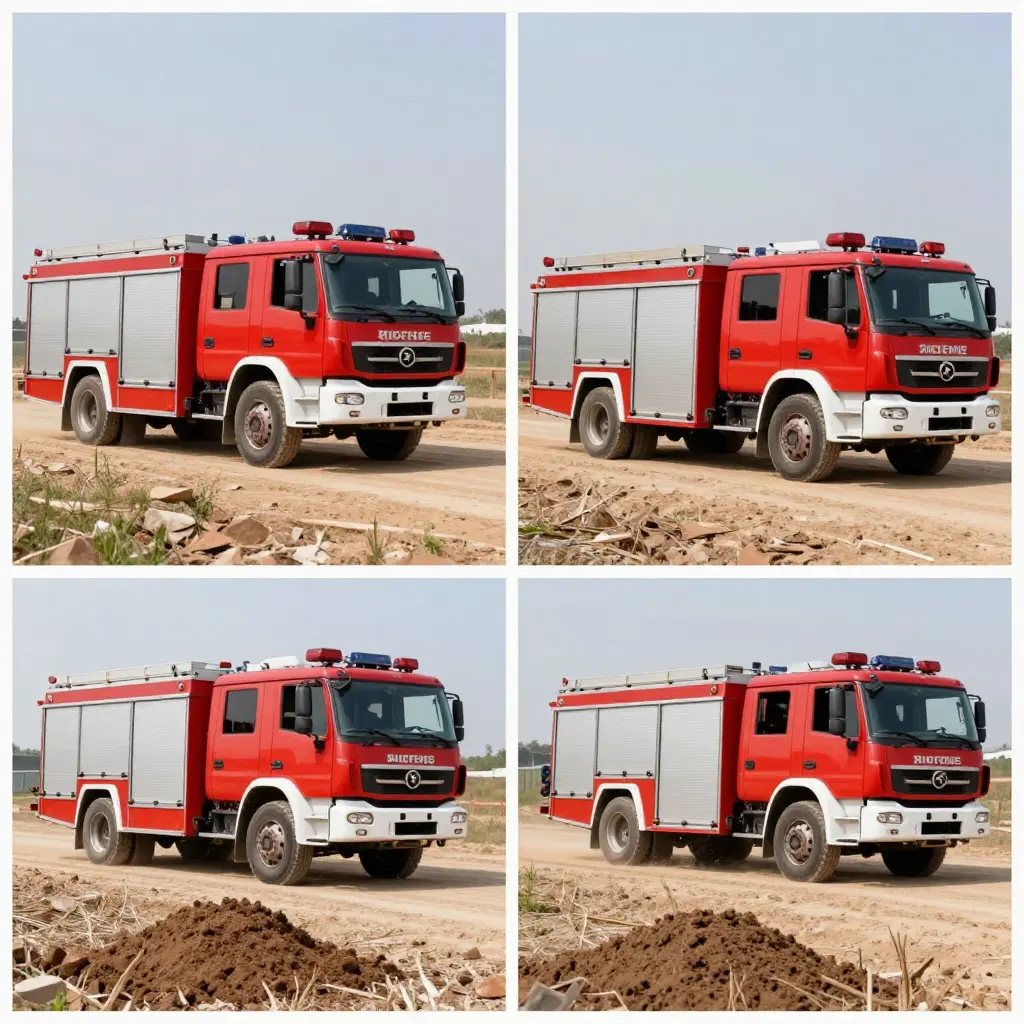
Axle Load and Ground Pressure: The Two Numbers That Decide Off-Road Reach
Axle load is the mass one axle carries. Builders check it against the chassis gross vehicle weight rating (GVWR) so that neither axle goes past its rating with a full load of water, foam and equipment. Ground pressure is the force per unit area the truck passes into the surface through the tire contact patch, usually written in kPa or psi.
| Metric | What it measures | Why it matters on unpaved access |
|---|---|---|
| Axle load | Mass carried per axle, checked against the chassis GVWR | Overloading one axle concentrates weight, breaks through crusted ground and moves traction away from the wheels that need it |
| Ground pressure | Force per unit area at the tire contact patch | Lower ground pressure keeps the truck on top of sand, mud, gravel and soft soil instead of sinking into it |
Horsepower and pump capacity describe what an appliance can deliver once it is standing at the water source. They say nothing about whether it can get there. A high-output pump on a truck that bogs down 200 metres from a draft site delivers nothing, and an engine rated for highway gradients gains nothing on a rutted track that swallows the tires.
The comparison below sets four wheel drive fire trucks against two wheel drive configurations, for the people who specify, buy or run fire-fighting vehicles. Axle load and ground pressure serve as the first filters; drivetrain layout, tire choice and load distribution then explain how both figures move in practice. Buyers starting from a wider fleet list can look through the municipal vehicle range before narrowing down to a chassis.
Used together, the two metrics turn an access question into something you can write into a specification: how much weight sits on each axle, and how much of that weight presses into each square centimetre of ground.
Axle Load Distribution in 2WD and 4WD Fire Truck Chassis
Axle load distribution is the share of the finished truck weight carried by the front axle and by the rear. Builders weigh it twice, at tare and at gross vehicle weight, for two reasons: every axle has to stay inside its rating, and the truck has to stay stable on the road.
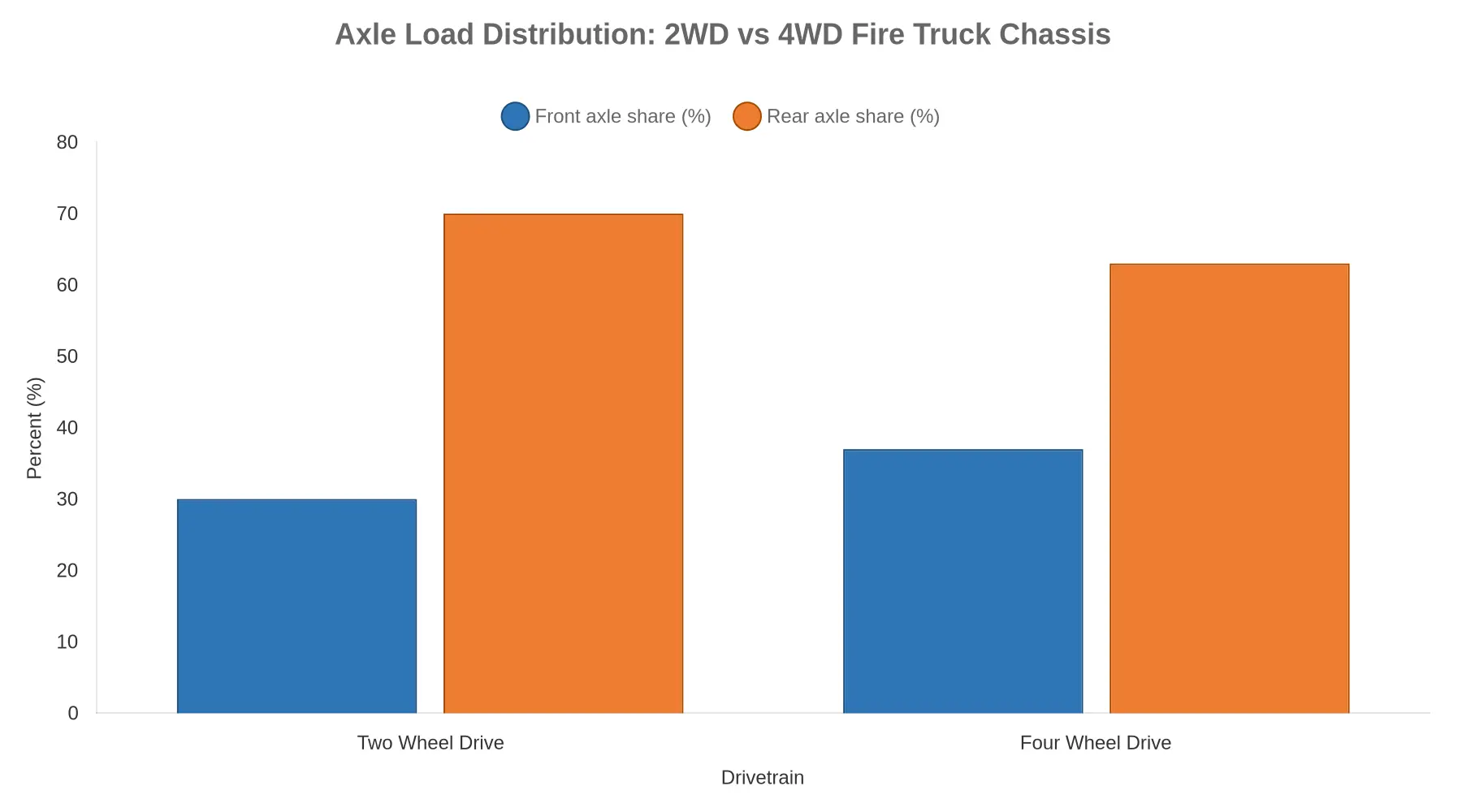
Front axle versus rear axle share
On a two wheel drive fire truck (4×2) the rear axle carries the larger share. The cab sits over the front axle and the pump ahead of it, but the body, the water and most of the equipment sit behind, so front share usually lands near 30 percent.
A four wheel drive fire truck (4×4) shifts that balance forward. The front axle now has to transmit drive torque, which means heavier springs and a heavier axle assembly in the same place, so front share commonly reaches about 37 percent and the tank moves slightly rearward to compensate.
| Chassis layout | Front axle share | Rear axle share | Tare weight change |
|---|---|---|---|
| Two wheel drive (4×2) | about 30% | about 70% | baseline |
| Four wheel drive (4×4) | about 37% | about 63% | plus 600 to 900 kg |
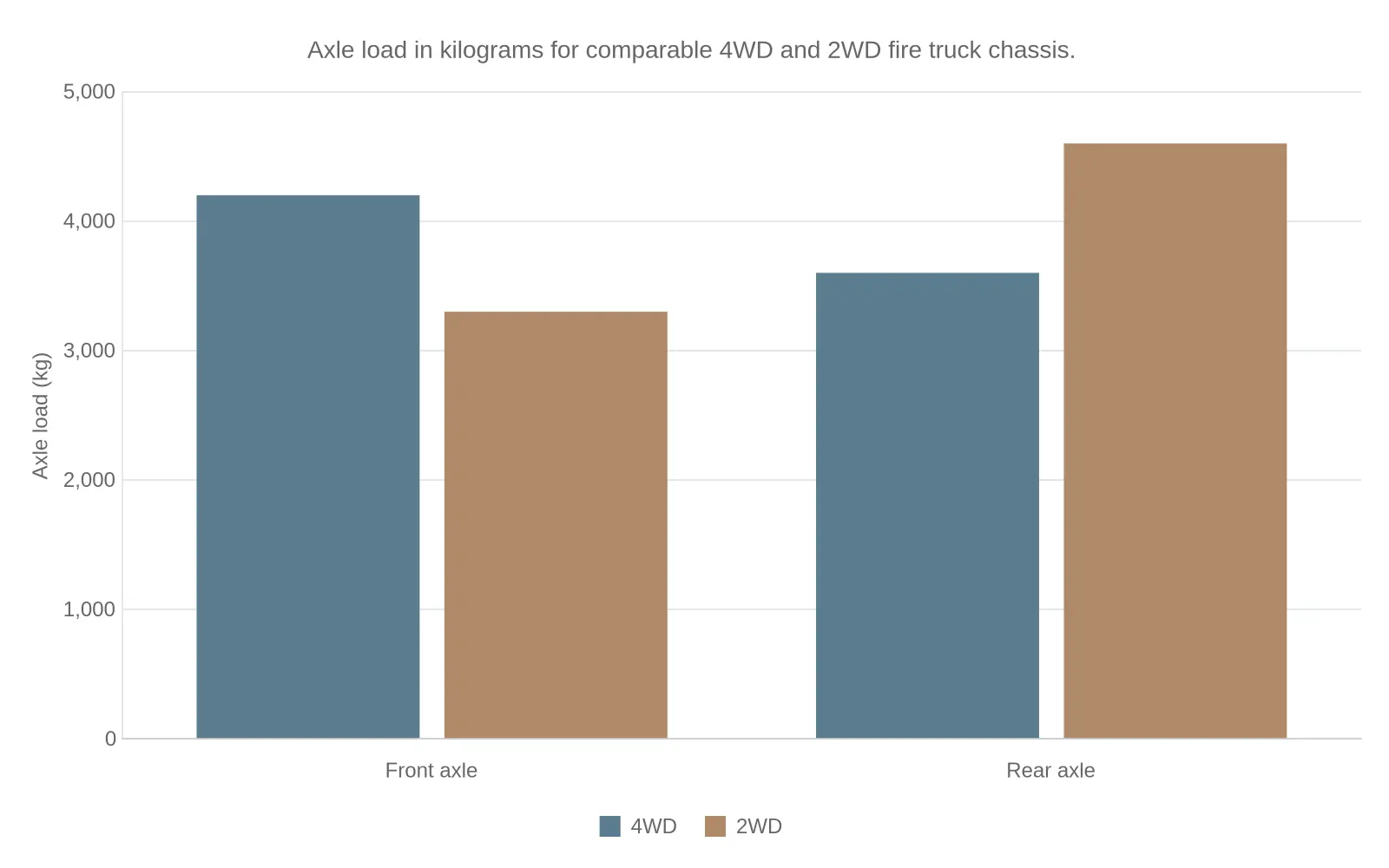
Three main mass contributors
- Forward-mounted pump and cab. A pump ahead of the front axle puts its weight straight onto the front springs. On a 4×4, that weight also passes through the drive axle.
- Water tank between the axles. Tank position is the main tuning tool. Slide it forward and the rear axle sheds load; slide it back and the front axle does.
- Transfer case, front drive axle and larger tires. Together these add roughly 400 to 700 kg of tare mass, and they lift the frame and the centre of gravity, which changes contact pressure on soft ground.
Legal axle load limits and chassis class
Every axle has a rated capacity and every road has a legal axle load limit. The rear axle is usually the binding constraint, since it carries the tank, the hose and the pump body.
Going over the rear axle rating is not a paperwork problem. It overloads tires, springs and brakes, and it can void the chassis warranty or fail an inspection.
When the numbers do not fit, you either fit a smaller tank or move up to a heavier chassis class, which brings a higher rear axle rating and more gross vehicle weight allowance.
That is why a 4×4 often carries less water than a 2WD truck of the same gross vehicle weight: the transfer case, front drive axle and bigger tires use up part of the payload before the tank is filled. Review finished municipal vehicle platforms before you lock a specification.
Ground Pressure and Tire Contact Patch Area
Ground pressure is the load a vehicle places on the surface beneath it, spread over the area where the tires actually touch. Total vehicle mass divided by the combined footprint of all tires touching the ground gives the average figure; for one wheel, divide the load on that wheel by the size of its own footprint. Two trucks of identical weight can behave very differently on the same track for exactly this reason, because the one spreading its mass over more square centimetres asks far less of the soil.
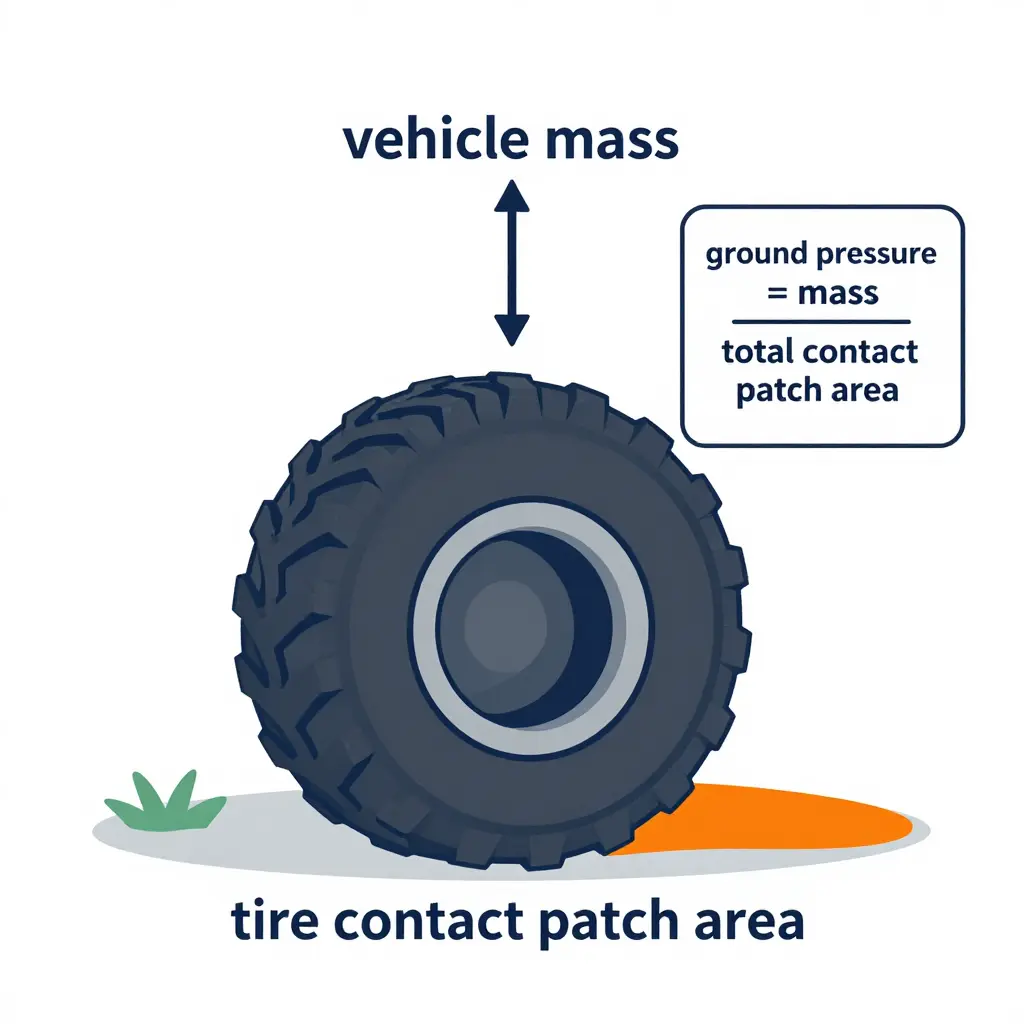
The tire contact patch is not a fixed number on a spec sheet. It responds to how the vehicle is built and how it is loaded:
- Tire size and construction – a wider or larger-diameter tire encloses a bigger footprint at the same load, so each square centimetre carries less mass.
- Tread pattern – a lugged or open-shouldered tread grips loose material well but puts less continuous rubber on the ground than a ribbed highway tread, which slightly reduces the effective load-bearing area.
- Inflation pressure – lower pressure lets the sidewall flex and the tread flatten against the ground, lengthening and widening the patch; higher pressure rounds the tire and shrinks it.
- Number of driven wheels – driving the front axle adds no contact area and, on a heavier 4×4 chassis, may reduce it slightly. What changes is how much torque each tire can put down before it slips.
Inflation pressure gets particular attention because it can be changed in the field. Halve the pressure at the same load and the contact area roughly doubles, and since ground pressure is mass divided by area, every added square centimetre of tread on the ground lowers what each tire presses into the soil. Airing down converts a heavy chassis into a gentler one without touching the load it carries.
The effect shows up most clearly on soft or loose surfaces: sand, mud, gravel, ploughed fields and seasonal tracks. Soil fails when the pressure applied at a point exceeds its bearing strength, so a high point load pushes material aside, compacts it unevenly and starts a rut. Once a rut forms, the tire sits lower, the sidewall and differential housing lose clearance, and rolling resistance climbs while traction falls. Deeper rut, more bogging, and a surface cut up for everyone who follows.
This is why off-road fire apparatus is usually specified with larger tires, more driven wheels and pressure-adjustable inflation rather than simply a more powerful engine. The same reasoning holds for any fleet running regular unpaved access, whether that is a rural station, a quarry, a farm or a construction site. Buyers comparing chassis can request axle loads and tire footprints and work out the figure themselves; matching that data to the right municipal vehicle platform keeps a heavy truck usable on ground that would otherwise reject it.
Before committing a chassis to a rural water shuttle or a construction-site standby contract, the axle load and ground pressure numbers tell you more than the brochure photographs. The table below compares four wheel drive and two wheel drive fire trucks on comparable chassis classes.
All values are typical ranges for comparable chassis classes in the 13,000 – 16,000 kg GVW bracket, reflecting common municipal fire apparatus practice rather than any single manufacturer’s type approval. Treat them as planning figures and confirm the final numbers on the specific chassis datasheet before you specify a build.
| Parameter | Four Wheel Drive Fire Truck | Two Wheel Drive Fire Truck | Impact on Unpaved Access |
|---|---|---|---|
| Tare weight (kg) | 6,800 – 8,200 | 6,000 – 7,400 | The driveline and suspension hardware is tare weight the ground still has to carry |
| Front axle load share (% of tare) | 36 – 40 | 30 – 34 | Higher front share keeps the steered axle biting instead of floating |
| Typical ground pressure range, laden drive axle (kPa) | 180 – 240 | 240 – 320 | Lower pressure per tire limits rutting on grass, gravel and soft shoulders |
| Tire size and inflation options | 365/80 R20 or 395/85 R20 single wide tires, adjustable 250 – 600 kPa | 295/80 R22.5 with dual rear tires, 700 – 830 kPa, essentially fixed | Wide singles plus adjustable pressure make low-pressure operation practical |
| Minimum turning circle, wall to wall (m) | 16.5 – 18.5 | 14.0 – 16.0 | The wider arc restricts tight farm tracks and forest trails |
| Gradability on loose surfaces (%, first gear, laden) | 30 – 40 | 15 – 22 | Roughly doubles the slope a loaded truck can climb without wheel slip |
| Driveline complexity | Transfer case, front differential, two prop shafts, hub reduction | Single prop shaft, one differential | More components exposed to impact, but the traction gain usually outweighs it |
| Maintenance intervals | 10,000 km or 6 months, extra grease points and transfer case oil | 15,000 km or 12 months | More service stops, so check workshop access before assigning remote duty |
| Purchase cost index (2WD = 100) | 125 – 140 | 100 | The extra capital only pays back where unpaved access is routine |
| Remaining payload for water and foam (kg, on 15,000 kg GVW) | 6,700 – 7,600 | 7,600 – 8,400 | Less tank volume per trip means more shuttles on long dirt runs |
| Ground clearance under differential (mm) | 320 – 380 | 240 – 280 | Clears centre-bars, roots and soft shoulders instead of scraping them |
| Differential locks and traction aids | Lockable front and rear, optional inter-axle lock | Open or limited-slip rear only | Locking axles let a loaded truck walk out of a mud hole unaided |
Read together, the numbers split cleanly: the two wheel drive truck takes payload, price and turning circle, the four wheel drive truck takes ground pressure, front axle grip and gradability. Where most call-outs stay on sealed roads, the 2WD duty cycle is cheaper to run. Where a real share of them involves earth tracks, verges or site access roads, the 4WD premium tends to pay for itself in fewer stucks and fewer damaged tanks.
Whichever way you lean, it helps to see how the rest of the chassis family is configured. Browse the municipal vehicle range to compare body layouts, tank capacities and axle ratings side by side before locking in a specification.
How a 4WD Driveline Changes the Mass and Traction Equation
Specifying four wheel drive fire trucks is a trade between mass and traction, not a free upgrade. The hardware needed to drive the front wheels – transfer case, front driving axle with its differential and steering knuckles, an extra propeller shaft, heavier springs and dampers, often larger tires and rims – is tare weight that stays on the chassis for the life of the vehicle. None of it extinguishes fires. It simply moves the truck closer to its gross vehicle weight rating before any water, foam concentrate, hose or crew goes on.
That extra tare weight affects axle load in two ways. It uses rating headroom that would otherwise go to the body and tank, and it usually pushes the front share upward, which makes the front axle and tire ratings the limiting constraint rather than the rear. The result is less usable payload capacity: inside the same GVWR, a 4×4 chassis typically carries a smaller water or foam tank, or else trades hose bed volume, locker space or crew seating to stay legal. Buyers comparing 2WD and 4WD versions of the same nominal chassis should compare usable tank litres, not just GVWR.
The benefit arrives the moment the truck leaves sealed road. On a two wheel drive chassis the front wheels are dragged through the surface while the rear axle generates all the traction and pushes a dead load ahead of it. Driven front wheels turn that otherwise passive mass into grip. With torque going to both axles, the vehicle pulls from more contact patches at once, so the tractive demand on each tire falls and wheel slip on loose gravel, wet clay or a saturated verge drops sharply. Less digging in, less rutting of a private access track, and fewer failures on a gradient the truck has the power to climb but not the grip.
What this means for buyers
- Fix the payload requirement first – tank size, foam, hose and crew – and choose the driveline afterwards. The transfer case and front axle assembly have already spent part of your GVWR before the body is fitted.
- Check front and rear axle load separately against their individual ratings, and confirm the heavier 4WD suspension does not push you onto a larger, more expensive chassis class.
- Match the driveline to the real access route. Unpaved tracks, wet grades or soft verge turning areas usually justify the payload the traction costs; where access is fully sealed, that weight is better spent on water.
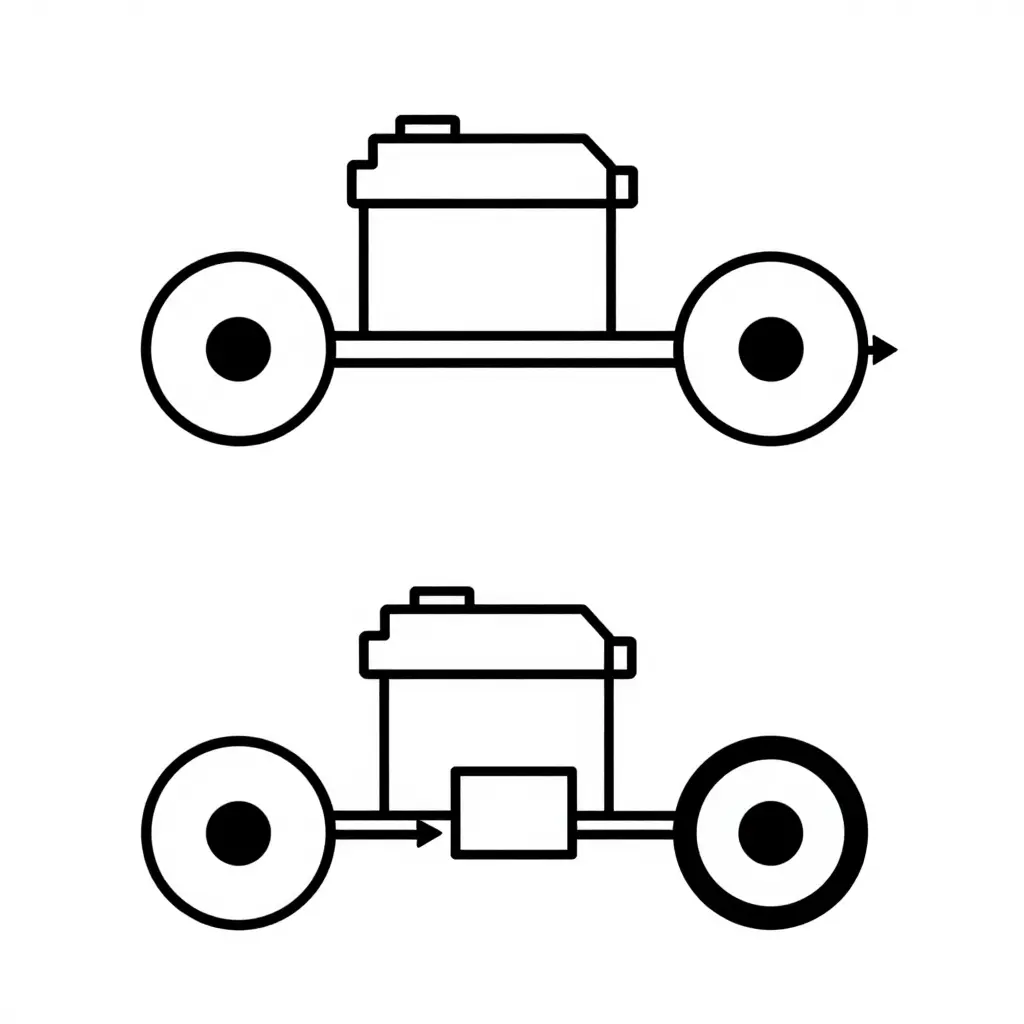
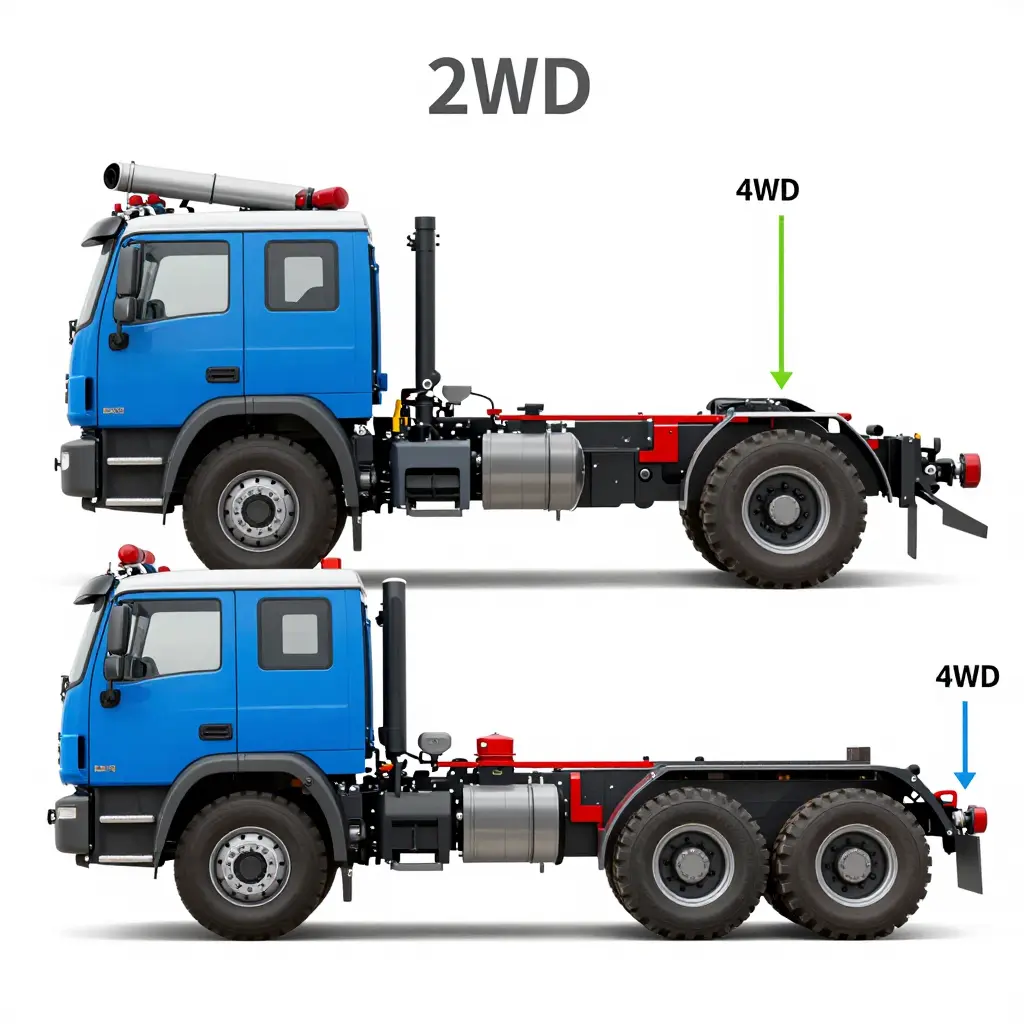
Reading the diagram at a glance:
- Upper panel (two-wheel drive): torque leaves the engine and runs down a single driveshaft to the rear axle only, so just the rear wheels drive on loose or muddy ground.
- Lower panel (four-wheel drive): a transfer case sits mid-driveline and splits that torque into two paths, one forward and one rearward, so all four contact points share the work.
- Filled dot = driven wheel; outlined dot = wheel that only rolls. In the top panel the front wheels are outlines; in the bottom panel every wheel is filled.
That single difference, how many wheels actually push, is where the axle-load and ground-pressure story starts. The vertical load does not change, but both axles put torque into the ground instead of one, so each driven tire has less work to do before it slips.
Surface Conditions That Determine Axle Load and Ground Pressure Limits
Before an appliance is committed to an unpaved access route, the decision should rest on measurable surface behaviour, not on the specification sheet alone. Five surface characteristics, read together with tire pressure and driven axle count, tell you whether a given axle load and ground pressure combination will hold up or break through. Owners comparing chassis across a range of municipal fire and emergency vehicles can write these criteria into the procurement brief.
Soil bearing capacity
Soil bearing capacity is the load per unit area the subgrade carries before shear failure. On unpaved access, read it from a California Bearing Ratio (CBR) test or a plate load test on the compacted surface, not from how firm the ground feels underfoot. Crushed stone bases and well-graded gravels commonly return CBR values above 15; silts and fine sands can drop below 5 once wet. What matters is the vehicle’s ground pressure at the contact patch against the allowable bearing pressure, with a safety factor of roughly 1.5 to 2.0 to cover dynamic wheel loads, braking and turning forces.
Moisture content
In cohesive soils, moisture content is the largest single multiplier on bearing capacity. Strength drops sharply between the plastic limit and full saturation, so a clay that performs well at 12% moisture may rut freely at 22%. Test at the depth of the subgrade rather than at the surface, and re-test after rain. Where access cannot be closed seasonally, specify a surface course of free-draining granular material and set the axle load limit from the wet-season value, not the dry one.
Rut depth
Rut depth is the most practical field metric, because it folds soil strength, axle load and tire pressure into one number you can measure after the first loaded pass.
| Rut depth after loaded pass | Reading | Action |
|---|---|---|
| Under 25 mm | Surface performing | Repeat passes acceptable at design axle load |
| 25 to 75 mm | Marginal, near plastic deformation | Lower tire pressure, limit to single-unit movements |
| 75 to 150 mm | Subgrade distress | Reduce axle load or add granular surface course |
| Over 150 mm | Bearing failure | Route unsuitable for loaded appliances |
Ruts deeper than about 75 mm also trap tires, raise rolling resistance and steer the vehicle into the softest line, which speeds up the next rut.
Slope and side slope
Longitudinal grade drives traction demand and shifts weight to the rear axle. On loose or wet surfaces, sustained grades above roughly 10 to 15% become a traction limit for a rear-drive-only chassis, which is where a driven front axle pays for itself. Cross slope matters more than most operators expect: a 5% side slope shifts weight onto the downhill wheels, raising ground pressure on that side and cutting rollover margin, particularly with a part-filled water tank.
Surface crust strength and seasonal variation
A thin crust over a soft base, such as caliche, dried silt or frozen ground, reads firm and can punch through under a point load. Frozen ground carries well until thaw, and spring thaw or monsoon onset can cut bearing capacity by half within days. Set access windows and axle load limits by season rather than by a single survey.
How tire pressure and driven axle count change the answer
Lowering tire pressure increases the contact patch and reduces ground pressure, but it also raises rolling resistance and sidewall risk, so it is a partial fix rather than a substitute for adequate bearing capacity. Driven axle count works differently: a four wheel drive chassis spreads torque across more wheels and cuts wheel slip, and slip is what destroys surface shear strength and starts ruts. Two wheel drive is efficient where the surface is strong and dry; four wheel drive earns its cost where bearing capacity is marginal or moisture-driven.
Rule of thumb
If the wet-season surface cannot carry your loaded axle load at a tire pressure that keeps rutting under about 75 mm, specify four wheel drive. If it can, two wheel drive will do the job for less money.
An Ordered Checklist for Evaluating 4WD vs. 2WD Fire Trucks on Unpaved Access
Work through these checks in sequence before you commit capital to a chassis. Each builds on the last, and each produces a number you can defend to your board. Anyone also comparing body configurations can review a broader municipal vehicle lineup alongside the fire apparatus shortlist.
- Survey the route surface and slope first. Drive or walk the worst leg of the unpaved access route and record gravel depth, mud, ruts, side slope, and any gradient above 10 percent that would make a single driven axle a liability.
- Calculate the worst-case axle load against the manufacturer’s axle ratings. Load the truck with a full tank, foam, crew and hose, then confirm every axle keeps a margin for the shock loads that off-road travel adds.
- Measure ground pressure and compare it with surface bearing capacity. Divide tire load by contact patch area, and treat any surface where measured ground pressure exceeds bearing capacity as closed to a two wheel drive unit.
- Define the water and foam payload requirement from real incidents, not brochures. Size the tank around the longest response you actually run, since every extra litre raises axle load and ground pressure on soft ground.
- Specify tires and a way to control their pressure. Choose tread and ply rating for your worst surface, and decide whether a central tire inflation system is worth the cost for routine unpaved access.
- Confirm your workshop can service the driveline. Check that technicians can handle transfer cases, front differentials and U-joints in-house, or that a dealer sits within a workable distance.
- Set the driver training requirement before delivery. Require documented training on four wheel drive engagement, weight transfer on slopes, and recovery procedures for the crews who will drive the truck.
- Model total cost of ownership and fleet mix. Compare purchase price, fuel, tire wear, driveline service and downtime across 4WD and 2WD, then decide whether one 4WD pumper plus 2WD support units fits your call volume.
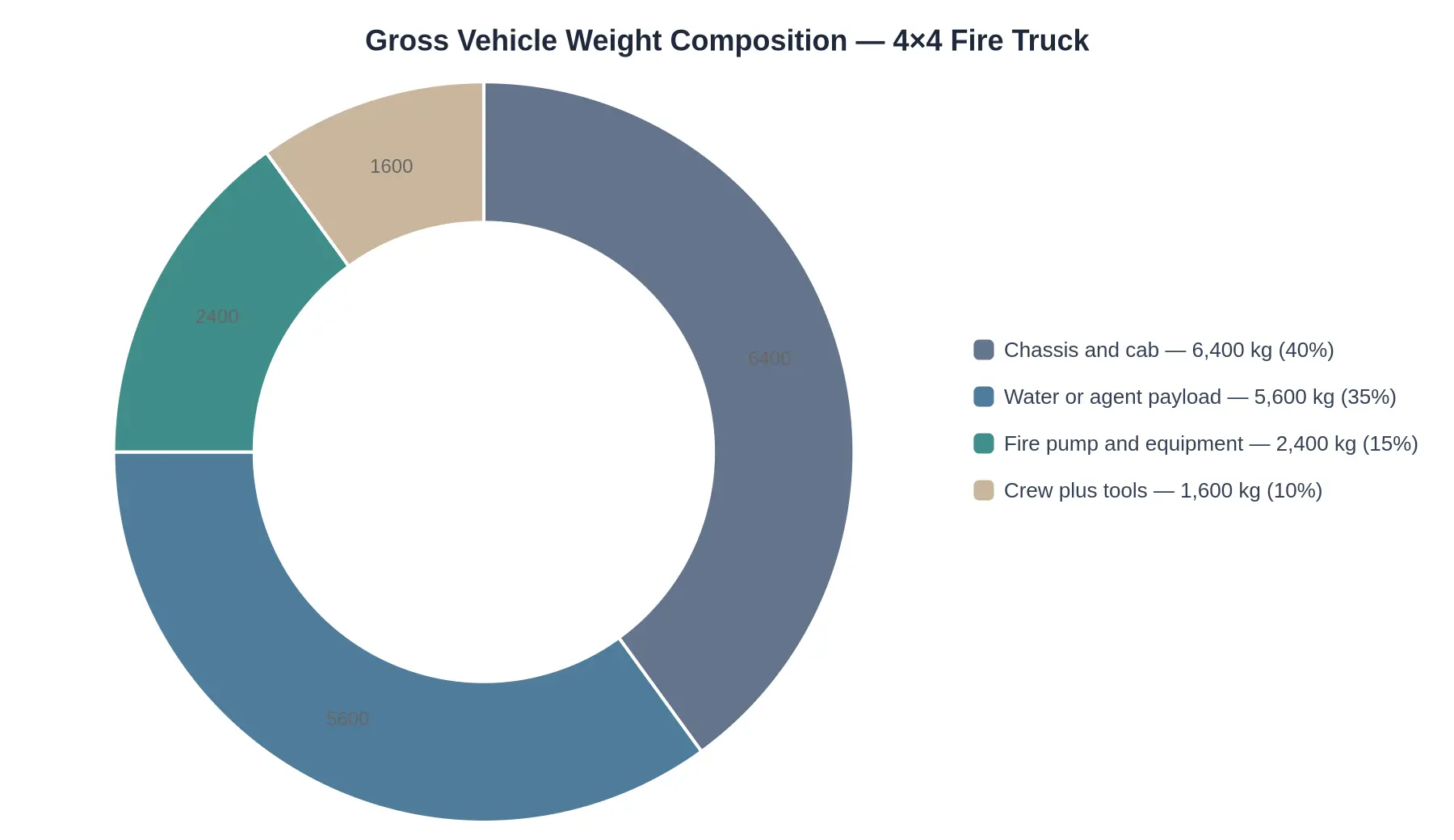
Total gross vehicle weight represented: 16,000 kg.
Operating Cost and Payload Trade-Offs
On unpaved access, the economics of four wheel drive differ from two wheel drive in four measurable ways. None is decisive alone, but together they move where the lowest total cost of ownership sits for a given duty cycle.
- Fuel consumption – the front driveline adds mass high and forward, and every kilogram has to be accelerated and stopped on every run. On many designs that driveline turns continuously, so part of the engine output goes into spinning gears and churning oil before the tires see it. Expect higher burn on soft, rolling ground where engine load is already high.
- Tire wear and replacement – driven front tires transmit torque while steering, which adds scrub on tight turns and produces cupping and shoulder wear a free-rolling axle never develops. 4WD units often run more aggressive lug patterns that cost more per casing and wear faster on abrasive gravel.
- Driveline service – transfer case fluid, front differential oil, universal joints and half shafts carry their own intervals, and dust ingress on unpaved routes shortens them.
- Reduced payload – GVWR is fixed by law and by the chassis, so a heavier tare leaves less for everything else: fewer litres of water or foam per trip, and on long unpaved approaches an extra shuttle run per shift.
Ground pressure management offsets part of that gap. A tire with a larger contact patch at a given load, run at an inflation pressure that suits the surface, spreads load over more area and limits sinkage. Less sinkage means less rolling resistance, which recovers some of the fuel penalty, and less slip, which saves tread. Load distribution across axles matters as much as the tire: a baffled tank and a low-mounted pump keep the centre of gravity down and each axle inside its share of the rating. Operators running mixed fleets often find a two wheel drive chassis with well-managed tire pressures handles moderate unpaved access at lower cost, while four wheel drive earns its premium only where grades, mud or loose sand genuinely need traction at the front axle.
The practical approach is to model both options over the same route, the same call volume and the same service life, then weigh fuel, tires, driveline labour and the payload you give up against the cost of a unit that cannot reach the site at all.
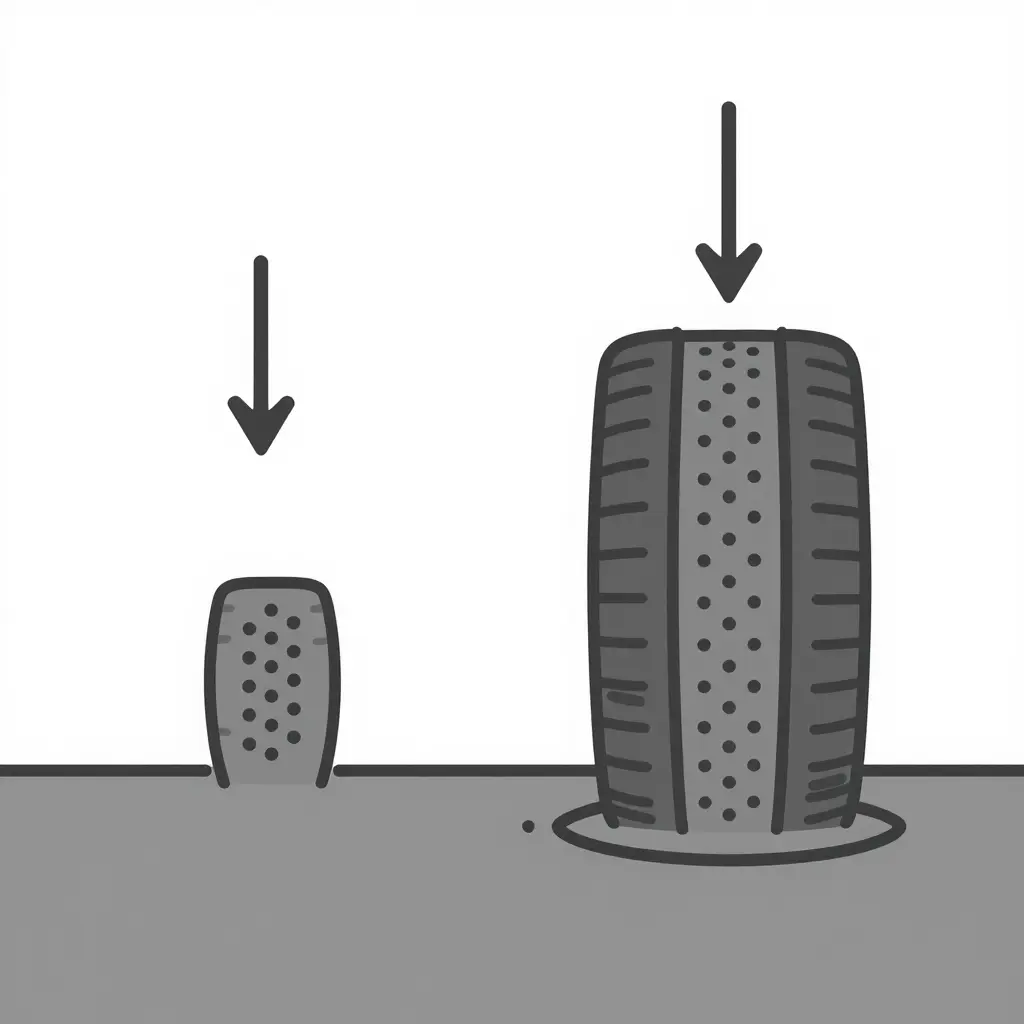
How to read it: both tires carry the same downward force, shown by the identical arrows. The small patch squeezes that force into a few square inches, so the dots stack densely and the rut digs deep and narrow. The wide patch spreads the same force across a much bigger area, so the dots sit far apart and the rut stays shallow.
The diagram makes one point: the same force over a wider footprint presses less hard per square centimetre. A driven front axle does not shrink the vertical load, and as the FAQ below explains, it can raise it slightly. What it buys is grip: more tires taking torque, less slip, and a surface that still holds together for the return trip.
For sites with weak pavement, or none, compare municipal and emergency vehicle platforms on axle configuration as well as pump capacity. The footprint, and how much of it drives, decides whether the truck arrives.
From Spec Sheet to Selection Guide
Buying fire apparatus starts with the routes your crews drive, not the brochure. Where access is compacted, firm and short, with moderate gradients, two wheel drive usually delivers enough traction at lower cost, weight and maintenance. Put the savings into tank capacity, pump output or crew comfort.
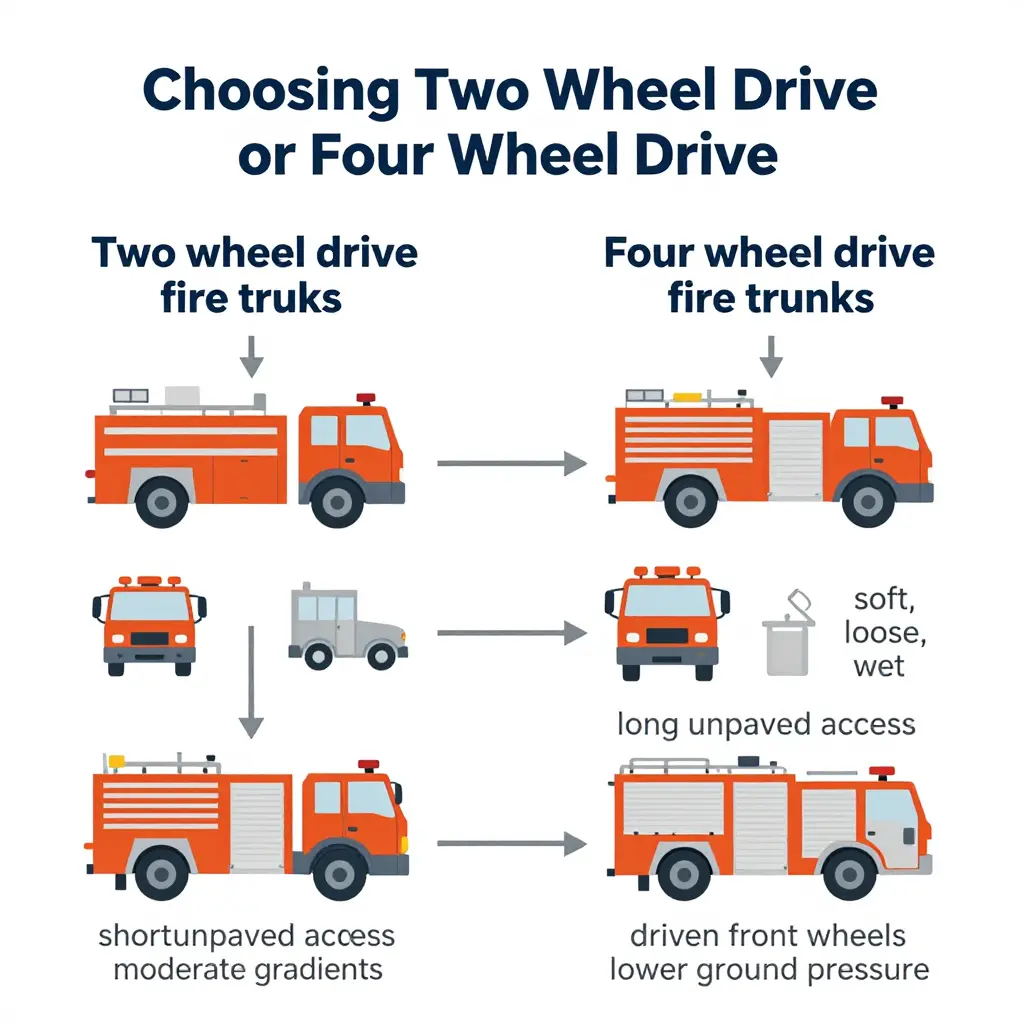
Matching Drivetrain to Access Conditions
| Access condition | Recommended drivetrain | What it buys you |
|---|---|---|
| Compacted, firm gravel or dirt, short runs, moderate gradients | Two wheel drive | Lower curb weight, simpler driveline, more payload budget |
| Soft, loose or wet surfaces, long unpaved runs, steep or variable gradients | Four wheel drive | Driven front wheels share torque, cut slip, spread load |
Treat that table as a starting point and confirm it with a site walk in wet weather. Mud, sand and freshly graded shoulders can change the answer quickly. Four wheel drive fire trucks earn their premium mainly on the long, soft or wet accesses where a two wheel drive would be waiting for a tow.
Fleet Mix Planning and Chassis Class
Most fleets should not standardize on a single drivetrain. Match each station to its own worst-case access: a station with a paved apron can run two wheel drive, while a rural station covering field tracks needs four wheel drive. The mix keeps capital cost down without stranding a crew in the rainy season.
Chassis class then decides how much water and equipment you can legally carry. A higher axle load rating buys payload back when 4×4 hardware and larger tires add weight, and a heavier frame keeps the body stable on uneven ground. Choose the lightest chassis that still meets your ground pressure target on the softest surface along the route, and check how the ratings stack up across municipal vehicle platforms.
Compare body mounting height and tire footprint before signing, because both shift contact pressure more than drivetrain alone. A chassis commonly shared with road service bodies often brings better parts availability at a similar rating. Ask for a wheelbase that keeps the rear axle load balanced when the tank is full.
The Same Logic Applies Beyond Fire Apparatus
Axle load and ground pressure decide traction and legal payload on every municipal and cargo platform, not just pumpers. If your yard or tip site turns soft after rain, run the same checklist against dump truck reference platforms. Recovery work on unpaved shoulders follows the same rule, so check tow truck chassis ratings against the ground you actually cross.
Before you write the spec, walk the route with a full tank in mind rather than an empty one. That habit separates a fleet that stays operational from one that gets stuck at the gate.
Frequently Asked Questions: Four Wheel Drive, Axle Load, and Ground Pressure
Does four wheel drive always mean lower ground pressure?
No. Ground pressure is the load on the tires divided by the total contact area, and adding a driven front axle works against that ratio. A transfer case, front drive axle, propeller shaft and heavier front hubs add roughly 400 to 700 kg of curb weight, so a 4×4 on identical tires carries more mass over the same footprint and can register equal or even higher ground pressure than its 2WD counterpart. What four wheel drive delivers is traction and gradeability on unpaved access, not flotation. Flotation comes from more tires, wider tires or less payload.
How do axle load limits constrain water tank size?
Water weighs about 1 kg per litre, so a 4,000 L tank is four tonnes of liquid before tank baffles, pump, hose bed and crew are counted. Payload is GVWR minus curb weight, and the rear axle rating (GAWR) usually absorbs most of the tank, so the rear figure sets the real ceiling. On a two-wheel drive chassis with a lower rear GAWR, engineers either shrink the tank or accept partial fills. Trucks specified for unpaved access typically trade water capacity for axle load margin, and published municipal vehicle configurations show that trade-off directly.
Can tire pressure adjustment substitute for a driven front axle?
Only within limits. Dropping inflation from 8 bar to 4 bar at the same load can nearly double the contact patch, which lowers ground pressure and improves flotation on soft ground. But deflation costs speed, builds sidewall heat and softens steering response, and it does nothing for grade climbing or rolling resistance in loose gravel. A driven front axle puts torque at the steering wheels; pressure adjustment supplements it rather than replacing it.
How can ground pressure be estimated from vehicle data?
Take the axle loads from the chassis load distribution, divide by the number of tires on that axle to get load per tire, then divide by tire footprint area (section width multiplied by contact length). For example, 2,750 kg per tire over a 0.06 m² footprint gives about 45,000 kg/m² of average contact stress. Tire manufacturer load-inflation tables give better footprint values than a tape measure, because footprint area changes with inflation and tread pattern.
What maintenance does a four wheel drive driveline add?
Transfer case fluid, front differential oil, front propeller shaft universal joints and CV boots, front hub seals, knuckle bearings, and breather extensions for wading. Part-time systems also require matched tire circumference at all four positions to prevent wind-up inside the transfer case. These items belong in the service schedule as separate line items with their own intervals.
Specifications and ratings vary by chassis and body builder, so confirm final figures against chassis documentation before a build is signed off.
Decision Summary: Let the Terrain and the Law Make the Call
Every two-wheel-drive versus four-wheel-drive debate comes down to three checks, and they go in this order.
1. Axle load sets the hard limits. The weight on each axle decides whether the truck is legal on public roads and whether the hubs, springs and frame survive the duty cycle. Nothing downstream matters until this number fits.
2. Ground pressure decides whether the surface can carry the vehicle. Total weight, tire construction and inflation together determine whether the truck rolls over a surface or sinks into it.
3. Driven axle count decides how much of that weight becomes traction. On soft going, only the driven share of the load pulls. Extra driven wheels convert load into grip; they do not reduce the load itself.
| Operating condition | Two wheel drive | Four wheel drive |
|---|---|---|
| Sealed roads, concrete yards, compacted gravel | Best fit, lowest cost per tonne | Extra weight, little gain |
| Soft soil, sand, mud, snow | High bogging risk | Clearly recommended |
| Steep or unmaintained grades | Marginal at best | Recommended |
| Weight-sensitive tank size, tight budget | Lower tare, more payload | Higher tare, higher price |
When two wheel drive is the more efficient choice
On sealed roads, firm aprons and well-maintained compacted gravel, two wheel drive is simply the better business case. Lower tare weight means more water, foam or equipment per legal tonne, so a smaller, cheaper chassis can still deliver the payload a station needs. Purchase price, tire replacement, driveline service and fuel consumption all stay lower, with no penalty in day-to-day performance.
When four wheel drive fire trucks earn their premium
Four wheel drive fire trucks justify the higher tare weight and cost when the route itself is the risk: soft verges, sand tracks, seasonal mud, long gradients or long stretches of unpaved access where a bogged appliance turns into a failed response rather than an inconvenience. Read the extra driveline mass and price as insurance against access failure, not as a performance upgrade for paved work. The same chassis logic applies to other municipal duties, including solid waste collection vehicles facing identical weight and traction trade-offs.
Specify two driven wheels where the surface is firm and payload matters most, and pay for four only where the ground genuinely demands it. That single decision keeps the budget and the response capability honest.