


Why Loose Equipment, Not Chassis Class, Decides Your New Fire Truck Cost
Two fire trucks can be built on identical commercial or custom chassis and still land six figures apart once the equipment list is closed. What separates them is the loose equipment specified on top of the chassis: pump, tank, hose, tools, electronics. That gap is the number a department borrows, insures and depreciates for fifteen years, and it is usually decided long before anyone argues about the badge on the cab.
What “Loose Equipment” Actually Covers
In fire apparatus procurement, loose equipment means everything specified onto or carried by the chassis rather than built into it. That includes the fire pump, water tank, hose and nozzles, self-contained breathing apparatus, scene and warning lighting, mobile radios, medical bags, hand tools, extrication gear and ground ladders. Each item is quoted separately, often by a different supplier, and each arrives with its own installation labor. No two builders break the list down the same way, which is why two quotes for the “same” truck rarely match line for line.
Why This Line Item Moves the Budget Most
Loose equipment is usually the largest single block of a purchase because it carries the most line items, the most labor hours, and the least price transparency. Chassis prices get benchmarked against cooperative purchasing contracts and competing dealers. Equipment prices do not. Suppliers quote what the local market will carry, and every added feature pulls in engineering time, mounting hardware and, for some systems, re-certification. Specification creep does the rest: each addition looks affordable on its own while the total climbs.
One useful habit is to split every quote into chassis, body and loose equipment, then compare suppliers only on the third column. Budgets are won or lost there, and a specification review that starts with that column tends to pay for itself. If the replacement cycle also covers support units, scan the broader municipal vehicle lineup before the spec sheets go out.
| Cost Block | Pricing Visibility | Typical Budget Influence |
|---|---|---|
| Chassis | High, benchmarked | Moderate |
| Body and cab conversion | Medium | Moderate |
| Loose equipment | Low, supplier-specific | Highest |
Why Chassis Class Sets the Floor, Not the Ceiling
Buyers usually start with the chassis when they ask what a new fire truck costs, and that is only half the calculation. Chassis class (commercial or custom, axle ratings, cab size, GVWR) sets the band you are shopping in. It sets the floor. What you specify on and inside that chassis decides where in the band you land, and how far above it you end up. Departments that understand the split get a budget that holds. The rest get change orders.
Most of the mechanism is weight and the systems that support it. A pump, a tank, an aerial device or a full complement of loose tools all add mass, and the mass has to be carried: axles and suspension get re-rated so the finished truck still meets the axle-loading and GVWR limits that NFPA 1901 and state weight laws require. Heavier electrical loads pull in larger alternators, more battery capacity and additional wiring runs. Water and foam systems drive plumbing, valve and control changes through the body. Because each of those updates is quoted against the chassis rather than in isolation, a modest equipment list can move a build from one weight rating into the next.
That cascade is where apparatus procurement gets expensive. Equipment choices can force a larger chassis: exceed the payload or axle capacity of the class you priced and the honest answer is a heavier frame, a bigger cab or a different driveline, not a creative loading plan. Department heads who write fire truck specifications around mission equipment and then select the fire apparatus chassis that can legally carry it usually land closer to their estimate than those who choose a chassis first and try to fit the tools afterward. Our municipal vehicle platforms show how chassis and body configurations get matched to real duty cycles. Treat chassis class as the range you are shopping in and equipment as the variable that sets your final number.
The table below illustrates how a new apparatus budget typically splits between the municipal vehicle platform and the equipment that makes it operational, using broad ranges rather than quoted figures.
Illustrative Budget Breakdown: Chassis Class vs. Loose Equipment
| Cost Component | What It Covers | Typical Share of Total Budget | Main Cost Drivers |
|---|---|---|---|
| Chassis and cab | Engine, drivetrain, cab, chassis frame, and base electrical system | 22-28% | Chassis class, GVWR, cab configuration, drivetrain, and emissions requirements |
| Body and compartment fabrication | Custom body, compartments, doors, shelving, and mounting | 15-20% | Aluminum versus stainless construction, compartment layout, labor, and customization |
| Fire pump and plumbing | Pump, valves, piping, intakes, discharges, and controls | 8-12% | Pump rating, plumbing complexity, foam system, and control package |
| Water tank | Tank shell, baffles, fill and vent hardware | 5-8% | Tank size, material, baffling, and mounting requirements |
| Hose and nozzles | Attack and supply hose, nozzles, fittings, and adapters | 4-7% | Hose length and diameter, nozzle type, and coupling standard |
| Breathing apparatus and PPE | SCBA, cylinders, masks, turnout gear, and helmets | 10-15% | Number of seats or crew positions, SCBA standard, and gear specification |
| Warning lights, sirens and communications | Light bars, sirens, radios, antennas, and control heads | 4-7% | Emergency lighting package, radio system, integration, and coverage needs |
| Rescue tools and ladders | Extrication tools, cutters, rams, ladders, and hand tools | 6-10% | Tool brand, battery versus hydraulic operation, and ladder complement |
| Contingency/specification changes | Change orders, late specification updates, spare parts, and delivery adjustments | 6-11% | Design changes, supply lead times, and escalation clauses |
The equipment rows together usually outweigh the chassis row. That is a pattern in apparatus budgeting rather than a quoted statistic, but it explains why a department that negotiates hardest on chassis class can still miss the budget by a wide margin.
Loose Equipment Categories That Drive Fire Truck Equipment Cost
Most buyers spend weeks comparing chassis classes and cab configurations, then meet the second sticker: the loose equipment list. The apparatus is only the platform. What you bolt onto it, hang from it and stock inside it is what turns a comfortable budget into a difficult council meeting. Because these items are quoted one at a time, they slip past review one at a time, and the total often exceeds the difference between chassis classes. If the vehicle side of the purchase is still open, review the available municipal vehicle platforms before you price a single tool. The categories below are the ones that most reliably expand a fire truck budget.
- Fire pump capacity and plumbing. A higher-rated pump with larger piping, valves and intakes delivers more flow at pressure, and each step up in rating can add tens of thousands to the build.
- Water and foam tank sizing. Bigger tanks and foam proportioning systems extend working time on scene. Every extra hundred gallons also raises cost and eats into available payload.
- Hose and nozzle inventory. Attack lines, supply hose and matched nozzles are what let a crew use the pump at all, and a complete complement is routinely a five-figure line item.
- Self-contained breathing apparatus. Air packs, harnesses and spare cylinders protect crews in toxic environments. A full set generally runs several thousand dollars per riding position.
- Personal protective equipment for the crew. Turnout gear, helmets, gloves and boots keep firefighters safe, and outfitting a full crew commonly runs well into five figures.
- Scene lighting and warning systems. Light towers, LED warning packages and traffic advisors improve visibility and roadside safety. Premium configurations raise cost faster than most buyers expect.
- Communications and mobile data. Radios, repeaters and mobile data terminals keep units coordinated on scene. Per-vehicle digital installations are consistently underestimated in early planning.
- Rescue and extrication tools. Hydraulic cutters, spreaders, rams and their power units shorten extrication times, and a complete set works out to a substantial standalone purchase.
- Ladders, ventilation and access equipment. Ground ladders, positive-pressure fans and saws support access and vertical ventilation, and they are usually itemized separately from the apparatus body.
- Medical and hazardous-materials supplies. AEDs, stretchers, spill absorbents and protective suits let the truck function as a genuine first-response unit. Stocking them adds a steady cumulative sum.
Before requesting a single quote, sort the wish list into two columns: equipment your jurisdiction or insurer mandates, and equipment that is merely desirable. Mandated items belong in the base specification so every bidder prices the same scope. Desirable items should be listed as priced options you can defend, defer or delete. Ask each supplier to quote the two groups separately, then compare delivered cost instead of headline apparatus price. That one habit keeps the comparison honest, keeps the finance committee onside, and usually saves more than any negotiation over the chassis.

How to read the stack: the thin base is the chassis and cab, the part most buyers negotiate hardest on. The medium layer above it is the body and compartments. Everything above that is loose equipment, and those separated blocks are what make the total budget tall. A cheaper chassis class rarely shortens the stack. A shorter equipment list does.
The Biggest Individual Line-Item Drivers, Ranked by Budget Impact
The gap between a lean quote and a loaded one seldom comes from the chassis badge. It comes from a handful of equipment decisions that stack on top of each other. When you compare bids, read past the cab and chassis and go through the loose-equipment list line by line, because that is where most fire truck specifications earn or burn their keep. The items below move the number most, in descending order of budget impact.
Pumps and drive systems are the loudest single line. Going from a 1,000 gpm midship pump to a 1,500 or 2,000 gpm unit raises cost steeply, and so does the drive arrangement behind it: split-shaft, power-take-off or rear-mount, each with its own hardware and installation labor. Higher flow also pulls in larger suction piping, heavier valves and plumbing in stainless or bronze. Ask for pump capacity quoted at a specific pressure rating rather than a headline number, because the same nominal rating can be built with different impellers and manifolds. Expect roughly 8 to 15 percent of the total build, widening quickly as flow rating climbs.
Tank material and capacity produce the second-largest swing. Poly is the value option, stainless steel adds durability and cost, and custom shapes add more again. Each extra 250 gallons means more structure, a heavier chassis rating and often upgraded suspension and brakes, so capacity decisions reach well beyond the tank itself.
Aerials, ladders and foam systems swing hardest where they apply. A 50-foot ladder or an aerial device in the 75-to-110-foot class can account for a large share of the whole build, since it brings structural reinforcement, outriggers, hydraulic systems and operator certification. Compressed air foam systems (CAFS) add a mid-range premium, and their proportioning controls, compressor and plumbing are usually quoted as one package, so ask what the package contains.
Seats, breathing air and communications are small per unit and large in total. Every riding position fitted with a seat-integrated SCBA bracket and cylinder adds cost, and four seats multiply it quickly. Integrated communications, intercoms and radio docking tack on more, and they are often the last items negotiated and the easiest to under-budget. Individually modest, collectively decisive.
| Line item | Illustrative share of build budget | What pushes it up |
|---|---|---|
| Pump and drive | 8-15% | Higher flow rating, drive type, plumbing material |
| Water tank | 5-8% | Steel over poly, larger capacity, custom shape |
| Aerial or ladder device | 20-50%+ | Height, outriggers, hydraulics, certification |
| CAFS package | 4-10% | Compressor size, proportioning controls |
| Seats with SCBA and comms | 3-8% | Number of seats, integration level |
Treat every figure above as directional. Final pricing depends on specification detail, supplier relationships and delivery timelines, so request itemized quotes against your own written spec. To see how these choices play out on working municipal vehicles, browse our municipal apparatus lineup for reference configurations.
The chart below ranks the loose equipment categories most likely to appear on a new pumper, using a common index so the bars compare like with like. Pump and plumbing anchor the top of the scale, the tank and breathing apparatus sit close behind, and the smaller bolt-on items fall away quickly.
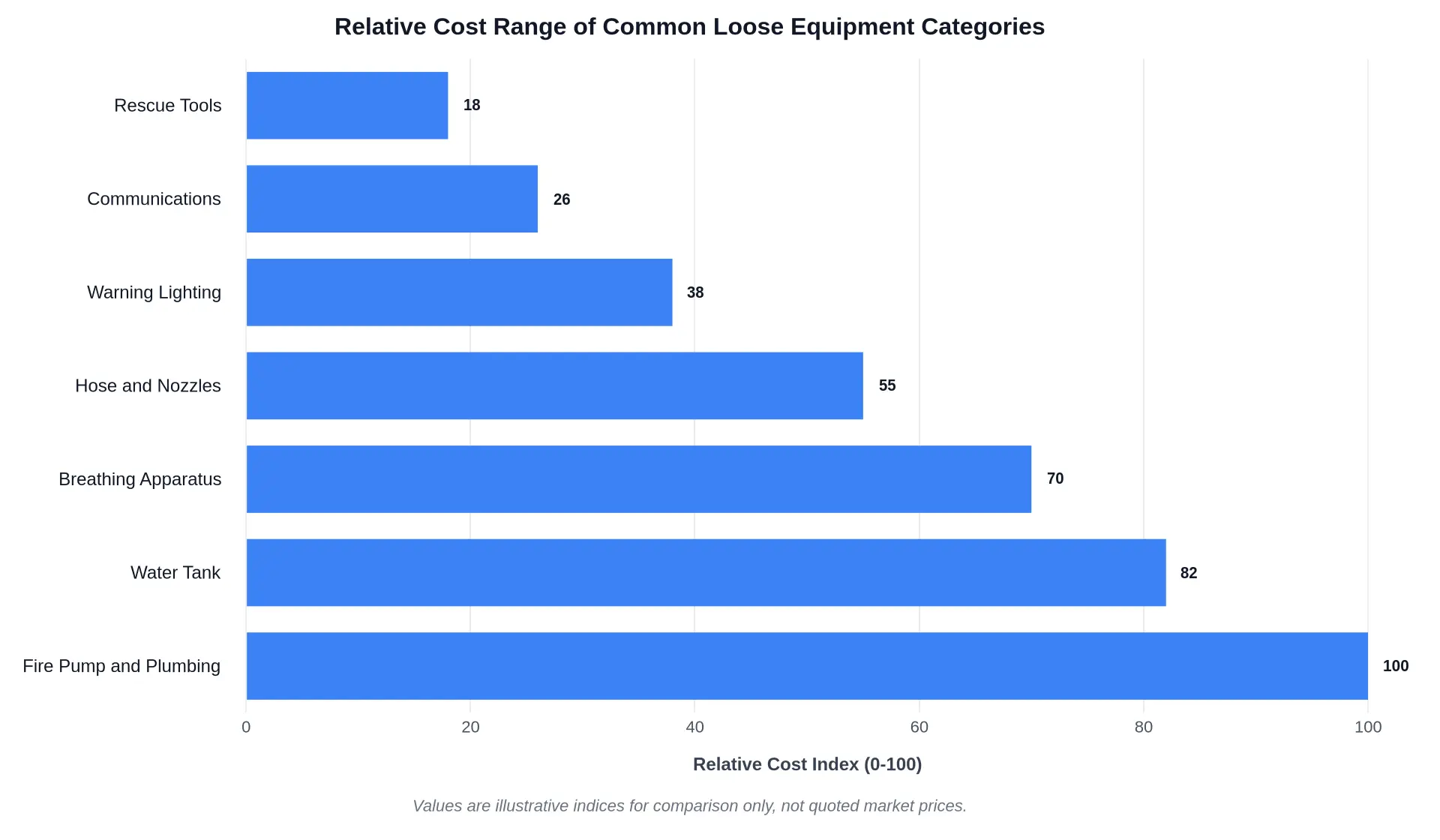
Values are illustrative indices for comparison only, not quoted market prices.
Read the bars as a budget triage tool, not a price list. If your build is heading toward a municipal fleet platform, the top three categories are where sequencing and negotiation pay off: lock the pump specification early, size the tank to the water demand your district actually has, then decide how much breathing apparatus capacity year one can fund.
Total Cost of Ownership: Why Specification Drives Fleet Budgeting
The sticker price is the smallest number in this conversation. Pump maintenance intervals, aerial device inspections, hose replacement cycles and PPE turnover are all set by the specification you choose, and they repeat every year the truck stays in service. A high-flow pump with complex controls can need servicing twice as often as a simpler unit. An aerial ladder adds structural, cable and hydraulic checks that a plain pumper never sees. Consumables behave the same way: hose sets, nozzles, gaskets and turnout gear have finite lives, and premium specifications mean premium replacement parts. Breathing apparatus is the clearest case, since calibration and annual certification costs scale with the number of packs carried and the sophistication of their electronics. None of that appears on the quotation, and all of it lands in total cost of ownership within the first five years.
Spare-parts availability is the quiet line item that decides how long a truck sits idle. A common, locally supported component can be swapped in a day; an exotic import can mean weeks of downtime plus a rental replacement. Training follows the same logic: every extra system adds hours of initial instruction and refresher training, and certified operators are a recurring cost rather than a one-time purchase. Residual value at disposal rewards restraint, because buyers pay more for well-maintained, widely understood configurations than for one-off builds with orphaned parts. Over-specifying therefore costs twice, once at purchase and again every year afterward, while under-specifying pushes the cost into the future, where undersized pumps, thin bodies and cheap hose fail early and force a replacement nobody budgeted for. Sensible fleet budgeting starts by matching specification to duty cycle, and reviewing the municipal and emergency vehicle range against your actual call mix is one way to compare like with like before you commit.
Every specification you add is a purchase you make once and a cost you carry until disposal. Buy the capability your calls actually demand, and be able to name the calls that justify it.
FAQ: Budgeting for a New Fire Truck
Does chassis class or loose equipment have a bigger effect on a new fire truck cost?
Usually loose equipment. Chassis pricing sits inside a fairly predictable band, while equipment lists vary enormously: two departments can choose the same chassis and land tens of thousands apart on pumps, hose, tools and medical gear. Budget the chassis first, then treat equipment as the variable that decides your real number.
What loose equipment items should be prioritized first in a budget?
Fund safety-critical and legally required items first: self-contained breathing apparatus, hose and nozzles, ladders, scene lighting and basic medical response kits. They drive crew capability and insurance compliance. Comfort and convenience items come after. Sort loose equipment into must-have, should-have and later phases, then price each group separately so the trade-offs stay visible during negotiation.
Can equipment be added after delivery to spread cost over time?
Yes. Ordering a fire apparatus with the chassis, body and core systems first, then adding equipment in later budget cycles, is common practice. Confirm that mounting points, wiring and compartment space are provisioned in the original build, because retrofitting that infrastructure costs far more than installing it at the factory. Staggered purchases also make annual approvals easier to pass.
How much contingency should be reserved for specification changes during build?
Reserve 5 to 10 percent of the equipment and outfitting portion, not of the whole contract. Specification changes concentrate in loose equipment as crews refine workflows, and a reserve in that range absorbs typical additions without forcing a re-approval. Label it explicitly, or it gets absorbed into general savings and is unavailable when a genuine change arrives.
How should buyers compare quotes from different apparatus suppliers?
Normalize every quote to the same scope before comparing totals. Ask for itemized lists covering chassis, body, pump and loose equipment, plus delivery, training and warranty terms. A lower headline price often hides a shorter equipment list or excluded services. Compare line items like for like, and get inclusions in writing rather than assuming them.
If you are also evaluating municipal fleet vehicles alongside fire apparatus, review the available municipal vehicle lineup to align specifications and procurement timelines.
Planning the Wider Municipal and Commercial Fleet
If you operate more than one vehicle type, budgeting fire apparatus as a standalone line item quietly costs money. A pumper bought alongside street sweepers, waste trucks and delivery vehicles is a very different negotiation from a pumper bought alone: shared chassis platforms, shared service intervals, one parts inventory, one driver-training programme. Departments that start with the full municipal vehicle range in front of them write better specs, because they can see where components overlap and where they genuinely cannot.
The overlap is mostly a matter of specification discipline. Writing a tight fire-apparatus spec means settling pump capacity, tank size and, crucially, the loose equipment allowance before the order is signed. The same habit transfers to road cleaning equipment (sweeper width, water capacity, hopper volume) and to solid waste and liquid waste units (compaction ratio, tank lining, tipping mechanism). Suppliers notice when a buyer arrives with written specs, and they price accordingly.
On the commercial side the categories are just as connected. Cargo box and trailer options share chassis and running gear with dump trucks, while tow trucks and loader cranes sit on the same body-builder relationships you already lean on for fire apparatus. Standardising hydraulics, lighting looms and telematics across the whole yard cuts training time, spares holding and downtime.
In practice: build a three-to-five year replacement calendar covering every category, group orders where volumes justify it, ring-fence a contingency for loose equipment on each unit, and negotiate framework agreements instead of one-off deals.
Chassis class sets the starting price. The equipment built onto and into the body drives the real budget. Plan fire apparatus inside that wider fleet picture, and the categories downstream get easier to cost, fund and defend.