

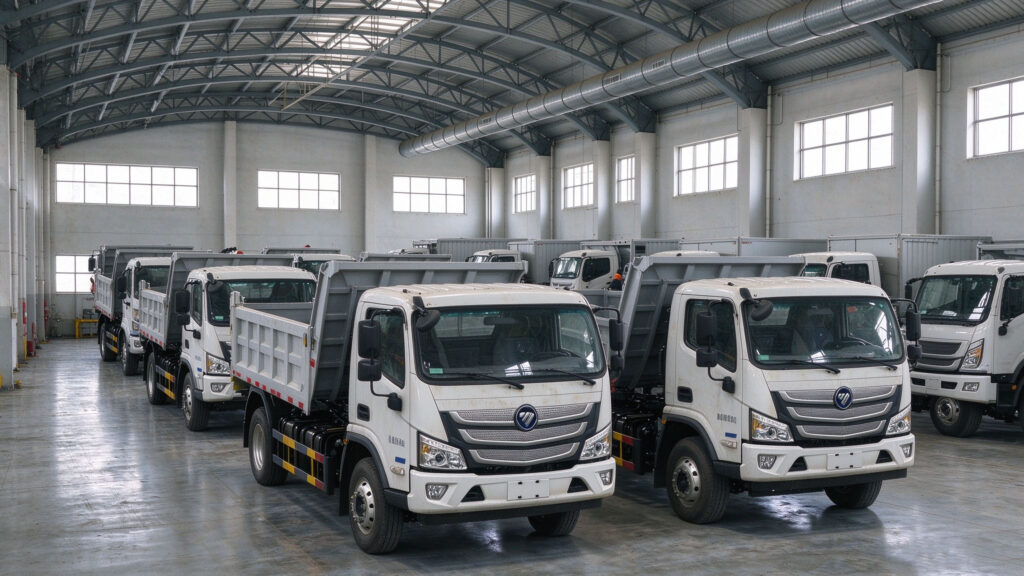
China tipper truck sourcing risks and factory audits
Buying a garbage tipper truck from China has become a routine move for municipal fleets and private contractors. The price gap is real, the manufacturing base is deep, and lead times are often shorter than local alternatives. The same market that rewards careful buyers can punish impatient ones, though. This guide walks through the risks that actually surface after the container is unloaded, and the factory-audit steps that separate a dependable supplier from a polished brochure.
Why buyers look at China first
Chinese commercial-vehicle plants have spent two decades building scale. A tipper – the hydraulic rear or side lift that tips a bin or container – is no longer a boutique item there; it is a catalogued, repeatably manufactured component mounted on chassis from established builders. For a fleet manager under budget pressure, that translates into a lower capital cost per unit and a wider choice of body sizes than many regional markets offer.
The second pull is customization. Because so many small and mid-size workshops sit inside the same industrial clusters, you can specify bin volume, lift geometry, and controls without the long engineering lead time a domestic OEM might quote. The third is the component ecosystem: cylinders, valves, and steel sections are sourced locally, which keeps both price and repair logistics simpler once the truck is in service. None of these advantages disappear if you buy carefully; they simply stop being free.
The risks that show up after delivery
The pleasant part of a Chinese purchase is the quotation. The harder part is everything that happens between the deposit and the first year of operation. The patterns below are the ones buyers report most often, and none of them is rare. Each one is cheaper to prevent than to repair.
Spec drift. A truck arrives with a thinner steel section, a smaller cylinder, or a different pump than the approved sample. Individual differences look minor on paper and matter a lot under a loaded bin. Certification mismatch. A CE mark or an ISO certificate is presented but does not map to the exact model, or the emissions level does not match the destination market. After-sales gaps. Spare parts are promised available for years and then the contact goes quiet after the warranty window. Subcontracting. The factory you audited is not the one that built your unit; the order was quietly pushed to a neighbor with looser process control. Logistics damage. Poor blocking and bracing inside the container turns a perfect truck into a dented one by the time it reaches the port.
What a factory audit should actually check
An audit is not a factory tour with coffee. It is a structured look at whether the workshop can build the truck it claims to build, repeatedly, to the standard on the order. The points below are the ones worth writing into your checklist before you book the visit, because they are where most failures hide.
Start with the basics: a valid business license, an export qualification, and a tax registration that all line up. Then move to the floor. Watch whether welding uses fixed jigs or freehand alignment, because repeatability lives or dies there. Ask how in-process quality checks are recorded – a workshop that writes down torque values and weld inspections is different from one that inspects by eye at the end. Confirm the donor chassis brand and model, since a mismatch there changes the whole compliance picture. Finally, ask for the test reports: a loaded hydraulic cycle test and a tilt test performed on a unit from the actual production line, not a showroom demonstrator.
| Audit area | What to verify | Pass signal |
|---|---|---|
| Business & export status | Valid license, export qualification, tax registration | Documents current, export record verifiable |
| Production process | Welding jigs, fixture repeatability, in-process QC | Documented steps, not ad-hoc |
| Chassis sourcing | OEM brand and model of donor chassis | Matched to order, traceable |
| Component traceability | Cylinder, valve, pump brands and batch numbers | Recorded per unit |
| Testing | Load test, tilt test, hydraulic cycle count | Report per batch |
| Reference customers | Repeat export buyers in similar markets | Named, contactable |
Documents to request before you fly
A good share of audit work can be done from your desk if you ask for the right papers first. Request these before committing to travel, because a supplier that stalls on documents will stall on far more later.
- The business license and export qualification, both current and legible.
- The model-specific certificate tied to the exact vehicle code you intend to buy.
- The chassis certificate and emissions level for the destination market.
- Two reference customers in a market comparable to yours, with contact details.
- A sample quality-control record from a recent production batch.
- The bill of materials for the configuration you specified.
How to run the audit without flying blind
You do not need to board a plane to get useful signal, but you do need a method. Start by requesting the document set in writing: business license, export license, the exact certificates tied to the model code, and at least two reference customers in a market comparable to yours. A supplier that cannot produce a model-specific certificate is telling you something even if the brochure looks great.
For the physical check, decide between an on-site visit and a third-party inspection. An on-site visit is best for a first large order; a qualified third-party inspector with a written protocol is a sensible substitute for repeat or smaller buys. Either way, ask for a loaded hydraulic cycle test on a unit off the actual production line, not a showroom demo. Watch whether the weld seams are consistent, whether the cylinder mounts sit square, and whether the control labels are legible and in a language your operators can use.
Payment structures that protect you
The deposit schedule is where leverage lives. A common and reasonable pattern is a modest deposit to reserve capacity, a progress payment released against a passed pre-shipment inspection, and a balance held until the container is loaded and the documents are in your hand. Tying the largest portion to the inspection pass – rather than to the booking date – keeps the supplier motivated to actually meet the standard. Avoid any structure that asks for most of the value up front with vague delivery promises; that is the single most reliable predictor of a bad outcome.
Total cost of ownership beyond the sticker
The purchase price is the smallest number that matters. Freight, insurance, import duties, and local compliance work add a meaningful slice before the truck ever works a route. After that come the operating costs: hydraulic oil, cylinder seals, weld repairs, and the spare-parts pipeline. A unit that is twenty percent cheaper to buy but impossible to source seals for will cost more by the second year. When you compare quotations, compare the landed, supportable cost – not the factory gate number.
A practical pre-order sequence
- Collect documents and certificates tied to the exact model code.
- Request two reference customers in a comparable market and actually call them.
- Commission a third-party inspection or plan an on-site audit with a written protocol.
- Agree a payment schedule that holds the balance against the inspection pass.
- Order one pilot unit before committing to a full fleet batch.
Where the problems actually come from
When buyers catalogue what went wrong after delivery, the causes cluster in predictable places. Build quality and specification drift lead, followed by documentation and after-sales issues. Compliance and homologation sit lower in frequency but are the most expensive to fix once a truck is rejected at import, because the remedy is rarely a local repair.
Figure 1. Relative share of post-delivery sourcing problems by root cause, based on aggregated buyer reports.
The same numbers in a form you can copy into a spreadsheet or a procurement note:
| Cause of sourcing problem | Share of cases (%) |
|---|---|
| Documentation & certification gaps | 24 |
| Build quality / spec drift | 28 |
| Logistics & container booking | 18 |
| After-sales & spare parts | 19 |
| Compliance / homologation | 11 |
Frequently asked questions
Do I need to visit the factory in person?Not for every order. A written document set plus a qualified third-party inspection covers most repeat and mid-size buys. Reserve the on-site visit for a first large batch or when the specification is unusual.
What certificate actually matters for a tipper truck?
It depends on the destination market, but the useful ones are a model-specific CE or local type-approval, an ISO 9001 quality system, and an emissions certificate that matches the chassis. Generic, model-less certificates are weak evidence.
How much should I hold back as a balance payment?
Enough to matter: a common pattern is a deposit, a progress payment against a passed inspection, and a balance released after the pre-shipment check rather than at booking. Tie the balance to the inspection pass, not the ship date.
Is a lower price always a red flag?
No, but a price far below comparable quotes usually means a thinner steel section, a smaller cylinder, or a subcontracted build. Ask what changed in the bill of materials to produce the saving.
What is the single most useful audit step?
A loaded hydraulic cycle test on a unit taken from the live production line, paired with a call to a reference customer in a market like yours. Those two steps expose most of the real risk.
Should I buy a pilot unit first?
For a fleet order, yes. One unit in your own depot reveals more about real build quality, parts availability, and operator fit than any factory tour, and it costs a fraction of a bad batch.