

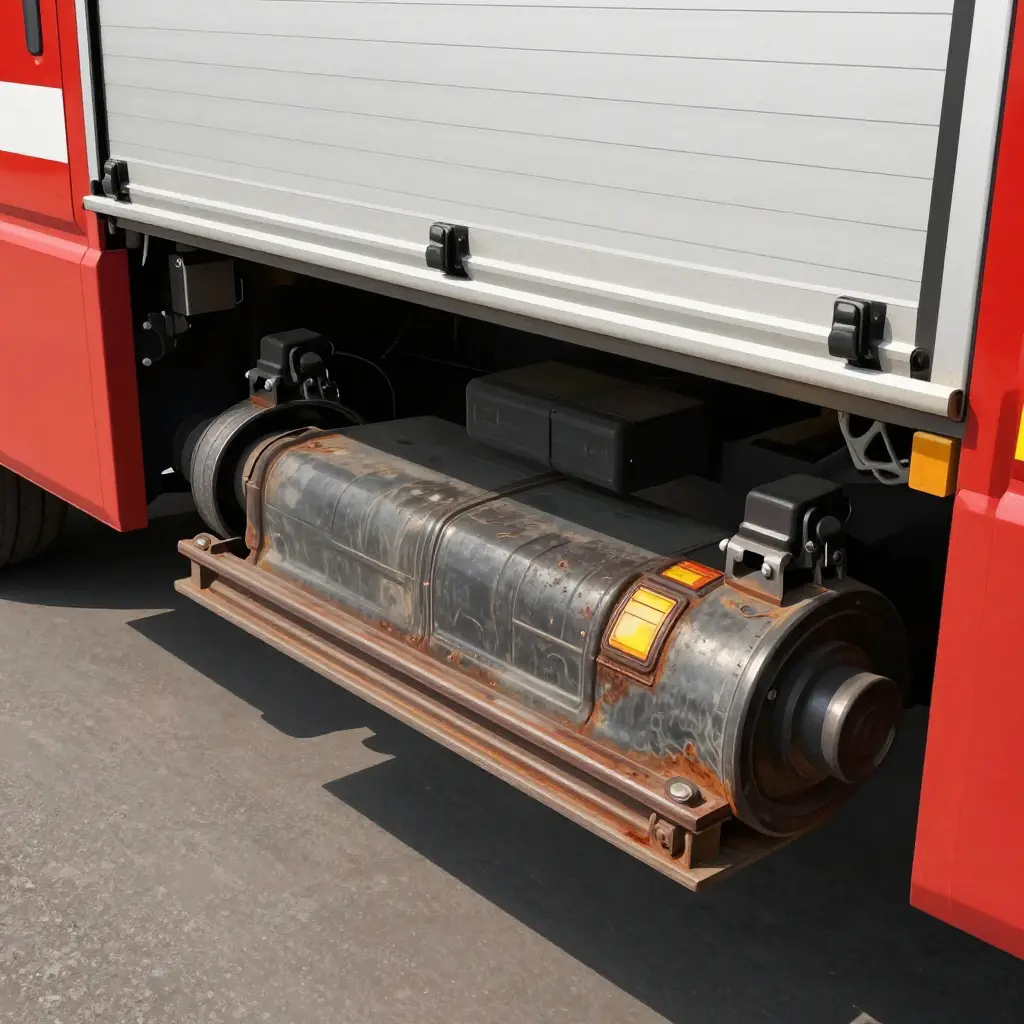
The Real Driver of Compartment Seal Failure
Compartment seals on rescue truck roll-up doors fail primarily because of track corrosion, not worn latches. For anyone maintaining these doors, that is where diagnosis should start, and it changes which parts get inspected first.
A seal only holds if the door panel sits square in its rails. Once the track corrodes, the panel drifts out of line, the gasket compresses unevenly, and water, dust, and road debris begin finding a way into the compartment.
A worn latch affects only the clamping force at the moment of closing. It has no control over how the panel travels sideways or up and down. Replace and readjust the latch as often as you like; the seals will keep failing while the track stays corroded.
That order matters when you plan maintenance. Treating the track extends seal life directly. Replacing the latch by itself treats a symptom.
For fleet managers responsible for municipal vehicle inventories, evaluate track condition first and latch wear second. That puts the repair budget behind the component that actually decides when these doors stop sealing.
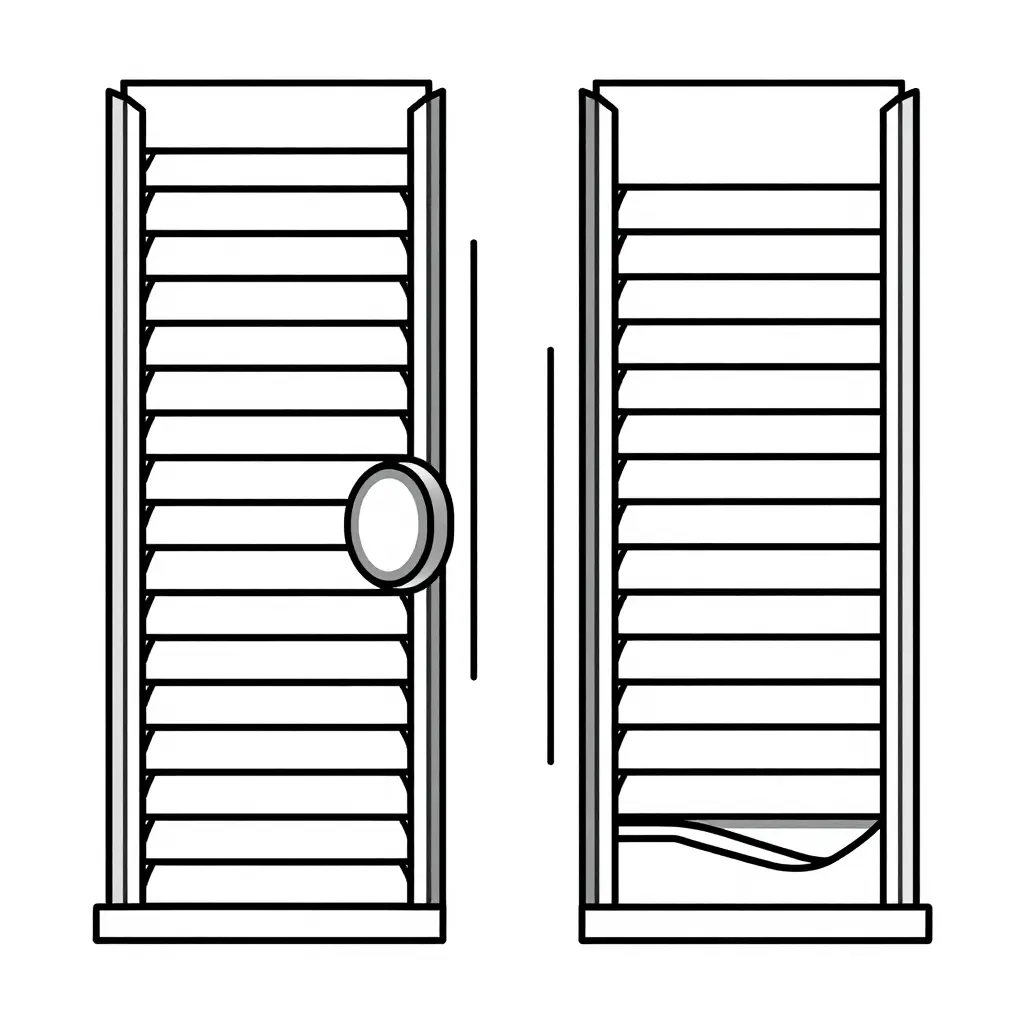
Why Worn Latches Are Misdiagnosed
When a compartment seal fails on a rescue truck roll-up door, the latch is the first thing anyone inspects. It is the most accessible part of the assembly, the cheapest, and the easiest to see. A stretched strike, a loose keeper, or a tired spring announces itself the moment you grab the handle. That is exactly why worn latches absorb so much diagnostic attention.
The trap is treating a symptom as the root cause.
A worn latch produces one defect: reduced clamping force. A slack latch lets the door panel lift a few millimeters off its gasket, which weakens compression but rarely breaks a sealed cargo box seal along its whole length. A corroded track does worse. As the roller path rusts and pits, the panel rides high and out of plane for its entire travel, so the gasket never seats evenly anywhere. The latch is only following the door. It reports the problem; it does not create it.
Replace the latch and the door closes tighter for a week or two. The corrosion underneath keeps growing.
That is why the leak comes back so reliably on rescue truck roll-up doors. A latch swap is quick and satisfying: it restores just enough clamping to hide a deeper track defect until the next heavy wash or hard freeze. The worn latch was never the cause, only the most visible clue.
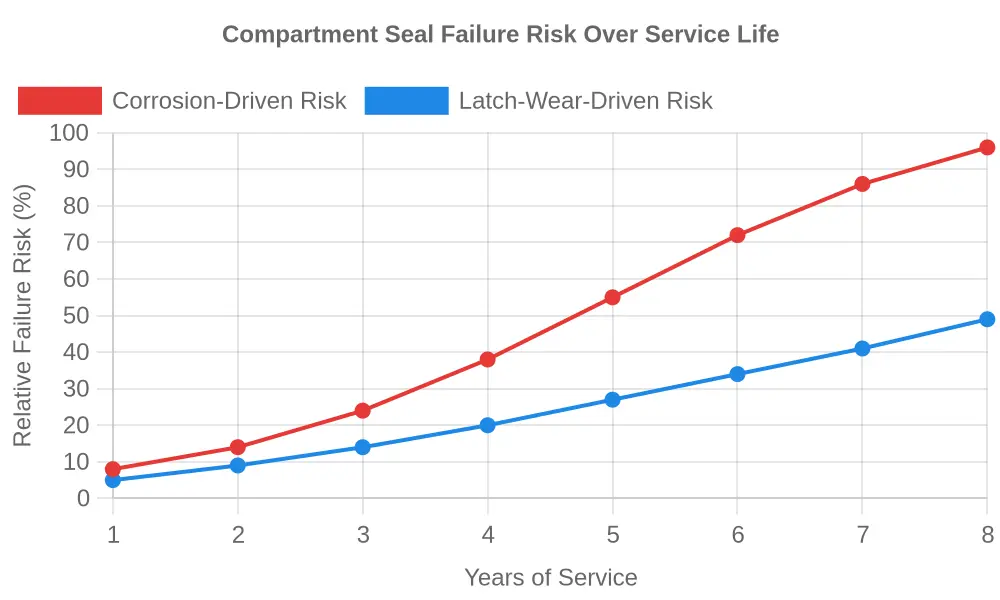
Track Corrosion: The Hidden Root Cause Behind Compartment Seal Failure
Leaks get blamed on the latch, but on most rescue truck roll-up doors the latch is just delivering the news. Track corrosion is the actual driver, and understanding how it develops tells you when the seals will go.
How Corrosion Actually Begins
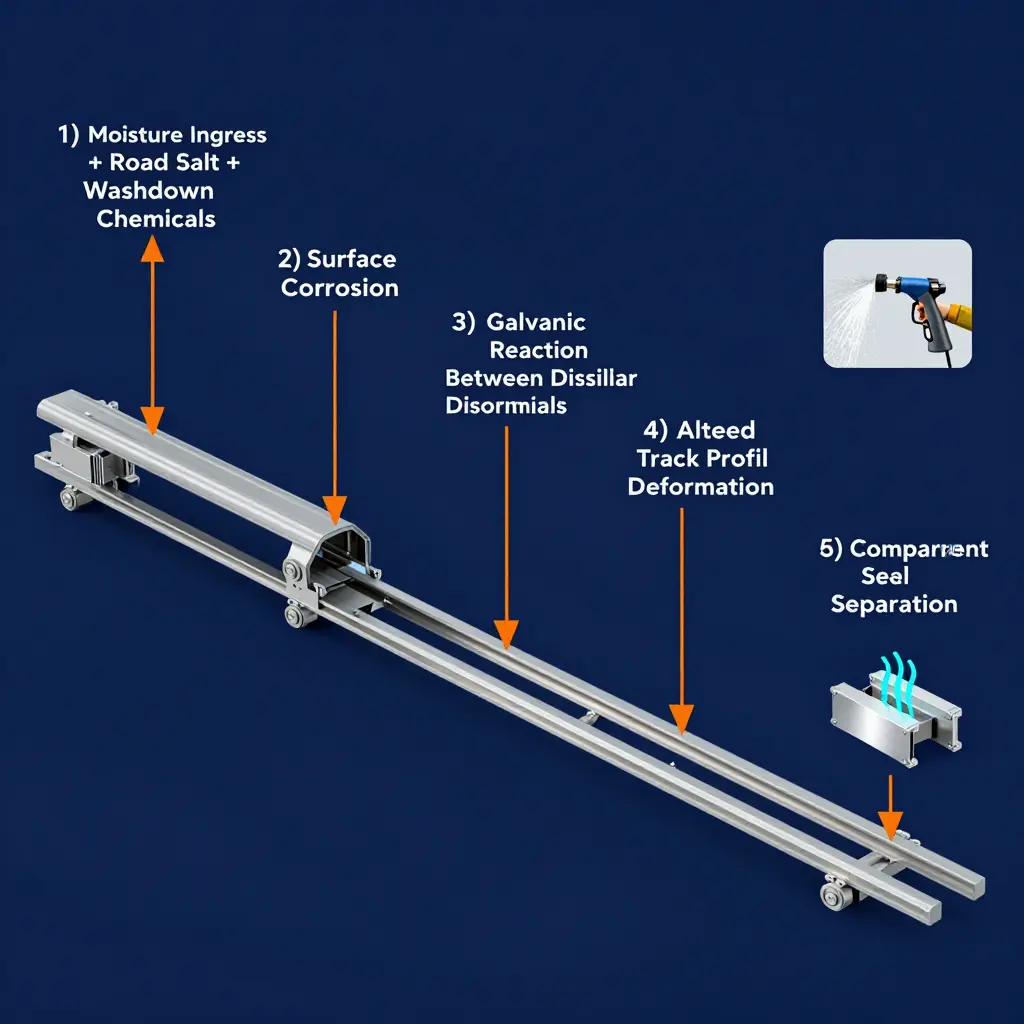
Corrosion rarely starts on the outside face of the track. It starts at the interfaces, and four things drive it:
- Moisture ingress – standing water collects in the lower track curve and behind the mounting flange, where drainage is poor and ventilation is worse.
- Road salt exposure – de-icing brine deposits chloride on the track face, accelerating oxide formation with every door cycle.
- Washdown chemicals – alkaline and acidic detergents strip protective coatings and etch bare metal, leaving it open to repeat attack.
- Galvanic reaction between dissimilar metals – steel tracks bolted to aluminum door panels create a small but persistent current; the less noble metal corrodes preferentially at every contact point.
Together they turn a protective finish into a pitted, porous surface long before anyone notices the door sagging.
The Cause-and-Effect Chain
Surface corrosion is only the first stage. Once pitting sets in, the rest follows in order:
- Surface corrosion roughens the track wall and increases friction.
- Track profile deformation follows as rust expansion and mechanical wear distort the original guide geometry.
- Altered door travel appears as binding, roller chatter, and uneven lifting.
- Seal separation occurs when that misaligned travel pulls the door edge away from the gasket face.
Why This Determines Seal Failure Timing
A seal needs flat, repeatable contact between door and frame. A deformed track breaks that contact, which makes seal failure a question of geometry rather than gasket age. Replace a latch and you reset the symptom; fix the track and you reset the cause. For fleet managers specifying durable apparatus, corrosion-resistant track assemblies and compatible metal pairings are worth prioritizing to extend seal life. See how robust municipal emergency apparatus is built to resist this failure path.
The table below separates what you see from what actually causes it. Read it left to right: start at the visible indicator, resist the urge to stop at the “apparent cause,” and let the actual root cause and diagnostic priority set the repair order. On a roll-up compartment door, the loudest symptom is rarely the part that started the failure.
| Failure Indicator | Typical Symptom | Apparent Cause | Actual Root Cause | Diagnostic Priority |
|---|---|---|---|---|
| Worn latches | Door pops open in transit; latch handle feels loose and won’t engage with a firm click | Latch has reached end of service life | Corrosion-driven fastener creep and track resistance force the latch out of alignment, so the springs never fully seat and latch wear accelerates | Medium – confirm smooth track travel before condemning the latch |
| Track corrosion | Door binds and needs two hands to move; rollers scrape and the metal squeals | Worn rollers or a stretched counterbalance spring | Road-salt and wash-water corrosion swells the vertical track channel, cutting roller clearance and loading every downstream component | High – inspect first; the primary driver of latch and seal failure |
| Seal hardening | Water intrusion, drafts, and condensation inside the compartment; visibly cracked rubber | Seal material simply aged out | UV exposure plus accelerated oxidation from constant micro-movement of a corrosion-binding door; new seals fail again if track drag remains | Medium – replace only after track and alignment are corrected |
| Slat misalignment | Crooked door edge, gaps between slats, uneven contact with the seal | Impact damage to a single slat | Differential corrosion or grit in one track leg pulls the curtain off-square, so slats ride out of parallel | High – measure track parallelism before straightening slats |
| Counterbalance spring failure | Door slams down or is extremely heavy to lift | Broken or tired spring | Extra friction from a corroded track over-cycles the spring and fatigues it prematurely | Medium – verify track friction before replacing |
| Roller wear / flat spots | Grinding noise, roller flats, jerky travel | Low-grade rollers | Corroded track groove stops rollers rotating, so they slide instead of roll and develop flat spots | Low-Medium – a symptom, not the source |
To separate track corrosion from worn latch wear before you commit to parts or labor, work through these steps in order.
- Document the leak pattern. Check the seals around the full perimeter and note where contact is lost. A uniform, even gap points to seal compression fatigue; one concentrated breach points to something mechanical, such as a latch or the track.
- Actuate the latch under load. Cycle each latch slowly and watch whether the panel draws flush to the frame. A latch that engages but will not pull the panel tight points to the latch rather than the seal.
- Examine the door track. Inspect the vertical and horizontal track surfaces for rust bloom, pitting, and scale buildup. Swelling, flaking, or a rough texture means active corrosion is keeping the door from seating evenly.
- Measure track clearance. Use a feeler gauge between the roller and the track channel to measure the gap. Excess clearance caused by corrosion scale confirms that the track, not the hardware, is displacing the door.
- Run a free-travel test. With the latch disengaged, roll the door through its full range and listen for binding or hesitation. Resistance that concentrates in one section usually means localized corrosion.
- Compare the two conditions directly. Reconcile what you found. If the latch closes firmly and the gap remains, the track governs the failure. If the gap follows the latch position, the latch is decisive.
- Trace the corrosion origin. Check welds, drains, and fasteners for the moisture paths feeding the track, so you can fix the source instead of replacing seals again.
- Record and prioritize the verdict. Log which condition caused the breach and fix that first. Replacing a latch while the track stays corroded only buys more downtime. Technicians servicing enclosed compartment systems can review recommended build specifications at these enclosed compartment solutions for reference.
Maintenance and Prevention Best Practices for Track Corrosion on Rescue Truck Roll-Up Doors
Track corrosion drives most compartment seal failures, and it starts wherever water lingers. Every cycle over a roughened surface speeds it up. Once pitting takes hold, the rollers drag, the panel misaligns, and the seals stop seating. The leak you blamed on a worn latch usually leads back to the track.
Establish defensible inspection intervals
Set intervals and keep to them. Log every result so trends are visible instead of reacting to failures as they appear.
| Interval | Action | Why it matters |
|---|---|---|
| Weekly | Visual scan for rust bloom, bubbling paint, debris | Catches early track corrosion before pitting |
| Monthly | Cycle every door; feel for drag and chatter | Detects roller-to-track interference early |
| Quarterly | Measure track straightness and roller clearance | Confirms alignment before seals distort |
| Annual | Remove doors; inspect hidden track and fasteners | Reveals concealed corrosion water leaves behind |
Clean and drain the track
Flush the tracks with fresh water, then clear every drain slot and weep hole. Debris holds moisture, and water that cannot drain sits against bare metal and creeps under the coating.
Apply protective coatings
Once the track is clean and dry, apply a zinc-rich primer and a flexible topcoat rated for road-salt exposure, then recoat wear points annually. Prep work matters as much as the product: a coating will not hold on dirty or damp steel.
Choose corrosion-resistant materials and specs
Specify stainless or galvanized tracks with sealed rollers and integrated drainage channels. Require compartment seals that shed water away from the track, not into it. When you source rescue truck roll-up doors and related components, buying to a corrosion standard costs less than repairing the result later. Fleet managers evaluating municipal-grade platforms can review municipal fleet build solutions built to hold up under constant washdown and salt spray.
Frequently Asked Questions: Track Corrosion vs. Worn Latches on Rescue Truck Roll-Up Doors
Why do rescue truck roll-up doors bind even when the latches look intact?
Binding is almost always a track symptom, not a latch one. Corrosion builds along the guide rails and raises the friction the panel has to overcome. As the rollers drag over rust scale and pitting, the door stops seating squarely, and the latch is left to compensate for the misalignment. In most cases the latch is only a bystander: the door simply cannot travel smoothly enough for it to engage cleanly.
How does track corrosion accelerate compartment seal failure?
Corrosion keeps the panel from dropping into its fully closed position. Stop a few millimeters short and the compression seal never gets the load it needs to stay watertight. Road spray and contaminants reach the seals continuously, and once failure begins, the rubber degrades faster than normal wear would suggest. That is why a corroded track shortens seal life far more than latch wear alone can.
What diagnostic signs separate worn latches from track corrosion?
Check travel first. Scrape the track interior and look for rust scale, pitting, and uneven roller wear, which point to the track. A worn latch usually shows up as a loose handle, elongated striker holes, or a door that closes with a soft rattle but still slides freely. If the door drags before it reaches the latch, the track is your root cause. If it glides easily but will not hold closed, suspect the latch.
Can replacing worn latches stop compartment seal failure?
Rarely on its own. New latches may improve holding force, but if the track is still corroded the panel will not square up to the frame, so the seals stay under-compressed and keep leaking. Replacing the latch without fixing the track masks the symptom while the misalignment keeps driving seal failure. Treat the track as the primary system and the latch as secondary.
How does track maintenance extend seal life?
Cleaning and lubricating the guide tracks lets the panel travel fully, so each seal compresses evenly against the frame. Regular inspection catches rust scale before it pits the rail and keeps alignment accurate. When travel is correct, the latches engage with little strain and the seals stay loaded as designed, which extends service life and cuts emergency repairs across the fleet.
The Verdict: Track Corrosion Decides, Not Worn Latches
When a rescue truck roll-up door finally leaks, the worn latch is almost never the cause. It is the symptom that draws the eye. The deciding factor is track corrosion.
The chain runs like this: corrosion narrows the channel and raises rolling resistance; the extra resistance makes the door skew and ride unevenly; the skew then loads the seal edges unevenly, and the seal begins to fail at the point of greatest distortion. The latch is simply doing its job against a door that no longer travels true. Replacing it fixes nothing.
The Diagnostic Takeaway
- Track first, latch last. Check the channel for pitting, scale, and debris before blaming the hardware.
- Seal failure is a downstream event. Treat a failed seal as evidence of a misaligned door, not an isolated part failure.
- Corrosion is progressive. Catching the track early prevents the cascade that ends in new seals.
For fleet managers balancing uptime across a whole vehicle portfolio, this changes where maintenance dollars should go. Track condition is the leading indicator; the seal is the lagging cost. Put inspection labor and protective treatment on the track, and latch and seal replacements become the exception rather than the routine.
CRRC’s work in fleet vehicle solutions covers municipal platforms, including road cleaning vehicle maintenance and municipal fleet upkeep. The same principle applies here: durable mechanical design and routine component care keep working vehicles in service. Treat the track as the root cause, and the rest of the door assembly follows.