

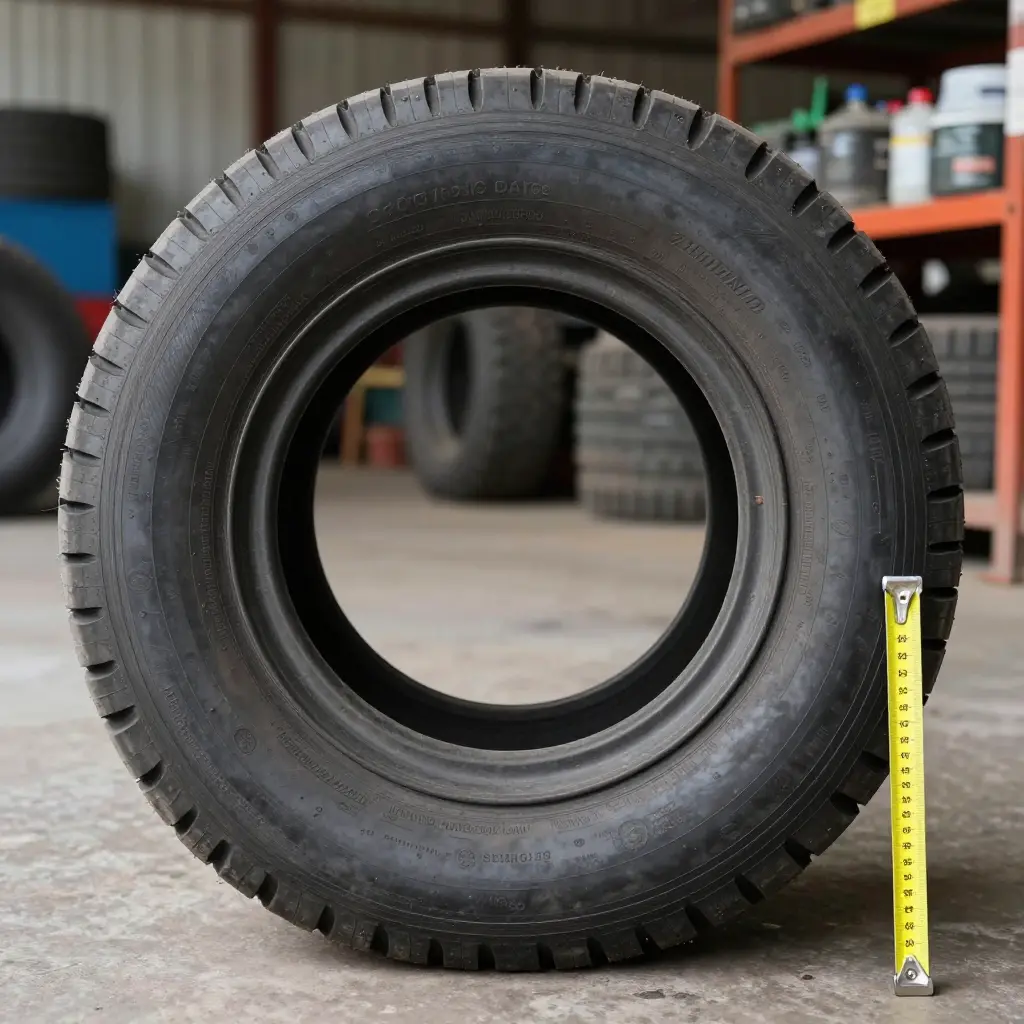
Why Tire Age, Not Tread Depth, Decides Rollout
On used apparatus, tire DOT age, not remaining tread depth, is what decides whether a unit can safely go out. A truck can arrive with matched tires and deep grooves and still be unfit for service that day.
Tread depth records wear, not time. Rubber hardens as it ages whether or not the vehicle turned a wheel, so a lightly used unit can sit for years on full-tread tires with expired rubber, while a hard-worked unit may run thin tires that are only three or four years old.
Every tire built since 2000 carries a four-digit DOT date code molded into the sidewall: the week and year of manufacture. Reading that code on each tire, spare included, takes a few minutes and gives you something concrete to accept or reject a unit on.
Age limits vary by manufacturer and application. Most fleets work to a seven-to-ten-year window, and a tire past it is a replacement candidate even if it looks new. For anyone evaluating used municipal apparatus, that reading shifts both the purchase price and the rollout date.
The sections below cover reading the code, where age limits and tread minimums diverge, and how to fit a tire age check into a pre-rollout inspection.
Reading the DOT Date Code Before You Trust the Tread
Start with a flashlight and the sidewall. The DOT date code sits inside an oval stamp at the end of the DOT serial string, usually low on the sidewall near the bead. The last four digits are what you need: the first two give the week of manufacture, the last two the year. A code ending in “2319” was built in the 23rd week of 2019. Find only three digits and you should stop there, because that format predates the 2000 change and puts the tire at a quarter-century old at minimum. Treat it as expired regardless of how much rubber is left. On a used unit, this is the only reliable age record built into the product itself.
Check both sidewalls. The full code is molded on one sidewall only, so a tire mounted in reverse hides its own birthday. If the complete stamp appears on just one face, the casing has been flipped, and the opposite sidewall needs a physical look before that tire goes into a purchase. Both faces should carry a matching, legible code; anything buffed away or unreadable should be assumed older than the seller says.
Tread depth answers a different question. A technician pushes a gauge into the main circumferential grooves at several points, usually the center rib and both shoulders, and records the lowest reading, since uneven wear says something about alignment and inflation habits. Depth tells you how much rubber remains. It says nothing about how long that rubber has been curing in the sun, so a tire can measure a healthy 18/32 inch and still be past its service window. A passing tread measurement documents wear; tire DOT age documents what has happened to the casing, the belts, and the compound. Approve on the code and use depth only to price the remaining life. If you are sourcing replacements, our municipal apparatus inventory can supply sidewall photos before you commit.
| Criterion | Tread Depth: What It Tells You | Tread Depth: How to Act | DOT Age: What It Tells You | DOT Age: How to Act |
|---|---|---|---|---|
| What it physically measures | Rubber left above the wear bars, in 32nds of an inch | Gauge it at three points across the tread | Week and year the tire was built, from the DOT code’s last four digits | Read the sidewall code and convert it to a calendar date |
| Failure mode it detects | Tread worn down: hydroplaning, heat buildup, lost traction | Replace below 4/32 in on steer axles, 2/32 in elsewhere | Compound aging: sidewall cracking, hardening, belt separation | Remove from service at the fleet age limit, whatever the tread reads |
| What it cannot detect | Age-related hardening, cracking, internal belt decay | Never treat deep tread as proof of a sound casing | Real miles, load history, sun or ozone exposure | Pair the build date with a physical casing and sidewall inspection |
| Recommended inspection frequency | Every PM interval and before each rollout | Record the reading at every PM | At acquisition, then every 90 days in service | Age out at purchase; re-verify at each annual audit |
| Documentation for an audit trail | Gauge readings by wheel position, date and inspector initials | File with the unit’s PM record | Photo of each DOT code, decoded build date, replacement schedule | File with the unit’s title and service records |
| Mixed-age sets on the same axle | Mismatched diameters strain the differential and ABS | Match depth within 2/32 in across an axle | The oldest tire caps the safe life of the whole axle | Age the axle by its oldest tire; replace as a set |
| Verdict | A wear indicator, not a rollout gate | Drives rotation and wear-based replacement | Controls whether the apparatus rolls at all | DOT age governs rollout approval; tread depth governs rotation and replacement |
Where to Look Before You Read the Checklist
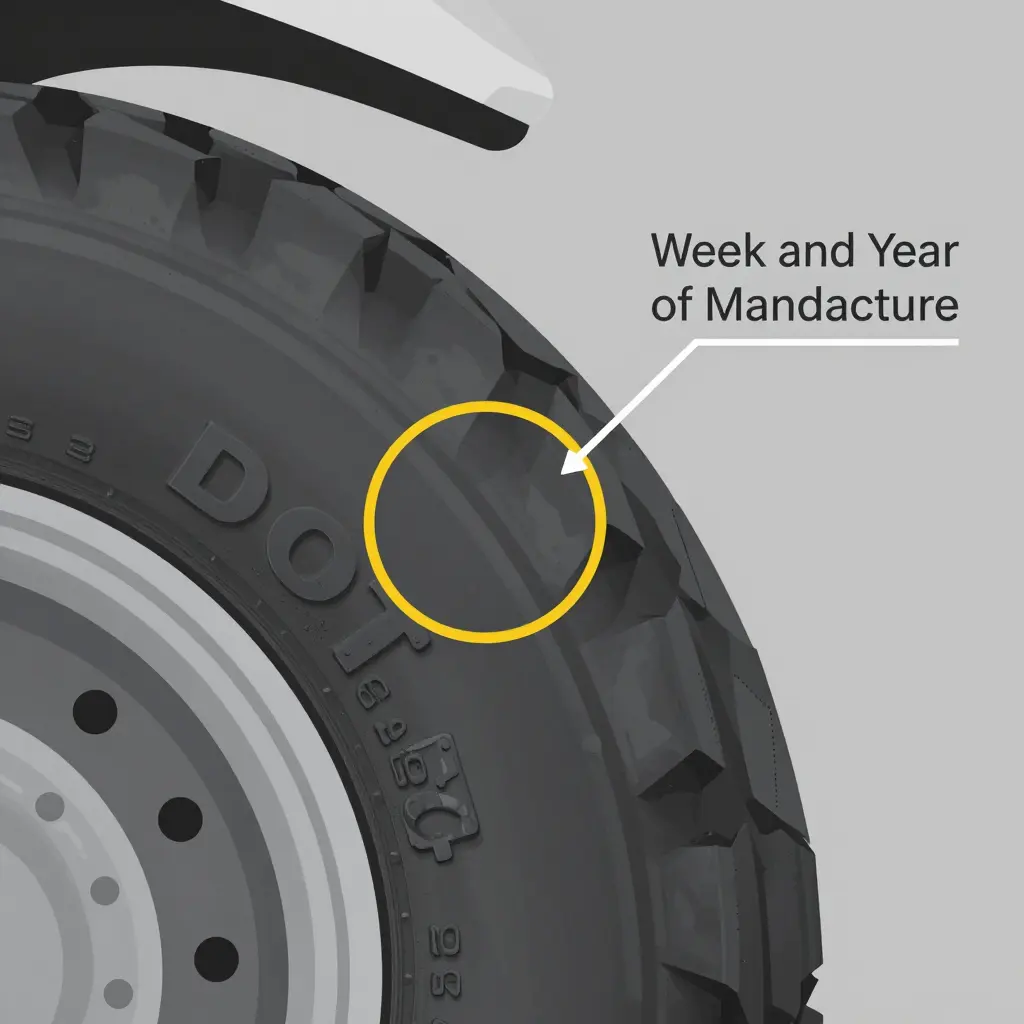
Before you reach for a tread gauge, get your eyes in the right place. The diagram marks three spots to check on every used apparatus tire: the DOT date code stamped in the sidewall, the tread band itself, and the bead and sidewall shoulder where the tire seats against the rim.

Work through them in that order. Sidewall first for the age stamp, tread second for the wear pattern, shoulder third for cracking and seating damage that no tread measurement will surface. Once you can find all three without hunting, the checklist below reads like a walkaround rather than an exam.
What Aged Rubber Does to a Used Apparatus Tire
Tread depth is the number most buyers check, and it says almost nothing about whether a truck is safe to send out. Tire rubber is a formulated compound with a shelf life, not just a wear surface. Long before the lugs look thin, aged rubber is changing chemistry, and every one of those changes lands on the owner’s balance sheet as downtime, damaged equipment, or liability.
- Oxidation and loss of elasticity. Oxygen and ozone break polymer chains in the compound year after year, so the rubber stops flexing and starts cracking. A tire that will not flex cannot follow the road, and a blowout on a scheduled route leaves a crew standing idle and a revenue day gone.
- Sidewall hardening. Plasticizers and waxes migrate out of the sidewall as it ages, leaving a stiff, brittle shell that cracks under the flexing of normal duty. Clipping a curb or a loading dock edge that a supple tire would absorb can turn into a sidewall failure with a loaded body behind it.
- Reduced wet grip. A hardened tread compound loses its bite on a water film, so stopping distances grow exactly when the load and the weather are already working against the driver. That is how a handling preference becomes a property claim or a collision report.
- Heat cycling in the casing. Every duty cycle heat-soaks the casing and lets it cool, and each cycle leaves the steel and fabric reinforcement a little more fatigued. Repeated heat history weakens the structure that actually holds the air in.
- Lost load margin. A fatigued casing once rated for full axle load gradually loses the reserve that absorbs potholes, curbs, and overloaded days. The margin disappears quietly, and it disappears first on the tires working hardest.
None of this shows up in tread appearance, and casing integrity cannot be confirmed by any measurement you can take in a yard. A tire can pass a tread gauge and a visual walkaround and still be years past its safe service life. That is why the date code belongs in every pre-delivery inspection of a used apparatus and in every fleet safety audit. When you evaluate municipal used apparatus, ask for the DOT codes before you ask about tread. A few hundred dollars of rubber is cheap next to an unplanned roadside failure with a crew and cargo behind it.
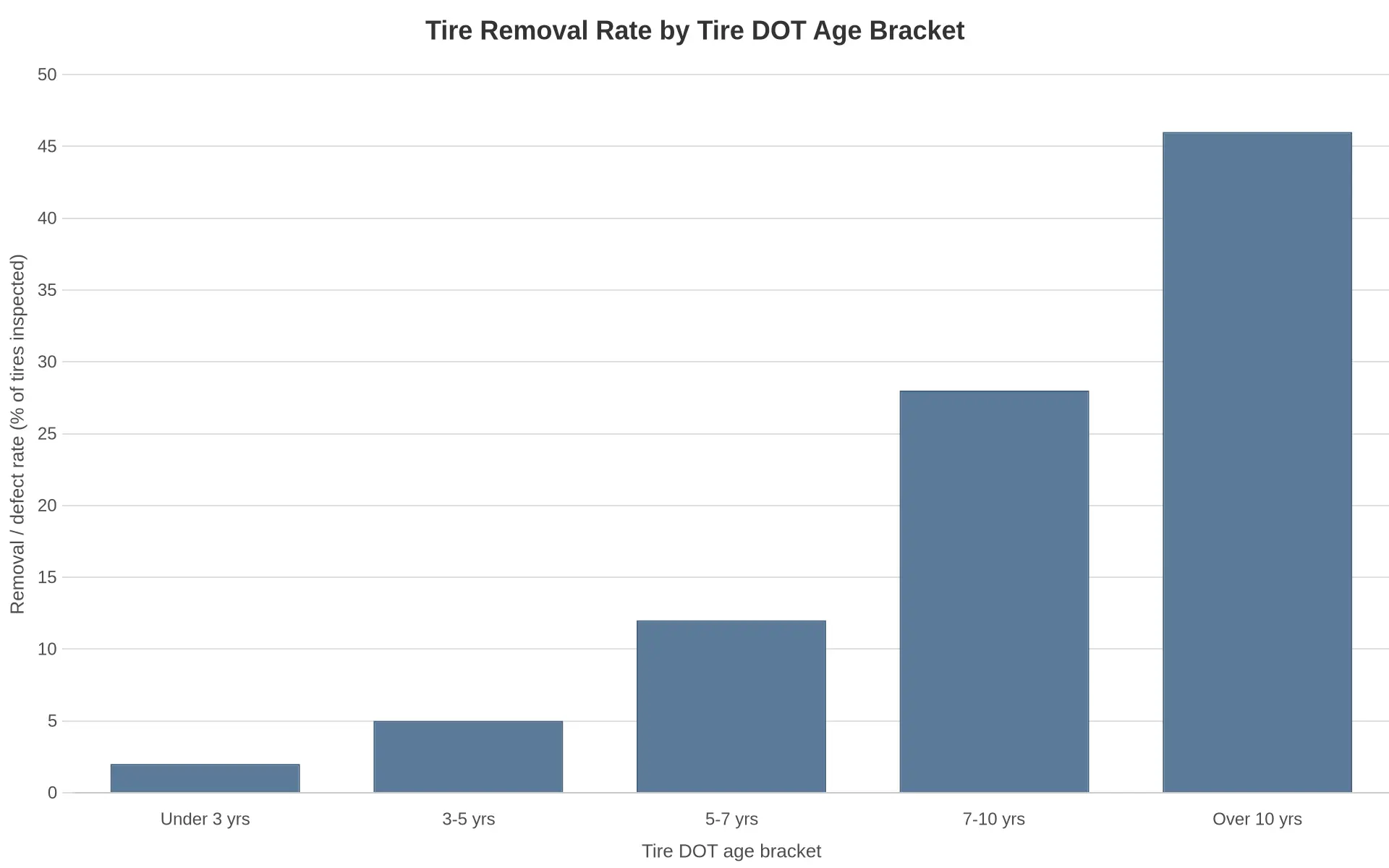
Figure 1. Tire removal / defect rate by tire DOT age bracket. Values represent indicative industry ranges for used apparatus and commercial vehicle fleets, not the audit data of any single fleet.
Defect incidence stays low through the first few years, climbs between five and seven, and keeps rising past ten, which is why age brackets and not tread readings anchor rollout policy.
A tire that measures 6/32″ can still be a 12-year-old casing with an aging belt package, a hardening sidewall compound, and damage most shops will decline to repair. The chart shows where the risk curve turns; the date code tells you where a particular tire sits on it. Tread gauges measure wear, date codes measure time and heat cycles, and only the second one tells you whether a tire holds at highway speed on the way to a call. For a fleet building a rollout sequence, that gap separates a defensible inspection policy from a hopeful one. Read the four digits on every tire before you read anything on the spec sheet.
Tire DOT Age Audit Checklist for Releasing Used Apparatus
Tire DOT age, not tread depth, decides whether a unit is safe to roll onto a job site, so work this sequence in order before any used apparatus leaves your yard.
- List the unit’s full tire inventory on one sheet: position, size, serial number.
- Record each DOT date code exactly as stamped, and photograph the stamp before dirt or wear obscures it.
- Convert every code to age in months, from the week of manufacture to today’s date.
- Check both sidewalls for matching codes and note any sign of re-mounting or a reversed casing.
- Compare each tire’s age against your written threshold and document every tire that exceeds it.
- Flag any axle where the ages diverge sharply; mismatched pairs stress casings and worsen handling.
- Record sidewall and casing condition: cracking, bulging, weathering, previous repairs or plugs.
- Mark each tire pass or hold, and pull every unit that fails the check.
- File the completed audit as a dated record inside the unit’s service history.
Repeat the audit annually and after any wheel work, then apply the same routine to every used municipal truck you add to the fleet later.
Cost, Uptime and Liability: What a Tire Age Policy Actually Buys You
If you run trucks, your tire policy is a financial policy. A fixed replacement age, set by tire DOT age rather than tread depth, costs money on a schedule you choose. Its alternative, a failure at speed mid-shift and mid-contract, costs money on someone else’s schedule.
Owners rarely lose on the purchase price of rubber. They lose on the categories clustered around it.
- Planned replacement cost: a known, budgetable line item you can spread, time around slow weeks, and negotiate.
- Unplanned failure cost: recovery, roadside labor, a chassis sitting on a shoulder, a load that never lands, a driver who burns a shift waiting.
- Contracted work exposure: missed pickups, delivery windows, and route obligations usually carry credits or penalty clauses. What is a small overrun on a tire becomes a large overrun on a contract.
- Insurance and liability treatment: adjusters and safety auditors ask what you inspected and when, not what you assumed. Tread depth satisfies a visual check; it says nothing about a casing that has been aging in service since before you owned the vehicle.
- Documentation cost: an age audit is mostly labor, and it is the cheapest line in the comparison.
Proactive replacement gives up a little on planned spend and wins on everything else. That is the trade most owners are actually being offered.
Why downtime outranks the tire invoice
A single in-service failure removes a vehicle from the roster with no notice. In a two- or three-truck operation that is not a maintenance event but a capacity event. Work gets declined or subcontracted at a premium, and the relationship cost lingers long after the tire is replaced.
Age-based replacement converts that risk into a scheduled window. You lose an afternoon and keep the schedule.
Insurance and safety files
When a claim or an inspection arrives, the question is rarely “was the tread legal?” It is “what did you know, and what did you record?” A dated log of tire DOT age per position, with replacement decisions tied to a written threshold, reads as a managed asset. A file of visual tread checks reads as a hope. That distinction shapes how adjusters, safety reviewers, and clients judge your fleet safety posture, and it is the difference between a defensible process and a negotiated settlement.
Specifying used apparatus with the paperwork in hand
Buying used apparatus without tire dates is buying an unknown liability. Ask for the DOT stamps per position before you commit, and treat a seller who cannot produce them as a signal rather than an inconvenience; good sellers keep them on file. Our municipal used apparatus inventory comes with age records available up front.
Set a fixed age threshold and retire tires on the calendar, not the tread gauge. Tread tells you how much rubber is left. The DOT code tells you how much confidence is left, and it is the only one of the two you can document before an incident instead of after.
Tire Rollout Approval: The Sequence at a Glance
Somebody has to sign off on the rubber before a used apparatus leaves the yard. The check reads like a paragraph on paper, but it is a straight line with one fork at the end. Here it is as a diagram, so you can see where the decision actually gets made.

Read it left to right. Each box is a gate, and nothing moves on until the gate passes.
Stage 1: Tire identified
Every wheel position gets recorded before anyone makes a judgment. Steer, drive, tag axle, spare: the technician notes which tire is where, what size it is, and whether it matches its partner across the axle. That is bookkeeping, not opinion, and it matters later because a mismatched pair changes how the rest of the inspection reads.
Stage 2: DOT date code decoded
The four digits molded into the sidewall get translated. The first two are the week of manufacture, the last two the year, so a code reading 2119 means the 21st week of 2019, a tire already several seasons old no matter how deep the tread looks. Most buyers skip this step, and it is the one that decides everything downstream.
Stage 3: Age compared against policy threshold
Now the tire’s age meets the fleet’s written limit. Most fire apparatus and heavy municipal fleets retire tires somewhere between seven and ten years regardless of mileage, with steer tires usually held to the tighter end. This is a comparison, not a negotiation: the tire is either inside the threshold or it is not.
| Gate | What is checked | Why it decides the outcome |
|---|---|---|
| 1 | Tire position and size match | Confirms the right tire is being judged |
| 2 | DOT week and year code | Establishes true calendar age |
| 3 | Age versus policy threshold | Turns age into a pass or fail |
| 4 | Two-way split | Routes the unit to service or to the shop |
Stage 4: The two-way split
This is the fork at the right edge of the diagram. A tire inside the threshold that passes visual inspection moves to approve for service: the unit rolls, the paperwork closes, the buyer takes delivery. A tire outside the threshold goes to hold for replacement: the unit stays put until new rubber is mounted, and the sale gets scheduled around that work rather than after it.
What makes the sequence useful is how little room it leaves for interpretation. Tread depth never appears as a decision point, because a tire with deep tread and a 2016 date code still fails gate three. Depth tells you how much rubber is left; the code tells you how much safe life is left, and those are different numbers.
Buyers comparing municipal equipment can ask for that check documented on the units staged in our municipal apparatus inventory: identified, decoded, compared, then routed to service or to the shop before anyone signs.
One practical note before you rely on the diagram: confirm the threshold your own insurer or department policy actually uses. The flow is the same either way, and only the pass line moves.
Set tire-age thresholds per duty cycle, not per fleet
A used apparatus fleet is rarely uniform, and its tire policy should not be either. The DOT birth date on each sidewall is fixed, but what it means depends on the work the unit performs. Short-cycle municipal routes, long-haul cargo runs, and intermittent lifting duty age rubber at different rates, so the threshold and the inspection interval belong per duty cycle, not per fleet. A single fleet-wide cutoff either retires serviceable tires on light-duty units or keeps hard-worked ones rolling past the point where heat and load have already done their damage.
Waste-handling equipment shows why. Solid waste units run stop-start collection loops with axles under near-constant load, so casing heat builds and never fully sheds between stops; a five- to six-year review trigger is sensible there. Liquid waste tankers carry a moving load that shifts weight and heat from side to side mid-route, which argues for shorter intervals and more frequent pressure checks. Road cleaning sweepers and scrubbers spend hours at low speed, where sidewall weathering and sun exposure matter as much as mileage. General municipal-duty apparatus sits between these patterns, so confirm the real route profile before you commit to a number.
Cargo and lifting categories each push a different variable. Cargo units and cargo box bodies typically run steady highway miles, where heat is continuous but predictable. Trailers often sit parked for long stretches, so date codes and sidewall cracking deserve more weight than remaining tread. Dump trucks combine heavy loads with rough-site cycles that punish casings quickly. On the lifting side, crane and lifting units and tow trucks concentrate extreme load on the rear axles for short bursts, while a loader crane adds outrigger stress and long idle periods. Write the threshold per category, log it by DOT week, and revisit it whenever a unit’s duty cycle changes.
Frequently Asked Questions About Tire DOT Age on Used Apparatus
Can a tire with legal tread depth still fail rollout on age grounds?
Yes. Tread depth only measures the rubber above the wear bars. It says nothing about the casing, belts, or compound, which degrade with time, heat cycles, and long idle periods. A tire can pass a gauge and still be past the point where most fleet standards call it serviceable. Recommendation: treat tire DOT age as a separate pass/fail item in your pre-delivery inspection, and replace on age even when the tread looks strong.
How old can a tire be before it should be pulled from service?
Manufacturer guidance varies, but most heavy-truck tire makers call for annual inspection once a tire passes five to six years and removal by ten years from the DOT date, whatever tread remains. Fire departments commonly work to the seven-year replacement point taken from NFPA 1911, and apparatus that sits for long stretches often ages faster than its mileage suggests. Recommendation: pick a written cut-off for your fleet, apply it per axle position, and record the date on every unit.
Is the DOT code stamped on only one side of the tire?
Yes. The date code is molded on a single sidewall, and which side faces out depends on how the tire was mounted, so duallies and reversed fitments can hide it on the inside. Reading only the visible sidewall may leave you with no date at all, or with the wrong one on a mismatched assembly. Recommendation: have the seller photograph both sidewalls of every tire, or inspect in person with a mirror before you commit.
What should I do if a used apparatus unit has tires with different dates?
Mixed dates are normal, because tires on a working truck get replaced one or two at a time rather than as a set. The oldest tire on each axle matters most, especially the steer axle, where age and casing history affect how the vehicle tracks and brakes. Recommendation: price the unit as though the oldest tire group needs replacing, or ask the seller to match tires across each axle as a condition of sale.
Does age-based replacement apply to spare and unmounted tires too?
Yes. A tire begins aging the day it is manufactured, whether or not it ever carries a load, so an unused spare can be nearly as old as the truck it rides on. Unmounted tires stored out of direct sunlight and away from ozone sources age more slowly, but they still age and still need a date check. Recommendation: pull the spare, read its code, and budget it alongside the tires on the ground.
If you are comparing units, review the municipal used apparatus inventory with tire dates in hand rather than relying on tread photos.
Closing Summary: The Rollout Decision Rule
Tire DOT age sets the rollout boundary; tread depth only tracks wear inside it. The date code stamped into the sidewall governs whether a vehicle can safely enter service, and no amount of remaining tread overrides it. Three actions follow:
- Decode and record every DOT code, axle by axle, spare included.
- Apply a fixed age threshold matched to the duty cycle, so line-haul, refuse, and seasonal work each carry a defined limit instead of an on-the-spot guess.
- Keep a dated audit record of when each code was read, who read it, and what was decided.
For owners expanding a fleet of municipal used apparatus, consistency across those three steps matters more than any single inspection result, because it turns a judgment call into a written standard. A documented age policy protects drivers and buyers alike, and it gives fleet safety and resale value a foundation that outlasts any individual unit.