

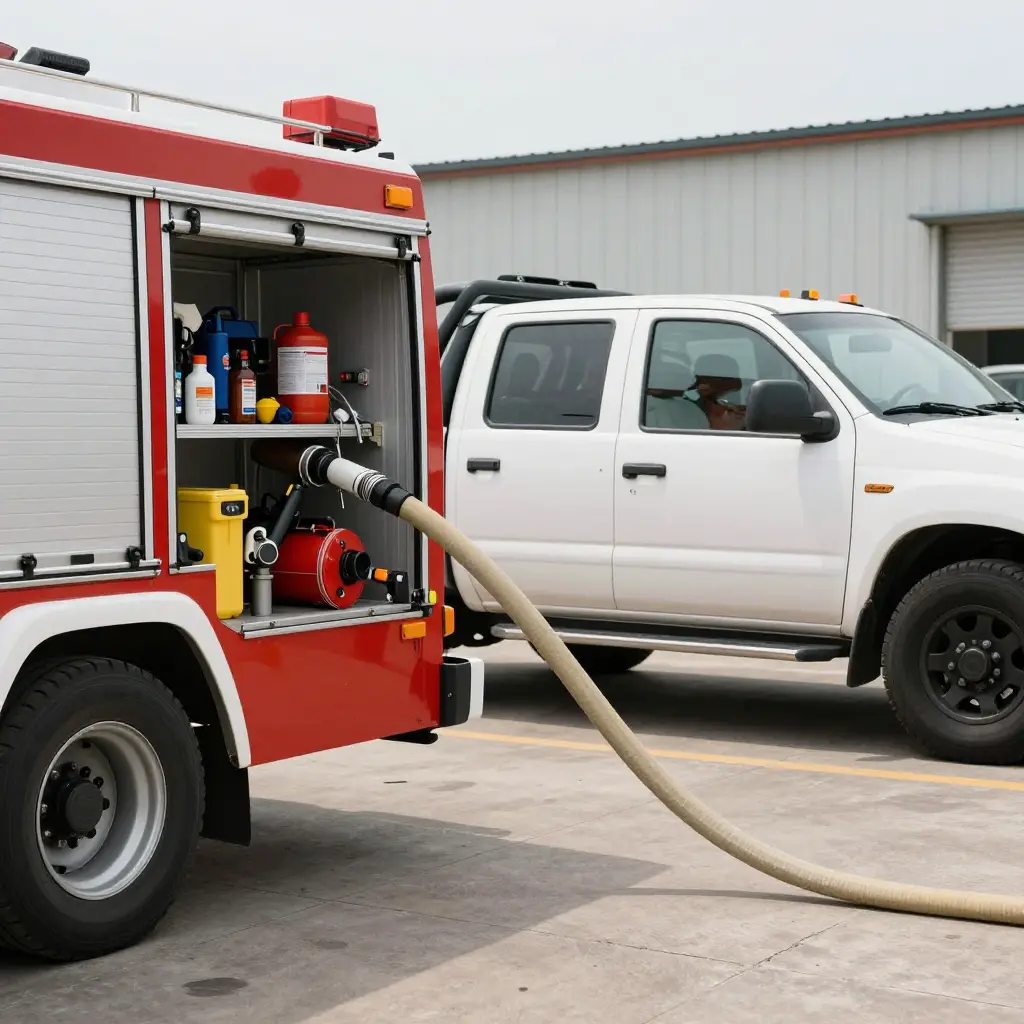
Any comparison of fire utility vehicles against pickup conversions should start with two measurable factors of plant first-response performance: how fast a crew can get equipment out of the vehicle, and how far the vehicle can push water from where it parks.
Those two dimensions are where purpose-built units and converted light trucks actually diverge. Equipment access depends on compartment layout, walk-around clearance, and the seconds lost to doors, sliding trays or a tonneau cover. Hose reach depends on pump placement, how much hose the body carries, and the distance water still travels under pressure from a parked chassis to the hazard.
This comparison uses those two measures throughout, with reference to municipal vehicle platforms built for the duty.
The practical question is narrower than the brochure: which platform puts a gloved hand on the right tool, and water on the fire, soonest on your site layout.
Two Ways to Build the Same Capability
Both concepts carry water, hose and a trained crew to an industrial fire. They differ in where the design starts.
A purpose-built fire utility vehicle is a dedicated chassis configuration built around the firefighting task. Water tank, pump, plumbing and secured equipment compartments are integrated into the body from the outset, normally with a crew cab and a defined walk-around envelope that lets a responder reach any compartment on foot.
Pickup conversions start elsewhere. The base vehicle is a series-produced light truck whose cargo bed carries a firefighting skid unit, with equipment stored in the bed, on racks or in add-on boxes. Capability is fitted into the volume left over.
The contrast is design intent rather than brand or price: one body is drawn around the equipment, the other accommodates it. Access speed and hose reach follow from that single choice.
Table 1: Side-by-side specification comparison for plant first response units
The table reads both configurations against the same nine parameters, from chassis weight class and GVWR through water capacity, pump flow, hose storage, compartment volume, seating, walk-around access, tool retrieval height and duty cycle. Metric figures come first, with US units in parentheses, because pump and hose ratings are still widely quoted in gpm and feet.
| Parameter | Fire utility vehicle | Pickup conversion |
|---|---|---|
| Chassis weight class and GVWR | Class 4-5; 6,351-8,845 kg (14,001-19,500 lb) | Class 2-3; 2,722-6,350 kg (6,001-14,000 lb) |
| Water tank capacity | 757-1,136 L (200-300 gal) | 189-379 L (50-100 gal) |
| Pump type and rated flow | Dedicated drive pump; 946-1,893 L/min (250-500 gpm) | Skid-mounted auxiliary pump; 379-568 L/min (100-150 gpm) |
| Hose storage and reel layout | 91-152 m of 45 mm (1.75 in) hose; dual fixed reels | 30-46 m of 45 mm (1.75 in) hose; single swing-out reel |
| Equipment compartment volume | 5.7-8.5 m³ (200-300 cu ft) | 1.1-1.7 m³ (40-60 cu ft) |
| Crew seating capacity | 4-6 seats | 2-3 seats |
| Walk-around access at scene | Full perimeter access on both sides | Curbside bed access only |
| Stored-tool retrieval height | 510-1,220 mm (20-48 in), side-opening lockers | 760-1,520 mm (30-60 in), over-side lift |
| Typical duty cycle per shift | 1-3 dedicated emergency calls | 6-10 shared utility runs |
Tank capacity, rated flow and hose length together set how long a crew can work before breaking off to resupply. That is the number worth pricing when a purpose-built municipal apparatus is set against a conversion: not the invoice, but how much work the unit completes before it has to leave the scene.
Equipment Access: Speed Matters More Than Volume
In plant first response, access is measured in seconds rather than cubic feet. A responder in turnout gear and heavy gloves is not going to dig, so what counts is how fast the next tool arrives in hand.
Compartment layout decides that. Vertical tool storage lets long tools stand in slim lockers along the perimeter, while horizontal racks push gear deep into the body where you must lean and reach. Roll-up doors clear the full aperture in one motion; hinged doors swing into the walkway and take shoulder room exactly when you need it.
Mounting boards and quick-release brackets keep tools presented at a workable height. In a conversion, storage is often forced upward and inward over the tailgate or side rail, while purpose-built body options stage gear at waist-to-shoulder height along the perimeter, turning a reach-over stretch into a walk-around position.
The test is simple: can a gloved hand reach every tool without stepping up, climbing, or leaning over a rail?
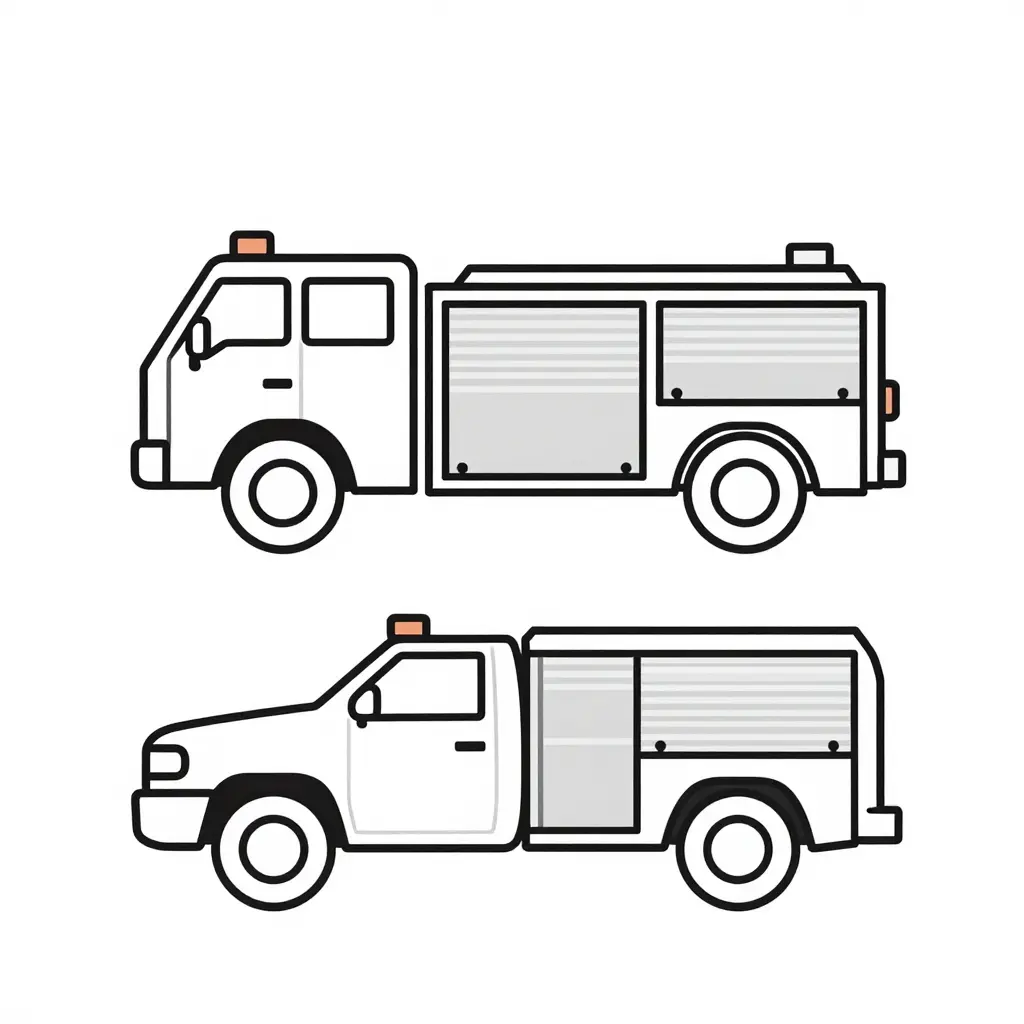
A flat, two-dimensional side profile of both vehicles drawn on the same baseline. The shaded blocks show where equipment sits inside each body, where the compartment doors open, how deep the storage actually is, and the band of height a responder can comfortably stand and reach. Compare the reachable band on each outline: on the purpose-built fire utility vehicle, most of the storage depth falls inside that band, while on the pickup conversion a share of the load sits above or behind it.
Hose Reach: Nominal Length vs Delivered Water
Usable hose reach is a calculation, not the length printed on the hose jacket. Start with hose length, then account for diameter: a larger line moves more water with lower friction loss per foot, while a smaller line sheds pressure quickly along its run. Friction loss climbs with flow rate and with length. Pump discharge pressure must cover that loss, the nozzle operating pressure, and any elevation gain at roughly 0.5 psi per foot of rise. Nominal hose length therefore overstates practical reach, because the last lengths deliver water at steadily falling pressure.
Deployment method sets the layout constraints. Reel-mounted pre-connected lines come off in seconds, suit a single responder and stay organized, but total length is fixed and the reel position dictates the first path the hose takes. Loose hose carried in a bed or compartment allows longer runs and flexible routing, at the cost of manual layout, more time and careful handling to avoid kinks.
Distance across the site and height to upper levels both consume pressure. Pump and reel position relative to the vehicle perimeter do the same: a reel at the rear or curb side saves the first length that would otherwise be spent routing around the body. When comparing fire utility vehicles, check which side the reels face against the side your crew will work from.
In practice, delivered reach is the length of hose that the pressure remaining after friction loss can still push water through at the nozzle’s required operating pressure.
Effective Hose Reach by Vehicle Configuration
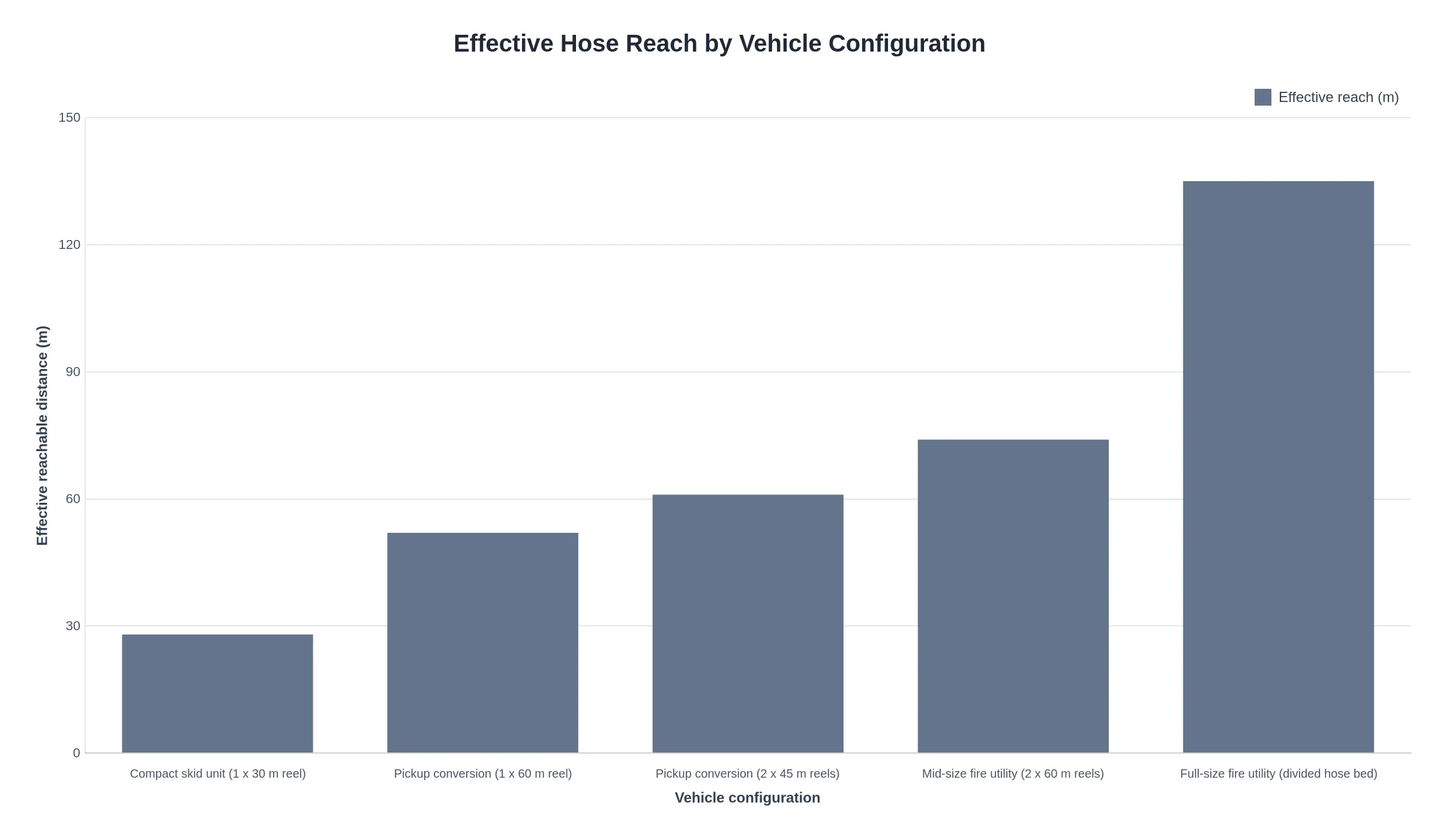
The chart separates hose length from effective reach, and the two are never the same number. Friction loss grows with length and flow, so every extra meter of line takes pump pressure out of the run. The gap between a compact skid unit and a full-size fire utility comes from hose diameter and pump capacity as much as from the meters carried: the larger unit can push water further before nozzle pressure falls below a usable level. A dual-reel pickup conversion wins on flexibility rather than distance; two lines give two attack points from the same truck. Where the site layout demands long lay-flats, a divided hose bed is the configuration that buys distance. Chassis, pump and hose storage are specified together in municipal-grade vehicle builds, which is why the reach figures spread as widely as they do.
Procurement Checklist: Access Against Reach
Equipment access and hose reach pull a specification in opposite directions, so treat them as one paired trade-off. Generous storage and wide doors speed up donning and tool retrieval, but every added body section brings weight and length that can cut usable hose capacity and slow the vehicle on narrow plant roads. A compact conversion with long hose runs gets water flowing quickly, yet cramped lockers and a single reel cost seconds when a crew needs a second length. Score both dimensions against your realistic response scenario (farthest hydrant, tallest rack, worst-case crew size), and compare body and compartment configurations side by side before you commit to a platform. Then ask which gap hurts more on your site: a minute lost hunting for a tool, or a minute lost stretching hose.
- Reachable storage height – confirm the top shelf sits within shoulder reach from ground level, so nobody climbs a bumper to grab a nozzle.
- Number and location of hose reels – count the reels and check they serve opposite sides of the body, so crews never drag hose around the truck.
- Compartment door type and opening width – specify roll-up or full-aperture doors that clear the opening completely, so a swing door never blocks the walkway.
- Time to first water discharge – measure seconds from arrival to flowing water with a full crew, not the brochure figure from a solo test.
- Hose length actually usable at working pressure – verify reach after pressure loss and couplings, since nominal length rarely matches real reach.
- Crew seating and donning space – check every seat has clearance to pull on a coat and pack without stepping outside.
- Payload margin after the tank is full – weigh the unit with water, fuel and crew, then confirm capacity remains for foam and tools.
Payload and Chassis Behavior
A full water tank is the largest single mass a light truck will ever carry, and it sits high and rearward. Fill it and the center of gravity moves back and up, loading the rear axle first and lifting weight off the front. On the fireground the rear suspension squats, steering feel goes light, and braking distances grow because the front tires carry less grip. Lockers and hose trays must still open and slide while the truck sits nose-high, so access height and hose deployment angles change with every fill level.
Payload math is where conversions and purpose-built fire utility vehicles part company. A tank and skid unit can consume most of a conversion’s gross vehicle weight rating headroom, leaving little for hose, tools or extra equipment; a dedicated chassis is specified around the tank from the outset, so crews keep usable capacity. Whatever headroom survives decides whether the full hose inventory described earlier actually rides on board.

Schematic deployment sequence: arrival and positioning, equipment access, hose deployment, water discharge, and resupply, with a return loop back to water discharge. No labels or icons are used so the order of access and reach constraints reads clearly even at thumbnail size.
Lifecycle Cost vs Sticker Price
Acquisition is the opening line of the cost, not the total. Pickup conversions carry a lower entry price and then add a concentrated upfit bill (pump, tank, body, wiring) in a single event. Fire utility vehicles build that capability into the chassis, spreading the cost across a longer service life.
Maintenance follows the same split. A conversion can need custom inspection routines and part-by-part sourcing. Dedicated units follow factory service intervals with published parts lists. Chassis warranty coverage is worth reading closely: an upfit can complicate it, while an integrated build keeps responsibility with one manufacturer. Insurance treatment tends to follow the same logic, and resale or redeployment value usually favors a purpose-built unit, though that varies by market and is worth checking before it becomes a line in the business case.
Downtime is an operating cost a plant feels directly. Every day a pump or body sits in repair is a day of reduced response capability. Compare over the full service life, or the cheaper vehicle wins by default.
For teams standardizing a first-response fleet, the broader municipal vehicle platforms are built on the same service logic.
Fitting a First-Response Vehicle Into the Wider Fleet
A fire utility vehicle rarely works alone. Where a plant or municipality already runs tippers, sweepers or waste trucks, chassis commonality is the quiet benefit: shared drivetrains and cab layouts mean one training program, one spare-parts crib and one maintenance schedule instead of several. A supplier that configures bodies across multiple chassis platforms simplifies long-term planning, because replacement cycles, driver pools and workshop capacity can be forecast on a single baseline. CRRC lists both the municipal vehicle range and dump truck configurations on shared platforms. Fleet planning is where the access and reach numbers get tested in the end: a specification that needs its own parts crib and its own training carries a cost the vehicle invoice never shows.
Frequently Asked Questions
Can a pickup conversion match a fire utility vehicle for equipment access?
A conversion comes close when the body is purpose-built with lockable compartments, slide-out trays and a walk-around pump deck. It still gives up factory municipal utility vehicle integration where speed is decided: perimeter access, storage height, and how much gear fits inside the body at all.
How much hose is realistically usable from a reel?
Not the full nominal length. Couplings, bends and friction loss along the run each take a share, and small-diameter hose loses pressure faster than large. The chart above gives the effective distance for each configuration, which is the figure to specify against a site layout.
Can a conversion be upgraded later to improve hose reach?
Yes. A larger reel, a higher-capacity pump or an extra hose tray can be added later. What limits the upgrade is payload headroom and wiring, both of which have to be planned when the unit is built; retrofitting either is the expensive part.
What payload limit should be specified for a site?
Specify against your heaviest realistic load, including water, hose, tools and crew, then add a 15 percent margin. On most plant sites tank size drives that figure rather than the tool load.
How does crew size affect vehicle choice?
Crew size determines seating and compartment count more than chassis class. Two-person crews work well from a conversion, while three or more responders usually need a utility vehicle with factory seating and walk-in access.
The Specification Test
Both criteria reduce to one question asked twice: can the crew reach what they need, when they need it? Compartment layout and storage height set equipment access, hose length and pressure and reel placement set reach. A dedicated fire utility vehicle resolves the two in the design; a pickup conversion resolves them by compromise.
The decision rule: specify around the hose inventory and the gear that must be reached fastest, then confirm the chassis can carry both. Applied to plant first response using purpose-built municipal vehicle platforms, that keeps layout, payload and hose capacity in one conversation instead of three.