


Two Routes to a Used Fire Truck: Consignment Auctions and Dealer Stock
Departments, contractors and district managers shopping for a used pumper usually have two ways in. On consignment, the owner lists the apparatus through a broker or auction house and the sale closes on whatever terms the seller wrote. Brindlee Mountain Fire Apparatus, in Arab, Alabama, runs one of the better-known programs in the Southeast, and it also sells from its own stock, which is a reminder that the two routes sometimes run through the same yard. The alternative is dealer stock of used municipal apparatus: the seller holds title, has already done the reconditioning, and quotes a price.
For a rural buyer the gap between those routes comes down to two things that decide real acquisition cost: consignment terms and pump test access. Paint, odometer and tires you can inspect at the walkaround and argue about at the table. Fees and test documentation usually are not up for discussion.
Terms decide who carries the risk and who pays which fee. Buyer’s premium, reserve, deposit rules, as-is language and settlement timing all cost money before the truck leaves the lot. A low hammer price with a ten percent premium and no right to inspect after the sale can cost more than a dealer’s higher asking price.
Test access decides whether the truck can do the work. A current performance test, with rated capacity, pressure and vacuum readings, is the strongest evidence of firefighting capability a buyer can hold in hand. When a consignment listing shows no test record and no way to run one on site, the buyer pays for that unknown one way or another.
Consignment Terms for Fire Apparatus Auctions vs. Dealer Stock
A used apparatus changes hands through two different commercial structures. On consignment the auction house acts as an agent: it lists equipment owned by a municipality, fire district or private seller and takes fees from both sides. A dealer owns the inventory, carries the capital and the re-marketing risk, and quotes one price with margin already inside it. The mechanics are the same whether the lot is a pumper, tanker, aerial or brush truck.
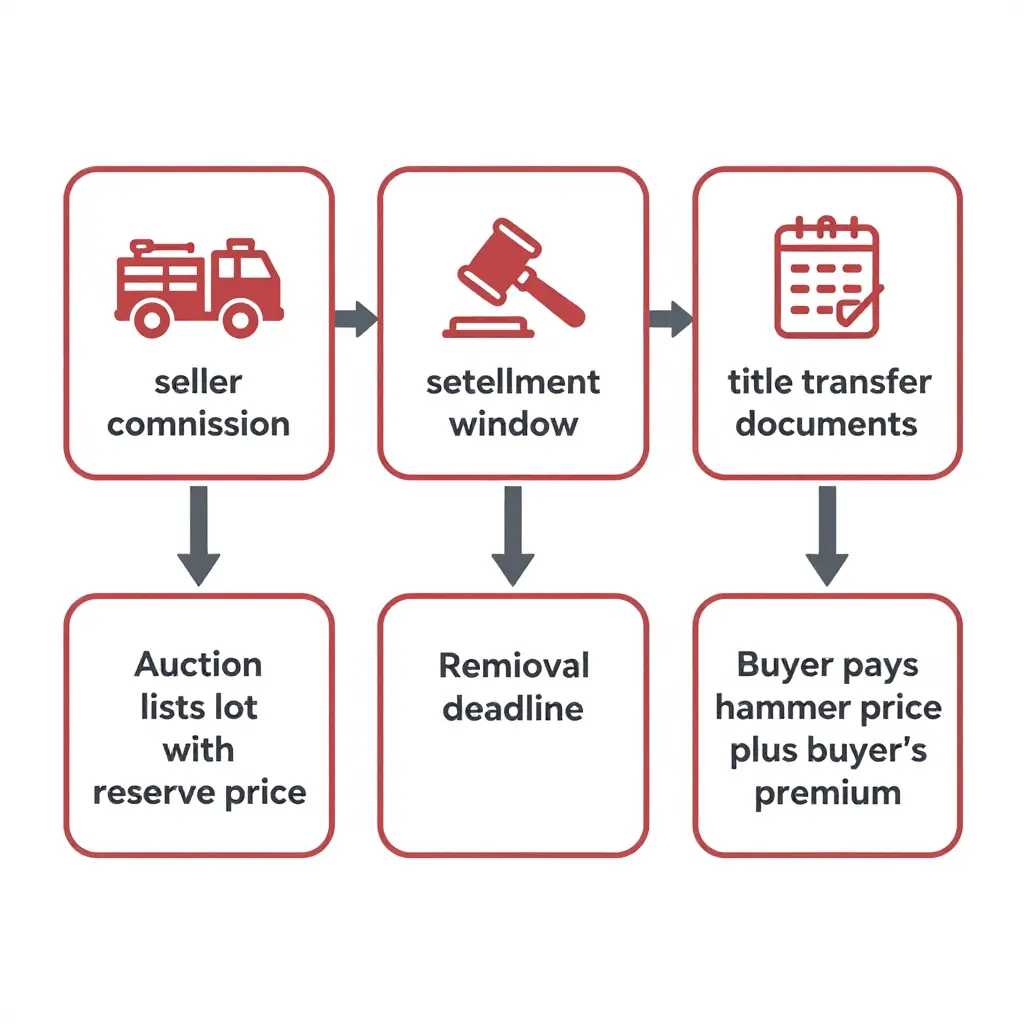
Reserve and commission structure
A consignment agreement assigns cost. The reserve price is the confidential minimum hammer price the seller will accept; if bidding stalls below it, the lot is passed and does not sell. Some sales are absolute instead, meaning the lot goes to the highest bidder whatever the figure. The seller’s commission comes out of the proceeds, as a flat percentage, a scale that steps down as the price rises, or in some programs a flat fee. Listing, entry, photography and withdrawal fees are common add-ons, and a seller who pulls a lot after publication may owe them anyway.
The buyer’s premium sits on top of the winning bid and is charged separately from the seller’s commission, usually as a percentage of the hammer price with a stated minimum per lot. In many states the premium is subject to sales tax. Dealer stock has no premium: the quoted price is the price, before negotiation, trade-in allowance or financing terms.
Bidding increments add a third variable. Platforms publish a ladder that widens as the price climbs, and online proxy bidding advances up that ladder as far as your maximum. Dealers negotiate a single figure with no published schedule.
| Structural element | Consignment auction | Dealer stock |
|---|---|---|
| Ownership during sale | Seller retains title until settlement | Dealer holds title and inventory risk |
| Pricing basis | Hammer price set by bidding, bounded by a reserve price | Single ask price with dealer margin included |
| Seller-side cost | Seller’s commission plus listing or entry fees | Not applicable |
| Buyer-side cost | Buyer’s premium added to the hammer price | No buyer’s premium; itemized taxes and fees |
| Price negotiation | Competitive bidding on set increments | Direct negotiation, trade-in, financing |
| Payment timing | Deposit at registration, balance within the settlement window | Deposit at order, balance at delivery or on finance |
Payment, removal and paperwork
Most auction houses want a deposit or pre-authorization before they issue a bidder number, applied to your invoice if you buy and returned if you do not. Terms vary, so read yours. Dealer deposits are usually tied to a specific unit and often become non-refundable once the order is signed.
The settlement window is the stated period for remitting the balance, premium and applicable taxes. Sellers are paid after funds clear and, in some programs, after the unit is removed, which is why consignment payouts lag the sale date. Removal runs on a tighter clock: storage accrues daily once the window closes, so price hauling, permits and escorts into the bid instead of discovering them later.
Title paperwork differs as well. Auction lots usually come with a title or bill of sale plus any lien release, and it is worth confirming which before you bid. Dealer transactions generally hand over the title at or soon after delivery, with warranty and service records attached. Either way, ask for pump test records, service history and specification sheets in writing; you can browse municipal and emergency vehicle inventory to see how listings present that documentation.
Fire apparatus and other municipal vehicles carry paperwork burdens that outweigh the hammer price, so the rows below are the ones to read line by line.
Consignment terms versus dealer stock: what rural buyers compare
| Term | Auction consignment | Dealer stock | What to verify before committing |
|---|---|---|---|
| Reserve price | Seller-set minimum, may be lowered on sale day | Dealer asking price, open to negotiation | Written reserve amount and who holds the right to change it |
| Seller commission or buyer’s premium | Seller pays commission; buyer pays premium on top of bid | No auction fees; quoted price is the price | Full fee schedule and whether fees are added after the bid |
| Deposit and payment terms | Deposit due at fall of hammer, balance in a set number of days | Deposit on order, financing often arranged | Deposit size, accepted payment methods, wire deadline |
| Settlement or invoicing timing | Invoice issued at close of sale | Invoice at pickup or delivery | When the invoice issues and what line items it lists |
| Removal deadline | Fixed pickup window after the sale | Unit held until collection is scheduled | Storage charges after deadline and load-out hours |
| Title and lien documentation | Title released once funds clear | Title transferred at point of sale | Lien releases and title already in the seller’s name |
| Inspection access | Preview day, pump test usually not permitted | Inspection by appointment, wet pump test often possible | Whether a wet pump test is allowed and who operates it |
| After-sale recourse | As-is, where-is, limited recourse | Dealer warranty or stated return terms | Exact as-is language, warranty exclusions, claim window |
Treat the last column as a checklist. Confirm each item in writing before you sign a consignment agreement or release a deposit.
Pump Test Access: What the Documentation Actually Proves
A pump test is the closest thing to a performance audit a buyer can get on used apparatus. It says nothing about paint, tires or cab comfort. It says how much water the pump moves compared with what the data plate claims, at pressures a crew can actually use. For a department drafting from ponds, cisterns and portable tanks, that number matters far more than horsepower badges or an odometer.
What a Fire Pump Test Records
A service test under NFPA 1911 runs in a fixed order: rated capacity at 150 psi net pump pressure, then 70 percent of capacity at 200 psi and 50 percent at 250 psi, each held for a timed interval, followed by priming and vacuum checks. That sequence is what separates a measured flow from one flattering figure. Suction and discharge performance is logged at each inlet and outlet, which is how a vacuum leak, a collapsing hard suction line or a discharge valve that will not hold under load shows up on paper.
The report should also cover relief valve operation (does it open and reseat at the set pressure), gauge accuracy against a calibrated master gauge, and the condition of the hose and appliances used in the run, including nozzles, adapters and strainers. Then the certification layer: who witnessed the test, whether calibration certificates came with the gauges, and whether the report is signed, dated and tied to that apparatus.
How Pump Test Access Differs by Channel
On fire truck auctions run on consignment, the rig still belongs to the selling department, and the auctioneer lists only what the consignor supplies. A test happens if the consignor arranged one, results often arrive as a summary rather than a full report, and posting them before bidding is inconsistent. Plenty of units sell as-is, where-is, with nothing beyond a data plate and a walkaround.
A dealer has taken title and holds the asset on its own floor, and that changes the calendar. A fire pump test can be run before the unit is listed, repeated after service work, and attached to the listing as a dated report. Because the seller controls the unit, a witnessed run is usually available on request. Buyers who also source other public-works equipment can apply the same documentation-first test to municipal vehicle inventory.
Independent Testing and Cost Allocation
Who pays is the practical dividing line. In a consignment sale an independent test is normally commissioned and funded by the buyer, sometimes needs the seller’s permission and site access, and is rarely refundable if the unit fails. On dealer stock the baseline test is often absorbed as a listing expense; a buyer-arranged verification is still the buyer’s cost, but it is easier to schedule and to watch.
Quick Summary
- Consignment: testing is optional, seller-driven, and often unpublished before bidding.
- Dealer stock: testing is usually completed pre-listing and shared with the report.
- Independent tests are buyer-funded in both channels, but access is simpler where the seller holds title.
- Certification, gauge calibration and a signed report are what separate proof from a verbal claim.
| Question | Auction consignment | Dealer stock |
|---|---|---|
| When is the test scheduled | If the consignor arranges one | Before listing, and after service |
| Results published before bidding | Inconsistent, often summary only | Usually attached to the listing |
| Buyer may commission a test | Possible, subject to seller access | Routine, with scheduled access |
| Who bears the cost | Buyer, non-refundable | Seller for baseline, buyer for verification |
Records and documents to request before committing
Before you sign with an auction house, a dealer or an online municipal trucks listing, get the following in writing:
- Most recent pump test results, with flow, pressure and gauge readings, and the date each test was run.
- Full service and maintenance history, including unscheduled shop visits, with dates and work performed.
- Pump rebuild and repair records naming the shop, the date, the scope and the parts replaced.
- Title and lien status, confirming clear ownership and disclosing any recorded encumbrance.
- Current certifications, such as a pump test certificate, aerial inspection and any required safety stickers.
- Engine hour and odometer logs, with the duty pattern behind those numbers.
- Written disclosure of any prior accident or structural repair, including body, frame, subframe and tank work.
- Removal or delivery terms: pickup deadline, who loads, transport cost, storage fees.
None of this reads as easily as a listing photo, and all of it is worth more at the negotiating table than another picture of the cab.
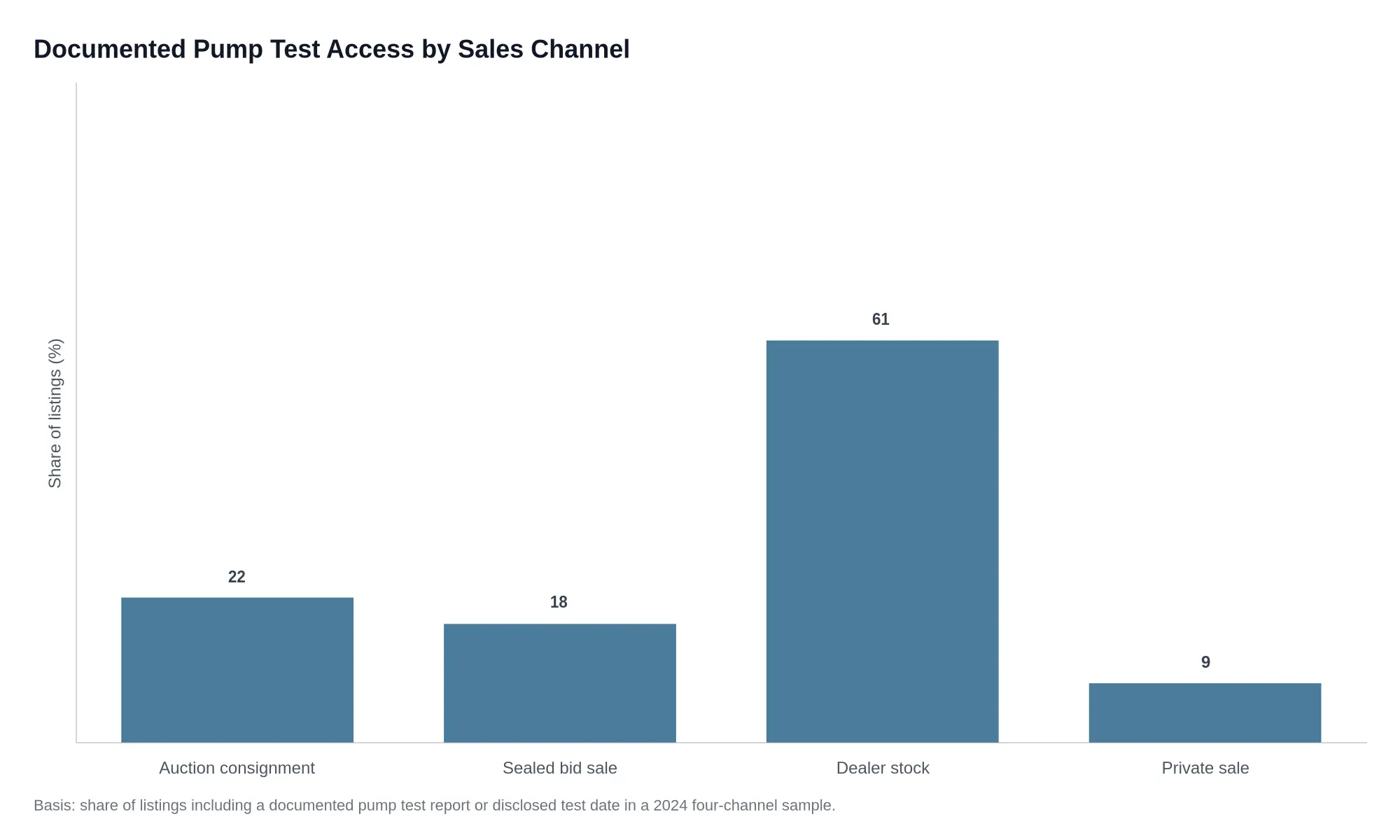
What it shows: Documented test access is not uniform across channels. Among the listings sampled for this chart, dealer stock carried a written test report or a disclosed test date at roughly three times the rate of auction consignment and sealed bid lots, and about six times the rate of private sales. A missing test record on an auction or private unit is therefore a capital cost, a pump rebuild plus freight and downtime, and it belongs in the bid rather than in the hope that nothing fails.
Transport, Hauling and Delivery for Rural Buyers
Delivered cost decides whether a rural purchase works. A pumper or tanker that looks cheap on the block can gain several thousand dollars on the way home once distance, permits, escorts and a recovery rig are counted. Work the transport line before you bid and treat it as part of the price.
Weight, Dimensions and Permit Corridors
Start with distance from the yard to your station. Rural buyers usually absorb a longer deadhead leg, which raises mileage and driver hours together. Then confirm apparatus weight and axle loading. A loaded tanker or heavy rescue can exceed highway axle limits even when gross vehicle weight looks legal, and bridge formulas may force a longer route.
Height and width matter just as much. Aerial ladders, raised booms and wide mirror arrays can trigger oversize permits, pilot cars or full escort requirements, and some jurisdictions require a police escort for the widest loads.
Seasonal road access is the next constraint. Weight-restricted spring roads, unplowed passes and soft gravel approaches to a rural station can close a collection window for weeks. Set that against removal deadlines at auction sites, typically measured in days and enforced with daily storage charges, and timing becomes the real risk. Insurance in transit deserves the same attention: find out when the seller’s coverage ends, and check that the carrier’s policy covers the declared value of the apparatus rather than the purchase price.
Where several units or attachments travel together, trailer hauling capacity and tie-down configuration drive the quote as much as mileage does; heavy-duty options in this range of cargo trailers built for vehicle transport are worth pricing early. If a unit cannot move under its own power, or has to be lifted out of a tight yard, plan recovery in advance instead of relying on whichever wrecker the sale site recommends, and compare tow truck configurations suited to heavy apparatus recovery.
Consignment Sales vs. Dealer Stock: Who Arranges and Insures Transport
The channels place the logistics burden in different places. At a consignment sale the vehicle belongs to a private owner and sits on a third-party site. The buyer arranges and pays for transport, insurance in transit and any escorts, and collection is bound to a narrow removal window set by the auction terms. Flexibility is low and storage fees accumulate quickly.
Dealer stock works differently. The dealer holds title, controls yard equipment and works with established carriers, so it can often quote delivery, arrange coverage to your gate and hold a unit for a scheduled pickup. Collection windows are longer and negotiable, though dealer-arranged freight may be bundled into the asking price rather than itemized. Ask both channels for a written delivered-cost figure so the comparison stays honest.
Total Cost of Ownership and Budgeting: Comparing Auction and Dealer Numbers Fairly
The sticker figure is where most fire apparatus comparisons go wrong. A $185,000 consignment truck and a $290,000 dealer unit are not two versions of the same number. One is an opening figure; the other is closer to a total. Build the full cost stack for each before you commit budget.
The Cost Stack: Eight Line Items That Decide the Deal
Pull every line onto a single worksheet, side by side, for each truck you are considering. If a seller cannot supply a number, mark it unknown and estimate it high.
- Hammer price or list price: the winning bid, or the dealer’s asking price. It is the line most buyers compare and the least informative on its own.
- Buyer’s premium or commission: consignment adds a premium on top of the hammer, typically a percentage with a floor. Dealer stock almost never carries a separate premium line.
- Independent pump test cost: a third-party performance test at rated capacity. On auction trucks the buyer often has to arrange and pay for it after the sale; many dealer listings include a current certificate.
- Mechanical and pump repairs: seals, packing, impellers, valves, priming systems, engine and driveline work. Budget from the test results, not from the listing description.
- Tires and brake work: the quiet budget killer on rural apparatus with high idle hours and long gravel-road service.
- Certification and compliance: NFPA 1901 items such as lighting and signage, current pump test certification, and any state or local registration requirements.
- Transport: delivery from the yard to your station, permit escorts and fuel, priced both ways for comparison.
- Contingency allowance: 10 to 15 percent of the subtotal is a reasonable cushion for first-90-day surprises on any used apparatus.
| Cost line | Auction consignment | Dealer stock |
|---|---|---|
| Hammer or list price | Bid price | Asking price |
| Buyer’s premium / commission | Usually added on top | Typically bundled |
| Independent pump test | Buyer arranges and pays | Often recent and included |
| Mechanical and pump repairs | Buyer’s scope | Frequently reconditioned |
| Tires and brakes | Buyer’s scope | Sometimes replaced |
| Certification and compliance | Buyer’s responsibility | Usually handled |
| Transport | Buyer’s responsibility | Negotiable in deal |
| Contingency | 10 to 15 percent | 5 to 10 percent, still wise |
Why the Two Numbers Do Not Line Up
Dealer asking prices generally fold the pump test, the reconditioning and the compliance work into one figure. Consignment prices generally do not. The hammer buys the truck as it sits, and every line beneath it belongs to you.
So run the arithmetic on your own numbers rather than on the headline. A $185,000 hammer with a 10 percent premium is $203,500 before the first repair; if price and premium end up near the 62 percent share in the chart below, the all-in total lands around $328,000. A $290,000 dealer truck that arrives with a fresh pump test, new brakes and delivery already arranged may need little more than a reserve. Which one is cheaper depends entirely on how much work the auction unit needs, and only a test and a service file will tell you.
Buyers running mixed fleets should look past the single purchase as well. If you also operate municipal units and dump trucks, timing an apparatus purchase with the surrounding fleet budget keeps one capital request from crowding out the rest of the year. Reviewing municipal fleet options and dump truck inventory alongside your apparatus shortlist gives a clearer picture of annual fleet spend and where a used fire truck actually fits.
Budget the stack, not the sticker. That is how a rural buyer ends up with a truck that is genuinely cheaper, rather than cheaper on the day of the sale.
Where the Money Actually Goes
When a rural department or small fleet owner wins a used pumper or aerial at a Brindlee Mountain-style consignment auction, the hammer price is only the opening act. The chart below splits an all-in delivered cost into the five buckets that absorb it.
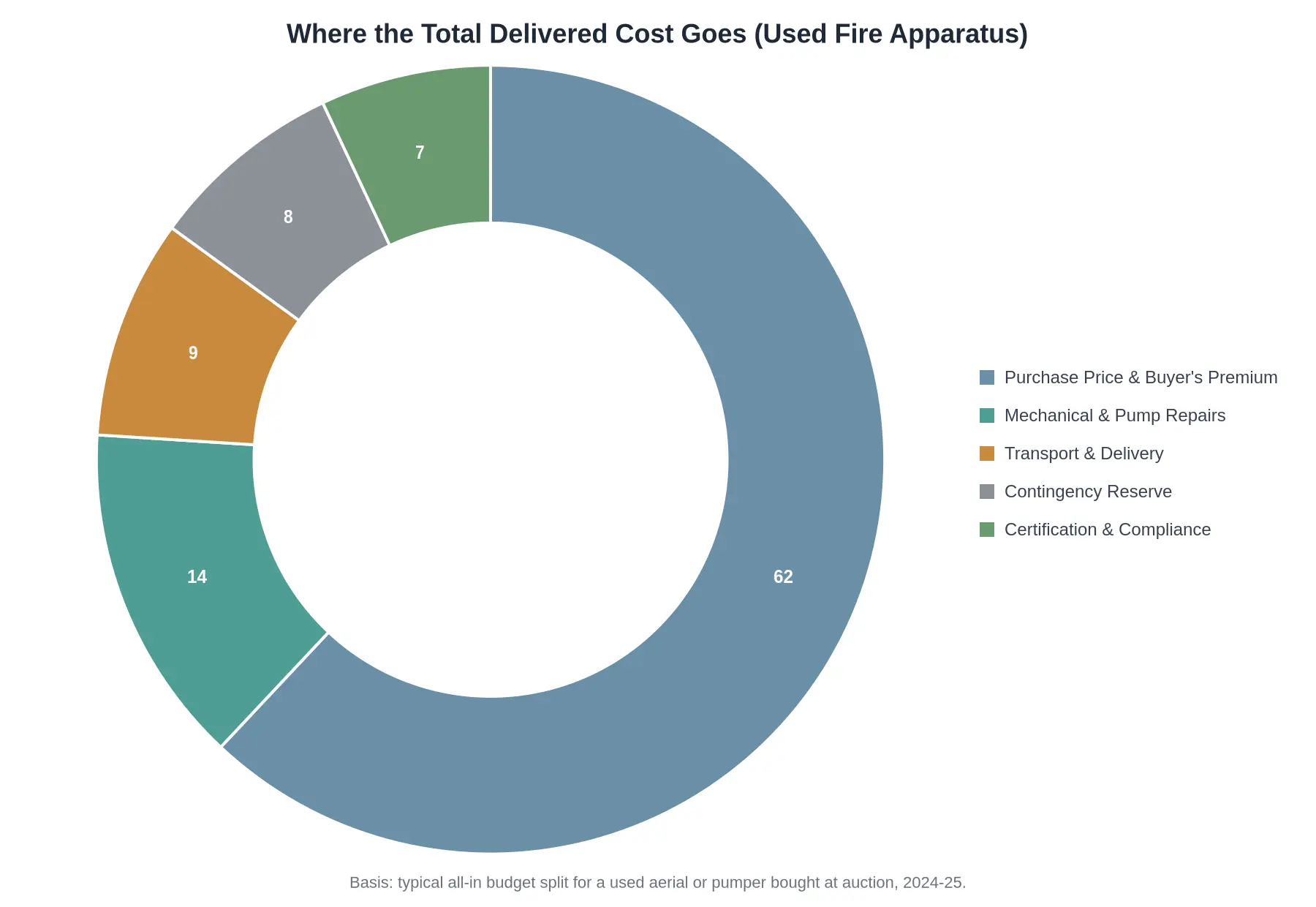
| Segment | Typical Share | What It Covers |
|---|---|---|
| Purchase price and buyer’s premium | 62% | Hammer price plus 8-12% auction fee |
| Mechanical and pump repairs | 14% | Brakes, tires, pump seals, valves, hose testing fixes |
| Transport and delivery | 9% | Lowboy haul, permits, escorts, fuel |
| Contingency reserve | 8% | Unseen rot, electrical gremlins, staffing delays |
| Certification and compliance | 7% | Pump test, aerial inspection, DOT and state paperwork |
The two lines buyers under-budget most often are mechanical and pump repairs and certification, because a pump that hits 100 psi on the yard can still fail a flow test once it is hooked to a real hydrant. Those two lines together can quietly add a fifth of your total outlay. If you would rather buy with known service history than take a chance on a sealed bid, our municipal fire and emergency vehicle stock lists units whose pump test results and inspection notes travel with them.
Frequently Asked Questions About Fire Truck Auctions
Are Brindlee Mountain fire auctions open to out-of-region and rural buyers?
Yes. Registration and bidding happen online, so distance does not limit participation, and rural departments can review listings and bid remotely just as they would browse municipal vehicle inventory. Inspection visits can usually be arranged in advance, which lets remote buyers look at used fire apparatus before paying.
What is the substantive difference between consignment terms and dealer stock terms?
On consignment the selling department owns the truck and the auction house acts as agent, so title, warranty and condition disclosures come from that seller. Dealer stock is inventory owned outright by the dealer, who sets the price and stands behind the representations. That difference shapes negotiation, paperwork and who answers questions about used fire apparatus after the sale.
Can a buyer obtain a pump test before bidding at a fire truck auction?
Sometimes. The buyer requests a test through the auction house, which then approaches the selling department for a date and site access; whether one is granted depends on the consignor, and many lots are sold without it. Where a test is possible, confirm the scheduling window, who operates the pump and what documentation you will receive when you register. A flow test at rated capacity is the most useful evidence of condition you can get on used fire apparatus.
Who arranges and pays for transport?
The buyer does. Auction houses typically list pickup windows and may share contacts for haulers, but the buyer contracts the carrier, confirms insurance and covers fuel and mileage. Rural buyers should budget for longer deadhead distances before bidding, since transport changes the real price of used fire apparatus.
Which documents should be verified before payment?
Title or certificate of origin, bill of sale, lien releases and current pump test documentation. Match the vehicle identification number across documents and confirm the title seller matches the bill of sale. Ask for service records and warranty terms, especially where consignment terms make the selling department the source.
Two Ways In, One Gate to Pass
Rural buyers chasing a used fire apparatus usually face a fork: bid on a consigned rig through an auction like Brindlee Mountain, or buy from a dealer’s standing stock. The routes look different up front. They should not stay different by the time you sign.
Why the shared stage matters more than the path
The two formats differ mostly in timing and leverage. An auction compresses your window to inspect and often sells as-is; dealer inventory usually gives you a longer look and a seller with a reputation to protect. Neither format guarantees a pump that performs, so the verification stage is where the decision actually gets made.
- Inspection records: service history, the previous department’s maintenance logs, and any documented repairs or damage.
- Pump test evidence: a current performance test with actual flow and pressure numbers, not a verbal assurance.
- Documentation: title clarity, lien status, mileage and hour readings, and the consignment or sale terms in writing.
A quick way to weigh the two paths
| Question | Auction Consignment | Dealer Stock |
|---|---|---|
| Time to inspect | Often a fixed preview window | Usually schedule at your convenience |
| Pump test access | May be limited or pre-arranged only | Typically available on request |
| Terms flexibility | Set by consignor and auction rules | Negotiable, often with support after sale |
| Risk if verification falls short | Buyer absorbs most of it | Shared with the seller |
If pump and tank performance is your make-or-break item, get familiar with how a well-documented unit is presented before you bid; the same inventory pages cover liquid waste and vacuum truck stock on the municipal side, with specification sheets in the same format.
Drawing the path yourself
Print the diagram and treat the middle column as a checklist rather than a formality. If a seller on either path cannot produce all three items, you are not at a purchase decision yet. You are at a research decision, and walking away is a legitimate outcome that costs far less than a pump rebuild six months into service.
Key takeaways for rural buyers
Consignment terms versus dealer stock terms. Consignment sales usually price on a hammer figure plus a buyer’s premium, and a reserve can stop the sale even when you are the high bidder. Settlement tends to be fast and rigid, with loading deadlines attached. Dealer stock is generally quoted as one asking price, without a premium, and that number is negotiable before paperwork starts. Settlement follows financing and title transfer rather than an auction clock, which gives a rural buyer more room to line up funds.
Pump test access and documentation. At a consignment yard the pump test paperwork comes from the seller, may be months old, and live testing, if allowed at all, is limited to a short window on site. Dealer stock normally lets you schedule a witnessed test before committing, and service records, build sheets and inspection notes are usually available in advance. Ask who performed the test, on what date, and at which pressures.
Transport and repair line items. Delivered cost is the number that matters. Freight from a remote auction site, plus repairs found after arrival, can push a low hammer price above a dealer quote that already includes delivery and a documented pump. Compare full cost sheets side by side, including municipal truck inventory with known histories.
Before releasing funds, work through four checks:
- Get a written cost sheet covering price, buyer’s premium or fees, taxes, loading and freight, then compare delivered cost rather than the headline figure.
- Confirm in writing whether a reserve applies and whether the seller will accept the current high bid, before you travel or pay a deposit.
- Request the pump test report with date, tester and results at rated capacity, and either witness a live test or review documented testing at multiple pressures.
- Verify title, lien status, apparatus serial number and repair history, then hold a contingency reserve for post-delivery work.