

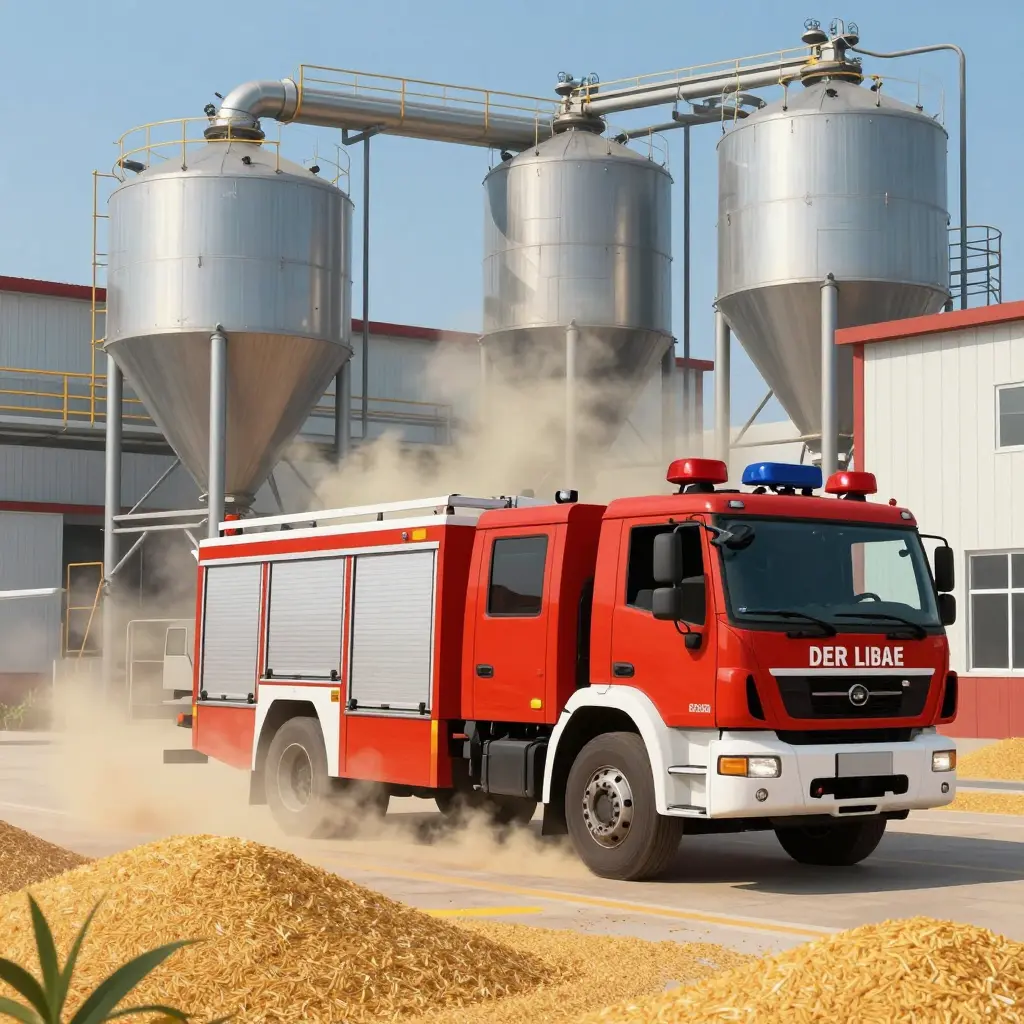
What Grain Dust Explosion Risk Means for Your Facility
Dust on a structural beam is fuel, and every load of grain you receive, mill, dry or convey leaves more of it on ledges, equipment housings and floors than in the product. Those particles are far smaller than a kernel, so a single kilogram of settled dust exposes a large surface area to air. Lift it into a cloud and a spark has everything it needs. That is the raw material behind every grain dust explosion.
Bulk grain in a bin burns slowly because oxygen only reaches the outside of the mass. A suspended cloud is different: each particle sits in air, so flame passes from particle to particle in milliseconds and the energy needed to start it is small. Add confinement and an ordinary ignition source, whether hot work, a failed bearing, friction on a slipping belt or a static discharge, and the dust ignition risk in your plant stops being theoretical.
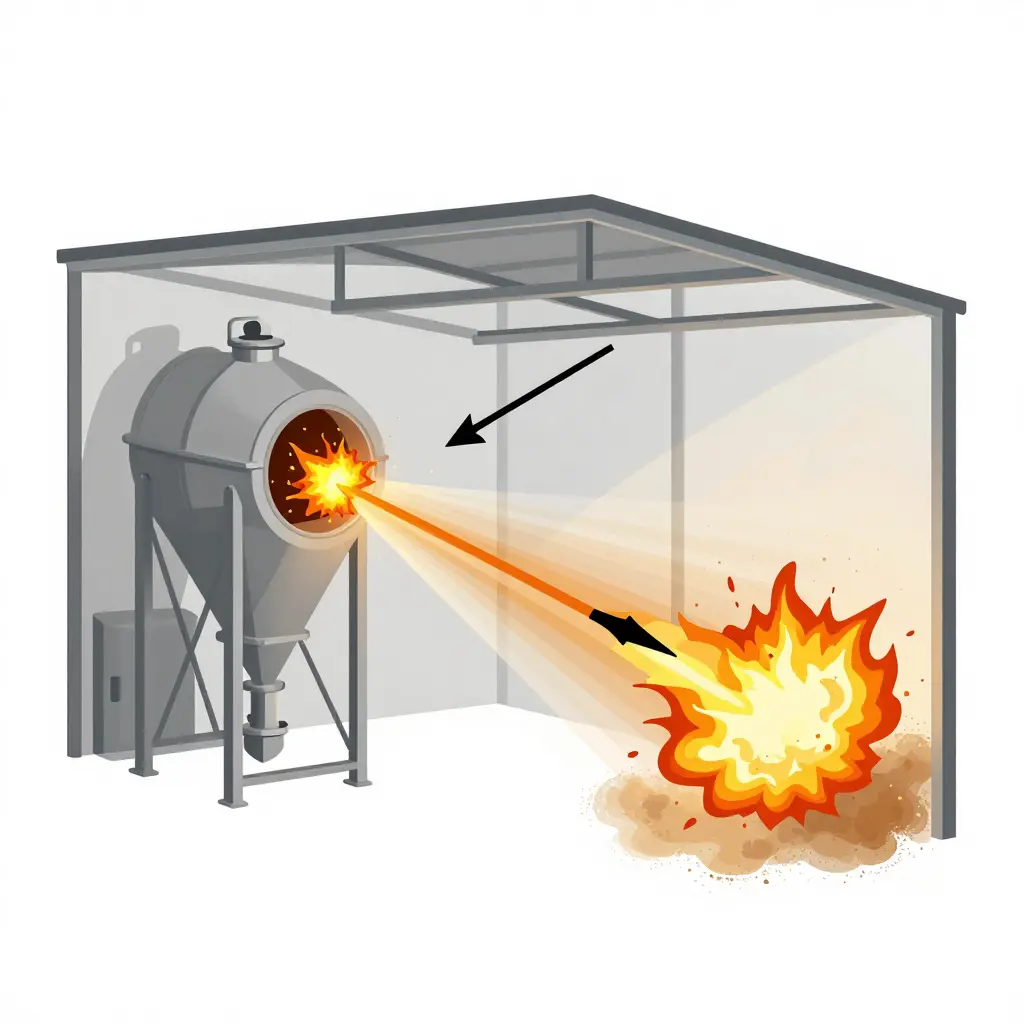
Plan for two events, because they behave differently. The primary explosion happens inside equipment such as a bucket elevator leg, conveyor transfer point, dryer or dust collector, where the housing holds pressure long enough for it to build. The secondary explosion usually does the damage: the pressure wave from the first event lifts the dust that has collected on overhead surfaces, and the whole building volume becomes a cloud that ignites a second or two later.
What decides whether an incident stays inside one piece of equipment is the extinguishing agent, not the size of the tank behind it. A large load of the wrong medium makes things worse. A high-pressure water stream, for example, throws settled layers into suspension and builds the very cloud you are trying to avoid. Match the agent to the fuel instead: dry chemical or a clean agent for fast knockdown, water mist where you need cooling and inerting, and delivery hardware that reaches the fire without disturbing the dust on the way. Agent type, flow characteristics and reach should drive a fire vehicle specification, with tank capacity following behind them.
All of it belongs in the risk register, because the exposure reaches every number a plant owner watches: production downtime, equipment replacement, contracts, insurance and the follow-up from your authority having jurisdiction. Record the hazard, the ignition controls and what your vehicle can actually deliver on arrival. Underwriters and compliance auditors read that record as diligence.
The chassis, tank and agent system all follow from the hazard profile of the site. The available municipal and industrial vehicle configurations show how those response platforms are built out.
Dust Ignition Mechanisms and Hazard Parameters
A thin film of grain dust on a beam looks about as dangerous as flour on a kitchen counter, and that is the problem. Suspend the same material in air inside an enclosure and it behaves like a fuel gas. Ignition still follows a mechanism you can trace, and each step of it gives you somewhere to intervene.
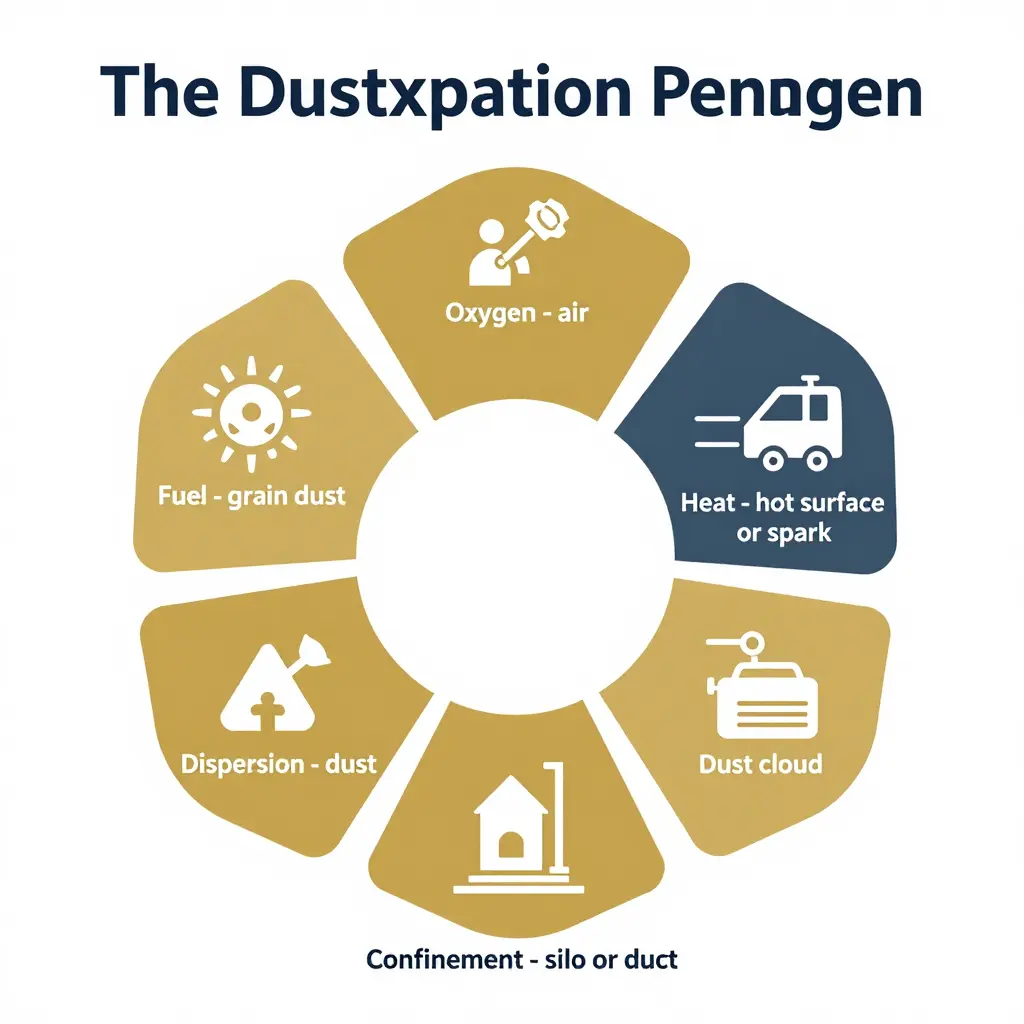
The three legs of the combustion triangle
Fuel, oxygen, heat. Grain dust supplies the fuel as fine starch, husk and kernel particles. Air supplies the oxygen, and a plant is full of it. Heat arrives from hot bearings, friction in conveying equipment, tramp metal striking a casing, hot work, a blocked or overheating dryer, and electrical faults.
Remove any one leg and ignition stops. Housekeeping, lubrication schedules and hot-work permits work because they take a leg away, not because a file requires them.
Dispersion and confinement: the two legs that turn a fire into an explosion
A settled pile of dust burns slowly and predictably. Two further conditions produce a true grain dust explosion. The dust has to be dispersed into a cloud at roughly the right concentration, since too thin a cloud cannot sustain a flame and too rich a one has too little oxygen between particles. That cloud also has to be at least partly confined, so pressure builds faster than it can escape.
Dumping, sieving, pneumatic conveying, bin filling and cleaning with compressed air all put dust into the air. So does the pressure wave of a small primary event, which lifts the settled layer that feeds a much larger secondary deflagration. Silos, bins, ducts, elevator legs, hoppers and dryer housings supply the confinement. Take away dispersion or confinement and you are left with a flash fire: dangerous, but not a pressure-driven deflagration.
Layer ignition versus cloud ignition
Two mechanisms, two different triggers, and both matter.
Layer ignition begins when dust settles on a warm motor housing, bearing or steam line. The layer insulates itself, holds the heat it generates, and smoulders well below the temperature a suspended cloud needs. It can sit quietly for hours and then become the ignition source the moment a process disturbs it.
Cloud ignition runs the other way round: a spark, hot particle or flame front reaches a suspended cloud and has to deliver its energy within milliseconds. One mechanism is slow and patient, the other instant. That is why surface temperature limits and grounding are not substitutes for each other.
The four hazard parameters that set the severity
A dust test reports a handful of numbers. Four of them drive almost every engineering decision.
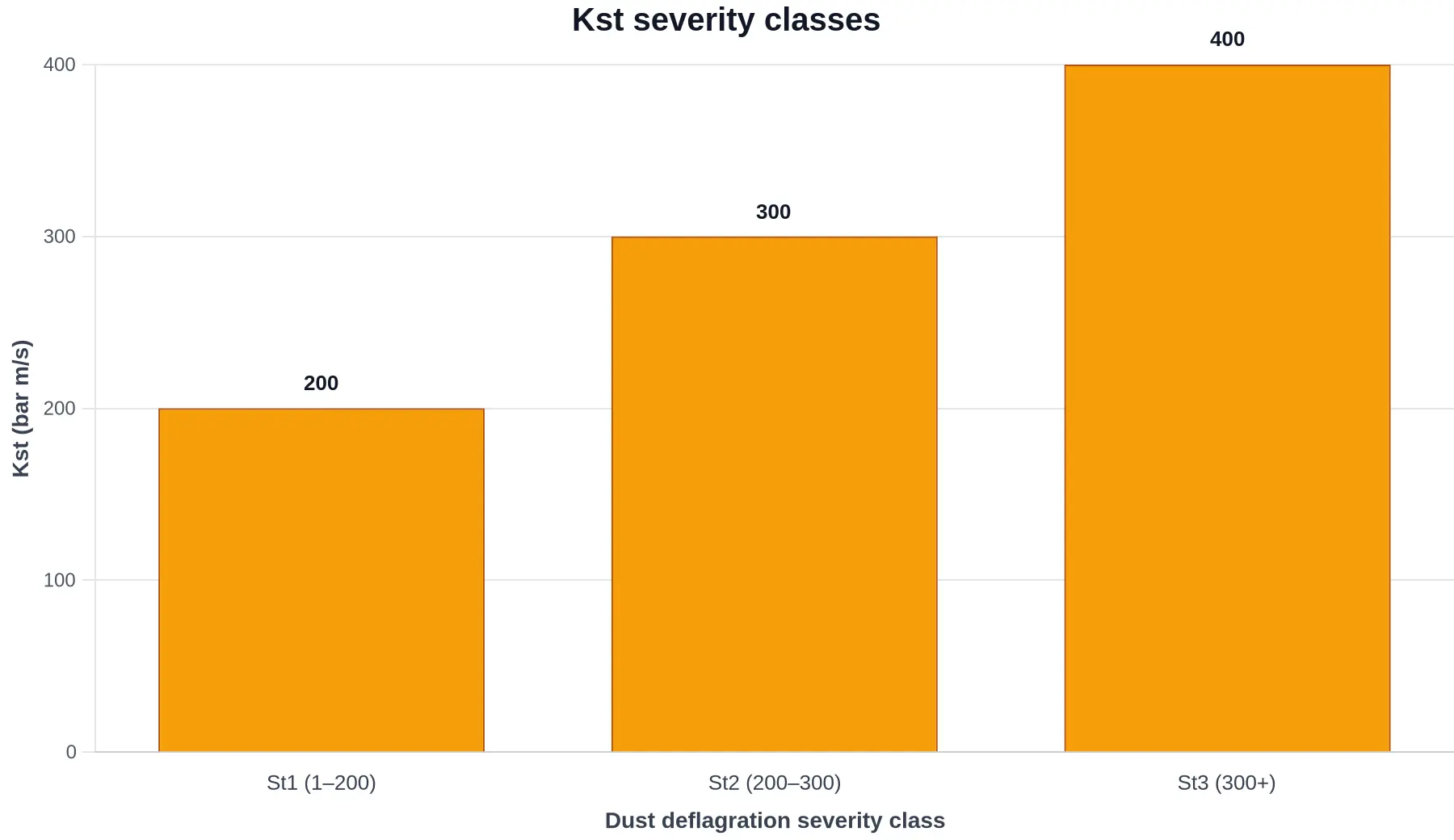
Kst value is the normalized rate of pressure rise during a deflagration, measured in bar m/s, and it sets the severity classes St1, St2 and St3. The higher the number, the faster pressure climbs and the less time a protection system has to react.
Pmax is the maximum pressure a confined deflagration can reach, expressed in bar. It sets what your equipment, venting and ductwork have to survive, and it is often several times the design strength of a standard silo or filter housing.
Minimum ignition energy (MIE) is the smallest spark energy, in millijoules, that will ignite the most sensitive cloud of that dust.
Minimum ignition temperature of a dust layer (MIT layer) is the surface temperature at which a settled layer of a stated thickness begins to smoulder. It is normally far below the cloud ignition temperature, and it is the number that applies to every warm surface in the plant.
| Parameter | What it measures | Typical units | Why it matters |
|---|---|---|---|
| Kst value | Rate of pressure rise, gives St1 / St2 / St3 | bar m/s | Sets how fast protection must act |
| Pmax | Peak pressure in a confined deflagration | bar | Defines equipment and vent strength |
| MIE | Smallest igniting spark energy | mJ | Decides whether static is a credible source |
| MIT layer | Surface temperature that ignites a settled layer | degrees C | Drives surface temperature limits |
Why low MIE values make static and hot surfaces credible
When a dust’s MIE sits in the tens or low hundreds of millijoules, a spark from an ungrounded operator, a plastic liner pulled out of a bin or a belt running on a dry pulley stops being a theoretical concern. At the low end of that range you are close to the energy of a static shock you would barely notice from a doorknob, which puts every unbonded metal component, every insulating liner and every synthetic garment on the list of credible ignition sources. Grounding, bonding and antistatic footwear move to the top of the control list as a result.
Heat follows the same logic. A layer MIT of a couple of hundred degrees or less means a surface that feels harmless through a glove can still start a slow smoulder, which is why surface temperature limits are set against the layer value rather than the cloud value.
Why these parameters must shape extinguishing agent selection
Agents are not interchangeable, and the hazard numbers tell you which one can work. A high Kst value means the flame front and the pressure peak arrive in milliseconds, so the agent has to suppress combustion faster than the enclosure can fail; an application built around slow cooling may arrive after the event. High Pmax values influence whether you are protecting people, equipment or both, and whether the agent needs to knock down flame or inert a volume.
MIE and layer MIT add two constraints on delivery. Low ignition energy thresholds mean the delivery method itself must not generate static or entrain dust into a new cloud. Smouldering layers at modest temperatures mean flame knockdown alone will not hold, because a hot or still-burning layer will undo the initial suppression. Deep-seated cooling and post-incident monitoring become part of the agent strategy.
Measured numbers turn a worry into a specification. Kst, Pmax, MIE and layer MIT let you size protection, set maintenance priorities and choose response equipment on evidence rather than instinct, whether you are specifying fixed systems or municipal emergency response vehicles for the site.
Comparing Minimum Ignition Energy Across Grain and Oilseed Dusts
Grain dusts do not ignite at the same spark energy, and the spread between them shapes which suppression agents and equipment you specify.
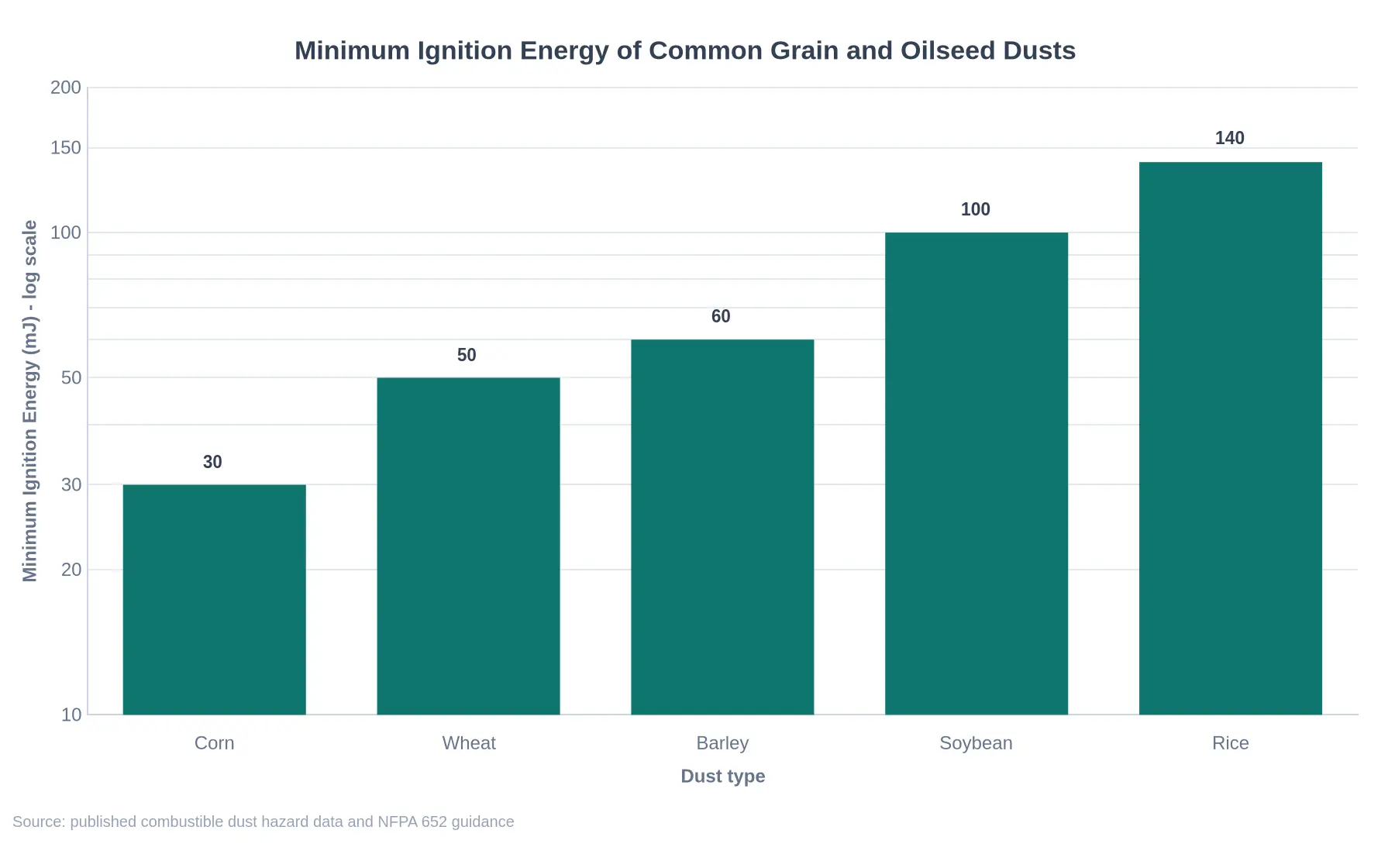
Figure 1. Minimum ignition energy (MIE) of common grain and oilseed dusts. Lower MIE means easier ignition, and these values inform agent and equipment selection.
Source: representative MIE midpoints taken from published combustible dust hazard data. Values shift with particle size, moisture content and the finest fraction present, so treat them as planning figures rather than a substitute for testing your own samples.
What the spread tells you
The chart uses a logarithmic axis because MIE for agricultural dusts can move by an order of magnitude with particle size, moisture content and the proportion of fines floating in your elevator legs and bins. Corn starch and finely milled corn dust sit at the low end of the range: a discharge too weak to notice in wheat or rice dust is enough to start an explosion. Rice and soybean dusts typically need several times more energy, which still leaves them well inside the range of ordinary electrical arcs and hot work.
- Bonding and grounding come first. Reducing ignition sources costs less than suppressing them, and low-MIE material demands it everywhere, including bucket elevators, screw conveyors and bin vents.
- Agent selection follows the material. Water mist and Class A/B rated dry chemical are the usual choices for organic grain dust, while ABC dry chemical offers broader coverage where electrical equipment sits alongside the hazard.
- Water supply decides how long knockdown lasts. A fast knockdown depends on how much suppressant and water your fleet can deliver to the silo area, so pairing a dry chemical unit with properly sized water tanker and liquid-hauling vehicles keeps the first response from running dry mid-incident.
Validate these numbers against your own test data, then match apparatus, agent load and pre-incident plan to the dust that is actually present on site.
| Dust type | Approx. MIE (mJ) | Relative ignition ease |
|---|---|---|
| Corn | 30 | Highest |
| Wheat | 50 | High |
| Barley | 60 | Moderate-high |
| Soybean | 100 | Moderate |
| Rice | 140 | Lowest |
Walk the plant before you specify a truck. These are the places where accumulation and ignition sources meet:
- Bucket elevator legs and boot pits – fines settle in the boot, and belt misalignment, hot bearings or a choked boot supply the friction and sparks.
- Enclosed conveyors and transfer points – dust clouds form where product drops, with slipping belts and hot rollers waiting nearby as an ignition source.
- Bin and silo tops – displaced air pushes dust out of hatches and coats roofs, level sensors and vents that are often poorly bonded.
- Dryer sections and hot bearings – the hottest surfaces in the building sit beside the driest, most combustible material you handle.
- Milling and grinding equipment – impact and metal-to-metal contact create the dust and the spark in the same pass.
- Dust collector hoppers and ductwork – hoppers fill when discharge fails, and smouldering embers travel the ducts to places nobody is watching.
- Floor ledges, structural beams and cable trays – horizontal surfaces hold layers that go airborne when a forklift passes or a door slams.
- Electrical panels and motors in classified areas – arcing contacts and overheated windings sit inside the zones with the deepest layers.
- Receiving pits and truck loadout spouts – open dumping and drop chutes generate the heaviest airborne dust with the least ventilation.
- Bagging and palletizing lines – paper, dust and stretch wrap build a mixed fuel bed around motors that run all shift.
Log every finding as a zone, with its extent, layer depth and ignition sources, then let those zones shape how you spec municipal fire and emergency vehicles: pump and tank size, and the water, foam and dry chemical mix your crews will actually deploy.
What Owners Are Actually Accountable For
Dust hazard rules are often read as engineering guidance for consultants. They arrive on the owner’s desk as duties that have to be resourced, documented and repeated. What follows describes those duties plainly without interpreting any jurisdiction’s legal text; standards are named only where the reference is broadly accurate, so confirm each item with a qualified authority or your local enforcing body before relying on it.
Dust hazard analysis (DHA). The owner commissions a DHA covering every dust-handling operation on site and keeps it current, with a review at least every five years and an interim update whenever a process, material, equipment layout or dust characteristic changes. A DHA that lives on a shelf proves nothing; it has to be revised when the plant is.
Documented housekeeping programme. Owners hold a written housekeeping plan that specifies frequencies, methods, assigned responsibilities and recorded completion. It should define acceptable dust layer depths for each area and set an action threshold at which accumulated dust counts as an immediate hazard rather than a maintenance backlog. The records are the evidence that the programme exists.
Ignition source control. Owners identify and control ignition sources in classified areas: hot work permitting, electrical equipment selected for the declared zone, and management of friction, static and self-heating risks. ATEX zoning provides a workable framework for choosing equipment against the zone you have declared, and NFPA 61 covers similar ground for agricultural and food processing operations. Mobile plant entering the site, including a fire vehicle responding to an incident, sits inside that control boundary too.
Employee training and emergency drills. Training has to reach everyone whose work touches dust-handling areas, not only operators, and it has to be refreshed and recorded. Drills covering evacuation, isolation of process equipment and response to a deflagration should be scheduled and logged. For grain processing facility fire safety, rehearsal more often separates a contained incident from a total loss than equipment does.
Extinguishing media and access routes. Owners confirm that suitable extinguishing media are available and appropriate to the dust present, and that hydrants, appliance hardstanding and access roads stay unobstructed. Routes and turning areas need to take the largest responding appliance at full water load, since a tight approach neutralises an otherwise adequate municipal emergency vehicle fleet response.
| Duty | Evidence an owner should be able to produce |
|---|---|
| Dust hazard analysis | Current report, revision log, change-triggered updates |
| Housekeeping | Written plan, layer depth limits, completed checklists |
| Ignition control | Zone drawings, equipment certificates, hot work permits |
| Training and drills | Attendance records, drill logs, refresher dates |
| Media and access | Extinguisher schedule, access route inspection records |
Requirements differ by country, sector and insurer, so confirm the obligations that apply to your site with a qualified authority before treating this list as complete.
Before comparing agents, it is worth knowing where the agent actually goes once it leaves the tank.
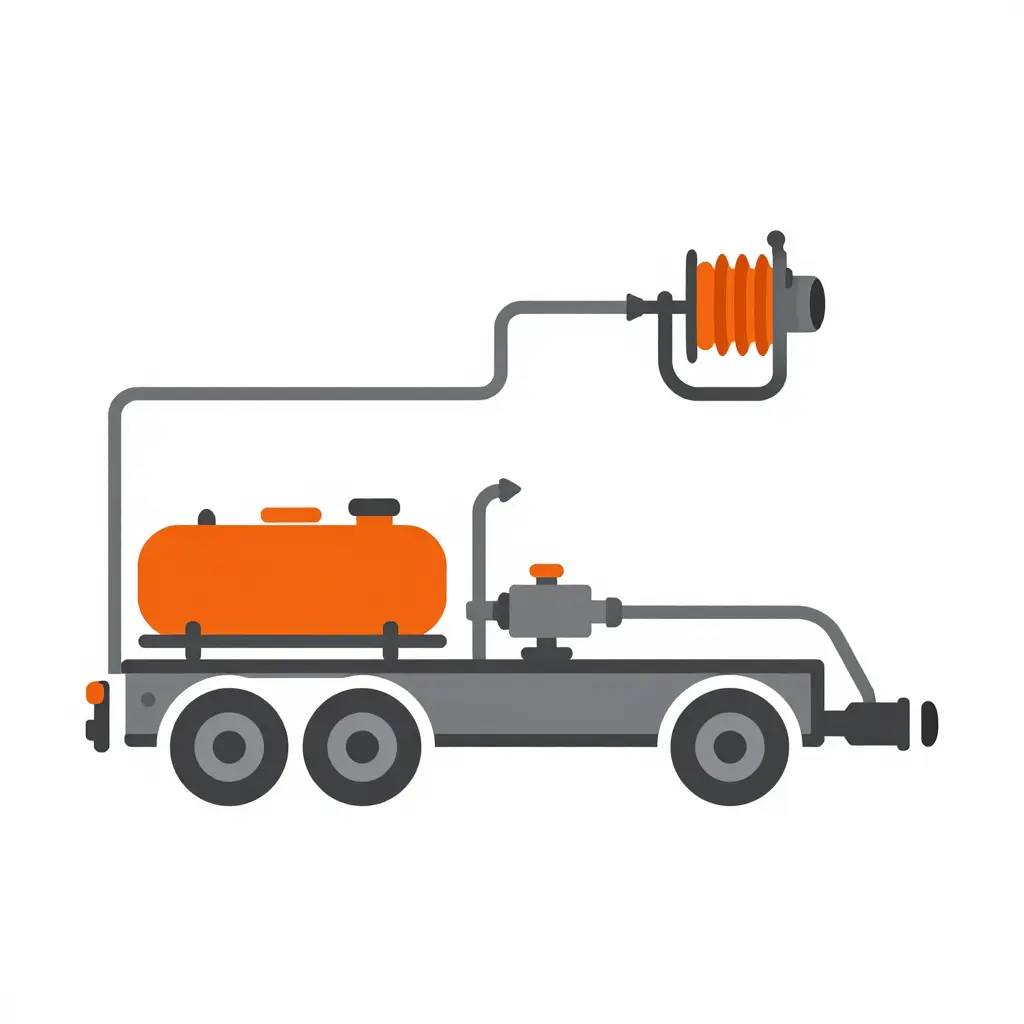
Figure: The flow path of a stored agent on a municipal fire and specialty vehicle. Water enters from the source through the pump, passes the foam proportioner where concentrate is metered in, and is then delivered either to the monitor outlet or to the hose reel branch – the two points where the finished agent actually reaches the fire.
How to Think About Extinguishing Agent Selection in a Grain Plant
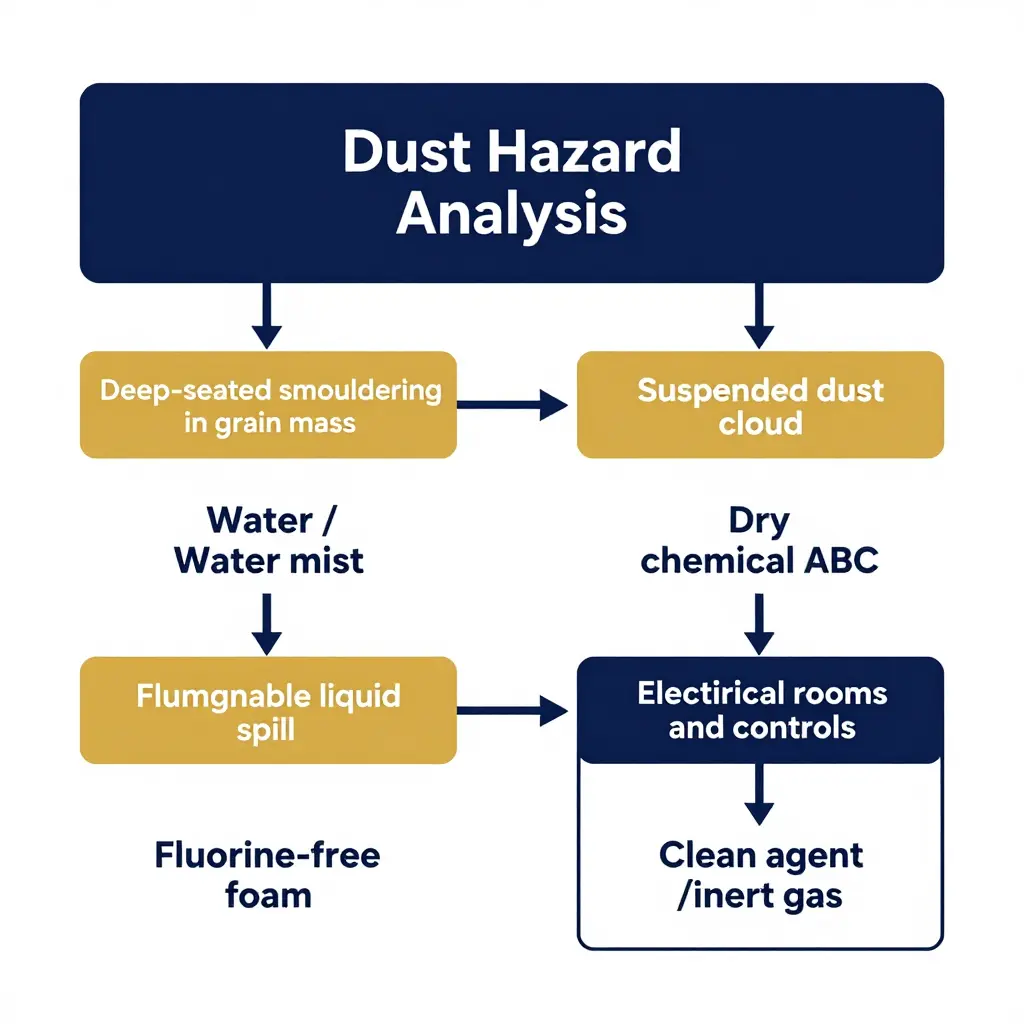
In a grain plant the agent question is really a question about which fire you are fighting. A smouldering kernel deep inside a silo, a dust cloud rolling through a bucket elevator and a burning hydraulic oil puddle on the maintenance floor need three different mechanisms, and sound firefighting agent selection starts from the dust hazard analysis rather than from the vehicle brochure.
Only three mechanisms exist: cooling, smothering (oxygen displacement or a barrier blanket) and chemical inhibition (breaking the flame chain reaction). A plant that carries one of them will eventually meet the fire that needs another. Here is how the common agents perform against the criteria owners actually weigh: re-ignition resistance, cleanup cost, electrical safety, and whether the agent suits deep-seated smouldering or a suspended cloud.
Agent-by-Agent Comparison
Water – the strongest cooling agent, and the only common option that genuinely reaches deep-seated smouldering in a grain mass, provided it soaks in and penetrates rather than running off the crust. Its weaknesses are practical: it wets product and equipment, creates expensive contaminated runoff and spoiled inventory, and conducts electricity. Applied carelessly at high pressure it also lifts settled dust into the cloud you are trying to avoid.
Water mist – fine droplets give very high surface cooling plus local oxygen displacement from a fraction of the water, so cleanup and water damage stay far below what hoseline streams cause. Low-conductivity mist is comparatively safe around energised equipment and works well on a flame front in an open gallery. It does not penetrate a compacted grain mass, and its performance depends on ventilation and draft.
AFFF and fluorine-free foam – a smothering mechanism: the blanket seals a fuel surface, suppresses vapour and prevents re-ignition of Class B liquid spills such as fuel, oil and solvent. Procurement is shifting to fluorine-free formulations for environmental and reporting reasons. Foam does not cool a smouldering grain core, and concentrate and residue contaminate product, so it is a specialist tool for fuel and oil rather than a default for process areas.
Dry chemical powder (ABC) – chemical inhibition, and the fastest knockdown of a moving flame front or a suspended dust cloud in open space. It leaves no cooling behind, so re-ignition resistance on Class A material is weak, and the powder is abrasive, finds its way into bearings, motors and control cabinets, and is costly to clean out of product and machinery. BC powder handles flammable gas and liquid fires but does nothing for smouldering solids.
Inert gas and clean agent systems – smothering by oxygen reduction, or chemical inhibition depending on the agent, with effectively zero residue and good electrical safety. They suit electrical rooms, control cabinets and enclosed process volumes, all of which need to be reasonably tight. There is no cooling effect, and they are impractical in large open galleries or against a cloud you cannot confine.
| Agent | Main mechanism | Re-ignition resistance | Cleanup and contamination cost | Electrical safety | Best suited to |
|---|---|---|---|---|---|
| Water | Cooling | High on Class A when soaked | High (wet product, runoff) | Poor near live equipment | Deep-seated smouldering grain mass |
| Water mist | Cooling, local oxygen displacement | Moderate | Low | Good at low conductivity | Flame front in galleries, equipment areas |
| AFFF / fluorine-free foam | Smothering blanket | High on liquid fuels | High (foam residue) | Moderate | Class B fuel and oil spills |
| Dry chemical ABC | Chemical inhibition | Low on Class A | Very high (abrasive powder) | Good | Suspended dust cloud, rapid knockdown |
| Dry chemical BC | Chemical inhibition | Moderate on gases/liquids | Very high | Good | Flammable gas and liquid fires |
| Inert gas / clean agent | Oxygen displacement | High inside enclosure | Very low | Excellent | Electrical rooms, enclosed volumes |
Why One Vehicle Is Rarely Enough
No single vehicle carries the right agent for every zone, and a plant that assumes otherwise ends up with a truck full of the wrong thing. A dust collector, a bucket elevator leg, a solvent store and a motor control room each sit on a different row of the table above. The practical answer is a complement: water or water mist for soaking and cooling, fluorine-free foam for liquid fuels, ABC powder for fast knockdown of a cloud, and clean agent for the rooms nobody wants to clean. Quantities come from the dust hazard analysis, zone by zone, sized to the largest credible fire in each.
This is where fire vehicle specification turns commercial as much as technical. Tank capacity, pump output, foam proportioning, powder payload, nitrogen or agent cylinders and hose reach all decide whether the vehicle can deliver the intended mechanism where it is needed. Dust migration paths, wind exposure and the reach into upper floors or silo tops should shape the specification as much as fire class does. Owners comparing municipal firefighting vehicle platforms can start with the municipal range and match configuration to their own zone map.
Match the mechanism to the hazard, keep product and machinery as clean as the response allows, and treat a single-agent solution as a choice made for one zone rather than a plant-wide default.
Extinguishing agents at a glance
This table is a shortlist for grain dust and grain processing risks, not a specification. The decision belongs with your hazard review and the vehicle-mounted response platforms you plan to equip.
| Agent Type | Primary Extinguishing Mechanism | Best-Fit Hazard Zones | Main Limitation on a Grain Site | Relative Agent Cost |
|---|---|---|---|---|
| Water | Absorbs heat, wets dust | Bulk storage, outdoor piles, smouldering grain mass | Heavy runoff and spoiled grain; conductive near live equipment | Lowest per litre |
| Water mist | Cools, displaces oxygen locally | Transfer points, enclosed conveyors | Limited penetration into compacted product; draft-sensitive | Low to moderate |
| Foam (AFFF or fluorine-free) | Blankets fuel, seals vapour | Loading bays, liquid fuel areas | No cooling of a smouldering core; residue contaminates product | Moderate |
| ABC dry chemical | Smothers, interrupts chain reaction | Suspended dust clouds, general plant areas | No cooling, so re-ignition is likely; abrasive powder in bearings and cabinets | Moderate |
| BC dry chemical | Smothers, inhibits flame chemistry | Flammable gas and liquid fires | No effect on smouldering solids | Moderate to high |
| Inert gas or clean agent | Displaces oxygen, leaves no residue | Control rooms, sealed silos, cabinets | Needs a reasonably tight enclosure; no cooling | Highest |
Footnote: Validate every agent choice against your own dust hazard analysis (DHA), insurer requirements, and local fire code before purchase or deployment.
Configuring the Vehicle to the Site
A firefighting agent selection decision only becomes real when it is written into steel: litres in the tanks, the shape of the pump curve, how far the monitor throws, and how tightly the truck turns in a yard built around hoppers and weighbridges. Site layout and agent strategy drive the chassis and body, never the other way round. Buyers who start from a favourite chassis end up trading away water volume, reach or access, and those trades show up on the worst night of the year.
Splitting tank capacity between water and foam
Grain processing sites rarely need one huge water load. They need enough water to knock down a dust flash and wet the bags beside it, plus a concentrate tank sized so the foam does not run out before the water does. A planning table makes the arithmetic visible:
| Site profile | Water (L) | Concentrate at about 3% (L) | Solution delivered (water + concentrate) |
|---|---|---|---|
| Small mill, one silo bank, hydrant on site | 3,000 | 90 | about 3,100 L |
| Mid-size plant, four silos, static tank 80 m away | 5,000 | 150 | about 5,150 L |
| Large terminal, conveyor network, no hydrant | 8,000 | 240 | about 8,250 L |
If the site strategy relies on a wetting agent rather than AFFF-class foam, the concentrate tank shrinks and the water tank grows. With CAFS the water-to-foam ratio changes again, and the compressor rather than the tank becomes the constraint.
Pump flow and pressure matched to monitor reach
Monitor reach is a plumbing calculation, not a brochure number. A monitor that delivers 3,000 L/min at 10 bar at the pump loses pressure through the pipework, the valve and the elevation change before the jet leaves the nozzle. For silo roofs and transfer towers 25 to 30 m up, budget roughly 8 to 10 bar at the monitor inlet and read the pump curve at that duty point rather than at its rated peak. Any fire vehicle specification should state pump flow at a defined pressure, because 4,000 L/min at 10 bar and 4,000 L/min at 7 bar are different machines.
Monitor or hose reel for elevated work
- Roof monitor for silo tops, bucket elevator heads and conveyor galleries: fixed elevation, controlled from a safe distance, nobody on a ladder.
- Hose reels for interior floors, bagging lines and machine rooms, where the fire is close and low.
- Both on terminals, with the monitor on a dedicated pipe run so a reel in use cannot starve it.
Foam proportioning method
Around-the-pump proportioning suits single-rate systems and is cheap to maintain. Balanced-pressure bladder tanks hold accuracy across a wider flow range, which matters when a monitor and a reel run together. For dust-driven Class A work on grain, a simple in-line eductor with a matched nozzle is often enough and is easy for site staff to verify. Whatever the method, it has to match the concentrate’s rated percentage rather than approximate it.
Suction capability for on-site water sources
Where a static tank, lagoon or pond is part of the plan, the pump needs a primer, a hard suction line and a rated lift of roughly 6 to 7 m at most. Strainers sized for silt and floating grain dust keep the lines open. Check the fittings on site as well: a 100 mm suction port will not take a 125 mm hose.
Yard access, turning radius, and axle load
A grain plant is a tight, heavy-duty environment. Check the turning circle against the actual apron between silos, the axle load the yard pavement can carry, and the grade of any ramp to a weighbridge. A loaded 4×2 tanker and a 6×4 with a full foam load place very different loads on compacted gravel, and tyre choice and approach angles matter where trucks leave sealed road for the stockpile area.
Dual-purpose bodies
The same chassis family carries quite different superstructures, so body configuration needs deciding early. Water tankers, tipper bodies and road-cleaning equipment share base platforms, as you can see in this municipal vehicle range and in these road cleaning bodies, yet each does a different job from the same cab and engine. A grain site can apply the same logic: a tanker that drafts from the site dam during the week and serves as a foam response unit at harvest.
Let the layout write the specification
Walk the site first: measure the access roads, note the silo heights, list every water source and its distance, and mark where a fire is most likely to start. Then set the agent strategy. The tanker, pump, monitor and body that come out of that exercise will be the right ones, and the chassis will be whatever carries them.
No single agent covers a dust fire on its own, so most grain facility units carry a blend rather than one big tank of anything.
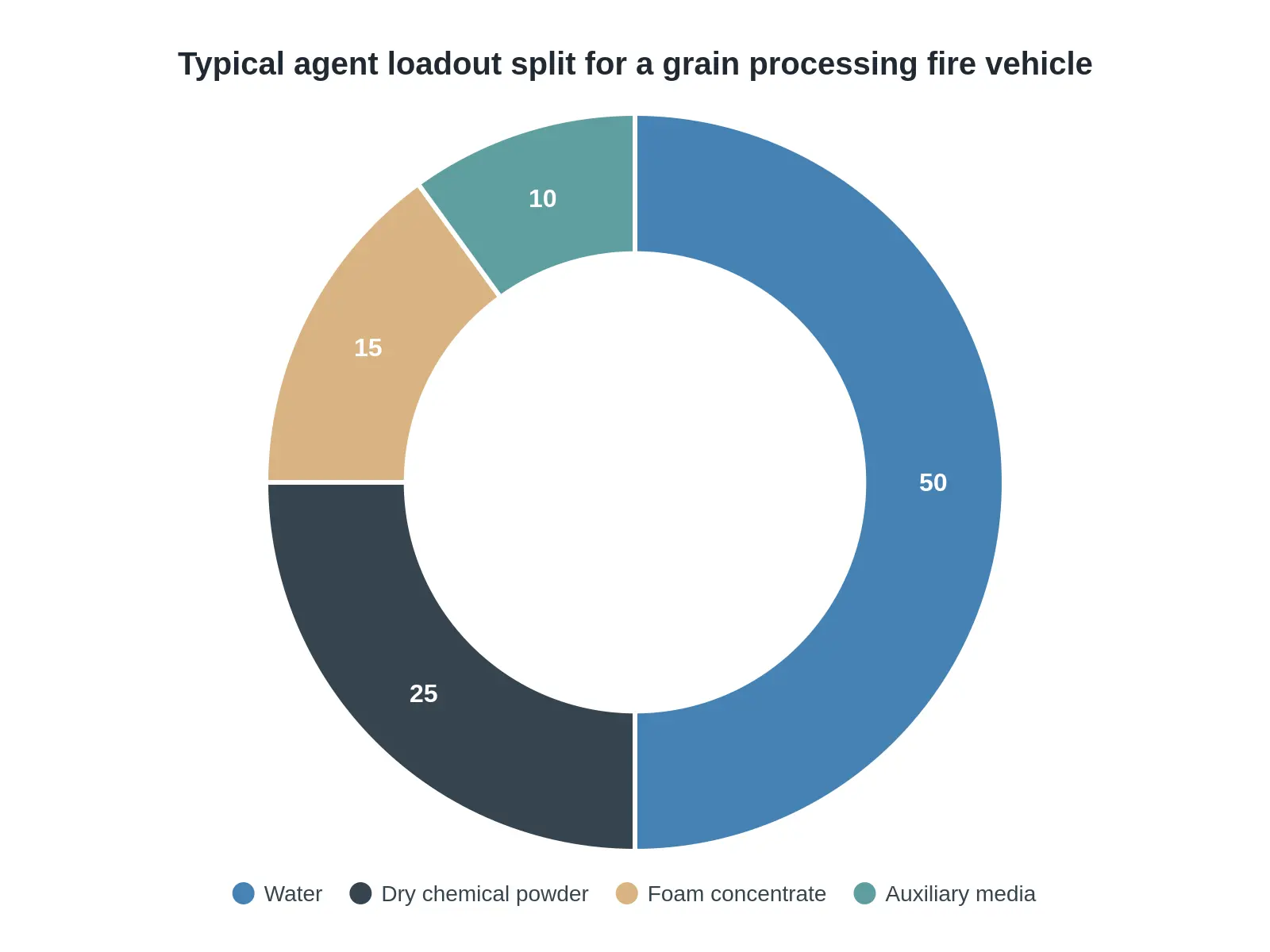
Figure: Illustrative agent loadout split for a grain processing fire vehicle. These shares are an example only and must be adjusted to the site’s own dust hazard analysis, building geometry, and water supply.
Treat the split as the start of a conversation. Water still does the heavy lifting for cooling smouldering grain and wetting hot surfaces, powder gives a fast knockdown on a flash fire, and foam concentrate stretches your water while suppressing vapour and re-ignition. The remaining 10 percent covers auxiliary media such as CO2 for electrical rooms and small Class C risks. Vehicle size, tank baffling and pump configuration all shift once those proportions change, so compare chassis and body options on municipal vehicle platforms before you commit to a build.
A capable chassis is not a plan. Before the first line is charged, the owner should name one incident commander who owns every decision on scene, so that alarms, evacuation and equipment shutdowns do not compete for the same attention. The plan then maps the plant into isolatable zones and fixes a shutdown sequence for conveying and dust collection equipment, working upstream to downstream so material stops feeding the hazard. Approach routes and staging follow from it: the fire vehicle parks clear of roofs, ductwork and any surface holding settled dust, and each crew knows its door and its lane. On paper this reads as a sequence; rehearsed on site, it is the difference between a controlled stop and a confused one. Related municipal fleets meet the same access constraints, including the solid waste bodies that share a common chassis and pump architecture.
The other half of the plan is physical. Hose lines are pre-connected to fixed monitor points and marked, so crews are not laying out lines while dust is airborne, and the local fire service is brought in early to confirm agent compatibility, water supply and apparatus access before anyone needs it. That conversation matters most in grain processing facility fire safety, where the wrong agent lifts settled dust or pushes burning material instead of knocking it down. Then drill the plan itself: who declares the emergency, who confirms each zone is isolated, who meets the arriving fire vehicle, and where the handoff happens.
Frequently Asked Questions
These are the questions site owners raise most often when planning fire response around grain handling and storage.
Can a standard water tanker be used for grain dust fires?
Yes, with limits. A tanker can wet down dust layers and cool hot surfaces, but a solid jet lifts dust into a cloud that supports a grain dust explosion. Use low-pressure fog patterns, and be careful with firefighting agent selection around confined equipment.
Which agent is preferred for smouldering grain inside a silo?
Water applied at the surface mostly runs off, and a solid stream will not reach a smoulder several metres down. Wetting agents and water mist penetrate slowly from above; an inert gas such as carbon dioxide or nitrogen holds down the oxygen in the headspace and the void spaces, but it does not cool the mass the way water does. Agent choice follows the silo design and the depth of stored product.
How often should the dust hazard analysis be updated?
Review it at least every five years, and sooner after any process change, new equipment or altered material. Reassess whenever inspections uncover accumulated dust or other conditions that could support a grain dust explosion.
What vehicle capacity is reasonable for a mid-sized grain processing site?
Most mid-sized sites land between the 5,000 L and 8,000 L water loads in the planning table above, with a dedicated foam unit and enough pump output to feed a monitor at working pressure. Capacity follows the largest foreseeable fire and the water supply available, not site size alone.
Before You Write the Specification
The dust hazard analysis is the foundation of any specification you can defend. It shows where dust accumulates, how readily it ignites and which agents will perform there, and those findings should settle agent selection before anyone discusses chassis or bodywork. Agent choice then sets configuration, because tank capacity, pump type, discharge reach and the weight and space those components demand all follow from it. Run the order backwards and you get a vehicle that reads well on a quotation sheet and does not match the hazard it was bought to control.
Agent first. Dry chemical, water mist, foam or a combination, chosen from your own dust test data rather than from habit.
Then configuration. Tank size, pump performance and discharge reach, set by the agent and by the access routes around silos, elevators and conveyors.
Then chassis and body. Payload, axle loading and manoeuvrability in tight process areas come into focus last.
The next step is internal and cheap: review your site’s dust hazard analysis before you approach a vehicle supplier, and bring its findings to that first conversation.