

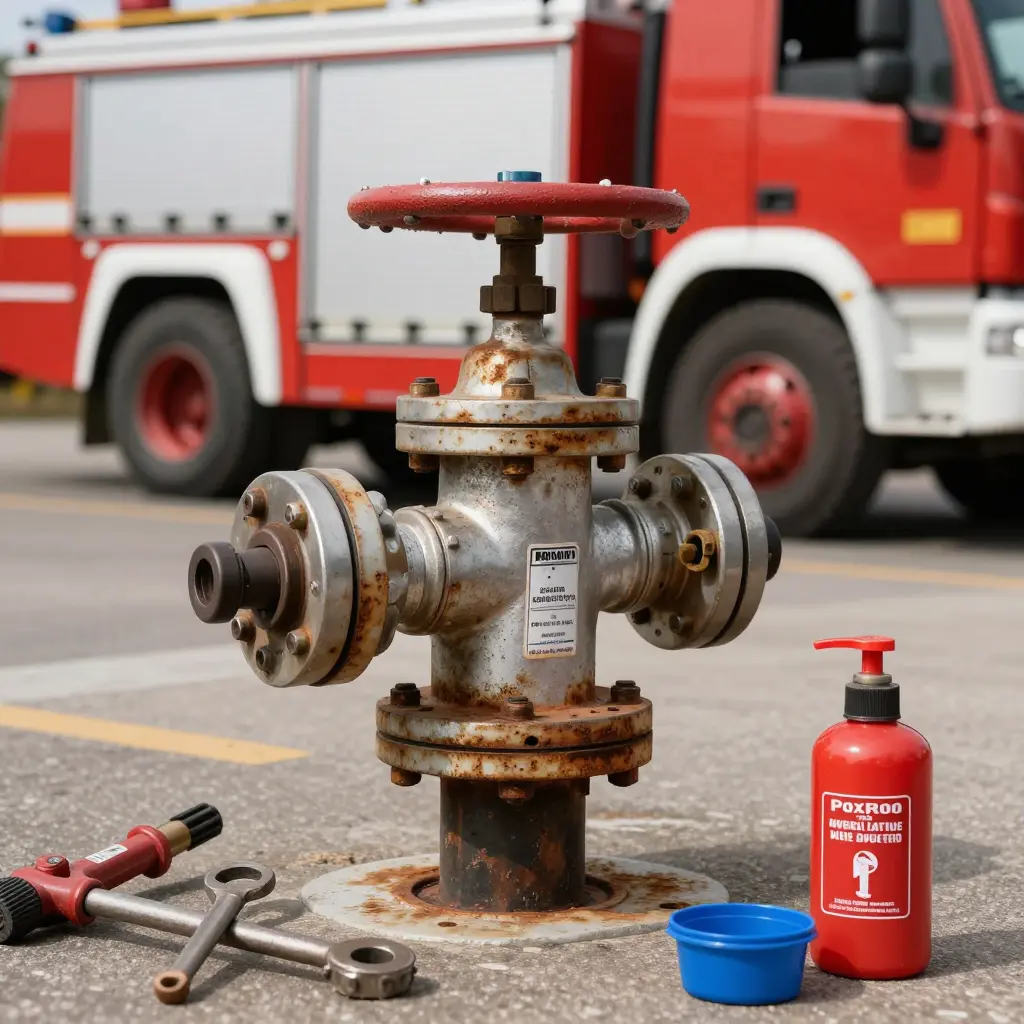
Why Pump Manifold Corrosion Decides Fire Engine Repair Outcomes
For fire apparatus, the condition of the pump manifold – not accumulated engine hours – is the primary determinant of whether a pump should be rebuilt or replaced.
Repair planning often treats engine hours as the definitive wear metric. That reading can be wrong. A pump with modest hours may still be corroded inside, while a high-hour pump with clean, well-maintained waterways may remain fully serviceable. The deciding factor is the manifold and pump body, where water, chemicals, and dissolved oxygen work steadily on the metal.
This guide is for fire department fleet managers, fire chiefs, municipal fleet supervisors, and apparatus maintenance technicians who have to justify rebuild-or-replace spending to elected officials and budget committees. It covers how corrosion develops, how to assess manifold condition, and how to turn those findings into a defensible capital or maintenance decision. Broader municipal fleet planning follows much the same logic; related municipal fleet solutions are a useful reference point.
Anatomy and Function of the Fire Pump Manifold
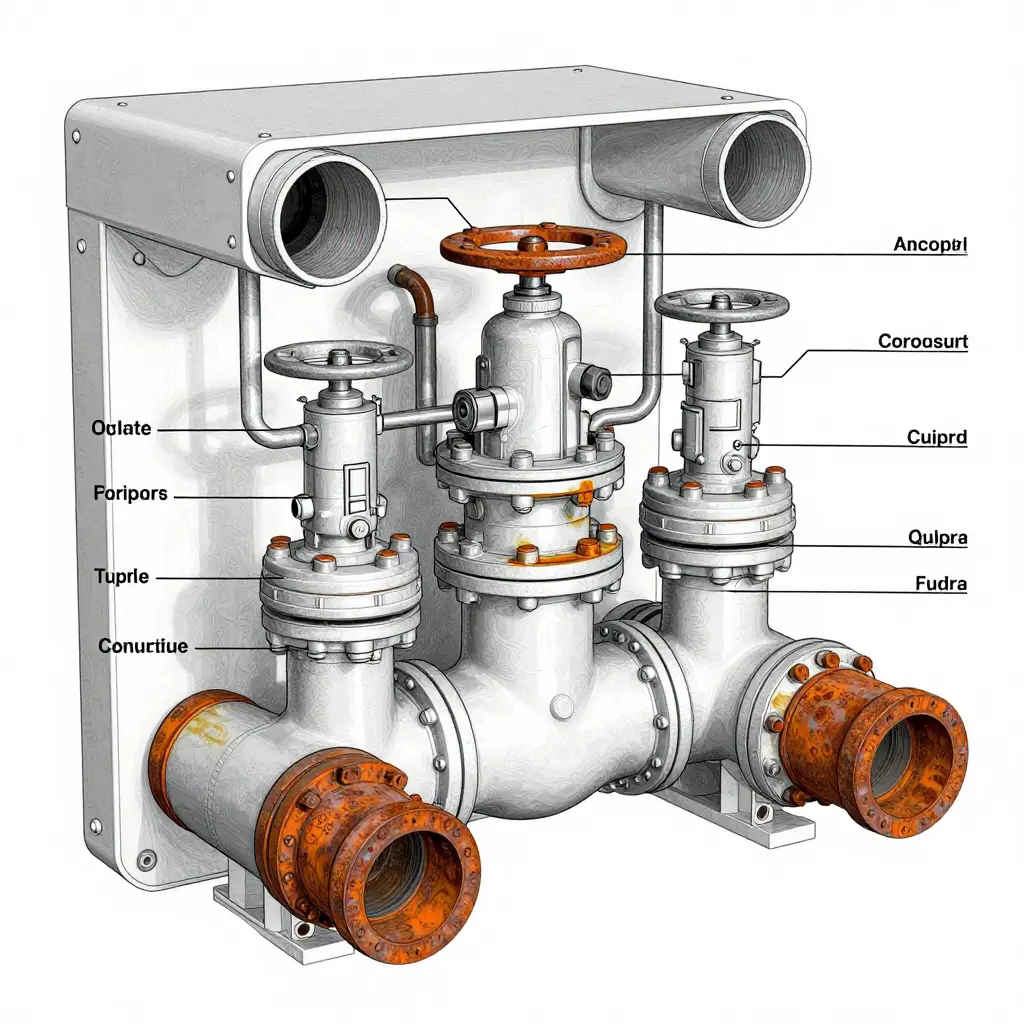
The fire pump manifold distributes water through the apparatus. Mounted on the discharge side of the fire pump, it receives pressurized water and splits it into separately controlled streams. Each branch ends in a discharge valve, so operators can open, throttle, or isolate outlets feeding attack lines, master stream devices, deck guns, and foam systems without cutting flow to the other ports.
Materials of Construction
Manifolds are usually cast from gray or ductile cast iron, which provides pressure containment and structural rigidity. Bronze is specified for valve bodies, stems, and bushings where wear resistance and machinability matter. Stainless steel appears in high-specification and coastal-service manifolds, where its chromium-oxide passive layer slows chloride attack.
Where Pump Manifold Corrosion Begins
Corrosion rarely starts on the painted exterior. It begins internally at the inlet and outlet ports, discharge valves, valve seats, gaskets, and the water passages that carry flow between them. Stagnant water, dissimilar-metal contact, and residual moisture accelerate galvanic and crevice attack at these points long before any external symptom becomes visible.
Why Internals Resist Inspection
Manifold internals are harder to inspect than external engine components. They are enclosed, gasket-sealed, and hidden behind valve bodies. External parts can be watched for leaks, cracks, or heat damage; water passages can only be assessed by pulling valves, breaking seals, and in some cases sectioning the casting. Corrosion can advance undetected in the meantime.
Asset-Lifecycle Implication
Because corrosion rather than engine hours often dictates viability, fleet supervisors weighing a rebuild or replacement must account for the fire pump manifold’s hidden condition alongside the service life of their broader municipal vehicle assets.
Where Pump Manifold Corrosion Begins
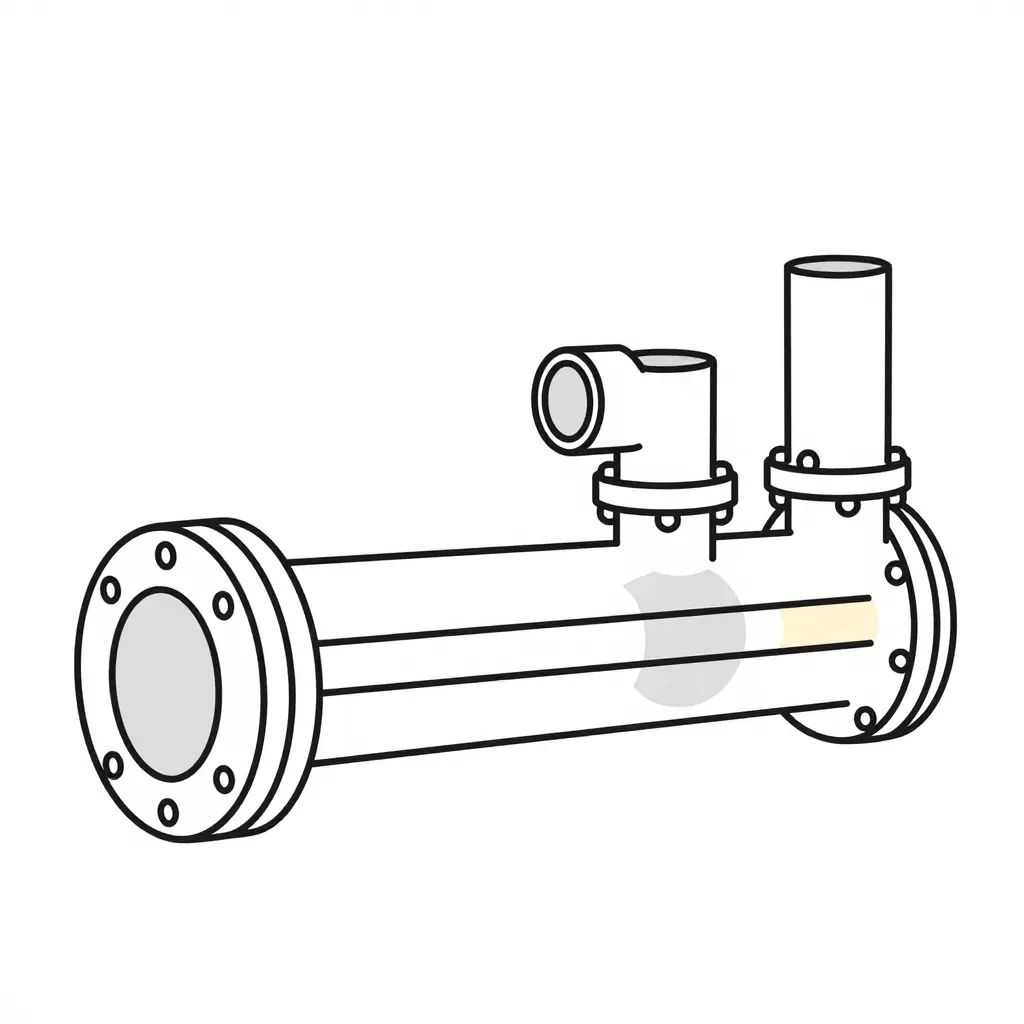
This cross-section maps the four internal zones where corrosion typically takes hold first. None of these failure points track engine operating hours; they follow water chemistry, idle time, and galvanic exposure. That is why a low-hour apparatus can still hide a manifold close to rebuild.
| Zone | Why It Corrodes First |
|---|---|
| Discharge ports | Frequent wet-dry cycling and trapped moisture at the opening |
| Inlet flange | Gasket-to-metal contact and standing water at the sealing face |
| Valve seats | Constant contact with stagnant water and electrolytic action |
| Internal water passages | Slow flow zones where sediment and chlorides accumulate |
How Pump Manifold Corrosion Forms and Progresses
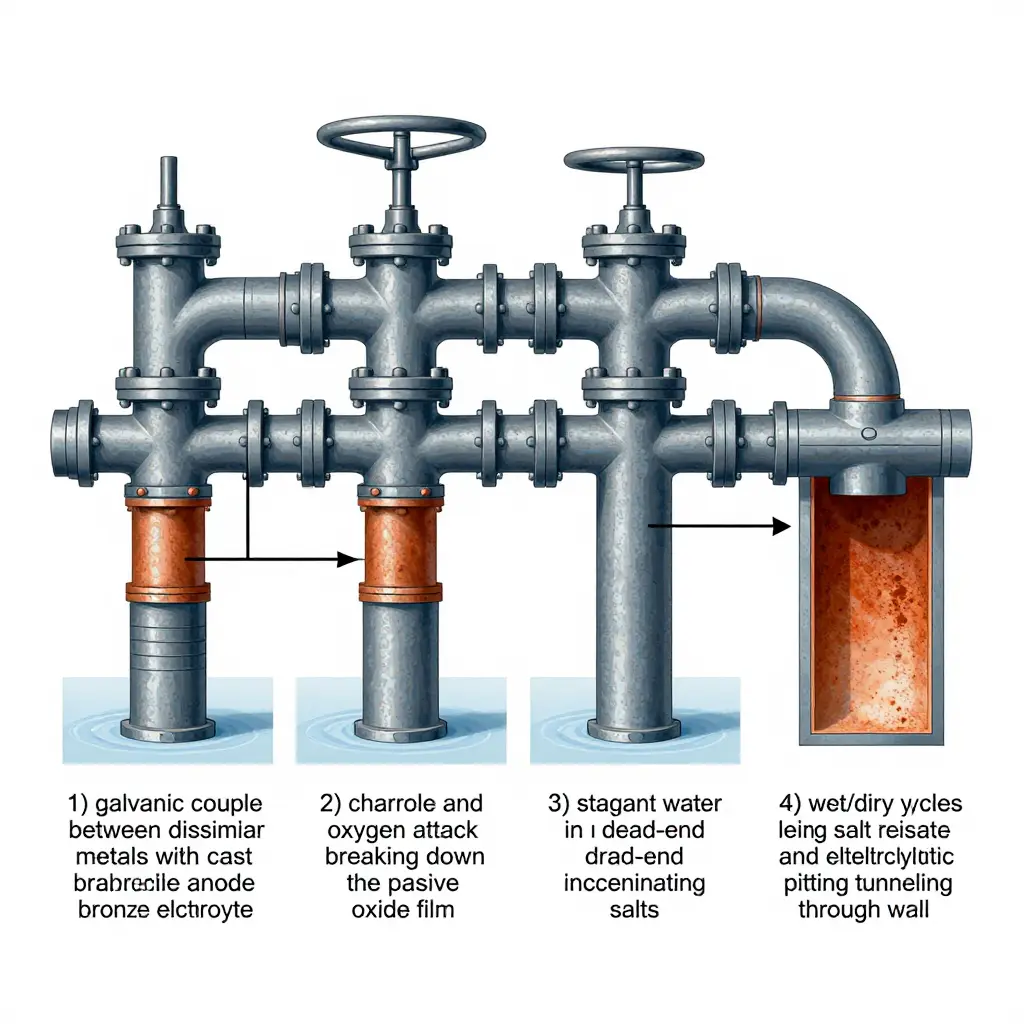
Pump manifold corrosion is an electrochemical process, not a simple surface reaction. It begins the moment dissimilar metals are wetted and electrically connected, then advances through a sequence of coupled mechanisms.
Galvanic coupling between dissimilar metals
Cast-iron bodies, bronze valves, and stainless or brass adapters sit in direct metallic contact, with residual fire water acting as the electrolyte. A galvanic couple forms: the more active metal (iron, or a zinc-rich coating) becomes the anode and dissolves, while the more noble metal (bronze, stainless steel) becomes the cathode and is preserved. Metal loss concentrates at threaded ports, joints, and weld zones.
Oxygen and chloride attack
Chlorides from road salt, brackish drafting sources, or residual foam concentrate are small mobile ions that migrate to breaks in the passive oxide film and destabilize it locally. Dissolved oxygen drives the cathodic half-reaction, and its replenishment at wet/dry interfaces keeps the corrosion cell active.
Stagnant water
Water trapped in low points, dead-end drain cocks, and transfer piping loses dissolved oxygen and inhibitor residual. As it slowly evaporates, chloride and other ionic species concentrate, and anaerobic sulfide generation can attack copper alloys and steel.
Electrolytic pitting
Where a small anode sits inside a large cathode, current density rises sharply. Pitting tunnels beneath paint and surface scale, penetrating wall thickness unevenly instead of thinning the metal uniformly.
The wet/dry cycling multiplier
Between emergency responses and routine pump tests, the manifold repeatedly floods and drains. Each drying cycle concentrates salts; each refill brings fresh oxygen and electrolyte. That cycle is far more aggressive than continuous submersion. Untreated or chemically loaded water – foam residue, chlorinated supplies, anti-freeze – raises conductivity and lowers pH, accelerating degradation and driving the need for fire engine repair. Because corrosion, not engine hours, decides manifold viability, flushing, inhibitor testing, and fitting replacement are the practical safeguards for municipal emergency vehicle fleets.
Why Low Engine Hours Do Not Mean a Healthy Fire Pump
A fire pump’s biggest threat is not wear from running; it is corrosion from sitting. Most fire apparatus sit idle for long stretches between calls, so the pump, manifold, and piping spend far more time full of stagnant water than moving it. Engine hours track the chassis powerplant and the time the engine ran. They say nothing about the water-system integrity of the pump end. That is why low engine hours can mislead in fire engine repair budgeting: a rig can log very few hours and still hide severe internal manifold corrosion.
Corrosion runs on a calendar-and-chemistry timeline, not an operating-hour one. It advances with time, exposure to oxygenated or contaminated water, dissimilar-metal contact, and temperature cycling, none of which depend on whether the engine was running. That produces two false signals:
- Low engine hours: idle rigs sit with wet, oxygen-rich water inside the manifold, so a low-hour pump can be more corroded than a high-hour one.
- High engine hours: heavy use masks corrosion too, because attention shifts to engine wear while the water path quietly degrades.
For municipal fleets planning maintenance and asset lifecycles, the rebuild-or-replace trigger should be pump-end condition – manifold wall thickness, corrosion pitting, and pressure-test results – not the hour meter. Reviewing the actual water-system hardware, much like reviewing the service life of municipal fleet vehicles, means inspecting the component that fails rather than the gauge that flatters it. Chase hours and you may keep a corroded pump in service or retire a sound one.
Pump Manifold Corrosion vs. Engine Hours: Reading the Real Signal
Fleet managers and fire chiefs have long used engine hours as the master gauge for apparatus lifecycle decisions. Isolate pump manifold wall-thickness loss and plot it across service years, though, and the picture changes. Corrosion advances with chronological age and wet-service exposure, while engine hours bounce irregularly from rig to rig. Two engines running identical hour totals can show very different manifold integrity.
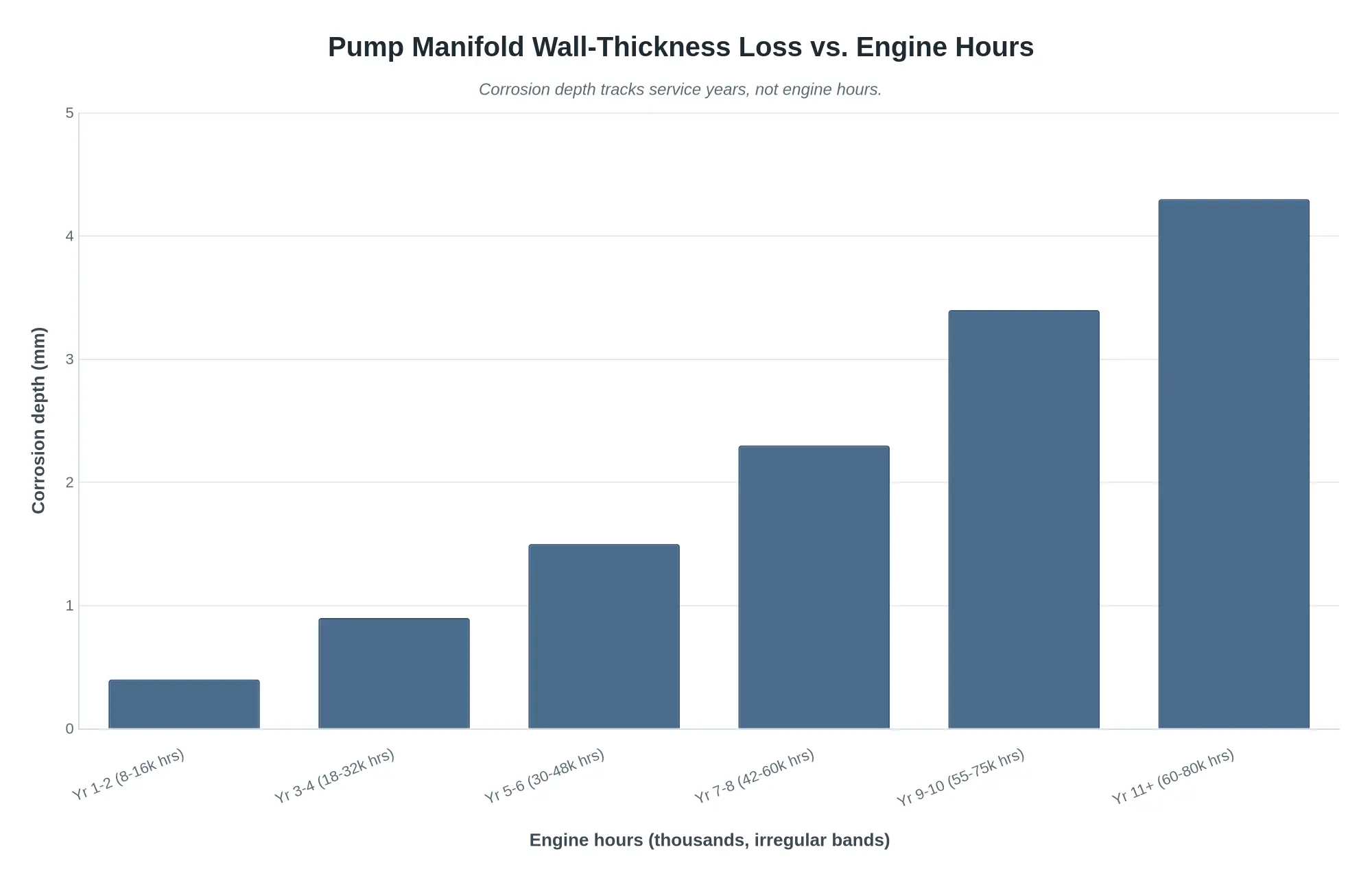
The chart maps corrosion severity ranges against engine-hour bands across six service intervals:
| Service Band | Typical Engine Hours | Corrosion Depth (mm) | Severity |
|---|---|---|---|
| Year 1-2 | 8,000-16,000 | 0.2-0.5 | Negligible |
| Year 3-4 | 18,000-32,000 | 0.6-1.0 | Minor |
| Year 5-6 | 30,000-48,000 | 1.1-1.8 | Moderate |
| Year 7-8 | 42,000-60,000 | 1.9-2.8 | Advancing |
| Year 9-10 | 55,000-75,000 | 2.9-4.0 | Critical |
| Year 11+ | 60,000-80,000 | 4.0+ | Replacement zone |
Engine-hour bands overlap across adjacent years, yet corrosion depth climbs in a smooth, monotonic curve. A rig can post 2.6 mm of loss on relatively few running hours if it spent years cycling chemically aggressive water and sitting idle with residual moisture. Conversely, a high-hour engine kept dry and flushed regularly may still show sub-millimeter pitting.
Why the Two Metrics Decouple
- Engine hours track usage; corrosion tracks exposure time. Manifold degradation is a chemical process driven by water chemistry, stagnant wet periods, and dissolved oxygen – not combustion cycles.
- Idle wet service accelerates loss invisibly. A pump that sits full of untreated water for months corrodes faster than one pumped hard and drained.
- Hour meters drift. Meter replacement, shared pump panels, and auxiliary systems all distort the hour reading as a reliability proxy.
Ultrasonic wall-thickness testing, not the hour meter, is what actually predicts rebuild or replace timing. For departments managing a mixed fleet, that distinction drives better capital planning – the same discipline behind spec’ing durable municipal-purpose chassis and apparatus that resist the environments they serve.
Takeaway: Corrosion depth – not engine hours – is what tracks rebuild need. Plotting wall-thickness loss against service years exposes a steady decline that hour counts simply cannot see.
Pre-Decision Inspection Checklist: Confirming Pump Manifold Corrosion Before You Rebuild or Replace
Before committing budget to a rebuild or replacement, put every suspect fire pump through the same documented inspection sequence, so corrosion damage is separated from ordinary wear.
- Measure manifold wall thickness at all accessible points with a calibrated ultrasonic gauge, and log every reading against the original material specification to expose metal loss early.
- Perform ultrasonic testing (UT) on weld seams, elbows, and low-flow zones to detect subsurface voids and thinning that visual inspection alone cannot reveal.
- Inspect the manifold bore for pitting and electrolysis damage, photographing pit depth and any stray-current scarring along the internal surface.
- Evaluate gasket mating faces and valve-seat condition for erosion, deformation, and crevice corrosion that compromise sealing under pressure.
- Sample and test fluid chemistry – pH, chloride content, and dissolved-metal levels – to confirm whether aggressive water is accelerating pump manifold corrosion.
- Confirm the fire pump’s suction and discharge connections for galvanic coupling between dissimilar metals that drives accelerated attack.
- Pressure-test the reassembled manifold to quantify leak-down rates and verify structural integrity at rated operating pressure.
- Verify that every corrosion-triggered repair is logged with dates, part numbers, technician notes, and before/after images for lifecycle traceability.
- Compare cumulative repair costs and remaining wall thickness against replacement thresholds to justify the final rebuild-or-replace decision.
- Require a second technician to review all measurements and sign off before any refurbishment or disposal recommendation is finalized.
Documenting each finding turns a hunch into a defensible, data-backed call that protects crew safety and the capital budget.
| Decision Signal | Corrosion-based indicators | Engine-hour-based indicators |
|---|---|---|
| Inspection basis | Internal pitting surveys and ultrasonic wall-thickness checks on the wet side of the pump manifold; pump manifold corrosion is detected by hydrostatic pressure testing and visual inspection of the water path | Cumulative runtime captured on the hour meter, plus trend analysis separating idle hours from working hours |
| Measurement unit | Wall-thickness loss measured in mils or millimeters, pit depth, and percentage of wall penetration | engine hours accrued, including hours since the last rebuild interval |
| Degradation driver | Electrochemical attack from untreated water, foam concentrate residue, and stagnant moisture trapped in the casting | Mechanical wear, thermal cycling, and lubrication breakdown tied to operating load |
| Lead time to failure | Often sudden and concealed; corrosion can breach a pressure-retaining wall within months with little outward sign | Progressive and predictable; wear advances in rough proportion to accumulated engine hours |
| Cost implication | Repair typically demands full manifold replacement plus corrosion-resistant upgrades and may cascade into the pump body or plumbing | Rebuild kits, machining, and labor mapped to known, budgetable service intervals |
| Recommended action threshold | Rebuild or replace when wall loss exceeds roughly 25-30 percent of original thickness or pit depth approaches the pressure-retaining limit | Rebuild at OEM intervals – commonly 8,000 to 10,000 engine hours – or when performance testing flags a decline |
Corrosion attacks the pressure boundary itself; engine hours only track a predictable wear clock. That is why corrosion indicators carry more weight when the rebuild-or-replace choice has to be made.
Frequently Asked Questions: Pump Manifold Corrosion and Rebuild Decisions
Does low engine hours mean my fire pump does not need rebuilding?
No. Low engine hours reflect limited running time, not internal water-path condition. A fire pump can sit idle for months while stagnant water and dissolved oxygen attack the manifold from within. Corrosion advances independently of running hours, so a low-hour apparatus may still need a rebuild or replace evaluation during routine fire engine repair. Hours alone never certify pump integrity.
How often should pump manifold corrosion be inspected?
At least annually, and ideally during every scheduled service, pump test, or after significant water exposure. High-risk units – those pumping brackish, salt, or chemically treated water – warrant semi-annual or quarterly checks. Catching corrosion early lets crews document wall-thickness loss before it forces a full rebuild or replacement in the fire engine repair program and the wider municipal fleet planning.
Can a corroded manifold be repaired instead of replaced?
Sometimes, within strict limits. Minor surface pitting or isolated corrosion may be cleaned, passivated, and evaluated for safe operating pressure. When wall thickness drops below manufacturer minimums, pitting penetrates deeply, or cracks emerge, replacement is the only safe path. Documented corrosion beyond those thresholds makes rebuild or replace the honest recommendation for fire engine repair.
What evidence should fleet managers document before approving a rebuild?
Record ultrasonic wall-thickness readings, corrosion photos, pressure and flow test results, repair cost estimates versus replacement quotes, and the asset’s remaining service life. That evidence turns a subjective judgment into a defensible rebuild-or-replace decision. It also supports budget justification for fire engine repair and holds up during audits and procurement reviews.
The Hidden Arithmetic of Deferring Corrosion Repairs
Corrosion rarely announces itself. A pump manifold degrades quietly until a compromised seal or a pitted valve body fails mid-incident. A routine fire engine repair then becomes an emergency callback to a service provider, and the cost curve bends upward. Planned intervention at a scheduled interval usually costs a fraction of the same work done under failure conditions, when labor is premium, parts are expedited, and the apparatus sits idle.
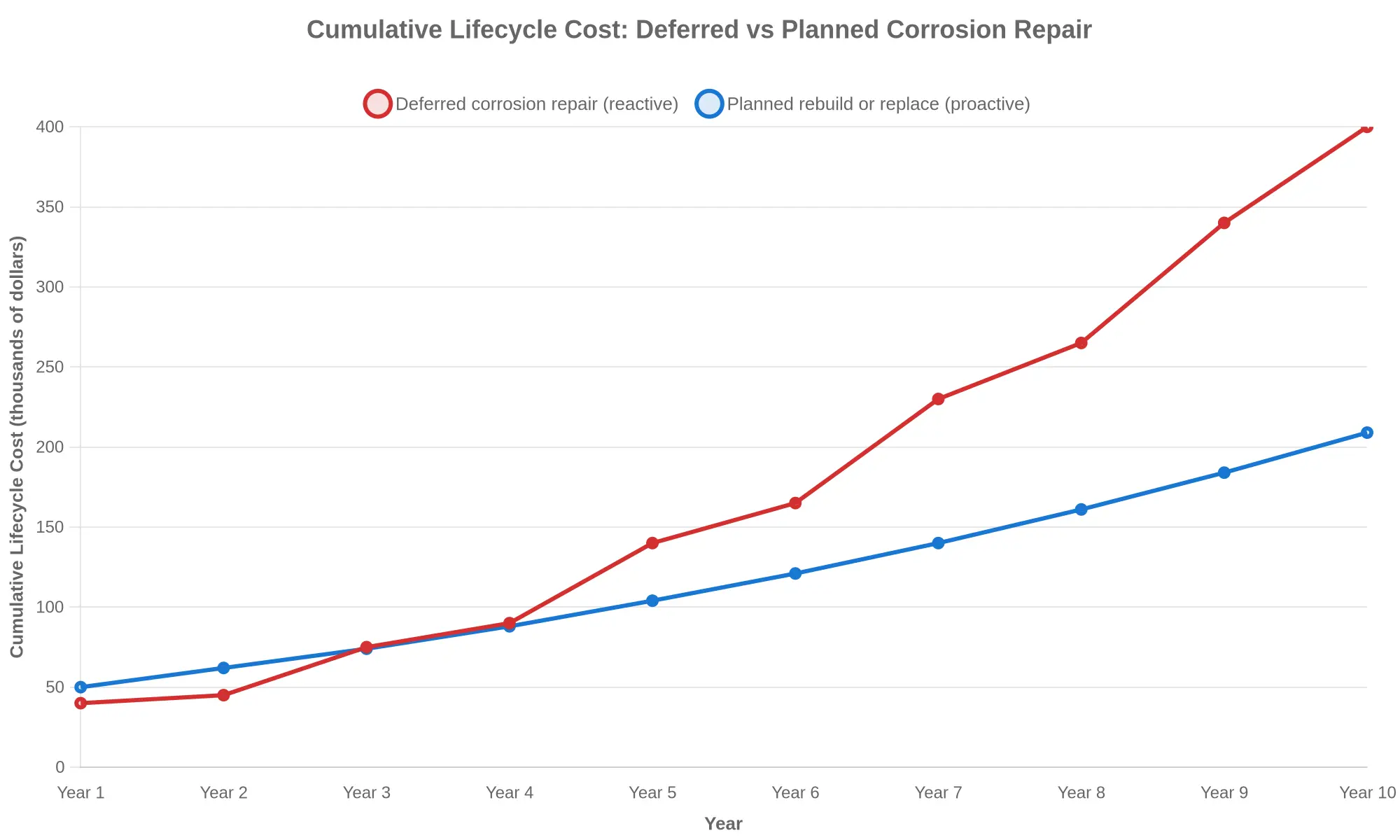
Deferred corrosion maintenance often starts cheaper, then overtakes planned spending by year four as emergency spikes compound. The penalty is cumulative, not transactional. Every unplanned failure introduces secondary risk: pressure surges and contamination cascade through adjacent valves, piping, and impellers, converting a single-point repair into a multi-component overhaul. Downtime deepens the loss, because a front-line apparatus off the road forces reserve-unit deployment and can drop the community below its response standard.
Trucks that already manage corrosive media handle this discipline routinely, scheduling preventive inspection before seals and liners degrade. Departments can apply the same logic to pump manifolds and municipal liquid-waste handling equipment planning alike: catch the chemistry before it reaches the metal.
As a lifecycle equation, the rebuild-or-replace question becomes clearer. Planned replacement of a corroded manifold preserves valve and piping integrity, locks in predictable budgets, and protects readiness. Deferral shifts cost forward, adds interest in the form of downtime and cascade damage, and rarely saves what the first estimate promised. For fire apparatus stewards, the numbers favor acting early rather than gambling late.