

Parts Availability, Not Listing Price, Decides Coastal Fleet Uptime
On a Craigslist Beaufort listing, the price is the easiest number to read and the least useful one to trust. Used equipment sourcing is a decision about uptime, not about the lowest opening ask. The advertised figure tells you what a seller hopes to get; it says nothing about whether the machine is still working six months from now.
Four terms do most of the work in that decision. Listing price is the number printed in the ad. Parts availability is how quickly and reliably you can get the components that actually fail. Lead time is the gap between placing a parts order and holding the part in your hand. Downtime cost is what every idle hour takes out of the business instead of earning.
A cheap unit with thin parts support can cost more in one season than a pricier one that keeps running. Salt air, humidity and steady seasonal demand find a weak supply chain fast.
The comparison below runs price-led buying against availability-led buying for three groups: municipal equipment, cargo units, and crane and lifting assets. Each fails in its own way, and each prices a lost day differently.
Parts Availability vs. Listing Price
A discounted unit with scarce parts turns a capital saving into a recurring downtime bill. The listing price is a single number you pay once. A part you cannot find is a cost you pay every month the machine sits still.
The mechanics behind the math
Coastal duty cycles are harsher than inland buyers expect. Salt air and humidity raise wear rates across hydraulic fittings, electrical connectors, fasteners, bed liners and undercarriage steel, so a unit here gets through replacement parts faster than the same unit would inland. That is affordable while parts sit on a shelf nearby. It gets expensive when they do not.
Three frictions make that worse:
- Longer order-to-delivery cycles for imported components. A seal kit or control module that ships from overseas can hold a unit down for weeks, not days.
- Thin local dealer stock. Coastal markets support small inventories, and dealers prioritize machines they sold and service.
- Interchangeability gaps between model years. Mid-cycle design changes mean a part that looks visually identical may not fit, so “close enough” becomes a second order and a second wait.
Used equipment sourcing on Craigslist Beaufort shows the trade-off in plain view. Listing volume is high, which is good for price discovery, but parts documentation is patchy: few ads carry part numbers, serial ranges or service history. That gap is where a bargain turns into a liability, so ask for the model year, a photo of the serial plate and the part number for one common wear item before you commit. Buyers who want predictable support often pair marketplace finds with purpose-built platforms such as these dump truck units engineered for steady duty cycles, where documentation ships with the product.
From sticker price to ownership cost
Run the arithmetic instead of comparing stickers: purchase price, expected annual parts spend, realistic days down per repair, and the revenue those days erase. Fleet uptime is what moves the number, and parts availability is what sets uptime. Modeled across three years, a slightly higher purchase price with reliable parts support usually wins on effective cost, while the cheap unit drifts upward as failures accumulate.
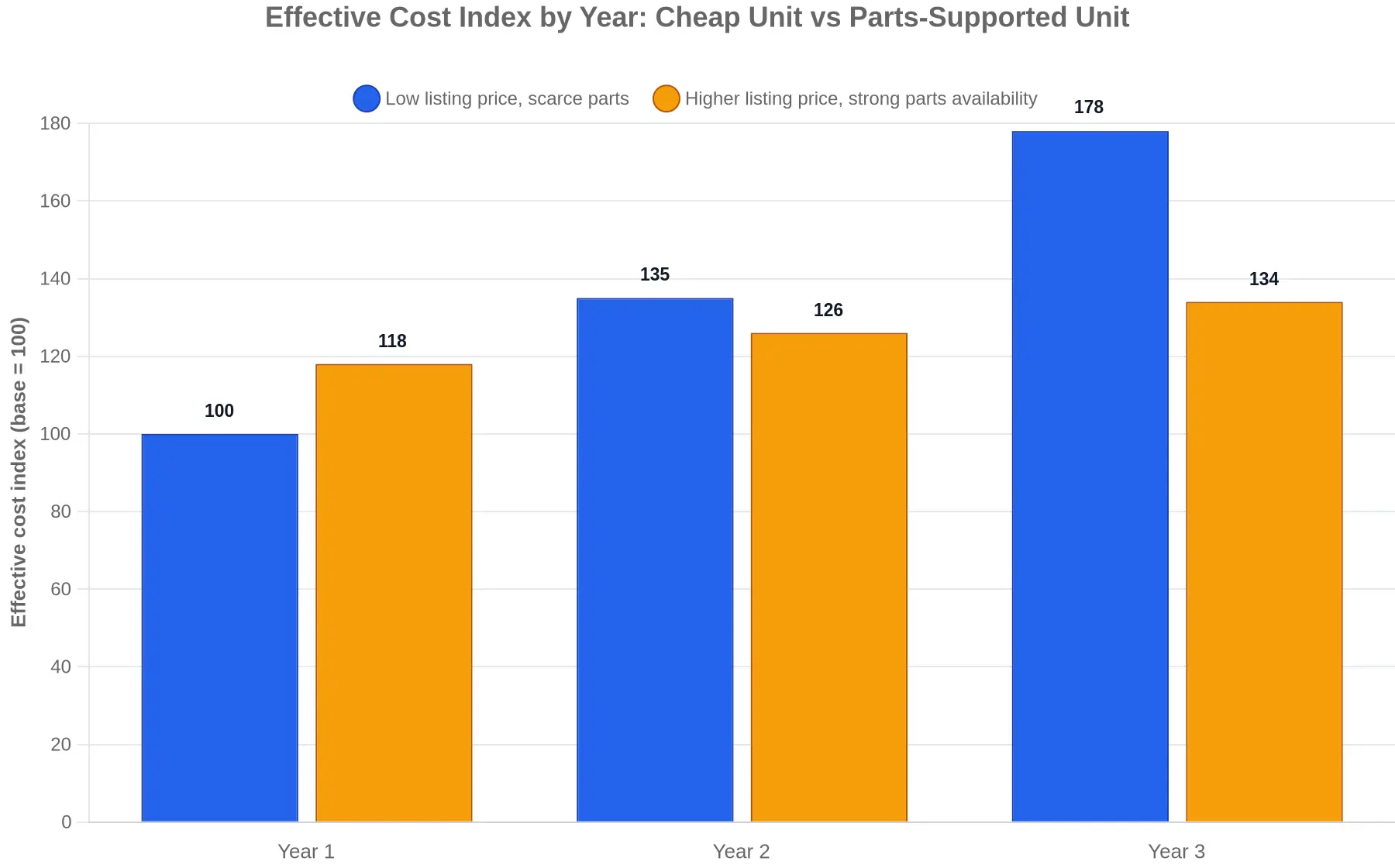
Compare on ownership cost, not on the number printed next to the photo.
Listing Price vs. Parts Availability by Equipment Category
All price bands below are indicative and relative (low, mid, high against the used coastal-fleet market), not verified quotes. Lead times reflect typical stocking patterns for common wear items, not worst-case special orders.
| Equipment Category | Typical Listing Price Band (indicative) | Common Wear Parts | Typical Parts Lead Time (indicative) | Downtime Risk Rating | Availability-Led Verdict |
|---|---|---|---|---|---|
| Road Cleaning Units | Mid to high | Sweeper brushes, spray nozzles, water pump seals | 3 to 10 days stock items; 3 to 6 weeks imported assemblies | Medium | Negotiate on parts network, not sticker price |
| Solid Waste Units | Mid to high | Packer blades, hydraulic cylinders, body panels | 4 to 12 days common items; 4 to 8 weeks body-specific parts | High | Highest risk; confirm local dealer stock first |
| Liquid Waste Units | Mid to high | Vacuum pump vanes, seals, hoses, valves | 5 to 15 days basics; 3 to 8 weeks pump rebuilds | High | Risk follows pump brand support, not mileage |
| Dump Trucks | Low to mid | Hoist cylinders, hinges, tailgates, tarp systems | 2 to 7 days | Low | Most forgiving; components widely shared |
| Cargo Box Bodies | Low to mid | Door hardware, hinges, flooring, lighting | 2 to 7 days | Low | Easy to keep rolling |
| Trailers | Low to mid | Brakes, bearings, tires, suspension bushings | 1 to 5 days | Low | Commodity parts, quick turnaround |
| Tow Trucks | Mid to high | Winch cables, booms, wheel-lift parts, hydraulics | 1 to 3 weeks; specialty booms 4 to 10 weeks | Medium to high | Check chassis-specific and boom support |
| Loader Cranes | High | Slewing rings, hydraulic hoses, control valves | 2 to 6 weeks; structural parts 6 to 12 weeks | High | Longest lead times; budget spares upfront |
Read the rows together and price stops predicting risk. The cheapest bands in that table – trailers, dump trucks and cargo box bodies – are also the easiest to keep running, because most of what fails is a commodity item any coastal parts counter stocks. The money sits in the specialized bodies: solid waste units, liquid waste units and loader cranes carry the top of the downtime risk scale, since their wear parts are built for one body or one brand and often ship from a single regional depot. Tow trucks land in the middle, fine on cables and hoses, slow on booms. Before you fall for a low asking price, spend ten minutes pricing the parts you will actually replace, and compare spec sheets for loader crane options that list serviceable components openly. Cheap iron with a six-week parts wait is the most expensive equipment on the lot.
Salt-Air Wear Items That Drive Parts Demand
Salt air doesn’t attack a machine evenly. It goes for the components closest to the spray, which are the same parts that keep a used unit earning. Before you commit to a Beaufort-area listing, work through the groups below and ask what each one will cost you in lead time.
- Hydraulic cylinders and seals – Airborne chloride settles on exposed rod surfaces and works in under wiper seals, so pitting and seal failure arrive years early on coastal fleets. Check whether seal kits and replacement cylinders are stocked domestically or special-ordered from overseas.
- Brake and air system components – Moisture-laden salt air corrodes air tanks, valves and brake chambers from the inside, eating the margin between a safe stop and a roadside failure. Ask whether chambers, valves and fittings are common cross-reference parts carried by several distributors.
- Electrical harnesses and connectors – Salt fog creeps into connector pins and ground points and produces the intermittent faults that take longest to trace. Harnesses and sealed connectors need to be in production or well supported in the aftermarket.
- Chassis and body corrosion zones – Frame rails, crossmembers and cab seams trap salt-laden moisture and rust from the inside out. Confirm that structural panels and weld-in sections can still be ordered, because fabricating them costs far more than buying them.
- Suspension bushings – Rubber and poly bushings harden and crack faster in salt air and constant humidity, tightening every service interval you plan around. Bushing sets sold individually and priced sensibly beat ones bundled into costly assemblies.
- Filtration and cooling parts – Salt-laden air loads intake filters and promotes corrosion in radiator cores and charge-air coolers. Cores, fan assemblies and filter elements should be catalogued with current numbers and real stock.
- Attachment wear parts on lifting and cleaning equipment – Pins, bushings, hoses and bucket edges on loader crane attachments take the worst of the spray and wear quickly under daily use. Confirm the attachment’s wear-part numbers are still supported before assuming the unit is serviceable.
Every group above fails on a schedule the salt air sets, so screening a used unit comes down to asking which of these components you can restock quickly. Put that question to each group before you drive out to see a machine.
The Screening Sequence at a Glance
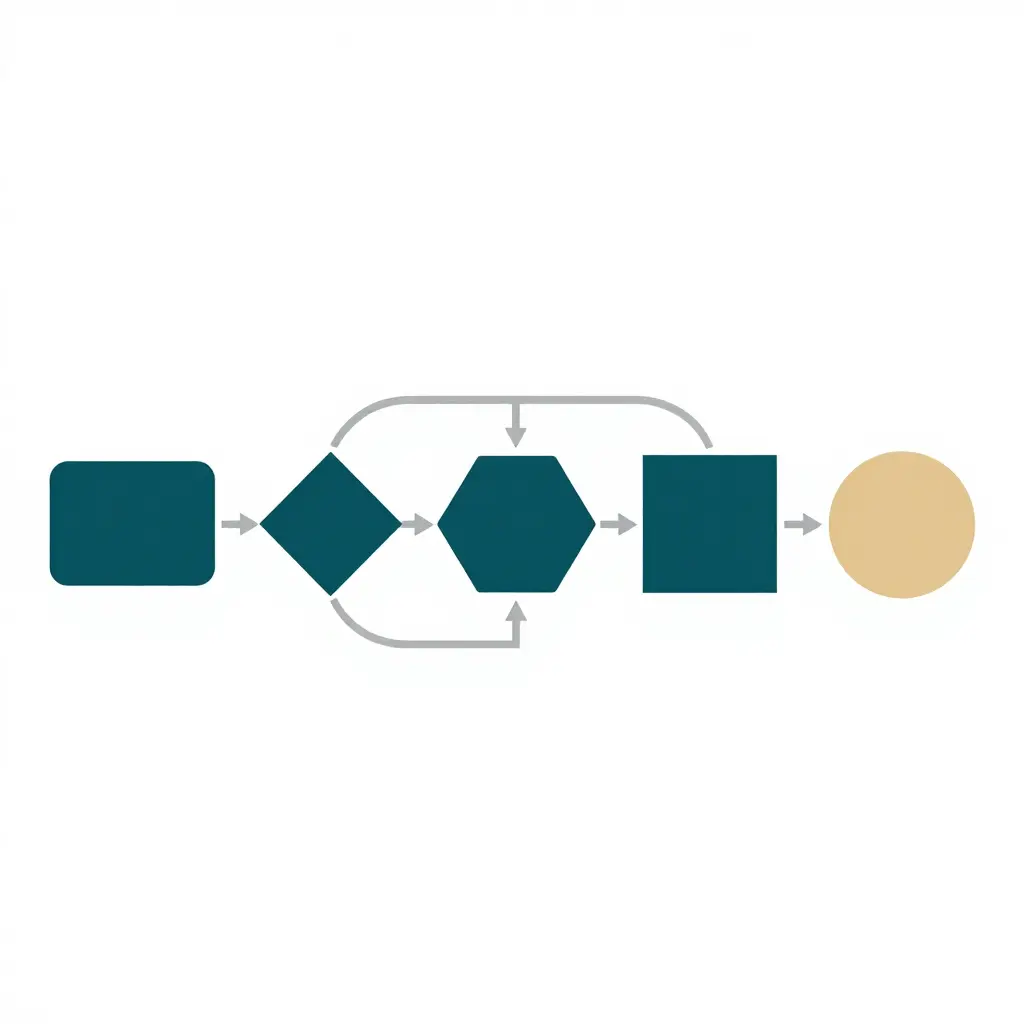
Price is the loudest number on the page and the last thing that should decide anything. The diagram maps the order our team works through, from spotting a listing to committing to a purchase, with a loop that sends weak candidates back for another pass.
Reading the Flow
- Listing found. The entry point. Something looks plausible, so you capture the basics before you get attached to the asking price.
- Parts documentation check. Can the seller produce manuals, parts diagrams, or at least a serial number you can verify? No documentation is a warning, not a dealbreaker.
- Interchange numbers verified. This is where coastal buyers get surprised. A part that fits one model year rarely fits the next, so the numbers get checked against real catalogs.
- Local stock confirmed. A part that exists three states away and ships in six weeks is not availability. It has to be on a shelf you can reach.
- Availability-led purchase decision. Only now does price enter the conversation, weighed against downtime risk and the cost of waiting.
When the documentation or interchange checks come back thin, the listing does not get deleted; it goes back for another round, usually with a narrower question for the seller. That loop is what keeps a cheap truck from becoming a paperweight in hurricane season prep or a peak collection week.
Design Brief for the Diagram
If your team rebuilds this asset for a slide deck or a buyer handout, here is the spec that produced it.
| Element | Specification |
|---|---|
| Format | Flat vector schematic, 2D, no perspective |
| Canvas | Pure white background, generous white space |
| Nodes | Five simple geometric shapes: rounded rectangle, diamond, hexagon, square, circle |
| Connectors | Thin arrows, left to right, plus one curved branch arrow looping back |
| Palette | Two-tone: deep teal and warm sand, light grey accents |
| Exclusions | No text labels, no numbers, no photographs, no realistic equipment renderings |
| Purpose | Visual anchor for the screening sequence, placed after the wear-parts list to break up the text |
Keeping the graphic label-free is deliberate: it works as a glanceable anchor in the middle of a long read, and you can drop your own captions underneath, whether you are explaining the sequence to a shop foreman or to a fleet owner comparing municipal fleet equipment options.
Documentation, interchange numbers and local stock act as gates. Price only gets a vote after all three have reported back.
Run a Parts Availability Audit Before You Send a Deposit
A listing photo and a low asking price say little about whether a machine is still earning in eighteen months. An afternoon on a structured parts audit is the cheapest hour of used equipment sourcing you will buy, and it turns parts availability from a gut feeling into a number you can defend to an accountant.
-
Capture the exact model and serial number from the data plate. Listing text and seller descriptions are often off by a model year or a trim level, and the wrong serial range sends you after the wrong parts for months. Photograph the plate yourself and use that number in every conversation that follows.
-
Request the parts manual or exploded diagrams as part of the deal. If the seller cannot produce them, call the OEM with the serial number and confirm the diagrams are still published and supported for that build.
-
Cross-check OEM and interchangeable part numbers for your likely wear items. Many components carry aftermarket or superseded equivalents, and knowing those numbers widens your supply options so one discontinued part cannot idle the machine.
-
Verify whether fast-moving parts are stocked locally or regionally. Call two or three dealers within a day’s drive and ask point-blank whether they keep filters, belts, hoses, brake components and hydraulic fittings for that model on the shelf right now.
-
Estimate the lead time for the longest-lead component, then plan around it. Ask the parts counter for a quoted factory lead time on the item most likely to stop you cold, and check whether it is unique to that model or shared across a larger platform.
-
Ask about service documentation and previous repairs in writing. Maintenance logs, invoices, and a straight answer on major repairs show which parts have already failed, and which are next.
-
Quantify downtime cost per day and use it as your comparison denominator. Add lost revenue, labor, replacement rental, and contract penalties for a single day out of service, then weigh that daily figure against the price gap between two candidates.
Recording the Findings in a Simple Scorecard
No software needed. One row per candidate, one column per criterion above, each scored 1 to 5 (5 is best), with the columns weighted by how badly a failure would hurt your routes. Total the weighted scores and keep the sheet with the listing printouts, so the decision is documented rather than argued over later. The layout looks like this:
| Criterion | Weight | Unit A (score 1-5) | Unit B (score 1-5) |
|---|---|---|---|
| Serial data and manual available | 10% | 5 | 3 |
| Interchangeable part coverage | 15% | 4 | 2 |
| Local stock for fast-moving parts | 20% | 3 | 4 |
| Longest lead time (5 = fastest) | 15% | 2 | 4 |
| Quality of service records | 10% | 2 | 5 |
| Downtime cost per day (5 = lowest) | 30% | 3 | 2 |
When a used unit scores badly, price the alternative instead of scrolling on to the next ad. Comparing it against new municipal-grade units with published parts support often settles the question faster than another weekend of bargain hunting. A machine that can be repaired by Thursday beats a machine that was cheap on Saturday.
Average Parts Lead Time by Sourcing Channel
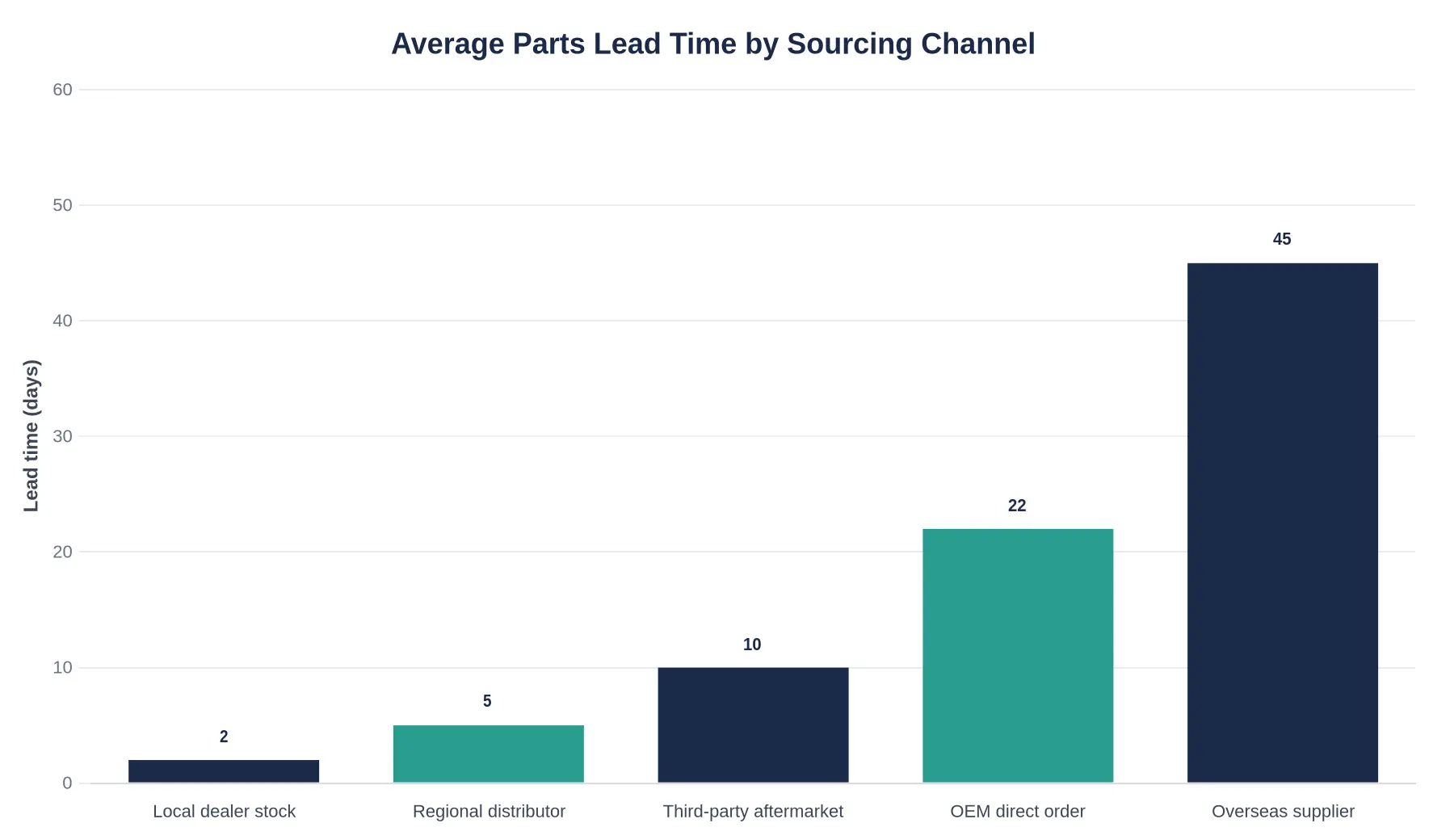
A machine down for three weeks is earning nothing, which is why the longest-lead component matters more than the asking price. Chart that part against the channels above before you commit to a candidate: it sets your realistic worst-case downtime. Use parts availability as the pass/fail filter and price as the second conversation. Fleets that run the two the other way around tend to find out on a Monday morning with a full route sheet and an empty bay.
Indicative ranges used in the chart:
| Sourcing Channel | Typical Lead Time |
|---|---|
| Local dealer stock | 1-3 days |
| Regional distributor | 3-7 days |
| Third-party aftermarket | 7-14 days |
| OEM direct order | 14-30 days |
| Overseas supplier | 30-60 days |
Verifying Part Numbers and Interchangeability
Before money changes hands, you should be able to answer one question with a document rather than a guess: can I still buy the parts this thing eats? In coastal work, where salt air accelerates corrosion and schedules are unforgiving, that question outranks the asking price on the ad.
OEM, superseded and interchange numbers
A number stamped on a casting is not automatically a number you can order. Catalogs use three kinds of numbers, and mixing them up is how buyers end up with a pallet of almost-right hardware.
| Number type | What it means | What to watch for |
|---|---|---|
| OEM number | The original manufacturer’s number for that exact assembly, as built | Retired numbers often stop being orderable even when the part is still in stock somewhere |
| Superseded number | The OEM’s replacement for a discontinued number, sometimes a redesign | Supersessions can change bolt patterns, fittings, or wiring; a supersession is not always a drop-in |
| Aftermarket interchange number | A third-party cross-reference to an OEM number | Interchange lists are marketing tools, not engineering approvals; quality and tolerances vary wildly |
A superseded number that is mechanically different from the original is the quiet trap. The catalog says “replaces,” your mechanic hears “fits,” and the machine sits in the yard with a hose that threads on but does not seal.
Why model-year changes and regional builds matter
Machines are not built to a single global recipe. A mid-year production change – a different hydraulic pump, a swapped control valve, a revised wiring harness – can split what looks like one model into two incompatible families. Regional build variants compound it: emissions packages, lighting and beacon requirements and chassis layouts differ by market, and the parts manual for one build region will not describe the other. On a coastal job site that means the pump you confidently ordered from a photo arrives with the wrong inlet orientation, and the original unit is already off the truck.
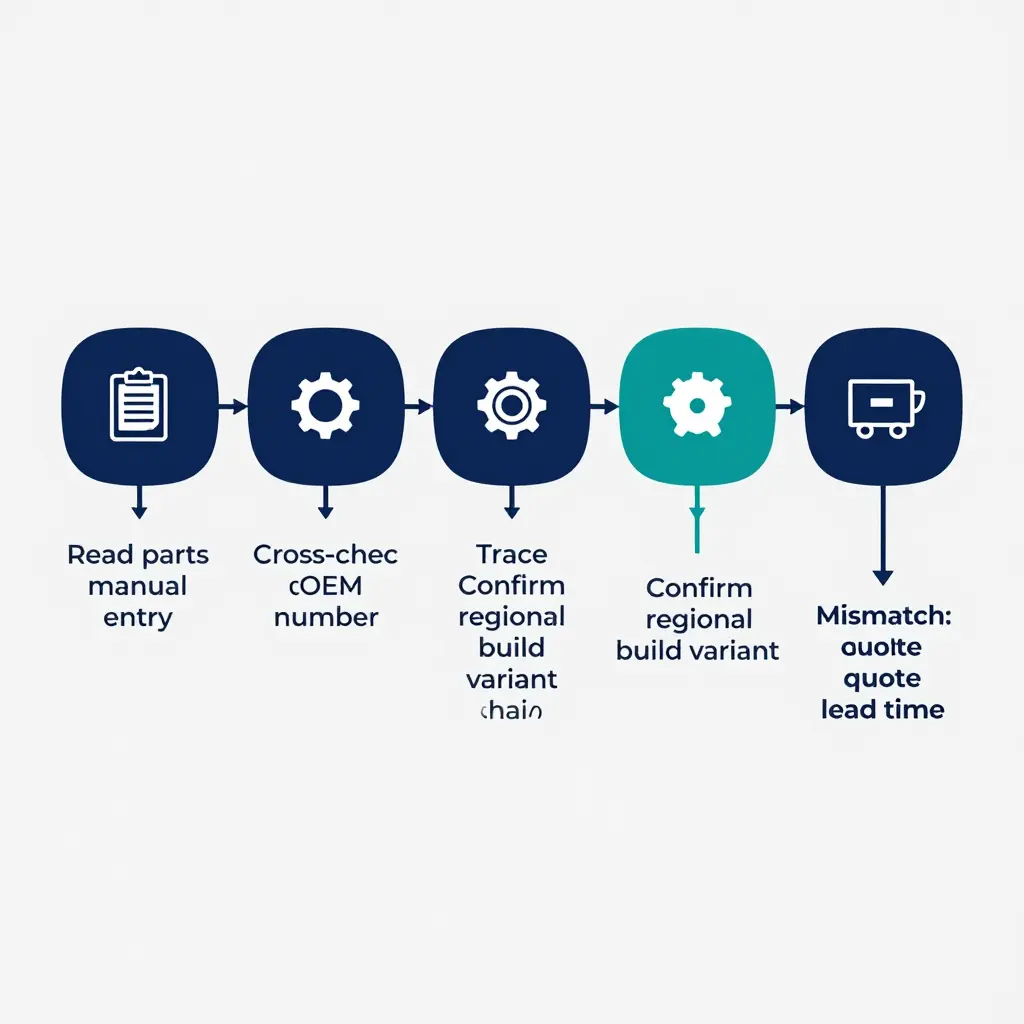
How to read a parts manual entry properly
Treat the manual page as a small legal document rather than a picture book.
- Read the header first. Model, serial number break, and build region live there. If the seller’s serial is outside that break, the whole page may be wrong for their machine.
- Follow the callouts to the item line, not the diagram. The diagram shows shape; the line item shows the number, quantity and any supersession note.
- Look for footnote markers. Notes like “used with” or “up to serial” are where variant differences hide.
- Separate consumables from structure. Belts, filters, sweeper bristles, wear blades and seals sit on their own pages with their own numbers, and these are the parts that decide uptime.
- Photograph the actual machine’s data plate. Compare it against the manual header before you agree on anything.
For fleets that lean on municipal road-cleaning units, the consumable pages pay for themselves fastest, since broom cores and wear parts change across build years.
One mismatch, weeks of downtime
A single wrong number on a high-wear component is not an inconvenience; it is a schedule event. A mismatched seal kit lets the machine keep working while it leaks, then stops it entirely. A wrong broom core or wear blade has to be re-ordered from a regional warehouse, and the freight clock starts over. Meanwhile the route slips, the backup unit racks up hours, and the labor you saved by buying cheap turns into overtime.
Documented interchangeability is a form of parts availability. A machine with a photographed data plate, a printed manual page and a written supersession chain can be repaired on a Tuesday. That documentation belongs in the asking-price conversation, because a unit with verified numbers is worth more than one that only looks clean. Ask sellers for part numbers early: it is the cheapest due diligence in used equipment sourcing, and the step most buyers skip.
Verification runs as a sequence, not a formality: read the entry, cross-check the OEM number, trace the supersession, confirm the build variant, validate the interchange. If any one of those fails, price the delay before you price the machine.
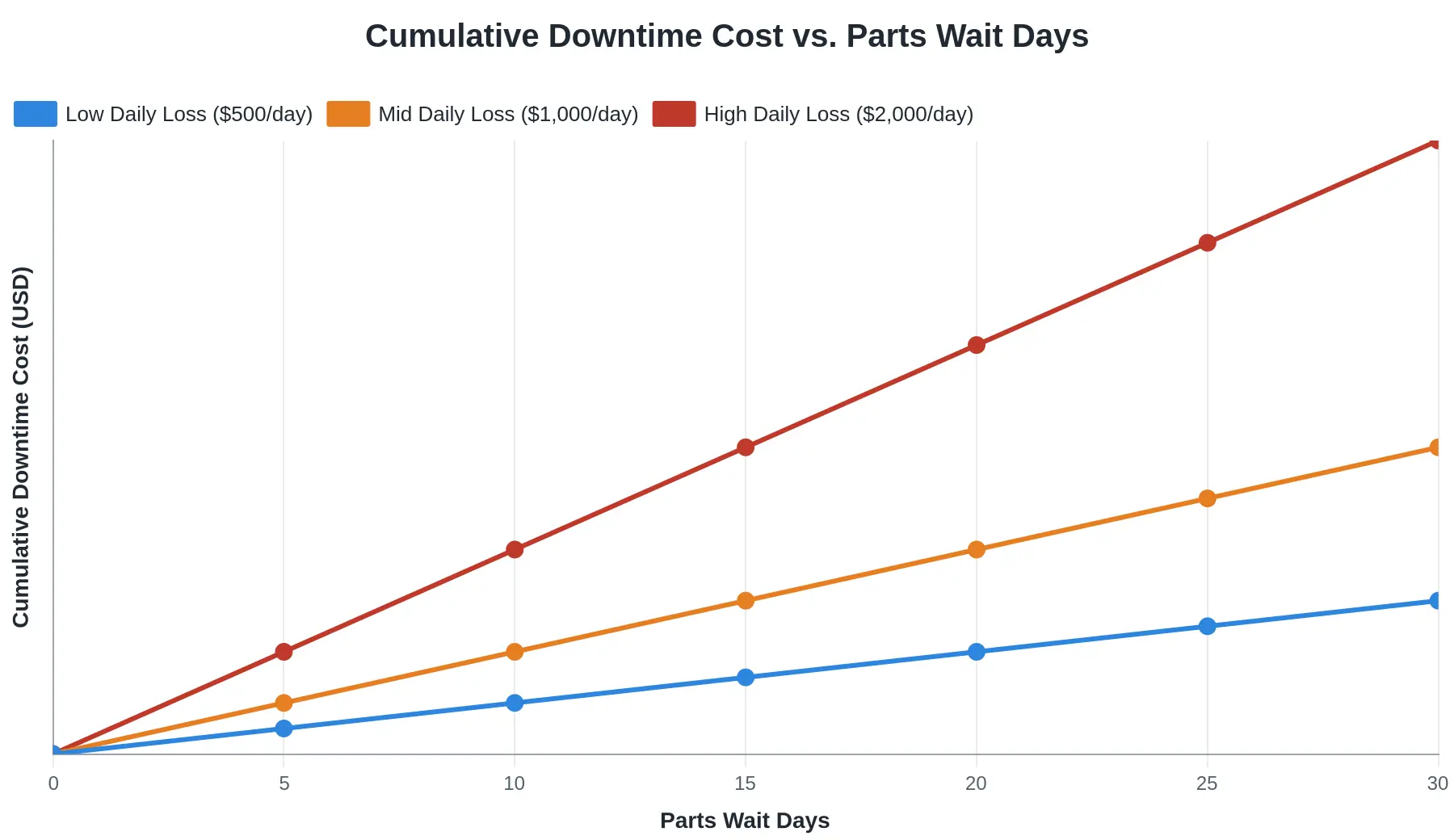
Figure 1: Cumulative downtime cost vs. parts wait days.
The three lines price the same 30-day wait at three different daily downtime rates, and they reach roughly $15,000, $30,000 and $60,000 by day 30. A stalled unit losing $2,000 a day has burned $60,000 by then, while a $500-a-day loss only reaches $15,000. That is how a higher listing price with short lead times can still finish with a lower cumulative cost.
Why Duty Cycle Decides Parts Demand
A used truck’s price tag is a snapshot; its duty cycle decides how fast consumables disappear. Duty cycle here means hours run per week, average load factor, how many stop-start or lift cycles a machine completes in a shift, and the environment it works in. In a coastal market like Beaufort, salt air and humidity belong to the duty cycle too, because they accelerate corrosion on every exposed component family.
Translate the seller’s description into a duty profile before comparing two listings. The table is a quick reference for the three equipment groups most buyers search for:
| Equipment group | Typical duty character | Fastest-wearing component families | Screening focus |
|---|---|---|---|
| Municipal | Two shifts, constant stop-start, frequent hydraulic cycles, low road speed | Packer and hoist hydraulics, PTOs, brake chambers, seals, wear strips | Service records over cosmetics |
| Cargo | Long highway miles, high payload, moderate cycle count | Axles, bearings, brakes, suspension bushings, body hardware | Rust and structural history |
| Crane and lifting | Low mileage, high shock loads, intermittent heavy hydraulic work | Winch cable and motors, cylinders, slew rings, hoses, pivot pins | Inspection certificates and weld condition |
Municipal Equipment: Continuous, Low-Speed, High-Cycle
Municipal work is punishing duty. Vehicles idle for hours, run short routes and cycle the same hydraulic system hundreds of times a day, so across this municipal equipment range engine hours translate almost directly into parts demand.
Solid Waste
Refuse bodies wear on the packer cycle, not the odometer. Packer cylinders, PTO shafts, hydraulic hoses, brake chambers and body floor wear strips are the first families to fail. On a used solid waste collection vehicle, a documented packer rebuild is worth more than fresh paint, so ask whether packer seals, pins and hoses were replaced within the last two to three years.
Liquid Waste
Vacuum and jetting trucks wear internally, where photos cannot reach. Vacuum pumps, shaft seals, gate valves, discharge fittings and hose reels dominate the parts bill, and coastal humidity drives corrosion inside tanks. When screening a liquid waste truck, ask about pump hours and recent seal changes rather than tire tread.
Road Cleaning
Sweepers and street washers are consumable machines by design. Broom bristles, suction fan assemblies, spray nozzles, water pump seals and conveyor bearings all reach end of life on a predictable schedule. On road cleaning units, the question is whether the model uses widely stocked wear parts, which protects parts availability and fleet uptime in one move.
Cargo Equipment: Highway Miles and Load Stress
Cargo duty is gentler per hour but accumulates faster in total miles. Load stress, not cycle count, sets the replacement curve, which is why cargo vehicles and bodies should be judged by structural and driveline condition.
Cargo Box
On a cargo box truck, the lift gate is the highest-failure assembly – hydraulics, hinges, rollers and springs. Door hardware and floor decking follow. A used box body with a tired gate can cost more in year one than the price difference between two listings.
Trailers
Trailers are wear items on wheels. Axles, bearings, brake drums, suspension bushings, landing gear and decking dominate. For trailers, inspect crossmembers and the frame underside for salt-driven corrosion before discussing price.
Dump Trucks
Dump duty combines payload shock with hydraulic work. Hoist cylinders, PTOs, tailgate latches, bed floors and hydraulic lines are the watch items. When reviewing a dump truck, look for bent or re-welded beds, and confirm hoist cylinder condition.
Crane and Lifting: Shock Loads and Structural Fatigue
Lifting equipment often shows low mileage and high stress. Shock loads fatigue pivots, pins and booms even when the truck barely moves, so crane and lifting units need a structural review rather than a mileage review.
Tow Trucks
Winch cable and winch motors, boom pivot pins, wheel-lift pivots, hydraulic cylinders and control valves wear fastest. On a used tow truck, cable age and boom weld condition tell you more than the hour meter.
Loader Cranes
Slew rings, boom extension cylinders, high-pressure hoses, outrigger legs and load moment limiter electronics drive the parts bill. A loader crane with serviceable hydraulics and a working limiter is a low-risk buy; one with intermittent faults is not.
What This Means for Screening Listings
- Match the seller’s duty statement to the category above, then price consumables as a first-year line item, not a surprise.
- Treat documented hydraulic and structural service as a price multiplier, and treat silence as a discount.
- Check that wear parts use common part numbers that local distributors stock, since a machine sitting idle for a seal kit erases any saving on the purchase price.
Standardizing on a small number of component families is often the cheapest route to predictable parts availability when you build a fleet from mixed used listings. A state-owned manufacturer with a broad portfolio can support that kind of standardization, and CRRC’s five-sector portfolio is one example of the breadth it takes.
Frequently Asked Questions: Used Equipment Sourcing on Craigslist Beaufort
Why does parts availability matter more than listing price when buying used equipment?
A low price saves money once; parts availability shapes every repair for as long as you own the machine. A truck that costs less upfront but sits for weeks waiting on a component usually gives the saving back in lost service hours and replacement rentals. Price the machine and its spare-parts reality together.
How can a business owner check parts availability on a Craigslist Beaufort listing before buying?
Start by pulling the exact model, serial number and engine or component codes from the photos and description, then call a dealer or independent supplier and ask what is stocked locally. Ask about maintenance records too, and whether filters, belts, hoses and brake parts sit on the shelf rather than in a catalog. A few phone calls tell you more than the photos do.
What is a reasonable lead time to accept for a fast-moving wear part?
For parts that fail routinely, a reasonable expectation is same-day to a few days from a local source, since these items normally sit on shelves in the region. If a common wear part has to be special-ordered with a multi-week wait, treat that as a warning sign about the machine’s support base rather than a one-off inconvenience. Long lead times on consumables often predict long lead times on major components too.
How should downtime cost be calculated for comparison purposes?
Add up the revenue the machine would have earned per day, the labor still being paid while it sits, and any rental or subcontracting cost needed to cover the work. Multiply that daily figure by expected repair days, then compare the total against the price gap between your two candidates. It is the simplest way to see why listing price alone misleads, and it keeps the decision in numbers you can defend.
Does buying newer or higher-priced used equipment guarantee better parts availability?
No. Newer or more expensive does not automatically mean easier to support. Availability depends on whether the model was widely sold in your region, whether the manufacturer still supplies components, and whether local dealers carry stock for common municipal fleet vehicles. An older, widely supported model can keep a coastal fleet running longer than a newer, rarer unit, so verify support before you pay a premium.
The Bottom Line: Uptime Is Bought Before the Invoice
A used machine in Beaufort is not priced by the sticker on the Craigslist post. It is priced by whether the parts that fail first – pumps, seals, hydraulic lines, wear plates, whatever salt air and brackish water attack – can be on a shelf before the machine stops earning. Parts availability, not listing price, is what decides coastal fleet uptime.
The Four-Step Decision Framework
- Document parts availability. Collect part numbers for the top failure items, confirm whether they are OEM-only or open to aftermarket supply, and count how many independent dealers actually stock them.
- Quantify lead time. Ask for real inbound shipping times to the Beaufort area rather than catalog promises, then add your shop’s diagnostic queue to that number.
- Convert wait days into downtime cost. Multiply idle days by lost revenue per day plus any rental replacement cost. Ten sidelined days frequently outweigh a four-figure discount.
- Compare against listing price. Set the all-in number, downtime included, beside the asking figure and beside the price of a comparable unit with a known supply chain.
Before You Call the Seller
Arrive with a one-page file in hand: serial numbers, the service records you intend to request, an approved parts list with current pricing, and your own downtime rate written down. Sellers respond differently when a buyer already knows what a week of lost service costs. Owners comparing configurations across a municipal fleet vehicle lineup can use published parts documentation as a benchmark during those conversations.
Looking Ahead
Planning around parts supply turns fleet upkeep into a lifecycle cost problem, where the number of distinct part numbers you hold across a mixed fleet matters as much as the machines. Standardizing consumables and wear components across brands shortens mean time to repair and cuts the capital tied up on shelves. CRRC operates at a manufacturing scale spanning multiple vehicle categories, a factor some buyers weigh when assessing long-term parts support.